Archive Page 74

The Art of Explaining: Starting With the Big Idea

We live in a time of thirty second sound bytes, 280 character tweets and general information overload. Our society seems to have ADHD. There is fierce competition for people’s attention.

As doctors, we have so many messages we want to get across to our patients. How many seconds do we have before we lose their attention in our severely time curtailed and content regulated office visits?

I have found that it generally works better to make a stark, radical statement as an attention grabber and then qualifying it than to carefully describe a context from beginning to end.

Once a person shows interest or responds with a followup statement or question, you have a better chance for a meaningful discussion. Just starting to explain something without knowing if the person wants to hear what you have to say could just be a waste of time.

Here are some of my typical conversation starters – or stoppers, if you will:

“The purpose of a physical is to talk about stuff that could kill you, more than about symptoms that annoy.”

“Nothing makes a cold go away faster.”

“Urology is about plumbing, nephrology is about chemistry.”

“Most headaches are migraines.”

“Sinus headaches don’t exist in Europe.”

“I don’t care what your blood pressure is today if you’re scared or in pain.”

“A healthy lifestyle is at least as effective as taking Lipitor.”

“We now know that eating fat makes you lose weight.”

“Cholesterol only causes damage if there is also inflammation.”

“Fat free means high in sugar.”

“I don’t believe in vitamins.”

“Osteoporosis happens to every woman around 80, so is it really a disease?”

“You have to treat 35 men for prostate cancer to save one life.”

“You know how many cases of testicular cancer I’ve come across in 40 years? Three!”

“It takes 45 minutes of walking to burn 100 calories, but only 10 seconds to drink them.”

My brief experience as a substitute teacher for junior high school students as well as my many years as a scout leader taught me that you can’t assume you have people’s attention just because you’re standing in front of them. They will give it to you if they believe you have something interesting to say. You often have less than thirty seconds to prove that you do.

Is our medical knowledge alive enough in our minds that we can share it in a quick, easy and captivating way with our distracted patients?

There Are Three Kinds of Primary Care, Not to Be Confused With Each Other

Primary care doctors, the way things are organized in this country, perform three kinds of services. If we don’t recognize very clearly just how fundamentally different they are, we risk becoming overwhelmed, burned out, inefficient and ineffective. And, if we think about it, should we really be the ones doing all three?

SICK CARE

Historically, people called the doctor when they were sick. That service has, at least in this country, become more or less viewed as a nuisance in primary care offices. We keep a few slots open for sick people, in part because the Patient Centered Medical Home recognition process requires us to. But our clinics may worry that those slots go unfilled and lead to lost revenue.

Instead, sick people scatter toward emergency rooms with crowding, high overhead and liability driven testing excesses or to freestanding walk-in clinics that only sometimes are integrated with the primary care office but universally staffed by providers who don’t know the patient. These providers, due to staffing cost strategies, are sometimes the least experienced clinicians within their organizations, doing what I feel is the most challenging work in health care – sorting the very sick from the only moderately ill or even completely healthy but worried patients.

In the worst case scenarios, the walk-in clinic is freestanding, operating without any access to primary care or hospital records, starting from absolute scratch with every patient. Some of these clinics are well equipped, with laboratory and x-ray facilities and highly skilled staff. But some are set up in a room in the back of a drug store and staffed by a lone nurse practitioner with minimal equipment and no backup.

Because health care in this country has no master plan, this is what has emerged. If we had a national strategy for health care services, does anybody think it would look like this?

CHRONIC DISEASE MANAGEMENT

More and more people suffer from chronic diseases like diabetes, hypertension and autoimmune conditions. This is where the bulk of primary care work is done. Much of it is straightforward and predictable: Diabetics get their glycosylated hemoglobin checked every three months, hypertensives get their blood pressure logs and blood tests reviewed at certain intervals. And, sadly, much of it is ineffective. Few people lose weight, improve their blood sugars or change their lifestyles. Our visits follow the same tired routine from one time to the next – “I’ll do better this time, Doc”.

The more our country’s chronic disease burden increases, the more clinician time and effort this kind of work will consume. And the more we need to question whether there isn’t a better way to deliver chronic disease management.

We already know that group visits can be very successful, because of the power of peer support. And even when they are limited to Zoom, they can be effective. They are certainly more efficient than speaking with patients one by one, again and again, like a broken record. Quite frankly, that is getting antiquated.

Besides through group visits, this aspect of primary care is also easily done or at least supported by technology. There are already apps for tracking blood sugar, blood pressure, exercise and sleep. I’m sure there are more applications out there already and even more in development. The feedback from all this data can easily be managed by artificial intelligence, leaving just the final decision making and personal touch for the medical provider. (More on why the personal touch is still necessary in an upcoming post.)

DISEASE PREVENTION AND SCREENING

You don’t need a dozen years of professional education to tell people to have their routine immunizations, to offer screening colonoscopies or to administer standardized questionnaires for anxiety, depression, alcohol or domestic abuse or whatever else the politicians and bureaucrats think we doctors should do.

My professional opinion is that this work is too routinized to require a medical license, but could safely be done by non-providers or even by computers with very rudimentary programming.

I also question the logic of bombarding patients with these when they come in for a sick visit with many worries and questions they hope to have time to address. In fact, I question why these things aren’t done outside the visit, through outreach via our patient portals, newsletters, phone calls, email or even printed letters.

What I do think, is that these screenings can and probably should be done under the umbrella of patients’ primary care “medical home”. But I strongly object to the misinformed assumption that this data collection is doctor work. The doctor should however be available in the loop to manage positive findings.

(In my EMR the doctor has to sign off even normal screening tests in a most cumbersome work flow as part of an office visit. Why not have a standing order and an automated process to only flag the provider for scores above a certain value?)

Prevention and screening services to 331,000,000 citizens, one by one and face to face, for innumerable diseases and risk factors is not the best use of our 209,000 primary care physicians. At least not if we want to be fiscally responsible. It is definitely not a good idea if we want doctors to also have time to treat the sick. And it is a very questionable strategy if we don’t want them to burn out and leave the profession as soon as they can afford to.

The Art of Asking: Show Me Where it Hurts

Norman Grant was a new patient. He had chronic back pain, not helped by surgery or a dozen injections after that. It all started with an industrial accident in 2001. He had settled his case and was on chronic OxyContin, which far from kept him functional. But as of January 1 his insurance was no longer covering that drug. He only had two weeks left of it.

He told me he hurt when he rolled over in bed, when he walked or if he sat or stood still too long. He didn’t have sciatica. His legs had normal strength and sensation. He could bend his back forward or back without too much pain.

I was puzzled.

“Show me exactly where your back hurts”, I asked him. He pointed low, to the right. I banged with my fist on his spine and palpated the muscles along his lumbar spine. No pain. Then I pressed over his left sacroiliac joint. No pain. But the right one was exquisitely tender.

I asked him to lie down on my exam table. I tested the range of motion in his hips and it was pretty normal. Then I checked for pain in his left S-I joint by flexing his hip and knee and pushing his left leg to the side and toward the exam table.

“It hurts on my right side”, he said.

I repeated the procedure on his right side.

“Ouch, I feel a click when you do that”, he exclaimed.

“Did anybody X-ray your S-I joints or your pelvis or talk about that area?” I asked.

“No, but I kept telling them it wasn’t my spine that hurt, it was down there.”

“We need some X-rays of that area, and there may be things we can do for you besides giving you more or stronger pain pills”, I explained.

He grinned and thanked me.

“I kept telling them I hurt down there, but they wouldn’t listen or check it out the way you did.”

“Well, we’ll see, maybe we’re on to something”, I said. I wondered to myself, could it really be that he had a disc herniation that really wasn’t causing any of his symptoms and his S-I joint problem had been overlooked for all these years?

This is Not Health Care

We use the word health rather loosely in America today. Especially the expression health care, whether you spell that as one word or two, is almost an oxymoron.

Health is not simply the absence of disease, even less the pharmaceutical management of disease. The healthcare “industry” is not the major portion of our GNP that it is because there is a lot of health out there, but the opposite. What consumes so much money and generates so much profit is, of course, sick care. The sicker people are, the more money is spent and earned in this market segment. It is a spiral, and a vicious one.

Health is a naturally occurring phenomenon, a state of perfection. Modern life has corrupted many natural, self-healing biological mechanisms and upended the natural order of things in our bodies – just the way it has altered our environment.

Our bodies are pretty ingenious in their ability to heal. When I crushed my finger in my garage door a few years ago, my disfigured fingertip, bisected nail and contused nail bed slowly regained their original shape, almost like a lizard grows a new tail. Yet in an opposite scenario, a person with scleroderma can lose their fingertip to gangrene without physical injury because of what we call autoimmunity – instead of self healing, our bodies can engage in self destruction. My fingertip could heal perfectly but some people’s skin or stomach ulcers fail to do so.

We intuitively seem to have accepted that, most of the time, nature takes care of itself if we don’t mess with it. And when temperatures rise, forests burn or species go extinct, we are quick to assume our industrial or agricultural processes are the cause.

Yet, we have this head-in-the-sand view of disease that it is a random occurrence, the sudden manifestation of ancient and rare genetic glitches or I don’t know what. The real answer is that much of it is a consequence of what we eat and otherwise expose our bodies to – how we produce and refine food, how we alter its natural properties and how we over- or under-consume basic nutrients.

Functional Medicine asks and answers many of these questions and promises to be the future of medicine. I believe in this, but I also believe that the sick-care industrial complex is powerful enough to severely slow down this revolution. I also believe the food industry will double down its efforts to continue misleading the public.

Functional Medicine cannot charge MRI scale fees for telling people to simply follow an ancestral diet, so corporate medicine will never fully embrace it.

Functional Medicine, I believe, will grow slowly and steadily as a counterculture and somewhat of a cottage industry. But then, once it gains enough momentum, maybe the “industry” will want to pay some homage to it in order to stave off the revolution that could lead to its own demise.

I fully expect corporate medicine and the pharmaceutical industry to offer healthy sounding shortcuts, like healthy eating in pill form and fecal transplants for exorbitant fees when the natural ways seem too time consuming or boring. But I seriously doubt that we will see decreased sick care spending in the next 100 years.

But I do think a growing portion of Americans will lessen their faith in traditional “health care” and live more consciously, experience better health and alter some of the disease statistics that have seemed to worsen so much just during my 40 years in practice: diabetes, obesity, heart disease and many cancers.

The Art of Triage: What’s the Worst Thing This Could Be?

Last week I became involved in two situations of pain between the eyes that seemed to potentially be presentations of very serious medical conditions.

Autumn took a call from her sister late on Friday afternoon. Her sister had been tested for Covid the day before and told Autumn she instantly felt a severe pain between her eyes and developed a nosebleed as soon as the nasal swabbing was completed. The nosebleed stopped, but the burning pain at the bridge of her nose had continued in spite of over the counter pain medications and the passage of 24 hours.

It was obvious that whoever did the nasal swab was under the impression that human nasal passages run upward at the same angle as the nasal bone and not horizontally. It was obvious that this had caused pain and a nosebleed. But the amount of pain seemed dramatic. I don’t know Autumn’s sister very well, but she never seemed melodramatic to me. I asked to talk to her myself.

“Do you have a nasal discharge from that nostril?” I asked.

“Yes”, she answered. “Constant.”

“Is it clear?”

“Yes.”

All I could think of was a cerebrospinal fluid leak. This can happen with nasal trauma, I knew, and a quick Internet search even turned up a case of this happening from a nasal swab for the coronavirus.

“You’ve got to go to the ER, and you need a CT scan”, I told her. Autumn told her she’d meet her there. I asked her to keep me posted. By 8 pm the scan was done and reported negative by the NightOwl radiologist, working in a different time zone. Autumn texted to me that the ER doctor called it a contusion. I wasn’t sure exactly what that was supposed to mean – a contusion of what, exactly. But I had done what I could and did not feel I overreacted by telling her to go to the ER.

The very next day I saw a young man with a pain between his eyes that got worse when he leaned forward. He also had decreased libido and mild erectile dysfunction, all for about two weeks. He had no nasal discharge, no visual disturbance and nothing abnormal on ENT or neurological exam.

My thoughts went to a pituitary tumor or a brain abscess from a sinus infection, but perhaps he was just feeling under the weather from an ordinary sinusitis. On a Saturday with no option for a same day CT except if I sent him to the ER, I prescribed a strong antibiotic and cautioned him to seek care if anything got worse or if all three symptoms didn’t clear after a few days of the antibiotic. After all, I told myself, his symptoms had been stable for some time and a few days would probably not alter the course of events.

Whether we take a phone call or see a patient in the office without any availability of diagnostic tests, sometimes all we do is triage and best guessing.

I slept soundly both Friday and Saturday night.

As the old adage goes: Medicine is a science of uncertainty and an art of probability.


I just realized none of the posts show on an iPad or a computer, but they do show on an iPhone. WordPress is working on this. In the meantime, please visit my Substack.


Osler said “Listen to your patient, he is telling you the diagnosis”. Duvefelt says “Listen to your patient, he is telling you what kind of doctor he needs you to be”.


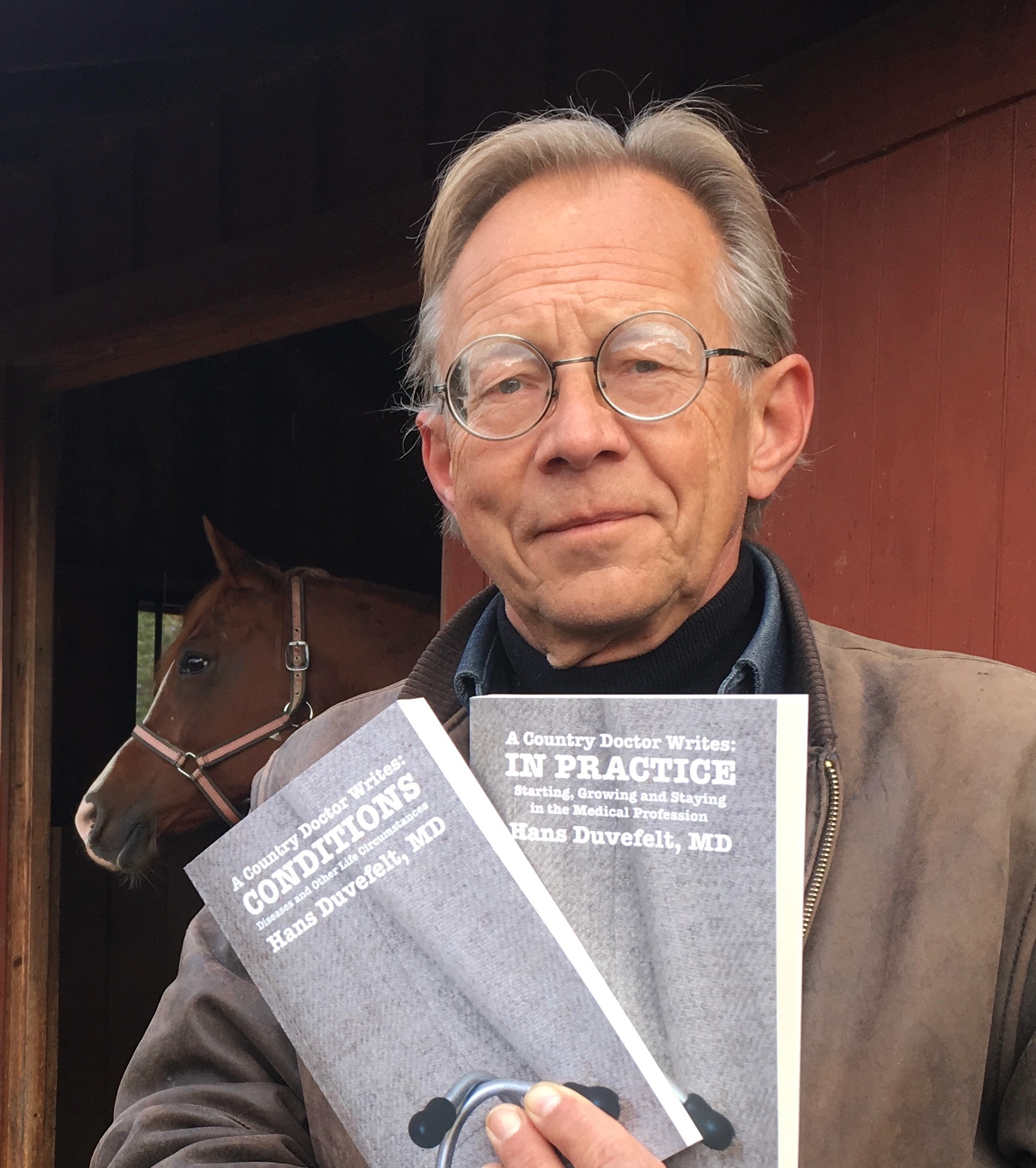
BOOKS BY HANS DUVEFELT, MD

CONDITIONS, Chapter 1: An Old, New Diagnosis

Top 25 Doctor Blogs Award

Doctor Blogs

Enter your email address to subscribe to this blog and receive notifications of new posts by email.

Mailbox

contact @ acountrydoctorwrites.com
Bookmark and Share
© A Country Doctor Writes, LLC 2008-2022 Unauthorized use and/or duplication of this material without express and written permission is strictly prohibited. Excerpts and links may be used, provided that full and clear credit is given.