Archive Page 72

How I Write

When I worked at MedNow, Dewey Richards’ walk-in family practice in Orono, a part time transcriptionist worked in the break room.

She would sit down in front of her old fashioned computer monitor, put a doctor’s micro cassette in her player, the ear phones in her ears and start typing. The screen in front of her was completely empty except for the cursor in the upper left corner. When each office note was finished, she would print it and start again with a completely blank screen.

Most word processors today are full of icons with formatting options. The only time I use that kind of writing platform is when I actually do some formatting, like a pamphlet or layout of a completed book manuscript.

I write on my iPad because it lets me work anywhere, and I prefer a blank screen in front of me as I choose the right words to express my thoughts. Just like I prefer to write in the early morning, when life has fewer distractions, I find the big white space of my favorite writing app helps me open my mind and be inspired. I don’t usually start with a topic already in my head until I see the empty screen in front of me.

The free program I use for creating blog posts and personal correspondence is called Simplenote. It was created by WordPress, which is the backbone of probably the majority of websites, from A Country Doctor Writes to The New York Times.

Simplenote synchs seamlessly between all my devices every time I close a document, so I can open what I created on my iPad minutes later on my iPhone or my MacBook.

This way of writing is as close to a blank page in a typewriter that you can get. I have heard some people are intimidated by sitting down in front of a blank page. I find it inviting and inspiring, because it suggests that anything is possible.

For blog posts, I copy the finished piece and paste it in WordPress, where I can insert graphics, italicize or make text bold, insert links or indents for quotes.
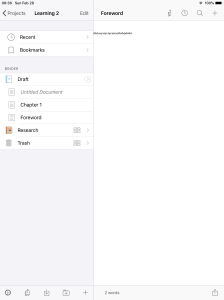
For book chapters, I paste my text into Scrivener, which synchs (although they spell it ‘syncs’) with Dropbox across devices. This is a writing program that lets you create, format and organize chapters. The last step is then to convert the whole project to a Pages, pdf or (if necessary – ugh) Word document.

As I now finish writing this post on my white iPad screen, my eyes also take in the whiteness of the new snow on the trees and the red cedar fence of the horse pasture outside my bedroom window. It is a silent, sunny Sunday morning.

Time to feed the horses.

It Pays to Play Dumb Sometimes

People don’t like to be outsmarted by someone else. They don’t like to have their actions questioned. And they really don’t like to have their mistakes or transgressions pointed out to them.

But that’s what we as doctors have a tendency to do. We need to curb those natural impulses if we want to influence people. Unless we are invited by a patient to render our opinion, we are better off not overemphasizing our insightfulness or expertise. If invited, a radical opening statement may be a very effective attention grabber, but not when our opinion may come as an unwelcome surprise to our patient.

Whether it is contradicting a patient’s misperception of the laws of nature or exposing their misuse of prescriptions, food or other substances, we need to tread very carefully if we expect to maintain a therapeutic relationship with our patient.

I often “think out loud” by asking a question, like “I wonder if you’re doing something different now that your weight is going up”. That is a lot less confrontational than “you must be doing something wrong”. Equally effective is to simply ask for the patient’s analysis and then gently probing it for loopholes. This creates a give and take atmosphere where our restraint in the opinion department may even nudge the patient into realizing for themselves what we might have been tempted to tell them in the first place.

The balance we constantly strive for is to be a trusted and credible guide for our patients in their own journey, without trying to replace them as heroes in their story. We cannot assume what all their priorities are when it comes to choosing how to handle medical circumstances and their treatment options. We may think we know what is best for them, but—if we can’t let go of that notion—should at least say that we don’t have all the answers. Otherwise, their success or failure will be entirely on our shoulders. And that can be a perilous spot to be in.

I seldom choose confrontation in my practice, or outside for that matter.

If a patient who is receiving a controlled substance fails a urine drug test, I don’t say, “I know you’re abusing meth/heroin/cocaine”. I just say “There is X in your urine sample and that means I can no longer prescribe controlled substances for you”.

When the patient says they don’t understand how the test could show that, I explain that they definitely had the substance in their urine but that it isn’t my job to figure out how. I suggest it could even have gotten into their system without their knowledge if they accepted a puff of marijuana or a headache pill from someone else. But that doesn’t even matter: I just follow the rules while still allowing my patient a graceful way to accept my decision without having to confess anything.

That way, in this doctor shortage area, I make it possible for my patient to continue getting general medical care from me if they choose to.

The Art of Asking: What Else is Going on?

Walter Brown’s blood sugars were out of control. Ellen Meek had put on 15 lbs. Diane Meserve’s blood pressure was suddenly 30 points higher than ever before.

In Walter’s case, he turned out to have an acute thyroiditis that caused many other symptoms that came to light during our standard Review of Systems.

Ellen, it turned out, was pretty sure her husband was having an affair with one of his coworkers. And, since this wasn’t the first time, she was secretly working on a plan to move out and file for divorce. She admitted she’d always had a tendency to stress eat.

Diane’s daughter had just announced that she was pregnant by a man she wasn’t sure wanted to be around in the long run.

How do we know whether a patient’s subjective symptoms, laboratory values or even their vital signs are caused by their known medical conditions, a new disease or their state of mind?

We are often tempted to proceed down familiar tracks and tackle seemingly straightforward problems with medications: More insulin would take care of Walter’s blood sugar. Ellen could use a couple of months of phentermine. Diane needed a higher dose of lisinopril or perhaps some hydrochlorothiazide.

As Sherlock Holmes said, “there is nothing more deceptive than an obvious fact”.

There are all kinds of algorithms and guidelines that are supposed to inform clinicians in situations like these, but I wonder how often they are helpful and how often they might actually cause harm.

Medicine is part physiology and part psychology. Are we giving both aspects of our craft the attention they deserve? And, of course, do we make choices and treatment decisions according to probability or by time available to stay on time in our clinic schedules?

Asking “what else is going on” can open up the dreaded, proverbial floodgates, can of worms or Pandora’s box. We don’t have all these cliches in our language for nothing.

Do we avoid asking the questions that will reveal the real answers we need in order to help our patients, or do we dare to?

Driverless Cars or Keyboardless EMRs? Which Do We Need Most?

I love cars and dislike computers.

My car takes me where I need to go, but it also gives me pleasure along the way. I have had it for just about ten years now and I have driven it almost 300,000 miles. It feels like an extension of me. Everything about it is just perfect for the way I drive and the things I need to do with it. From the sumptuously cavernous interior to the rugged all wheel drive features and the studded Finnish snow tires, it takes me pretty much anywhere, anytime. Why anyone would want to travel in a car without the sublime pleasure of driving it is beyond my comprehension.

My computers, on the other hand, are things I avoid whenever I can. My work laptop is an awkward Windows machine. Need I say more? Whatever it does happens stiltedly and unintuitively behind layers of barriers and firewalls that make me sign in again and again until I get to a pathetically clumsy EMR.

My MacBook Pro is slimmer and slicker but it gives me no pleasure to use it, I’m sorry to say.

Every word I have written and published – about as many words as I have miles on my car – has been put down on the virtual keyboard of my iPad. It feels more like an extension of my brain. I use it in bed, by the fireplace, in the barn or on the lawn. I can even talk into it without a microphone or any special software. I touch the screen and magic happens: Apps open, fonts and colors change and the world is at my fingertips, wherever I am.

The work I do remotely for my downstate clinic happens on my iPad and iPhone. That EMR works totally smoothly on my portable devices; the app is so much more modern and intuitive than the computer version.

Some people derive pleasure from the computer itself. I cringe when I have to use it. But driving is a sensual experience, whether it is my commute through the north woods or weekend drive along the Aroostook River through Fort Fairfield to Tractor Supply in Presque Isle. Shifting the manumatic 7-speed transmission with the steering wheel paddles so as not leaning on the brakes, accelerating gently through each curve for better traction, I am one with my machine.

I derive no pleasure from the process of getting my thoughts from my brain to the medical record. I just want it over and done. So if this Country Doctor had to choose between the future prospects of a driverless car or a driverless, keyboardless EMR, he wouldn’t hesitate for a split second.

(Written on my iPad)

Playing Poker With the Devil: “Prior Authorizations” are Paralyzing Patients and Burning out Providers

The faxes keep coming in, sometimes several at a time. “Your (Medicare) patient has received a temporary supply, but the drug you prescribed is not on our formulary or the dose is exceeding our limits.”

Well, which is it? Nine times out of ten, the fax doesn’t say. They don’t explain what their dosage limits are. And if it isn’t a covered drug, the covered alternatives are usually not listed.

So the insurance company is hoping for one of a few possible reactions to their fax: The patient gives up, the doctor tries but fails in getting approval, or the doctor doesn’t even try. In either case, the insurance company doesn’t pay for the drug, keeps their premium and pays their CEO a bigger bonus.

First problem: This may be in regards to a medication that costs less than a medium sized pizza. And the pharmacy generally doesn’t even bother telling the patient what the cash price is.

Second problem: A primary care physician’s time is worth $7 per minute (we need to generate $300-400/hour). We could spend half an hour or all day on a prior authorization and there is absolutely zero reimbursement for it.

In my opinion it is unconscionable for an insurer to say a drug isn’t covered without listing the covered alternatives. They are truly making us play a game where only they know the rules – and I have seen some of them change the rules mid-game.

EMRs sometimes have functional formulary checkers built in, but they don’t always work (I’m talking about you, Greenway – again).

There are too many insurance companies for a provider to separately check their websites before prescribing.

There is an app called Epocrates that has some formularies built in. I have it set to Mainecare, the Maine version of Medicaid. But far from all insurers are included. Whether this is Epocrates’ fault or the insurers, I don’t know. All I know is I’m playing prescriber without knowing the rules of the game.

It is a pathetic state of affairs. The technology is out there but it isn’t in the interest of the for profit insurance companies to use it.

This alone is a reason to consider a one payer system: Mainecare publishes their formulary with real time updates and shares it with Epocrates. Their step care rules are easy to understand for both prescribers and patients.

Prior Authorization requirements are mostly meant to save insurers money, but sometimes they are efforts to control provider behavior. But we have the medical license and bear the liability burden when we prescribe. And the insurance companies don’t seem to have any legal risk when they refuse to honor our prescriptions and leave patients without treatment.

This situation is pure evil. I don’t think my analogy of playing poker with the devil is exaggerated at all. It is provider harassment and customer abuse.


I just realized none of the posts show on an iPad or a computer, but they do show on an iPhone. WordPress is working on this. In the meantime, please visit my Substack.


Osler said “Listen to your patient, he is telling you the diagnosis”. Duvefelt says “Listen to your patient, he is telling you what kind of doctor he needs you to be”.


BOOKS BY HANS DUVEFELT, MD

CONDITIONS, Chapter 1: An Old, New Diagnosis

Top 25 Doctor Blogs Award

Doctor Blogs

Enter your email address to subscribe to this blog and receive notifications of new posts by email.

Mailbox

contact @ acountrydoctorwrites.com
Bookmark and Share
© A Country Doctor Writes, LLC 2008-2022 Unauthorized use and/or duplication of this material without express and written permission is strictly prohibited. Excerpts and links may be used, provided that full and clear credit is given.