Archive Page 67

“Tell Me More”

Words can be misleading. Medical terms work really well when shared between clinicians. But we can’t assume our patients speak the same language we do. If we “run with” whatever key words we pick up from our patient’s chief complaint, we can easily get lost chasing the wrong target.

Where I work, along the Canadian border, “Valley French” expressions tripped me up when I first arrived. The flu, or in French le flu (if that is how you spell it – I’ve never seen it in writing) is the word people use for diarrhea. Mal au cœur (heart pain) doesn’t mean angina or chest pain, but heartburn, a confusing expression in English, too.

But even if we are all English speaking, clinicians need to be careful not to assume common words mean the same to everyone.

I have seen many patients complain of anxiety, but not actually be worried about anything. A number of bipolar people have used the word anxiety when, in my personal vernacular, they are really describing pathological restlessness. I once had a patient complain of “nerves” but not have a worry in the world except for his hereditary essential tremor, which he assumed was a sign of untreated anxiety.

People often resist my labeling their symptom as chest pain, insisting that I am wrong about the location and the character of their discomfort. Instead, they might insist it is indigestion or prefer pressure, tightness or heaviness in their throat, epigastrium or even between their shoulder blades. “Chest pain is shorthand for all that”, I tell them.

I hear people use the word dizzy for a gnawing feeling in their epigastrium, and nauseous for a sense of early satiety after eating.

Even worse is when a patient attributes a symptom to the wrong organ or body part. It seems most people assume their kidneys to be much further down their back sides than they really are, so their “kidney pain” is really low back pain. This can be even more misleading if the patient claims to have a urinary infection and only when prompted for more history then says “because my kidneys hurt”, south of their anatomic location. Often this is entirely without urinary symptoms. Abdominal pain or pressure is also often self diagnosed as a UTI.

Most people want their hip joints to be where they might put their hands on their “hips”, the big body part in pear shaped people. I draw skeptical reactions when I tell them the hip joint is in the groin.

The other day I saw a 45 year old woman with a concern about burping incessantly for several weeks. She said she was hiding it the best she could. I asked her not to hide it, to “let it all out”. What I heard wasn’t burping, it was more of a hiccup. The workup and treatment is not the same, so it took me sitting with her for a while to know which way to go with her case.

We must avoid acting like bloodhounds in chasing the trail we are shown without taking in the surrounding territory. There may be something more obvious and important somewhere nearby.

The lesson I have learned is to use this three word question that should be a famous quote if it isn’t already:

“Tell me more!”

What Does Your Patient Need to Hear You Say Right Now?

Today a patient told me a cancer doctor had told her husband that he only had a year to live. She was angry, because she felt that statement robbed her husband of hope and she knew well enough that doctors don’t always know a patient’s prognosis in such detail.

“Would you want to know if you only had a year to live”, she asked me.

I thought for a moment and then answered that I probably would want to know. I explained that I would want to make decisions and provisions because I live alone and am responsible for my animals. As I told her, I am well aware that if I dropped dead right now, things would be pretty chaotic for a while.

Two and a half years ago, I wrote a post titled Be the Doctor Each Patient Needs. In it I presumptuously coined the phrase I later put right on top of the sidebar of this blog:

Osler said “Listen to your patient, he is telling you the diagnosis”. Duvefelt says “Listen to your patient, he is telling you what kind of doctor he needs you to be”.

I still believe we need to be incredibly sensitive to all the verbal and nonverbal clues our patients give us about what they need. In my 2018 post, I used the analogy of being like a chameleon. That’s not the same as being dishonest. It is a matter of knowing that your education and title give you an authority, an opportunity and an obligation to use your position of trust in your patient’s life to say things they need to hear in order to carry on or perhaps to take the first step in a new direction. We all wear the mantle of a superhero in a sense, and we can use this symbol for good. But that carries a responsibility to use our powers wisely.

We must strive to know our patients well enough to know what they need. Those things are seldom apparent from the medical record. They are subtle, subjective and often in some degree of flux through time and the course of life and disease.

The other day, a colleague who was scheduled to see a patient of mine I couldn’t accommodate in my schedule asked me if there was anything she should know before seeing this patient. What I did, in less than two minutes, was explain this person’s track record of resourcefulness, comprehension and follow-through.

Those qualities or capabilities in a patient must determine our behavior and care planning. I sometimes have a very full schedule because I think I know when I need to monitor each step in some patients’ treatment or they will get lost in terms of what to do and maybe even lost to followup entirely.

When I think about medicine being an art, I see the art in reading people and the art in applying basic treatment principles in an individualized way. This takes time to learn and hone, and it sometimes requires extra time in the patient encounter. My aim and my desire in practice is to automate and delegate the many mandated aspects of healthcare so I can focus on what only a treating physician can do: Pull together all the objective and subjective data, develop a treatment plan that makes sense for the patient and help them see the direction and steps needed to put that plan into action.

Another phrase I coined, perhaps equally presumptuous as the first one I quoted, and which I tried out on my boss a while ago (I can’t quite read the reaction I got) was “I’m an artist, not a bookkeeper”. I do believe that is what my patients need and are looking for.

Five Weight Loss Myths I am Constantly Fighting

1) EXERCISE MORE

I talk to people almost every day who think they can lose weight by exercising. I tell them that is impossible. I explain that it takes almost an hour of brisk walking to burn 100 calories, which equals one apple or a ten second binge on junk food. To lose a pound a week, you need to reduce your calorie intake by about 500 per day – that would be the equivalent of five hours of moderate exercise every day. We’d have to quit our jobs to do that.

2) EAT MORE FRUITS AND VEGETABLES

The other fallacy I hear all the time is that, somehow, adding “healthy” fruits and vegetables can make a person lose weight. I tell them that adding anything to their daily calorie intake will have the opposite effect. I more or less patiently explain that our job is to figure out what to take away instead of what to add. Maybe substituting a fruit for a Whoopie pie is healthy in other ways, but it has almost nothing to do with weight loss.

3) EAT BREAKFAST

A third fallacy is that eating a healthy breakfast will ensure weight loss. To explore this one, I ask: “Are you often hungry?”

So many of my overweight patients deny ever feeling hungry – that gnawing feeling in the pit of your stomach and the low blood sugar onfusion and weakness I feel by 9 or 10 am after doing barn chores on an empty stomach (only coffee).

When I hear “I never feel hungry”, I don’t recommend starting a good breakfast habit because that would likely increase a person’s daily calorie intake. But when I hear that a breakfast skipper goes for the doughnuts mid morning due to hunger, I certainly recommend eating breakfast. When I do, I always point out that the typical American cereal and banana breakfast, along with soft drinks, is actually the major reason for our obesity and diabetes epidemics.

4) EAT 3-4 MEALS A DAY

The fourth myth is that you somehow have to eat a certain number of meals. That depends on how you feel. If you’re in the habit of eating, say breakfast and supper and have no symptoms if you were to skip lunch, then why eat it, unless you’re trying to put on weight? The problem, again, is when a meal-skipper gets the munchies. We need to avoid that trap.

5) DIABETICS NEED CARBS (AND SEVERAL MEALS PER DAY)

Number five is all the overweight diabetics who have been told by dieticians and diabetic educators that they must eat a certain amount of calories or carbs or number of meals just because they are diabetics. That is sometimes the case, because some diabetic medications can cause low blood sugar if you skip meals, but it is by no means a universal truth. If you want to lose weight and feel just fine not eating all the meals and snacks those people tell you to consume, why force yourself to do it? Why not listen to your body (instead of your desires or prior indoctrination)?

It is a sad state of affairs that almost everybody knows complicated things like operating their smartphone but are so lost when it comes to knowing what to eat. (We can thank the food/snack industry for that.)

Cholesterol Guidelines and the Bachelor With Platform Shoes – 13 Years Later

April 28, 2008 I published my first post on A Country Doctor Writes. April 28, 2021 I published my video blog Why I Don’t Order Fasting Bloodwork Anymore. Today, A Country Doctor Writes broke all previous records for number of views. My first post back then and my first video blog (after the general introduction) touch on the same topic from different angles and I explain what has changed over the past 13 years.

All my videos in one place: https://acountrydoctortalks.com

Screening for Depression: Then What?

Primary Care is now mandated to screen for depression, among a growing host of other conditions. That makes intuitive sense to a lot of people. But the actual outcomes data for this are sketchy.

“Don’t order a test if the results won’t change the outcome” was often drilled into my cohort of medical students. Even the US Public Health Service Taskforce on Prevention admits that depression screening needs to take into consideration whether there are available resources for treatment. They, in their recommendation, refer to local availability. I am thinking we need to consider the availability in general of safe and effective treatments.

If the only resource when a patient screens positive for depression is some Prozac (fluoxetine) at the local drugstore, it may not be such a good idea to go probing.

The common screening test most clinics use, PHQ-9, asks blunt questions about our emotional state for the past two weeks. This, in my opinion, fits right into the new American mass hysteria of sound bites, TikTok, Tweets, Facebook Stories, instant messages, same-day Amazon deliveries and our worsening pathological need for stimulation and instant gratification.

Two weeks??

Does anybody need to be labeled with a mental illness that will follow them for the rest of their life because of a fleeting emotional funk?

What is the likelihood that a person – particularly during a pandemic and a historic economical downturn – who feels down in the dumps for a couple of weeks is going to be better off if started on a dependency-causing, mind altering SSRI that many people can never eventually stop because of severe withdrawal symptoms? And, consider the very modest therapeutic benefit of antidepressants on chronic and severe (but not mild) depression.

If we look at the statistics, a recent JAMA study found that 8.5% of a study population had active, diagnosable depression before Covid and 27.8% after the pandemic took hold. Historically, the lifetime incidence of depression is over 20% according to another JAMA article from 2018.

In many ways, depression is a cultural, societal phenomenon, whether it is fleeting, like the modern American definition allows, or chronic. And I believe that the cure in many cases requires cultural, social, societal, spiritual and existential interventions.

The fact that rates of depression can vary depending on external circumstances brings me back to my previous exploration of the way modern psychiatric treatment has negatively altered the natural history of depression – a disheartening consequence of our well meaning professional interventions.

We Have Lost Track of the Natural History of Disease

Are we wrong in our short perspective of what constitutes clinical depression? I think the past year is telling us that. “This, too, shall pass” needs to be paired with “First, do no harm”. A state of feeling depressed is not necessarily the beginning of a lifelong disease, best treated with drugs.


I just realized none of the posts show on an iPad or a computer, but they do show on an iPhone. WordPress is working on this. In the meantime, please visit my Substack.


Osler said “Listen to your patient, he is telling you the diagnosis”. Duvefelt says “Listen to your patient, he is telling you what kind of doctor he needs you to be”.


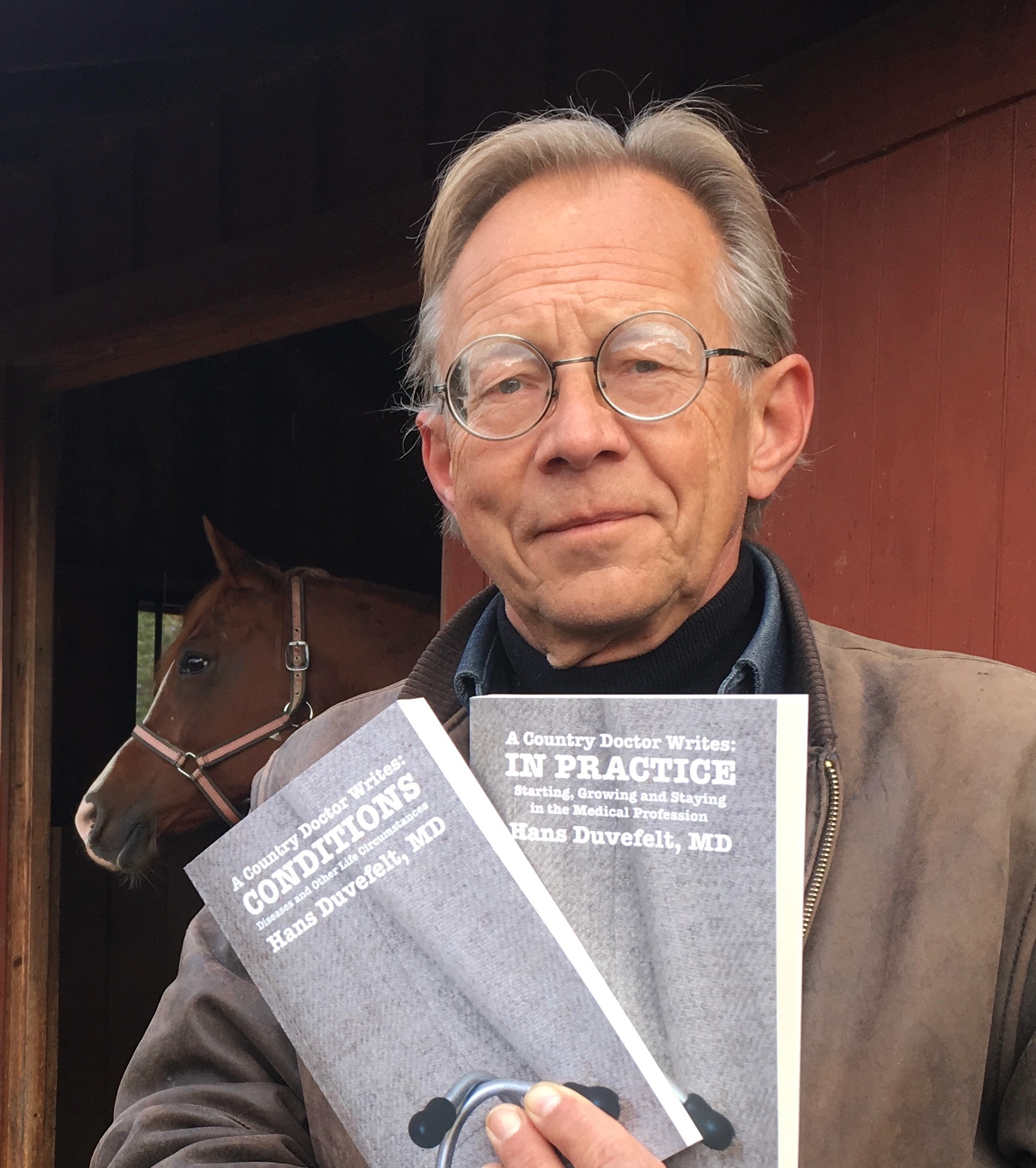
BOOKS BY HANS DUVEFELT, MD

CONDITIONS, Chapter 1: An Old, New Diagnosis

Top 25 Doctor Blogs Award

Doctor Blogs

Enter your email address to subscribe to this blog and receive notifications of new posts by email.

Mailbox

contact @ acountrydoctorwrites.com
Bookmark and Share
© A Country Doctor Writes, LLC 2008-2022 Unauthorized use and/or duplication of this material without express and written permission is strictly prohibited. Excerpts and links may be used, provided that full and clear credit is given.