Archive Page 66

Voicemail, Repeat Requests and Multitasking: Inefficiencies in Today’s Healthcare

My nurse regularly gets at least 50 voicemails every day, many saying “please call me back”.

I have one patient who frequently tests the patience of our clinic staff by calling multiple times for the same thing. He is the most dramatic example of what seems to be a widely held belief that physicians, nurses and medical assistants sit at their desks and answer phone calls all or most of their time. But when we do, we are often hampered by busy signals, phone tag or “voice mail not set up”. Electronic messaging isn’t a panacea, because patients don’t necessarily know what we need to know in order to answer their questions correctly and efficiently at first contact.

Pharmacies, too, create duplicate requests that bog down our workdays. In my EMR, if an electronic refill request doesn’t get a response the day it comes in, the “system” sends a repeat request every day until it gets done. This is one reason I look like I am further behind on “tasks” than I really am. To top it off, every single refill request generated by the “system” comes with a red exclamation point next to it. This happens even when a patient has just picked up their last 90 day refill – a case where I theoretically should have 89 days to respond. Meanwhile, my system has no way of flagging truly urgent refill requests. This “alarm fatigue” is common in EMRs today.

The business model in today’s healthcare is that reimbursable activities (seeing patients in person or via telemedicine) are scheduled back to back, all day long. There is a universal assumption that this will still provide enough slack to deal with prescription refills, phone calls, incoming reports and the further ordering and feedback to patients prompted by them. And did I mention EMR documentation? Multitasking, or rather, constantly switching between different kinds of tasks, is not a sane or efficient way to work.

Providers, as salaried employees, are universally expected to get their work done on their own time (jokingly called “pajama time”). This creates varying degrees of stress and burnout. But nurses and medical assistants have a different stress. As hourly employees, they are theoretically entitled to overtime pay if they can’t finish their work during their normal working hours. But that is expensive for healthcare organizations and often discouraged or forbidden.

In Sweden, known for its somewhat stodgy bureaucracy, clinics almost universally have “telefontid”, a portion of the day when patients can call, or when staff are not seeing patients but returning calls – the details can vary. This may not be ideal customer service, but it at least acknowledges that multitasking in healthcare isn’t always necessary and certainly not healthy.

A growing trend in this country, mysterious to me and a generator of patient frustration and employee stress, is that in spite of all our expensive computers and phone systems – or perhaps because of them – most clinics, even large organizations, can’t afford to have someone answer the telephone.

St Joseph Hospital in Bangor usually answers on the first ring, and the main operator (I know her voice well) is efficient and helpful. My mother worked as an operator for a big hotel and also at one point the phone company. I remember watching her efficiency plugging in those little cables to transfer callers to the right department. Most clinics and hospitals tell you to hang up and call 911 if you’re in trouble and make you “listen carefully” to all the options, threatening that they “may have changed” and eventually you end up in somebody’s voicemail.

When everybody is talking about patient centeredness, customer experience and such things, why isn’t it obvious that incoming calls and other types of requests need to be prioritized as they arrive and not just dumped, unsorted, in someone’s voicemail or inbox?

Organizations appear to be paranoid about being held responsible if non-clinicians are put in a position to “triage” incoming calls. But it isn’t rocket science – everybody does it at home, with their kids, pets and themselves. I believe it may be an even greater liability to have an automated telephone system people get lost or stuck in.

Here are two slides from a staff education talk I gave 10 years ago about common sense telephone triage.

The telephone used to be a powerful tool, connecting people with businesses, services and each other. It no longer works like it used to, because nobody’s answering.

The Art of Medicine is Not an Algorithm

The Art of Medicine is such a common phrase because, for many centuries, medicine has not been a cookie cutter activity. It has been a personalized craft, based on the science of the day, practiced by individual clinicians for diverse patients, one at a time.

Unlike industrial mass production, where everything from raw materials to tools to manufacturing processes are standardized and even automated or performed by robots, physicians work with raw materials of different age, shape and quality in what is more like restoration of damaged paintings or antique automobiles.

The Art of Medicine involves knowing how and with which tools to take something damaged or malfunctioning and make it better. There are general principles, but each case is different to at least some degree. In many cases there are different ways to improve something that is malfunctioning, but patients may prefer fixing certain aspects of a complex problem because of their individual needs.

Restoring a very old car may be a different process depending on its intended use, like parading it in car shows or driving cross country. Patients’ desires and expectations can vary just as much.

The view on optimal treatment of high blood pressure has become a vision of automation to the degree that many have proposed letting pharmacists follow protocols, actually prescribing and dispensing medications for better control.

But patients don’t usually fit into such manufacturing mode paradigms. Some hypertension patients also have swollen legs, rapid heart rates or blood pressure spikes when feeling stressed. Some have naturally low potassium levels or cold feet in the winter. A careful and individualized choice of blood pressure medication can make the whole person feel and function better, treating more than one thing at a time. Knowing all the available medications intimately is infinitely more valuable to the patient than blindly following the treatment algorithm of the day – because we have all seen them come and go.

To paraphrase Hippocrates: The Life of algorithms is short, the Art of practice is long.

Food is a Hot Potato

My recent post about weight loss myths generated more page views than anything else on my blog (9,394 and counting) and more comments, many arguing back and forth between them. A few were by board certified obesity experts who made the claim that fighting obesity is pretty much like rocket science – not something you should dabble in with just a regular MD degree.

Now, I’m just a Country Doctor (I imagine saying this with a slow drawl), but I have trouble understanding why this should be so.

I don’t think it’s rocket science to start with the premise that over the last few hundred years the human genome has not changed, but our habits and environment have. Sometimes those things have direct consequences and sometimes they change gene expression (epigenetics).

So if we look at what has changed parallel to the obesity, diabetes, cardiovascular and autoimmune epidemics, it is hard for me to accept the comment someone made that food has nothing to do with obesity.

We, as a culture, eat differently from one or two hundred years ago, and much has been written about the health benefits of eating a less processed, more natural diet. From Paleo to what the Functional Medicine movement calls “ancestral diet” these shouldn’t be shocking, radical or controversial ideas, yet they seem to be. I can understand that the food industry is fighting this movement vigorously, but I wonder why parts of the clinician community also are.

I live next to an Amish community, where children play in the dirt and with barn animals. They have fewer allergies than urban children in highly sanitized environments. The rate of obesity in the Amish is 4%, compared with 36% in the general population. The Amish typically walk 14,000 to 18,000 steps per day – far beyond the idealized 10,000 typical goal. They also do more manual labor beyond just walking. Their diet is not Paleo or ancestral, but quite high in meat, bread and root vegetables; you’d have to emulate more old fashioned habits than theirs to fit into those categories. But the differences between their statistics and ours are startling according to BMJ, the British Medical Journal:

Prevalence rates for diabetes, hypertension and hypercholesterolemia were 3.3%, 12.7%, and 26.2% in the Amish compared with 13.2%, 37.8% and 35.7% in NHANES (p<0.001 for all).

The Amish are a powerful illustration, with the caveat that they are a fairly homogenous genetic group, that a physically very active lifestyle (beyond the goals of many of the rest of us) is linked to low levels of obesity, and its related conditions. But if we don’t have that activity level, what impact does diet have on the prevalence of these diseases?

The Mayo Clinic states plainly:

Although there are genetic, behavioral, metabolic and hormonal influences on body weight, obesity occurs when you take in more calories than you burn through exercise and normal daily activities. Your body stores these excess calories as fat.

Most Americans’ diets are too high in calories — often from fast food and high-calorie beverages. People with obesity might eat more calories before feeling full, feel hungry sooner, or eat more due to stress or anxiety.

So, if the Mayo Clinic says so, I’ll simply start with the premise that food matters. It may be fascinating to some clinicians exactly which endocrine mechanisms are involved in the causation of obesity, diabetes, heart disease and so on. Again, I’m just a Country Doctor and it’s enough for me to ask, first, are you planning your meals in advance and consciously choosing portion size and, second, are you eating a lot of things that weren’t invented a couple of hundred years ago?

That’s a good start, in my humble opinion. It often leads to a plan for reversal of these disease processes right then and there. Even if the details of exactly how that happens may require another board certification or even a PhD.

New Book: SAMPLES – Recent Writings on the Art of Medicine. $2.99 on Amazon

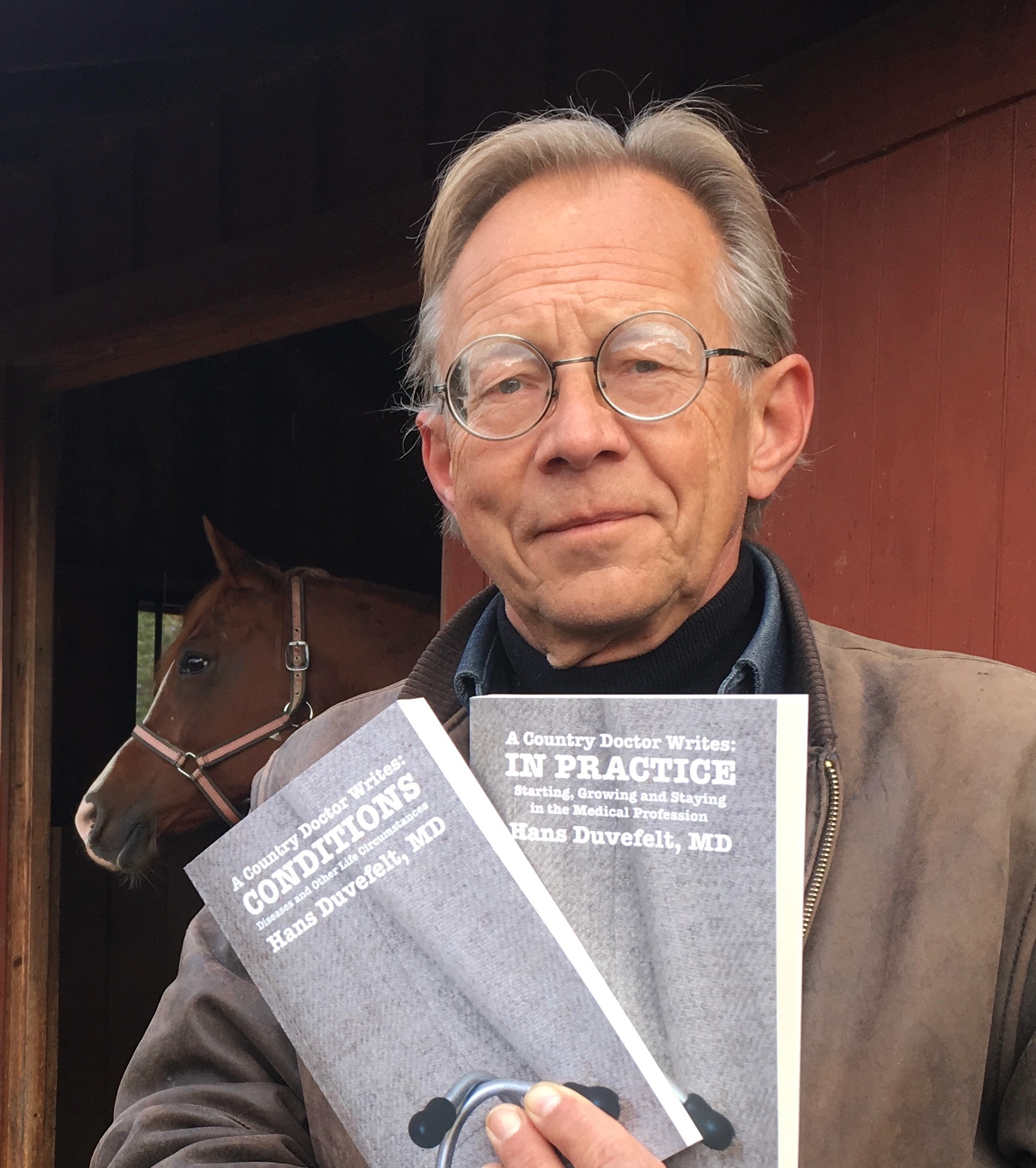
Flanked by BE THE GUIDE, NOT THE HERO and IT PAYS TO PLAY DUMB SOMETIMES, most of the new chapters have titles starting with THE ART OF and appeared on A Country Doctor Writes after the publication of CONDITIONS and IN PRACTICE.

This small ebook with clinical vignettes reveals the inner workings of small town medical practice and the continual learning and exploration of a 40 year veteran who still loves practicing the Art of Medicine.

PREVIEW and buy on Amazon: https://www.amazon.com/dp/B095HT8LPP

Suboxone Saves, Builds and Rebuilds Lives


I just realized none of the posts show on an iPad or a computer, but they do show on an iPhone. WordPress is working on this. In the meantime, please visit my Substack.


Osler said “Listen to your patient, he is telling you the diagnosis”. Duvefelt says “Listen to your patient, he is telling you what kind of doctor he needs you to be”.


BOOKS BY HANS DUVEFELT, MD

CONDITIONS, Chapter 1: An Old, New Diagnosis

Top 25 Doctor Blogs Award

Doctor Blogs

Enter your email address to subscribe to this blog and receive notifications of new posts by email.

Mailbox

contact @ acountrydoctorwrites.com
Bookmark and Share
© A Country Doctor Writes, LLC 2008-2022 Unauthorized use and/or duplication of this material without express and written permission is strictly prohibited. Excerpts and links may be used, provided that full and clear credit is given.