Archive Page 66

Food is a Hot Potato

My recent post about weight loss myths generated more page views than anything else on my blog (9,394 and counting) and more comments, many arguing back and forth between them. A few were by board certified obesity experts who made the claim that fighting obesity is pretty much like rocket science – not something you should dabble in with just a regular MD degree.

Now, I’m just a Country Doctor (I imagine saying this with a slow drawl), but I have trouble understanding why this should be so.

I don’t think it’s rocket science to start with the premise that over the last few hundred years the human genome has not changed, but our habits and environment have. Sometimes those things have direct consequences and sometimes they change gene expression (epigenetics).

So if we look at what has changed parallel to the obesity, diabetes, cardiovascular and autoimmune epidemics, it is hard for me to accept the comment someone made that food has nothing to do with obesity.

We, as a culture, eat differently from one or two hundred years ago, and much has been written about the health benefits of eating a less processed, more natural diet. From Paleo to what the Functional Medicine movement calls “ancestral diet” these shouldn’t be shocking, radical or controversial ideas, yet they seem to be. I can understand that the food industry is fighting this movement vigorously, but I wonder why parts of the clinician community also are.

I live next to an Amish community, where children play in the dirt and with barn animals. They have fewer allergies than urban children in highly sanitized environments. The rate of obesity in the Amish is 4%, compared with 36% in the general population. The Amish typically walk 14,000 to 18,000 steps per day – far beyond the idealized 10,000 typical goal. They also do more manual labor beyond just walking. Their diet is not Paleo or ancestral, but quite high in meat, bread and root vegetables; you’d have to emulate more old fashioned habits than theirs to fit into those categories. But the differences between their statistics and ours are startling according to BMJ, the British Medical Journal:

Prevalence rates for diabetes, hypertension and hypercholesterolemia were 3.3%, 12.7%, and 26.2% in the Amish compared with 13.2%, 37.8% and 35.7% in NHANES (p<0.001 for all).

The Amish are a powerful illustration, with the caveat that they are a fairly homogenous genetic group, that a physically very active lifestyle (beyond the goals of many of the rest of us) is linked to low levels of obesity, and its related conditions. But if we don’t have that activity level, what impact does diet have on the prevalence of these diseases?

The Mayo Clinic states plainly:

Although there are genetic, behavioral, metabolic and hormonal influences on body weight, obesity occurs when you take in more calories than you burn through exercise and normal daily activities. Your body stores these excess calories as fat.

Most Americans’ diets are too high in calories — often from fast food and high-calorie beverages. People with obesity might eat more calories before feeling full, feel hungry sooner, or eat more due to stress or anxiety.

So, if the Mayo Clinic says so, I’ll simply start with the premise that food matters. It may be fascinating to some clinicians exactly which endocrine mechanisms are involved in the causation of obesity, diabetes, heart disease and so on. Again, I’m just a Country Doctor and it’s enough for me to ask, first, are you planning your meals in advance and consciously choosing portion size and, second, are you eating a lot of things that weren’t invented a couple of hundred years ago?

That’s a good start, in my humble opinion. It often leads to a plan for reversal of these disease processes right then and there. Even if the details of exactly how that happens may require another board certification or even a PhD.
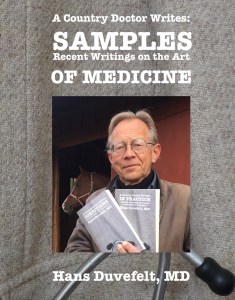
New Book: SAMPLES – Recent Writings on the Art of Medicine. $2.99 on Amazon

Flanked by BE THE GUIDE, NOT THE HERO and IT PAYS TO PLAY DUMB SOMETIMES, most of the new chapters have titles starting with THE ART OF and appeared on A Country Doctor Writes after the publication of CONDITIONS and IN PRACTICE.

This small ebook with clinical vignettes reveals the inner workings of small town medical practice and the continual learning and exploration of a 40 year veteran who still loves practicing the Art of Medicine.

PREVIEW and buy on Amazon: https://www.amazon.com/dp/B095HT8LPP

Suboxone Saves, Builds and Rebuilds Lives

Morgellons? I Made the Diagnosis of DP. Now I Have to Figure Out How to Manage it.

Sometimes you learn about a disease just before you run into it for the first time. That has happened again and again in my career.

After I published my post about bot fly infections, a commenter asked if I had seen the larvae and suggested it might have been a case of Morgellons disease. I had never heard of that one, so I read up on it. Morgellons is a subtype of delusional parasitoses (DP), which can have many etiologies.

My own patient’s larvae were well documented by others and I think I saw them during our telemedicine visits.

A few days later I had reason to remember my impromptu research.

Gail is a woman in her forties with anxiety disorder and fibromyalgia. She came in with a concern about parasites under her skin and told me two of her girlfriends and her next door neighbor also had them.

Each one of them had seen several providers including the emergency room and basically had been told they might have scabies but probably didn’t. They had all tried and failed topical permethrin.

But Gail gave me a vivid description of all the teeny-tiny parasites she saw in the bottom of the tub after she bathed off the permethrin the morning after her treatment.

She also described, in excited and dramatic language, how scraping the skin where she saw a little black “thing” would make her suddenly itch or bleed some distance away. She used descriptions like “they get angry” and “they are clever”.

I looked and I looked. I took off my -10 diopter glasses and placed my eyeballs 4 inches from her skin, spotted with blemishes of different age and size. I saw nothing that looked like insects, burrows or bites.

I offered to do some skin scrapings. Gail was pleased. As I did it, I did see her unusually thin skin start bleeding very slightly half an inch away from my sampling here and there and she said, “see, they’re on the move”.

I submitted my sample and as I wait for the path report I am thinking about what to say next.

Here is what I have learned from UpToDate:

Delusional parasitosis can be associated with a host of psychiatric conditions but can also have its root cause in tingling sensations caused by medications, from ciprofloxacin to topiramate, amantadine, ketoconazole and many others. It can be related to diseases that cause paresthesias, from Lyme disease to restless leg syndrome (Ekbom’s disease, which can be linked to iron deficiency) to diabetes and many others.

Regarding Morgellons, which my commenter suggested, UpToDate writes:

Morgellons is a syndrome characterized by symptoms that appear to be identical to delusional infestation or very similar, but with the addition of the affected patient’s beliefs that inanimate objects (such as colored strings or fibers) were present in the lesion as well.

UpToDate and many other sites, including Wikipedia, point out that one (possibly increasing) common cause of delusional parasitosis, or formication, is methadone or cocaine abuse:

Some users also report formication: a feeling of a crawling sensation on the skin also known as “coke bugs“. These symptoms can last for weeks or, in some cases, months.

So now my question is: How do I tactfully explore if the cluster of cases in my community has anything to do with meth or coke when so many other things theoretically could cause these symptoms?

“Tell Me More”

Words can be misleading. Medical terms work really well when shared between clinicians. But we can’t assume our patients speak the same language we do. If we “run with” whatever key words we pick up from our patient’s chief complaint, we can easily get lost chasing the wrong target.

Where I work, along the Canadian border, “Valley French” expressions tripped me up when I first arrived. The flu, or in French le flu (if that is how you spell it – I’ve never seen it in writing) is the word people use for diarrhea. Mal au cœur (heart pain) doesn’t mean angina or chest pain, but heartburn, a confusing expression in English, too.

But even if we are all English speaking, clinicians need to be careful not to assume common words mean the same to everyone.

I have seen many patients complain of anxiety, but not actually be worried about anything. A number of bipolar people have used the word anxiety when, in my personal vernacular, they are really describing pathological restlessness. I once had a patient complain of “nerves” but not have a worry in the world except for his hereditary essential tremor, which he assumed was a sign of untreated anxiety.

People often resist my labeling their symptom as chest pain, insisting that I am wrong about the location and the character of their discomfort. Instead, they might insist it is indigestion or prefer pressure, tightness or heaviness in their throat, epigastrium or even between their shoulder blades. “Chest pain is shorthand for all that”, I tell them.

I hear people use the word dizzy for a gnawing feeling in their epigastrium, and nauseous for a sense of early satiety after eating.

Even worse is when a patient attributes a symptom to the wrong organ or body part. It seems most people assume their kidneys to be much further down their back sides than they really are, so their “kidney pain” is really low back pain. This can be even more misleading if the patient claims to have a urinary infection and only when prompted for more history then says “because my kidneys hurt”, south of their anatomic location. Often this is entirely without urinary symptoms. Abdominal pain or pressure is also often self diagnosed as a UTI.

Most people want their hip joints to be where they might put their hands on their “hips”, the big body part in pear shaped people. I draw skeptical reactions when I tell them the hip joint is in the groin.

The other day I saw a 45 year old woman with a concern about burping incessantly for several weeks. She said she was hiding it the best she could. I asked her not to hide it, to “let it all out”. What I heard wasn’t burping, it was more of a hiccup. The workup and treatment is not the same, so it took me sitting with her for a while to know which way to go with her case.

We must avoid acting like bloodhounds in chasing the trail we are shown without taking in the surrounding territory. There may be something more obvious and important somewhere nearby.

The lesson I have learned is to use this three word question that should be a famous quote if it isn’t already:

“Tell me more!”


I just realized none of the posts show on an iPad or a computer, but they do show on an iPhone. WordPress is working on this. In the meantime, please visit my Substack.


Osler said “Listen to your patient, he is telling you the diagnosis”. Duvefelt says “Listen to your patient, he is telling you what kind of doctor he needs you to be”.


BOOKS BY HANS DUVEFELT, MD

CONDITIONS, Chapter 1: An Old, New Diagnosis

Top 25 Doctor Blogs Award

Doctor Blogs

Enter your email address to subscribe to this blog and receive notifications of new posts by email.

Mailbox

contact @ acountrydoctorwrites.com
Bookmark and Share
© A Country Doctor Writes, LLC 2008-2022 Unauthorized use and/or duplication of this material without express and written permission is strictly prohibited. Excerpts and links may be used, provided that full and clear credit is given.