Archive Page 64
People here in northern Maine, as in my native Sweden, don’t get a whole lot of natural sunlight a good part of the year. As a kid, I had to swallow a daily spoonful of cod liver oil to get the extra vitamin D my mother and many others believed we all needed. Some years later, that fell out of fashion as it turned out that too much vitamin A, also found in that particular dubious marine delicacy, could be harmful.
This is how it goes in medicine: Things that sound like a good idea often turn out to be not so good, or even downright bad for you.
Other vitamins, like B12, can also cause harm: Excess vitamin B12 can cause nerve damage, just as deficiency can.
Both B12 and D can be measured with simple blood tests, but the insurance industry doesn’t pay for screening. That is because it hasn’t been proven that testing asymptomatic people brings any benefit. In the case of B12, it is well established that deficiency can cause anemia and neuropathy, for example. But here is no clear evidence what the consequences are of vitamin D “deficiency”. A statistically abnormal result is not yet known to definitely cause a disease or clinical risk, in spite of all the research so far, but we’re staying tuned.
This is what I tell my patients:
I don’t recommend supplements or vitamins because, as a physician, my job is to only recommend pills that are scientifically proven to treat or prevent disease. Prescription medications also have quality controls to make sure you get what you’re supposed to.
For example, we have proof that aspirin is aspirin and it can cut a person’s risk for blood clots. But fish oil capsules can have varying quality and composition, so they may or may not be as good for you as eating salmon.
I make a distinction in my practice between what we know works and what we believe might work. I feel I owe my patients that honesty. I work from the assumption that most people don’t want to pop unnecessary pills, so I keep my recommendations to the tried and true.
If I go out on a limb and recommend unproven remedies, I risk losing my credibility with my patients also when I recommend well established life-saving medications as a well trained, critically thinking and experienced physician.
Did Covid and Telemedicine Finally Make the Physical Exam Obsolete?
Published June 11, 2021 Progress Notes 8 CommentsLeft to my own devices, I would be selective about when and how much of a physical exam I do: either not at all or very detailed for just those things that can help me make the diagnosis. I have no patience for boilerplate normal exams. Any doctor who uses the term PERRLA (pupils equal, round, reactive to light and accommodation) is probably faking it. First, most of the time this isn’t actually tested completely and, second, even if it’s done correctly, it has no relevance in the majority of chart notes I have found it in. I have actually seen it in office note templates for urinary tract infections!
It is well known that the history makes the diagnosis in the vast majority of cases. But that task – or art, actually – is sometimes relegated to support staff or forced into unnatural click boxes. Because reimbursement until very recently was tied to how many items were asked about and examined, there was a loss of the story, or narrative, of the patient’s illness. And you could get more brownie points by including things that were extremely peripheral to the clinical problem at hand.
EMRs make it easy to produce long office notes with lots of reimbursement and quality scoring points of uncertain clinical value and accuracy.
Specifically, the physical exam has in many instances become a corrupted, fraudulent, one-click travesty of the art and professionalism we swore an oath to hold high when we graduated from medical school.
The pandemic and the rush toward telemedicine made it clear to most people that medical diagnosis, advice and treatment is entirely possible without physical contact. It was just a matter of getting paid for it, or the healthcare industry would have come to a stop, or at least a crawl.
Now that we have admitted that listening, talking and a certain amount of looking or observing can be done without being in the same room, it is time for us to be honest about the value of the physical exam:
- It is a ritual.
- It is often irrelevant.
- It is often done poorly.
- It was exploited for reimbursement when cognitive work was undervalued.
Our medical education in universities and tertiary medical centers taught us how to handle complex and baffling cases that had eluded diagnosis in the primary care setting: Start from scratch, assume nothing. This is a method we need to use in select clinical situations.
But in everyday practice that is inefficient and unnecessary. Most of what we see is simple stuff and part of our job is to triage, to know when something seemingly ordinary is or has the potential to be more serious.
We need to know how to do a really good and relevant physical exam when the situation requires it. But we also need to know when that would add nothing and only waste our time and effort.
(“Routine physical exams“ for asymptomatic people are a separate topic. They have almost no proven value according to Choosing Wisely. Even clinical breast exams are not supported by evidence.)
Let’s embrace the new honesty about the value of our work:
Our work cannot always be measured by its comprehensiveness or by the time it takes. The sages people have sought out throughout human history all tended to be brief and to the point, which is part of why they have always been valued. They see the central issue more clearly. So should we as physicians. We need to know where to spend our effort.
The practice of medicine is cognitive work. The more skilled you are, the less you may need to fumble around to make a diagnosis. The better you explain and motivate, the less time you might need to initiate a treatment plan for each patient.
Televisits tended to take less time than in-person visits. Consider the implications of that in this era of purported physician shortages. It is part of the basic question: Where is our training and experience best used, performing ritualistic and pseudo-comprehensive exams or zeroing in where attention is needed?
I am not advocating telemedicine over in-person visits. Telemedicine can be convenient and practical, especially when you live hundreds of miles from specialists. But I am advocating a different view of the clinic visit in general:
Stop faking comprehensiveness. Have the courage and integrity to do only what the clinical situation requires. Don’t fill your visit or office notes with phony fluff. If you then have time left over, use it to relate to your patient as a human being, instead of a virtual/human checklist.
A Short Video For Patients Based on My Warfarin Post:
Published June 9, 2021 Progress Notes Leave a CommentI just posted this on A Country Doctor Talks. There are more patient education videos in the pipeline, but I would love to hear suggestions for other topics.
Three Challenges in the Art of Prescribing Warfarin
Published June 7, 2021 Progress Notes 2 CommentsThe blood thinner we have used for so many years is gradually being replaced by the novel anticoagulants, which don’t require laboratory monitoring and have fewer interactions. But for some indications, warfarin is still preferred and for many patients, it is still by far the more affordable anticoagulant.
Dosing warfarin has always been an art and it seems to be less often mastered than it used to be. The three challenges are drug interactions, food interactions and dosing schedules.
DRUG INTERACTIONS
Just the other day, I was covering for a colleague and got an urgent message that her patient had a supratherapeutic INR – too much thinning of his blood. I asked the medical assistant to find out if the patient was taking any new medications, like ciprofloxacin, that might interact with the warfarin. I just threw that drug name out because it is such a common and overlooked interaction. Sure enough, somebody else had prescribed ciprofloxacin two days earlier for a urinary infection.
I played detective and tracked down the urine culture, which showed the coli bacteria were resistant to ciprofloxacin, but sensitive to nitrofurantoin (safe) and Bactrim (unsafe). I messaged the prescribing provider, who changed the patient’s antibiotic to nitrofurantoin, so I just ordered the warfarin held for two days.
 Many providers seem to be unaware or less paranoid than I am about drugs that interact with warfarin. I once had a patient end up in the intensive care unit with critical internal bleeding because I prescribed levofloxacin with plans to check her INR every couple of days during her antibiotic course. That was clearly not cautious enough in her case.
I have seen great variability in how much other drugs affect the effect of warfarin, especially azithromycin, amoxicillin-clavulanate and also acetaminophen and prednisone, both of which in most people doesn’t seem to cause much trouble. But I worry about all of them, plus sulfamethoxazole, metronidazole, fluconazole, NSAIDs (obviously) and new starts of amiodarone, sertraline, carbamazepine and many others. Over the counter agents to worry about include fish oil, ginkgo biloba and St Johns Wort.
This is not a complete listing, and since most of us have EMRs that warn us of interactions you would think close calls like this would never happen. The problem here is the multitude of basic warnings providers know in their sleep, so that the less famous issues drown among the unnecessary alerts (see my posts about Alarm Fatigue).
I end up using epocrates’ interaction checker on my iPhone to double check sometimes, but, as I said, I’ve been burned so I know this stuff know.
FOOD INTERACTIONS
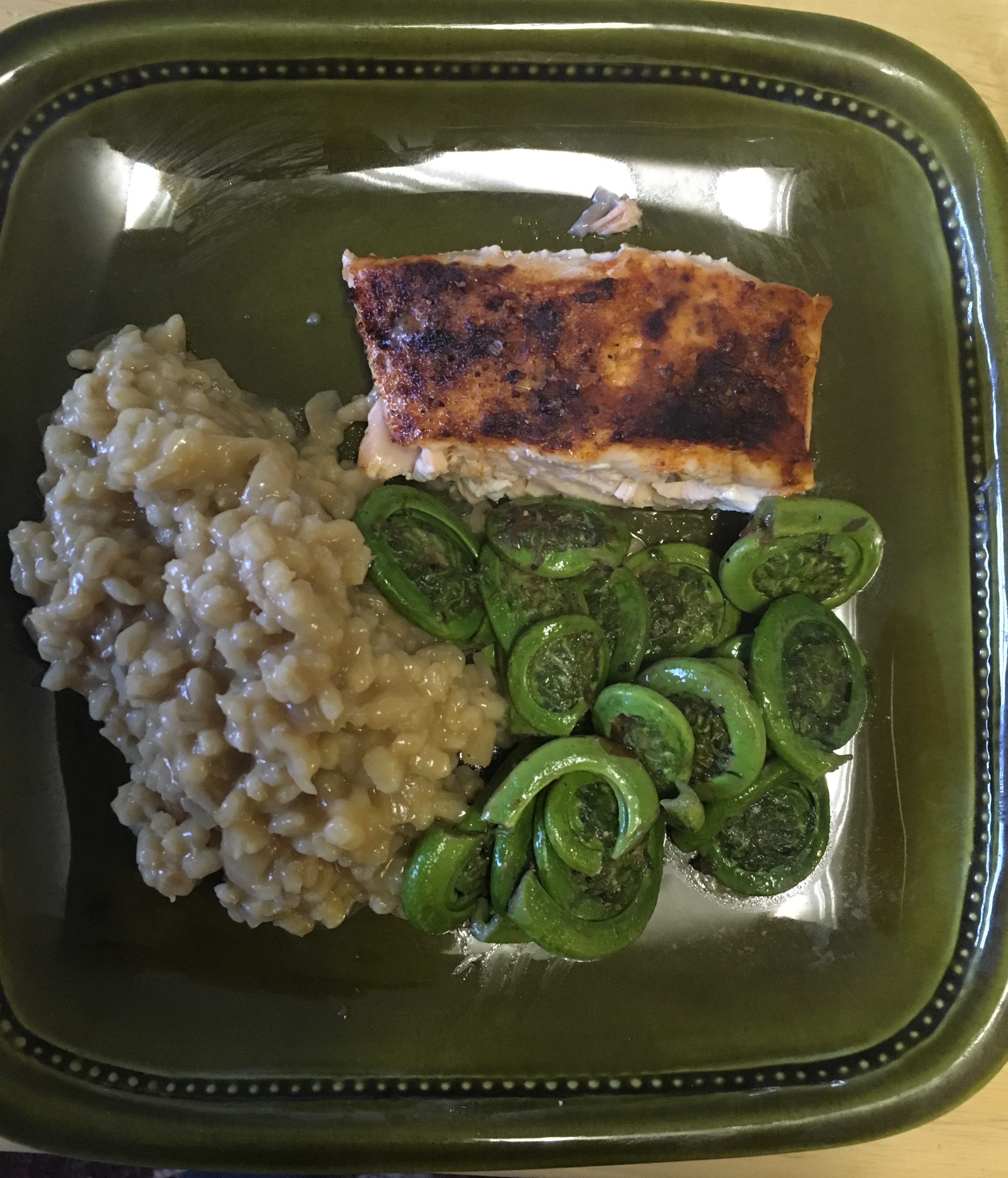 Warfarin interferes with the role of vitamin K in the coagulation process. Therefore, if you flood your system with foods rich in vitamin K, which is the pharmacological antidote to warfarin, you decrease the effectiveness of warfarin. A week before my ciprofloxacin case, one of my own patients suddenly had a low INR. “Ask him if he’s been eating fiddleheads”, I told Autumn. Sure enough, this Maine spring delicacy was the culprit. The season is short and he wasn’t going to have more, he said, so I didn’t change his dose schedule.
 A lot of people are under the impression they cannot eat green vegetables while on warfarin. I tell them that’s like saying you can’t open your windows in the winter if you heat with wood. Imagine you know how many logs to put in the wood stove at certain outdoor temperatures. Then imagine you decide to open a window now and then. You would then have to adjust your fire whenever you opened the window, compensating for the heat loss. If you instead decided to leave a crack open all the time, you would quickly figure out your new firewood budget.
So I simply tell my patients, “eat all the greens you want, but be sure to keep the amount the same every day”.
DOSING WARFARIN: DON’T DRIVE LIKE YOU’RE MR. MAGOO AND PLEASE LEARN FROM YOUR MISTAKES
 Mr. Magoo is like me without my glasses. If I were to drive in a snowstorm without my glasses, I would only see a couple of feet in front of me and I would be turning my steering wheel a lot more than necessary. I wouldn’t be able to tell if I was entering a small or a big curve, for instance. If I could see further ahead, I would make smaller corrections. Many providers will look at the current INR value and the previous one, and the current warfarin dose. Then they change the dose. Unless you have a flowsheet that tells you that the last time you made that change, bad things happened, you will make the same poor choice again. On paper, such flowsheets are easy to maintain, but – believe it or not – in many EMRs it is just too darn cumbersome to do.
I have a three ring binder with all my warfarin patients’ flowsheets. It helps me avoid Mr. Magoo type errors and it also serves as a low tech way of making sure no warfarin patients fall off my radar screen. Autumn or I sometimes just flip through the binder to make sure our flock doesn’t wander off, so to speak.
An old fashioned method of managing an old fashioned medication…











 A Country Doctor Writes:
