Archive Page 61

The Call to Be a Primary Care Doctor

I suspect the notion of calling in narrower specialties is quite different from mine. Surgeons operate, neurologists treat diseases of the nervous system, even as the methods they use change over time.

Primary care has changed fundamentally since I started out. Others have actually altered the definition of what primary care is, and there is more and more of a mismatch between what we were envisioning and trained for and what we are now being asked to do. Our specialty is often the first to see a patient and also the last stop when no other specialty wants to deal with them.

We have also been required to do more public health, more clerical work, more protocol-driven pseudo-care and pseudo-documentation like the current forms of depression screening and followup documentation. And don’t get me started on the Medicare Annual Wellness Visit. How can we follow the rigid protocol and be culturally and ethnically sensitive at the same time?

We are less and less valued for our ability – by virtue of our education and experience – to take general principles and apply them to individual people or cases that aren’t quite like the research populations behind the data and the guidelines. The cultural climate in healthcare today is that conformity equals quality and thinking out of the box is not appreciated. The heavy-handed mandates imposed on our history taking and screening constantly risk eroding our patients’ trust in us as their confidants and advocates. The finesse and sensitivity of the wise old fashioned family doctor is gradually being squeezed out of existence.

The call to primary care medicine, if it isn’t going to pave the road straight to professional burnout, today needs to be a bit like the call to be a missionary doctor somewhere far away:

To go into a sometimes hostile environment, without the right kind of resources, where people don’t speak your language, where you never feel you can do everything you hoped to do for your patient, and where some of the things you want to do might even encounter cultural or political taboos.

In other words, to do what we can in the moment for each patient, regardless of the system and the circumstances.

That is a very noble call, but not one for the faint-hearted.

The Annual Physical: Is it Worth Having?

My Blog is Setting Many Records, Except One, a Surprise Hit from 2015

One might say I’m on a roll. Halfway through the year I have already broken my 2017 record for best year. I have published three of my most read ever blog posts in the past three months. But, even combined, they don’t surpass my 2015 piece “Normal Blood Pressure”. If that one was a movie, it would be characterized as a sleeper. It describes a housecall on a snowy day in Van Buren. And I guess it is a fair little snapshot of the essence of rural medicine at the northern edge of my adopted homeland.

Normal Blood Pressure

Does Tramadol Create More Cold Blooded Killers?

My Swedish morning paper had an article about the increased use of tramadol by criminal gang members. When an investigator asked if there was anything special about tramadol, she was again and again told that this drug made it easier to commit crimes. Maria Almazidou, quoted in the article, said “the chemical has a double effect. You can get turned on and feel more focused, while at the same time it blunts your emotions. That is one reason it fits in with the criminal lifestyle”.

I was intrigued, but not surprised. After all, tramadol hits the opioid mu receptor and also has serotonergic properties, making it reduce anxiety as well as blunting affect.

Although I don’t think I have come across tramadol addiction here, I realize its potential to destabilize mood in bipolar disorder. I have seen florid psychosis and tremors in combination with duloxetine. But have never seen it cause full blown serotonin syndrome.

There are many case reports and news articles, like this one, of people with tramadol addiction and overdoses committing violent crimes. But then, there are also FDA black box warnings about traditional serotonergic drugs causing suicidal ideation.

I started looking for more information on the link between tramadol and murders. The connections are all there, in many countries.

First of all, it is a more common drug of abuse in many countries, especially in Africa, and as such, the trade of it is linked with crime. But its use by criminals to enhance their unscrupulousness is actually well documented.

Here are some quotes I ran across:

“Tramadol is regularly found in the pockets of suspects arrested for terrorism in the Sahel, or who have committed suicidal attacks.” – The United Nations Office of Drugs and Crime

AP NEWS writes:

“One woman said children stumble down the streets, high on the opioid; parents add it to tea to dull the ache of hunger. Nigerian officials said at a United Nations meeting on tramadol trafficking that the number of people there living with addiction is now far higher than the number with AIDS or HIV.

Tramadol is so pervasive in Cameroon scientists a few years ago believed they’d discovered a natural version in tree roots. But it was not natural at all: Farmers bought pills and fed them to their cattle to ward off the effects of debilitating heat. Their waste contaminated the soil, and the chemical seeped into the trees.

Police began finding pills on terrorists, who traffic it to fund their networks and take it to bolster their capacity for violence.”

So, by now I have even more respect than I used to for the dark side of this unique (next to tapentadol/Nucynta) analgesic and all other drugs that work on so many neuroreceptors at the same time.

The World Health Organization has a comprehensive summary on Tramadol here.

The Complete Workup: Virtue or Waste?

Last year I saw an elderly man with mild peripheral neuropathy that had not been evaluated before. He was not a diabetic. I ran some basic tests and his vitamin B-12 level was extremely low. We started him on injections and monitored his response. He needed the injection every two weeks to stay in range. He said he felt better.

Recently, he saw a very respected neurologist for something unrelated. The in-depth report stated that the patient had undergone no testing for his peripheral neuropathy and the neurologist ordered a very extensive, undoubtedly expensive, set of bloodwork, part of which was eventually denied by the man’s health insurance. All of those tests were normal, starting with the first one on his list – an RPR test for syphilis.

This illustrates what I see as a fundamental issue in the practice of medicine, not often talked about: How far do you take the workup for mild, common symptoms?

In my 42 years in medicine I have never heard of a single case of syphilis (even before I stopped testing for it) in any patient I or a colleague saw, for example. But there it is, a recommendation passed down from the days of the Wassermann test (1906) and Portnoy’s RPR (1963). The incidence in Maine (1 million people) is reported to be about 50 cases per year. How likely is my octogenarian with mildly tingly toes one of them? Especially if we already know his B-12 was extremely low?

The syphilis test probably doesn’t cost much, but it is a fair illustration of consideration of probability. That is happening in some areas where the unreliability of testing is perhaps more accepted: Cardiac tests have different accuracy depending on pretest probability. Why have we forgotten that blood tests are also fraught with sensitivity and specificity problems that make them less useful in low probability clinical scenarios?

Maybe it’s the Swede in me, but my thinking is that healthcare spending cannot be limitless and needs to match the risk of the clinical situation.

When I trained, we didn’t compete about who could come up with the greatest number of esoteric differential diagnoses. There was more emphasis of what was common and what were the most dangerous and significant pitfalls in diagnosis.

We now have the insurance companies curtailing our workups, albeit often for profit reasons. Wouldn’t it have been better if we as diagnosticians practiced more stewardship and common sense in ordering tests?


I just realized none of the posts show on an iPad or a computer, but they do show on an iPhone. WordPress is working on this. In the meantime, please visit my Substack.


Osler said “Listen to your patient, he is telling you the diagnosis”. Duvefelt says “Listen to your patient, he is telling you what kind of doctor he needs you to be”.


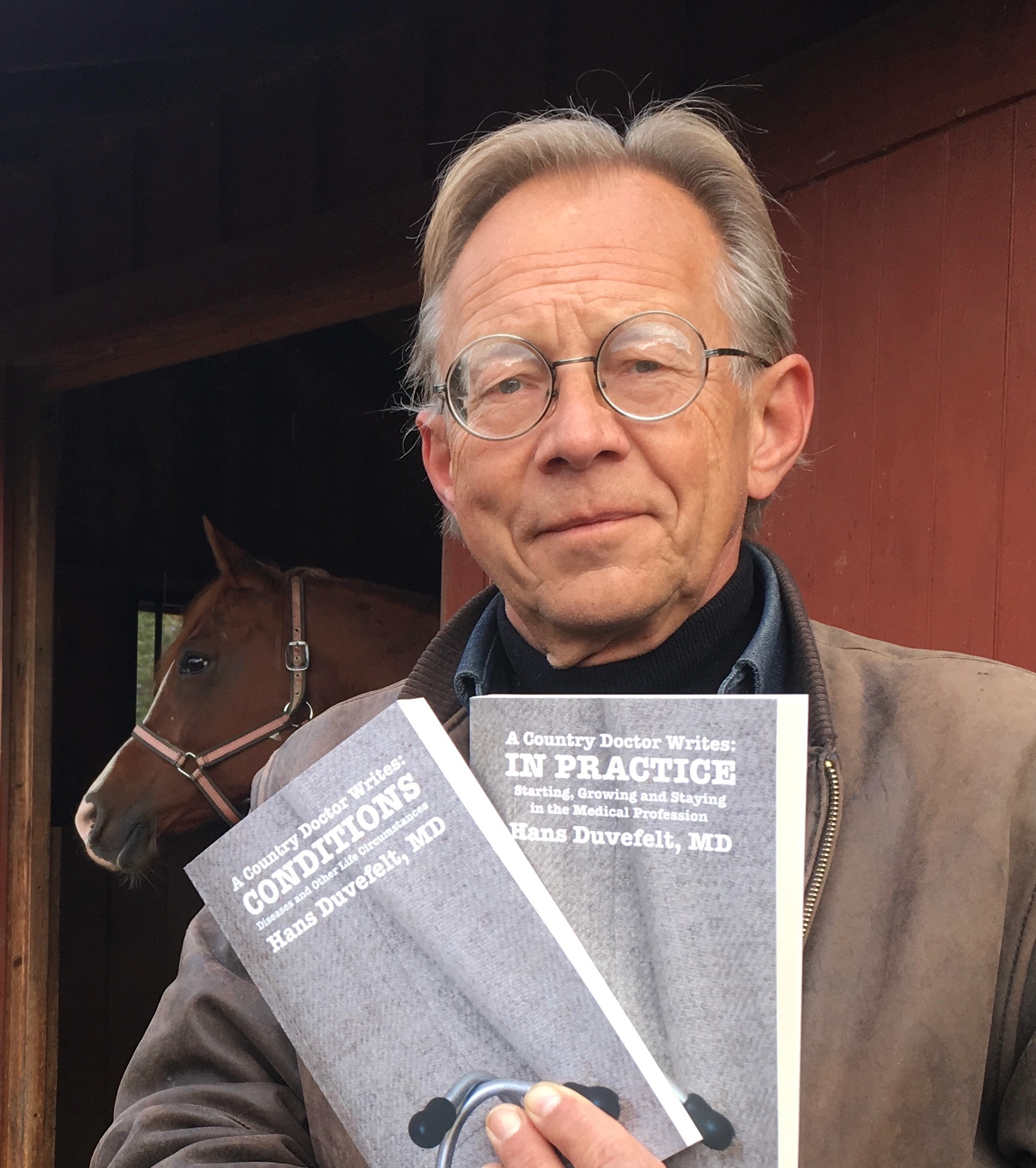
BOOKS BY HANS DUVEFELT, MD

CONDITIONS, Chapter 1: An Old, New Diagnosis

Top 25 Doctor Blogs Award

Doctor Blogs

Enter your email address to subscribe to this blog and receive notifications of new posts by email.

Mailbox

contact @ acountrydoctorwrites.com
Bookmark and Share
© A Country Doctor Writes, LLC 2008-2022 Unauthorized use and/or duplication of this material without express and written permission is strictly prohibited. Excerpts and links may be used, provided that full and clear credit is given.