Archive Page 56

EHRs Are Workarounds, Rerouting the Way Physicians Work

IT GUY: Hey, Doc, don’t make up workarounds, use the EHR the way it was designed.

DOCTOR: Listen, your whole EHR is a workaround itself – around the way medicine is practiced.

– Hans Duvefelt, MD

This was a tweet I posted a while ago. I expected it to either go viral among doctors or catch the ire of administrators and IT folks. Neither happened. So I’m back on my soap box:

Imagine creating a computer simulation or video game that people expected to prepare them for or refine their skills in any given sport. Then, assume that this game altered the rules of the game – using a volley ball instead of a hockey puck, scoring goal attempts rather than goals, rewarding slowness rather than speed and so on.

Then, imagine you, the programmers/code writers, went to the team owners and proposed athletes and coaches should abandon the time-honored rules of the game and instead play like it plays out on the pixelated imitation you just created. And just to be clear: You, the programmer, actually never played the game yourself.

You’d get shown the door and sent back to the digital drawing board.

But that’s not what is happening in medicine.

FIRST: Is finding the clinically relevant information easier than, or at least as easy as, the regulatory information? (The cumbersome ways we have to enter information is a big topic, better covered separately.)

Here’s a silly example: One of the EMRs I work with displays prominently that the smoking assessment requirement has been satisfied, but I’ll be darned if I can see whether the patient smokes or not. Whom does the Holy Grail serve here?

SECOND: Why is it that EHR interfaces are so far removed from how doctors think?

Show me a lab result and imagine what I would need:

– The prior value?

– The current medications?

– The current vital signs?

– A quick way to order medications?

– The patient’s next scheduled appointment?

– A quick way to make sure the patient gets a followup?

– The patient’s phone number?

– A quick way, on the same screen, to order more labs?

– And more…

Any EHR can do these things, but our gripe is that many interfaces are rudimentary and require countless clicks. Then, when you get to the next screen to do what you needed to do, you can’t see the screen that prompted your action, and so on.

I also object to how my (Greenway) EMR doesn’t understand that when I prescribe a medication, I am doing it righ now (it asks me what date I’m doing it) and what type of “encounter” this is (a “medication” encounter, what else?).

More Greenway gripes: A patient is on losartan. I decide to stop it. I click “discontinue”. While doctor-think is that the medication list at the beginning of the visit note includes the losartan and the PLAN includes an AUTOMATIC notation that I stopped that particular drug. (After all, the patient had that particular drug in his bloodstream after already taking their morning dose). There is also an automatic notification to the pharmacy to stop the (often automatic) refills of the drug.

BUT, in Greenway’s INTERGY, if I just stop the drug, it disappears from the top of the visit as if they weren’t on it when they walked through the door. And there is no automatic comment below that this drug was stopped. So, my workaround, and common doctor logic, is to stop the drug TOMORROW. (I then have to MANUALLY type “STOP LOSARTAN”.) I mean this is what the patient will actually do, right? But when I choose a future date do stop the drug, the system claims to be unable to notify the pharmacy. So I then have to pick up the phone and let them know.

The programmer in this case obviously has NO IDEA how doctors, patients and pharmacists think.

Imagine if you had $1,500 in the bank and took out $1,000 today, and your statement showed only that you had $500 without mentioning that here was a transaction at all today. Wouldn’t that seem confusing?

So, don’t be too hard on me for using workarounds. I’m just trying to do my job with tools made for some other occupation than being a doctor.
Getting to the Doctor When You’re Sick and Scared

Portland is 322 miles from Van Buren, where I work. Some medical sub-specialty clinics are only available down there, at the opposite end of our state.

I have many patients who don’t trusts their vehicle or their driving savvy to get to Portland, and others who don’t have the gas money to drive there and back for a consultation. Many don’t even have a car.

Amy S. is a young woman with a newly diagnosed gynecological malignancy. The only specialist who deals with her condition is in Portland. Actually, they do their surgeries in Portland, but their office is in Scarborough, a suburb. Amy has neither a car nor a drivers license. She has no family locally and her boyfriend dumped her last winter. She is still trying to figure out what to do next in her life. She feels very alone here at the end of the land.

Her only option for getting to Portland is with a transportation service that is available for Medicaid patients. They don’t have any drivers of their own. Instead, they coordinate public and private resources.

I saw her today, distraught and confused. She had walked to my clinic in the muggy 86 degree weather.

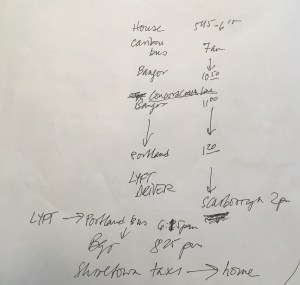
“I don’t know if I can do this”, she said. “I’m supposed to get a taxi to catch the 5:45 am bus from Caribou, and…” she continued to rattle off a very complicated list of times and modes of transportations.

“Wait a minute”, I said. “The Cyr bus from Caribou to Bangor leaves at 7. I know that, because I have dropped people off there many times. And Cyr doesn’t have a bus from Bangor to Portland. Who is the carrier for that one? And, how did you say you’re getting from the Portland bus terminal to the doctor’s office? Do you have this schedule in writing?”

“No, they talked so fast on the phone”, she said, throwing her hands in the air.

Amy has ADHD, PTSD and social anxiety. She is clearly overwhelmed with her situation and her new diagnosis.

“Do you mind if I call them”, I asked.

“No, I wish you would. I’m so confused”, she answered as she turned on her phone to look up the number.

I went back to my office and dialed the 800 number.

I was greeted by an “automated attendant” who asked if [my clinic phone number] was the account I was calling about. I said “no”. I said “Attendant”, but didn’t get one until I had spoken “the ten digit phone number associated with this account”.

A man with a southern accent greeted me and I said I wanted to clarify my patient’s travel. He looked up her account. Then there was a long pause.

“Oh, my”, he said. “This looks complicated. Give me a minute.”

It took a full five minutes, which is a long time in a pressure-cooker primary care environment. But then he started reading the itinerary, after first stating that it is complicated because it is over 100 miles. “Right, three times more, each way”, I said.

I scribbled the schedule down and brought it back to my patient. She seemed to feel a bit better having it on paper and said “I think I can do it”.

Tomorrow I will be watching for a report from Portland. Or a call from Amy that she didn’t make it down there.

“I Thought I’d Wait Until My Appointment”

It happened again. A sick patient needed to be double booked this morning. Looking at my schedule, I saw Gordon Plourde had his six month diabetes visit today. He is well controlled, takes as good care of his health as his impeccable lawns and gardens.

“Have her come when Gordon is here, he’s usually a quick visit”, I told Autumn.

As soon as I walked through the door I knew this wasn’t going to be a quick visit. Gordon had lost a lot of weight. His blood sugars were up and he started telling me about all the symptoms he’d been having the past couple of months.

“My wife kept bugging me to call you, but I figured I’d wait for my appointment”, he said. “I probably should have listened to her.”

“Probably”, I answered. What more could I say?

His visit ran over, as did my double booked patient who had done what I wished Gordon would have done. It took a few hours before I caught up. But I did, and everybody was understanding.

Tonight, over barn coffee with the animals, my random thoughts returned to this morning’s patients.

Some people have a rigid view of when they need to see us – every so many months, whether they feel well or very ill. That is not good. Have we, as a profession, fostered such an inflexibility? Or is it procrastination, or maybe for cost reasons, although so many of my patients have Medicaid or Medicare with supplemental insurance and virtually no copays.

I have experimented with letting patients decide when to come back and often seen that this doesn’t work.

I have said “Come back in three months, but if all your blood sugars are good, you can push your followup out to six months. That just seems to confuse people, so I almost don’t do it anymore.

If we had more staff, and if we were capitated (payment per member per month) or paid for outcomes (although risk -possibility of losing money – isn’t something a small group or clinic might dare to get involved with), perhaps we could reach out to patients with chronic conditions and see if they needed to come in or not.

Even though I like the old fashioned, patient centered interaction once I’m in the room with my patients, the surrounding clinic routines can seem old fashioned in a bad way.

The “Patient Centered Medical Home” was supposed to fix all that, but the rules were stilted and ultimately counterproductive. For example, you HAVE TO use the EMR for things like educational handouts, even if the old fashioned preprinted handouts have better information. And you get credit for keeping open same day slots but not for squeezing people in, like I did today.

So, since I can’t change the system, I’ll have to work harder at reminding patients that three or six months until the next appointment is the plan AS LONG AS THERE IS NOTHING NEW GOING ON.

PCMH Certification and Designing the Perfect Car

Anxiety? It’s All in Your Head. Your Sinuses, to Be Exact

The man with chronic sinusitis was ecstatic. “I feel so much better. No more headache, no more congestion, no more fatigue. I even feel less anxious. I mean that’s not really possible, is it? Somebody told me there’s a link…”

“Well, you know, men with prostate infections sometimes present with fatigue and depression”, I said as I minimized the EMR on my laptop and googled “SINUSITIS ANXIETY”.

There were many sites with articles about such an association. Some were blogs, some were ENT practice website and some were actually scientific papers, like JAMA Otolaryngology about anxiety and depression and American Journal of Rhinology an Allergy about depression.

Of course this got me thinking:

Is it the type of bacteria or the location of the infection that is the risk factor?

Is this perhaps a universal association with all infections?

Are the psychological symptoms due to the infection or to our immune response?

How can you be a clinician and not love medicine?

May I never lose my curiosity.

Curiosity, Antidote to Burnout

Practicing Where the Action Is

Our new Nurse Practitioner stopped in my doorway the other day to update me on a patient’s progress. It was a difficult case we had talked about before, with several complications, twists and turns in his case history.

I reflected about how similar that case was to one of my own, where she had been involved enough to know the dilemma – in both these cases, why neurosurgeons sometimes turn down patients with far-gone tissue damage and risk for poor outcomes.

“You know, in just one year here”, she said, “I have seen so much more and learned so much more than my classmates. None of them work in big cities or anything, but they’re all closer to specialists in towns that seem less remote than here.”

“I know”, I answered. “Sometimes it feels a little heroic to be the only resource a patient has or is willing or able to use. So many of my patients have major diseases and don’t want to go 20 miles down the road to Caribou or 35 to Presque Isle. And now endocrinology is gone, rheumatology almost not available, with even Bangor short staffed, and on and on.”

“People think primary care is just simple stuff”, she said. “But it isn’t at all when you practice in rural Maine.”

Thinking back over my career I certainly agree. As it happened, the very same day I saw a patient I once puzzled about and found a rare diagnosis in: a fifty-something man with undiagnosed fairly rapidly progressive shortness of breath seemed to have weaker breath sounds on the left side of his chest. His left lung looked different on X-ray, almost as if it was starting to shrivel up. His CTA showed agenesis of his left pulmonary artery. Only in rural America does the family doctor make that kind of diagnosis.

The Man With the Shrinking Lung


I just realized none of the posts show on an iPad or a computer, but they do show on an iPhone. WordPress is working on this. In the meantime, please visit my Substack.


Osler said “Listen to your patient, he is telling you the diagnosis”. Duvefelt says “Listen to your patient, he is telling you what kind of doctor he needs you to be”.


BOOKS BY HANS DUVEFELT, MD

CONDITIONS, Chapter 1: An Old, New Diagnosis

Top 25 Doctor Blogs Award

Doctor Blogs

Enter your email address to subscribe to this blog and receive notifications of new posts by email.

Mailbox

contact @ acountrydoctorwrites.com
Bookmark and Share
© A Country Doctor Writes, LLC 2008-2022 Unauthorized use and/or duplication of this material without express and written permission is strictly prohibited. Excerpts and links may be used, provided that full and clear credit is given.