Archive Page 56

“I Thought I’d Wait Until My Appointment”

It happened again. A sick patient needed to be double booked this morning. Looking at my schedule, I saw Gordon Plourde had his six month diabetes visit today. He is well controlled, takes as good care of his health as his impeccable lawns and gardens.

“Have her come when Gordon is here, he’s usually a quick visit”, I told Autumn.

As soon as I walked through the door I knew this wasn’t going to be a quick visit. Gordon had lost a lot of weight. His blood sugars were up and he started telling me about all the symptoms he’d been having the past couple of months.

“My wife kept bugging me to call you, but I figured I’d wait for my appointment”, he said. “I probably should have listened to her.”

“Probably”, I answered. What more could I say?

His visit ran over, as did my double booked patient who had done what I wished Gordon would have done. It took a few hours before I caught up. But I did, and everybody was understanding.

Tonight, over barn coffee with the animals, my random thoughts returned to this morning’s patients.

Some people have a rigid view of when they need to see us – every so many months, whether they feel well or very ill. That is not good. Have we, as a profession, fostered such an inflexibility? Or is it procrastination, or maybe for cost reasons, although so many of my patients have Medicaid or Medicare with supplemental insurance and virtually no copays.

I have experimented with letting patients decide when to come back and often seen that this doesn’t work.

I have said “Come back in three months, but if all your blood sugars are good, you can push your followup out to six months. That just seems to confuse people, so I almost don’t do it anymore.

If we had more staff, and if we were capitated (payment per member per month) or paid for outcomes (although risk -possibility of losing money – isn’t something a small group or clinic might dare to get involved with), perhaps we could reach out to patients with chronic conditions and see if they needed to come in or not.

Even though I like the old fashioned, patient centered interaction once I’m in the room with my patients, the surrounding clinic routines can seem old fashioned in a bad way.

The “Patient Centered Medical Home” was supposed to fix all that, but the rules were stilted and ultimately counterproductive. For example, you HAVE TO use the EMR for things like educational handouts, even if the old fashioned preprinted handouts have better information. And you get credit for keeping open same day slots but not for squeezing people in, like I did today.

So, since I can’t change the system, I’ll have to work harder at reminding patients that three or six months until the next appointment is the plan AS LONG AS THERE IS NOTHING NEW GOING ON.
PCMH Certification and Designing the Perfect Car

Anxiety? It’s All in Your Head. Your Sinuses, to Be Exact

The man with chronic sinusitis was ecstatic. “I feel so much better. No more headache, no more congestion, no more fatigue. I even feel less anxious. I mean that’s not really possible, is it? Somebody told me there’s a link…”

“Well, you know, men with prostate infections sometimes present with fatigue and depression”, I said as I minimized the EMR on my laptop and googled “SINUSITIS ANXIETY”.

There were many sites with articles about such an association. Some were blogs, some were ENT practice website and some were actually scientific papers, like JAMA Otolaryngology about anxiety and depression and American Journal of Rhinology an Allergy about depression.

Of course this got me thinking:

Is it the type of bacteria or the location of the infection that is the risk factor?

Is this perhaps a universal association with all infections?

Are the psychological symptoms due to the infection or to our immune response?

How can you be a clinician and not love medicine?

May I never lose my curiosity.

Curiosity, Antidote to Burnout

Practicing Where the Action Is

Our new Nurse Practitioner stopped in my doorway the other day to update me on a patient’s progress. It was a difficult case we had talked about before, with several complications, twists and turns in his case history.

I reflected about how similar that case was to one of my own, where she had been involved enough to know the dilemma – in both these cases, why neurosurgeons sometimes turn down patients with far-gone tissue damage and risk for poor outcomes.

“You know, in just one year here”, she said, “I have seen so much more and learned so much more than my classmates. None of them work in big cities or anything, but they’re all closer to specialists in towns that seem less remote than here.”

“I know”, I answered. “Sometimes it feels a little heroic to be the only resource a patient has or is willing or able to use. So many of my patients have major diseases and don’t want to go 20 miles down the road to Caribou or 35 to Presque Isle. And now endocrinology is gone, rheumatology almost not available, with even Bangor short staffed, and on and on.”

“People think primary care is just simple stuff”, she said. “But it isn’t at all when you practice in rural Maine.”

Thinking back over my career I certainly agree. As it happened, the very same day I saw a patient I once puzzled about and found a rare diagnosis in: a fifty-something man with undiagnosed fairly rapidly progressive shortness of breath seemed to have weaker breath sounds on the left side of his chest. His left lung looked different on X-ray, almost as if it was starting to shrivel up. His CTA showed agenesis of his left pulmonary artery. Only in rural America does the family doctor make that kind of diagnosis.

The Man With the Shrinking Lung

When Dogs Lick Their Wounds

We use the expression “licking your wounds” as an act of defeat and it may be, but I’m thinking about the medical implications of this ancient practice of our closest companions.

I have had dogs and other pets incessantly lick their wounds and have been forced to cover them up to prevent further damage. We even have those Elizabethan collars to keep dogs from doing that.

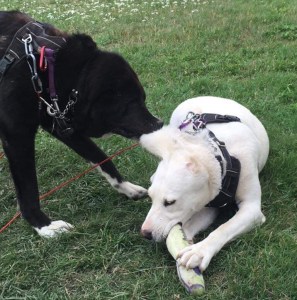
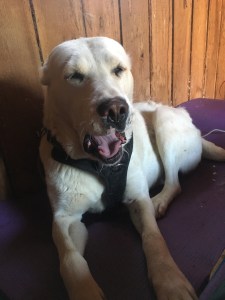
Recently I had almost parallel experiences with an elderly male patient and a young Alabai female dog who happens to be the latest addition to my household.

The older man has venous insufficiency, chronic edema and a past history of leg ulcers. He had a new one that was treated (elsewhere) with four layers of various dressings I’m not familiar with.

The smell in the room after his dressings were removed was alarming. We (my nurse practitioner and I) cleaned his leg up. The leg ulcer wasn’t bad, but most of the area that had been covered under the thick bandaging was denuded, red and weepy. We decided on a thin layer of Silvadene cream and plain gauze wrapping.

Within a week, he was almost healed and my conclusion was, as often before, that in wound care, less is usually more.

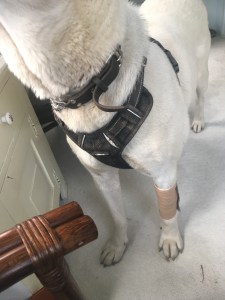
My Alabai had a couple of puncture wounds on her front leg from play fighting with the other Alabai. The breed is nicknamed volkodav in Russian. I never learned that word, as I dropped out of the Swedish military’s interpreter school to pursue my medical training. But it means “wolf crusher”. These dogs are fearless livestock guardians and practice fight with each other.


Anyway, my young dog seemed to be licking her front leg an awful lot, so I got worried and bandaged it up with antibacterial ointment, a Telfa non-stick pad, gauze and “vet-wrap”.

When I got home from work the next few days, the Telfa pad was always on the floor and the dressing seemed intact. But there was redness and hair loss under the bandage, suggesting she had been bothering her front leg through the bandage.

In an act of faith and courage, I then left her without any bandage in her barn guarding spot and went to work.

Lo and behold, she’s licking it almost casually now and then and it is healing nicely.

Again, less is more in wound care.

(There is something about those nonstick pads and animals. Last year my horse had a leg wound. I started out, on my veterinarians recommendation, using such a pad under all the other prescribed wrapping. On three occasions I found the Telfa pad on the ground in the paddock with a completely intact bulky dressing on the horse’s leg. I don’t know how she got it out of there but clearly she didn’t want that kind of dressing material on her wound. So I simplified the dressings and she healed just fine.)

The Power of Silence (Reflections on Writing)

I don’t have a TV and I seldom listen to the radio. Pandora and satellite car radio don’t interest me much anymore. If I watch a movie on my iPad, it is a conscious choice.

Once in a while I play music on my Bose while I iron shirts, but more often I do that and all my other chores in silence.

It is like when I was a young boy, a quiet only child, living in a silent household with my parents or staying with my grandparents. My head was full of thoughts, dreams and reflections.

My grandmother, who was born in 1900, had no toys at her house. She gave me paper and pencil and it was up to me to do something with them. She told me about how she used to play farm with pine cones for animals when she was little. There were different kinds in the park-like woods outside her house and I, too, played with them.

I have written almost a thousand blog posts. Sometimes after a significant clinical event or encounter, I make a note to myself to write about it. But more often, my days pass and their observations fade into some recesses of my mind. They don’t come back until I find myself in silence, doing manual tasks or sitting down, in bed or in my recliner, with the blank, white screen of my iPad in front of me.

Thoughts like, “what have I learned this week”, or “what has struck me about my work or the practice of medicine lately” make me bring back those fleeting moments I almost have forgotten.

I consume less and less and create more and more. The Internet nomenclature for people who do what I do is just that: Content Creator. Sometimes I write because something I read made me reflect or react, but mostly I draw from my own experiences.

I find that the more I write, the more ideas I get for what more to write about. Nothing I think or write about is totally new or earth shattering, but it serves a purpose for me in keeping me deeply conscious of what I do and who I am.

Knowing that others read my words is a great and humbling privilege that gives me more inspiration to keep trying to capture the essence of being a 68 year old, 41 year veteran family doctor in rural America.

From the silence in my life to all these published words, I am firmly present here on this plot of land, and I am out there, all over the world. How strange.


I just realized none of the posts show on an iPad or a computer, but they do show on an iPhone. WordPress is working on this. In the meantime, please visit my Substack.


Osler said “Listen to your patient, he is telling you the diagnosis”. Duvefelt says “Listen to your patient, he is telling you what kind of doctor he needs you to be”.


BOOKS BY HANS DUVEFELT, MD

CONDITIONS, Chapter 1: An Old, New Diagnosis

Top 25 Doctor Blogs Award

Doctor Blogs

Enter your email address to subscribe to this blog and receive notifications of new posts by email.

Mailbox

contact @ acountrydoctorwrites.com
Bookmark and Share
© A Country Doctor Writes, LLC 2008-2022 Unauthorized use and/or duplication of this material without express and written permission is strictly prohibited. Excerpts and links may be used, provided that full and clear credit is given.