
Archive Page 46

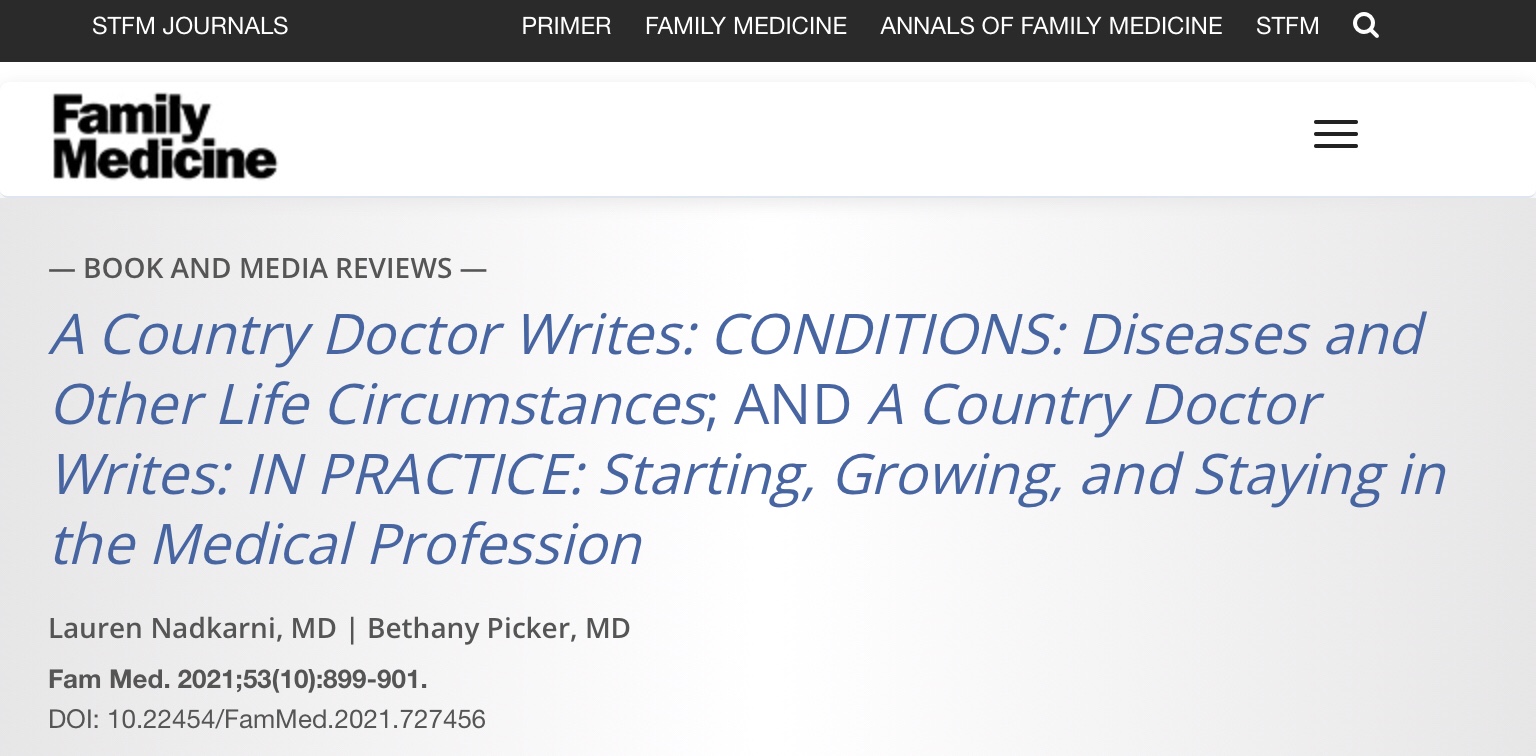
A Kind Review of My Books in FAMILY MEDICINE

I found out today that my books are reviewed in the December issue of Family Medicine:

“Originally from Sweden, Hans Duvefelt, MD, trained at Central Maine Medical Center 40 years ago and has practiced in rural Maine ever since. In 2008, he began writing a reflective blog to document his medical experiences, and that writing ultimately became the basis for these collections of brief vignettes. The topics range from his initial impressions of medical school to meaningful personal connections with patients, difficult diagnoses, exciting patient encounters, and even his own experiences as a patient.”

“Through his words as a seasoned and experienced generalist, Duvefelt reminds us all to examine why we practice medicine and to reflect on our experiences in a way that encourages not only learning, but also gratitude for the ability to participate in the many moments of our patients’ lives.”

https://journals.stfm.org/familymedicine/2021/november-december/br-nadkarni-nov-dec21/

Behind the Mask

Today I saw a patient I have known for years. He suddenly pulled his mask down and said, “I’d like to know what you think I should do about this”.

On his nose was an 8 mm (1/3”) brownish red flat spot with a crack or scrape through it.

“How long have you had it”, I asked.

“Oh, a while now” he answered. That is about the least helpful time measurement I know of. I asked him to pin it down a bit more precisely. He settled for about a year. I prescribed a cream and made a two week followup appointment for either cryo or a biopsy. It’s probably just an excoriated, premalignant, actinic keratosis.

Back when life was different, this would not have gone unnoticed. But, of course, we’ve been wearing masks for over a year and a half now, so no wonder I wouldn’t have noticed it just talking to the man.

I walked down the hall and told my new partner what just happened.

“Oh, yeah”, she said. “Same thing happened to me – a basal cell cancer. And I find it difficult sometimes to assess things like state of emotion with no facial expressions. And, even worse, I’ve got a lot of patients that are new to me that I don’t even know what they look like.”

“Of course, you started here six months before the pandemic”, I registered. “That really must feel weird.”

Telemedicine is considered better than telephone medicine just because you can judge demeanor, facial expressions and so many other things better visually than with your hearing only. So where do masked in-person visits fall on that spectrum? Of course we can see head shaking and shoulder shrugging, so masked visits win over telephonic, but my next thought here is that maybe I should reconsider my scepticism about a former colleague I heard about just the other day.

This doctor will now have a patient sit in the exam room while she herself sits in her office. In front of the patient is a computer and the two of them basically do the first part of the visit as if they had a “regular” telemedicine consultation. Then, the doctor may or may not step into the office in order to do whatever physical exam the clinical situation requires.

I suddenly see at least a little bit of logic in that approach. Because that way they can both talk without masks on. (Or should you, with what we now know about aerosol transmission in the exam room and all…)
My Patient Has Hepatitis C. He Tested Positive Five Years Ago And Nobody Told Him

Dylan didn’t have a family doctor when he ended up hospitalized one weekend five years ago. He was a drug addict with a bad infection in his arm, probably from injecting heroin.

I’ve known him for a while now, and he’s been sober pretty much since that hospitalization. During a physical a few weeks ago, I asked him if he had ever been tested for hepatitis since he got clean. He didn’t think so.

I checked his account in Maine Health InfoNet, just to see what kinds of testing he had gone through. Sure enough, five years ago there was an entry for a hepatitis C screening. The name of the test was displayed in yellow instead of black. That means abnormal.

I clicked on the test. It was a positive antibody test, not followed up with a viral load test.

Dylan’s arm felt better and he was discharged. He didn’t have a family doctor and he didn’t join any Suboxone or methadone clinic. So nothing happened. Nobody asked him until I did. I ordered a viral load and it is up there. I personally don’t treat Hep C, but I referred him to a local colleague who is board certified in infectious diseases and does a great job.

Dylan took the news well. He suspected something was going on when the result hadn’t gone up in the portal. His partner went and got tested. A negative result often comes back quicker than a positive one. So only he needs treatment.

But I feel bad in situations like this. People get discharged so quickly from the hospital these days. The workup isn’t always finished. And the business model of having the primary care physician wrap things up after a hospitalization doesn’t work for people with no PCP – like most twenty somethings.

My old adage “if you find it, you own it” is not universally accepted. Maybe it should be.

If You Find It, You Own It

https://acountrydoctorwrites.blog/2009/10/06/if-you-find-it-you-own-it/

A Wasted Peer-to-Peer Call for my WellCare Patient

Doris Holt had an unprovoked deep vein thrombosis in her leg. Her managed Medicare plan (ironically called a Medicare Advantage plan – certainly not true for patients who get snuckered into signing up) required a Peer-to-Peer call when I ordered a CT scan of her chest, abdomen and pelvis to look for occult cancer. They teach you to do that in medical school.

The man on the phone called himself doctor so-and-so. He didn’t tell me his specialty.

“Has she had any coags (blood tests for clotting disorders)?”

“No, she needs lifelong anticoagulation with apixiban anyway, so that would be moot.”

“Has she had any other imaging?”

“Doppler of the leg. Mammogram scheduled.”

“Colonoscopy? Pap smear?”

“Colonoscopy consult pending, but she’d have to hold her blood thinner then…”

“Hmmm. Has she had any weight loss or B-symptoms (fever, night sweats etc.).”

“No.”

“I’m checking her plan.” (Pause.) “I cant approve the chest without a chest X-ray first, or the abdomen-pelvis without a colonoscopy or Pap smear.”

“So, you’re denying everything.”

“Yes.”

I didn’t even say goodbye.

Pancreas cancer is first on the CDC’s list of malignancies that can cause blood clots:

Some cancers pose a greater risk for blood clots, including cancers involving the pancreas, stomach, brain, lungs, uterus, ovaries, and kidneys, as well as blood cancers, such as lymphoma and myeloma.

Medicare Advantage is a golden goose for the for-profit insurance companies that offer them. They lure patients in with low premiums (and they get Federal subsidies), hearing aids, free vitamins, rides to the doctor and so on, but they waste my time with roadblocks like peer-to-peer calls and prescription prior authorizations. And they deny rapid diagnosis of occult cancers where time is sometimes of the utmost essence.

The Cruelty of Managed Medicare

Confusing Numbers in Medicine

Numbers ought to be obvious and straightforward in all walks of life, one would think. But there are many sets of numbers in medicine that confuse people.

The other day a patient told me tearfully that her brother’s heart was only working at 25%. I told her I was pretty sure that he had only lost half of his pump function and not 75%. I explained that a beating heart never contracts so completely that there is no blood left inside it. Instead, only about 55% of the blood inside it is pushed out with every beat. That 55% is what we call the normal ejection fraction (EF).

Systolic heart failure with only 25% of the blood volume pumped out is definitely a significant problem, and associated with a risk of deadly rhythm disturbances like ventricular tachycardia. This is why patients in that category often get an implantable defibrillator. But many people with ejection fractions in the 25% range look and act almost like anybody else during ordinary day-to-day activities.

Another set of numbers that can cause panic and confusion is the stages of chronic kidney disease. Specifically stage 3. I tell people that the founders of the nephrology speciality were either idiots or just plain cruel because they defined stage 1 and 2 chronic kidney disease as changes that routine testing can’t detect. So the first sign of trouble is automatically called stage 3. This is possibly designed to make primary care physicians look stupid. We follow patients for years and suddenly they have stage 3 of this feared (and often overrated) problem – we must obviously have been negligent and asleep at the wheel to have missed some early warning signs.

Stage 1 hypertension is a less dramatic numeric disease label that I see stamped on patients unnecessarily, especially by emergency room doctors. Elevated blood pressure when a person is in acute pain or fear is physiologic – an adrenalin mediated fight or flight response we share with all other animals, maybe with the exception of opossums.

“I’m Sorry Mrs. Jones, But You Have Albuminurophobia”


I just realized none of the posts show on an iPad or a computer, but they do show on an iPhone. WordPress is working on this. In the meantime, please visit my Substack.


Osler said “Listen to your patient, he is telling you the diagnosis”. Duvefelt says “Listen to your patient, he is telling you what kind of doctor he needs you to be”.


BOOKS BY HANS DUVEFELT, MD

CONDITIONS, Chapter 1: An Old, New Diagnosis

Top 25 Doctor Blogs Award

Doctor Blogs

Enter your email address to subscribe to this blog and receive notifications of new posts by email.

Mailbox

contact @ acountrydoctorwrites.com
Bookmark and Share
© A Country Doctor Writes, LLC 2008-2022 Unauthorized use and/or duplication of this material without express and written permission is strictly prohibited. Excerpts and links may be used, provided that full and clear credit is given.