Archive Page 41

Health Care Through the Back Door: The Dangers of Nurse Visits

In some practices, patients with seemingly simple problems are scheduled to be seen by a nurse or medical assistant. Sometimes they can even just drop off a urine sample in case of a suspected urinary tract infection.

This is a dangerous trap. What if the patient rarely gets urinary infections, has back pain and assumes it is a UTI instead of a kidney stone or shingles on their back just where one kidney is located; what if they have lower abdominal pain from an ovarian cyst or an ectopic pregnancy?

Another dangerous type of “nurse visit” is when patients focus on one symptom or parameter, thinking for example that as long as their blood pressure is okay, their vague chest pressure with sweating and shortness of breath isn’t anything serious. It’s one thing if I want a couple of blood pressure checks by my nurse, but a whole different thing when it is the patient’s idea, assumption or self diagnosis.

In many cases, a telephone call with the provider or a triage nurse can be safer and more diagnostic than starting with a nurse visit. Because the symptom history is usually more important when making a diagnosis. And nurse visits tend to be skimpy when it comes to the clinical history, even though the provider assumes responsibility for the diagnosis and treatment of a patient they didn’t talk to or examine.

Seemingly simple things can sometimes be disasters waiting to happen. Nurse visits are not billable, only the dipstick urine test is in my first example. But the malpractice payout could be bigger than for a missed diagnosis made by a thorough clinician in good faith – if there was little clinical history and no physical exam done, not even eye contact between patient and treating physician.

Consider this analogy: How much less is a meal at the takeout window than inside the restaurant? The cost is usually the same and it certainly isn’t free.

A Happy Meal is a Happy Meal, no matter where or how you receive it. Diagnosis and treatment are not defined by their setting or visit charge.

Since When? Looking for Change: The Heart of the Art of Diagnosis

Our receptionist asked: “Do you want your 10 o’clock to reschedule? He has a runny nose, a cough and muscle aches”. He failed some of the Covid screening questions.

“Well, he has allergies, chronic bronchitis and fibromyalgia. If he’s worse than usual, reschedule, but if he’s the same as always, I’ll see him”, I answered.

Mr. Swift’s wife told me he has diarrhea ten minutes after every meal, sometimes even fecal incontinence. When I asked how long that had been going on, she said two years, ever since his colon resection. And yes, the surgeons knew about it. The Swifts just never mentioned it to me.

“How long have you had these headaches?” I asked Randy Blake. “A while”, he answered. “Ballpark? A week, a month, a year?” I asked. “Maybe two or three years” was his reassuring answer. Not that it couldn’t be something serious, but it certainly wasn’t a fast moving disease.

It is striking, how often I as a physician am presented with a symptom without any information about its duration, speed of onset or progression. But that, the time factor, is usually the most important part of a case history.

Our bodies tend to be in a fairly steady state: Our weight, energy level, appetite, elimination habits and even our mood tend to vary only within a certain range. The more things deviate from that typical range and the faster this occurs, the more aggressively we tend to pursue an explanation.

A typical example of this is the kind of patient who comes in for a routine visit, 15-30 minutes at most, and mentions more than half a dozen symptoms just to be sure they’re not serious. One patient I had even said “just so it’s in my record”. Taken the wrong (?) way, that could even be seen as building a case against me in case one of those symptoms later turned out to be something serious that I overlooked.

Think of this as one of those sets of near-identical pictures where you have to spot the difference. That’s usually an easier task than finding something wrong with one single picture; our brains are wired to compare, and that’s easier with a real set of pictures than one faulty picture we have to compare with our internal vision of what things should look like.

Also think of this as considering the inevitability of age related changes. If someone seems to age more rapidly than we are used to, look for disease. Graying hair in a middle aged person is expected, but in a twenty year old it is very unusual. (That, by the way, is how I explain osteoporosis, T-score and Z-score to my patients.)

Timing is everything.

A Very Near Miss: The Worst Bout of Sciatica Ever

Ron Beck has a bad back. Sometimes he gets a bout of sciatica. It usually gets better after a week of prednisone.

Over a three day weekend, Ron went to the emergency room twice. The first time he got a shot of Toradol that did little for his pain. The second time, he got X-rays, some basic lab work and a prescription for prednisone and an urgent message for me to order an updated MRI as soon as possible. That message reached me late morning.

I called him up to see how he was doing. He was still in a great deal of pain and his leg had given out under him. But his leg did not feel numb, his back did not hurt, even with coughing, and he had full control of his urine and bowels. And then he told me his toes were blue.

I told him to come right over. His wife drove him.

On exam, his left leg seemed a little cool. His toes were indeed slightly bluish. I could not feel a pulse on top of his foot, at his ankle or even behind his knee. I listened for a long time with my pocket Doppler. There was no pulse.

I have seen a couple of cases of acute limb ischemia where the patient was in a wheelchair, writhing in agony. Ron was uncomfortable but not in agony. And this was day four of his leg pain.

“I’m worried that you’re having a vascular emergency that will need emergency surgery in Bangor. You will need a CT scan of your aorta and the blood vessels to your legs. So I want to send you to the hospital by ambulance”, I said.

“Anything, Doc”, he answered as his wife stroked his hand.

The staff called 911 and I called the emergency room. I told the doctor on duty what was going on.

“Well, if that’s what’s going on”, he said, “you’re better off sending him down the road to Mountainview Hospital, because our scanner is down and may be for the rest of the day.”

“Will you be medical control and order the crew to give him some analgesia on the way”, I asked.

“You’ve got it, we’ll keep him comfy on the way.”

A few hours went by.

“Look at this”, Autumn said as she handed me Ron’s report from the Mountainview ER.

The note said Ron had a palpable pulse on his left foot with good capillary refill. They did an ultrasound to rule out a deep vein thrombosis and sent him home. “Needs urgent lumbar MRI”, it ended.

“How are you feeling”, I asked him on the phone.

“Better, whatever they gave me finally helped the pain fairly well”, he answered.

“I’m still worried about your circulation”, I told him. “Let me see if I can get a CT scan anywhere.”

My hospital’s scanner was still down. Mountainview had no openings until the following week and neither did the only other hospital within 50 miles of us.

I called the vascular surgery office in Bangor and was able to speak to one of their doctors.

“I’ve never seen limb ischemia this outdrawn before, but I’m sure that’s what he has”, I said.

“Well, he’s had this for several days now, why don’t you just have him see me here in our clinic first thing tomorrow morning. We’ll do some noninvasive studies and take it from there.”

His pulse volume recordings were flatlined and his CT showed critical iliac stenosis. He had surgery and his limb was saved. I reported the case to the Chief Medical Officer of Mountainview Hospital.

Sometimes when you palpate for a pulse you can feel your own instead. And sometimes when examining a patient you find what you expect to find. A man with recurrent sciatica might be just another episode of the same thing. And an older doctor in a small rural clinic may just be an overreacting alarmist, looking for Zebras. But not this time.

Notes From My Sick Bed: Cold War, Viruses and History Repeating Itself

Growing up in Sweden in the late 1950s, I remember walking past the metal gated entrances to the underground bomb shelters from World War II on my way to kindergarten. Around the same time, mass polio vaccination was introduced.

My parents and grandparents still held on to the rationing coupon booklets they had left over from the war – needed to buy sugar, coffee and other staples.

As the years passed, Russia continued to loom as a threat close to our borders. In 1969, as I traveled around Europe with the Swedish Explorer Scouts, we visited Prague almost exactly a year after the Soviet invasion that crushed the democratic reforms led by Alexander Dubček.

The oppression was palpable and the beauty of the ancient city was shrouded under the dystopian Soviet totalitarianism.

In 1973, Sweden and much of the rest of the world faced a gasoline crisis following the October war in the Middle East.

In 1977 I visited Moscow with my medical school class. We saw underequipped hospitals with underpaid physicians and we saw long lines of people waiting to buy basic groceries.

Also in 1977, the last case of smallpox was recorded in Somalia after a worldwide campaign to eradicate the disease.

And in 1989, the Berlin Wall came down, in many ways ending the Cold War that had started in 1947. The bunker memories of my preschool years finally faded away.

Fast forward, through the bulk of my career as a physician, to 2022:

A pandemic, finally appearing to be less lethal than at its onset. The medical victory of mass vaccinations, but not before our economies almost crashed. Supply chains strangulated and people scrambling to buy toilet paper and other necessities. Lingering chip shortages crippling the automobile industry. A rising awareness that our global marketplace has made us vulnerable in our interdependence.

And now, Russia has invaded its non-communist neighbor. We are at war again, cold or otherwise, a war between communist totalitarianism and democracy. Oil and gas movement across the globe may end. More shortages are looming. Military conflict may erupt in other places; Sweden is mobilizing and reconsidering its independence from NATO.

And here we are, deeply divided, bickering about the right to refuse vaccinations and masks, the right to bear arms, the right to abortion, the right to discuss race or sexual orientation and even the right to vote. Not to mention how to handle the climate issues we are facing.

Meanwhile, our victory over the coronavirus may be only temporary: I am writing this on my iPad from my sick bed on day 8 of my fortunately mild case of Covid-19. Me, triple vaccinated, living alone, N-95 masked whenever I leave the house, goggles at work. If I can get infected, anyone can.

It makes me humble. We are all vulnerable – to illness, war, natural disasters, supply shortages, civil unrest and loss of the freedoms of movement and self expression we have been accustomed to.

How to Talk to Clinicians: Forget Workflows, Just Tell Us How Things Work

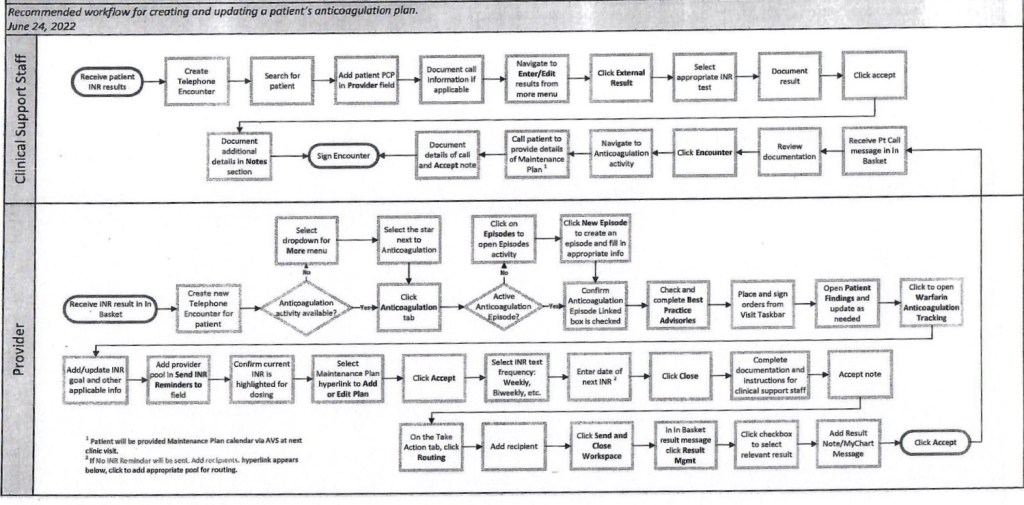
Workflows are all the rage with EMR people. But doctors, NPs and PAs are smart. Nothing burns us out as fast or as completely as being told how to do things instead of why. We are not circus animals.

Let me explain:

If we had no professional education at all, we would have clinical workflows memorized instead of clinical knowledge. For example, two weeks after starting an ACE inhibitor like lisinopril, order a basic metabolic profile. That sounds pretty straightforward, but if you add up all the possible clinical workflows we would need if we didn’t know medicine at all, that would be a huge burden – a massive amount of seemingly random and senseless rules.

But, of course, the clinical knowledge we acquired in our training is that ACE inhibitors can act like a stress test for patients with undiagnosed renal artery stenosis and a BMP drawn soon after starting such medications ensures we aren’t causing kidney damage with our prescription.

Such clinical knowledge makes us not only order the blood test, it guarantees that we will always remember to do it because it makes sense. It is like memorizing a beautiful poem instead of a long string of random letters.

Especially since computer workflows are often counterintuitive to clinicians, it helps us to know why they require us to seemingly do the wrong thing. As I have written before, EMRs are workarounds because today’s computer programs can’t replicate how the clinical mind works. Some of us might even take a certain pride in becoming expert at using a less than brilliant tool when we have the admission of our IT people that it is the EMR that is stupid and not us.

Seriously, we deal with worse challenges than that every day, just trust our intelligence and let us know when and why our computers can’t yet do what every reasonable clinician would expect them to.


I just realized none of the posts show on an iPad or a computer, but they do show on an iPhone. WordPress is working on this. In the meantime, please visit my Substack.


Osler said “Listen to your patient, he is telling you the diagnosis”. Duvefelt says “Listen to your patient, he is telling you what kind of doctor he needs you to be”.


BOOKS BY HANS DUVEFELT, MD

CONDITIONS, Chapter 1: An Old, New Diagnosis

Top 25 Doctor Blogs Award

Doctor Blogs

Enter your email address to subscribe to this blog and receive notifications of new posts by email.

Mailbox

contact @ acountrydoctorwrites.com
Bookmark and Share
© A Country Doctor Writes, LLC 2008-2022 Unauthorized use and/or duplication of this material without express and written permission is strictly prohibited. Excerpts and links may be used, provided that full and clear credit is given.