Archive Page 36

Acceptance Speech (long version): 2022 Carol Eckert, MD Memorial Award, Maine Primary Care Association

My name is Hans Duvefelt. I drove 232 miles this morning to attend this event and receive this award and I was told I have four minutes for my remarks.

That is less than the mean time of 5.4 minutes that 500 couples in five different countries spent on the act of lovemaking according to a 2005 study in the Journal of Sexual Medicine.

But, don’t worry, I am going to spend my glorious four minutes describing my love of being a family doctor in two Federally Qualified Health Centers 210 miles apart.

The full version, that didn’t fit in my four minute time slot, is online at ACOUNTRYDOCTORWRITES.BLOG, where I’ve been posting reflections about my work since 2008.

So let me start at the beginning.

65 years ago, when I was four years old, I made the announcement that I was going to be a doctor. Everybody seemed to believe me and I never doubted myself. I only applied to one medical school, Uppsala University, and I was accepted.

But before I began medical school, I developed a fascination with America. This seemed like a country full of initiative, optimism and opportunity.

A few months before I left Sweden in a Rolls-Royce engined turbo prop plane in August 1971 for a year as an exchange student in Massachusetts, someone introduced me to James Taylor, and the album was Mud Slide Slim and the Blue Horizon, the one with You’ve Got a Friend. I couldn’t wait to go where that kind of music came from.

Surprise! The change was somehow bigger than I was prepared for and by September I wrote to my parents – international phone calls were expensive then and required dialing incredibly long numbers on the rotary wall phone in my host family’s kitchen – and asked if I could come home early because I was so homesick.

By the time their reply reached me I had changed my mind. I got used to to the heat and humidity, the food and the school routines and I had bonded with my “brother”, whom I still FaceTime with every two weeks fifty-one years later – I had also developed a crush on a girl in my sociology class and had become a regular follower of Marcus Welby, MD, which I watched on a Zenith console TV from the shag wall to wall carpet in my host family’s living room. This was the now classic medical drama about a general practitioner in private practice in California.

By the time that year was over, I knew I wanted to be a country doctor in America.

I started writing letters to the girl in my sociology class. I must have had a way with words, because she moved to Sweden and we were married there in 1977. She had become a nurse and I was in medical school. I did diabetes research on nude, athymic mice from the Jackson Lab in Bar Harbor, Maine. On our honeymoon we stayed briefly with her parents outside Boston, and then we rented an AMC Pacer (for those too young to remember, that was an awkward looking compact car with a bigger door on the passenger side than on the driver’s side) and drove to Bar Harbor.

I actually remember crossing the Penobscot River on the old suspension bridge that looked just like the Golden Gate bridge and thinking that Bucksport looked like the perfect Maine town, not knowing that destiny, in the form of a random recruitment letter, would bring me there to work eight years later.

We decided we wanted to live in Maine, because of its quiet beauty and because it was within driving distance from Boston without being in her parents back yard.

After my graduation from medical school in 1979 I did a two year rotating internship in my Swedish home town where I had gone to high school. I had arranged for interviews at the family practice residencies in Portland, Augusta and Bangor. I really liked Bangor, but it did seem a little far north (at the time). They told me about the relatively new program in Lewiston. They gave me an interview on short notice, and I ranked them my number one choice in the match and that’s where I ended up.

The winter before my Lewiston residency was to begin, I read in one of the Stockholm Sunday papers about the Swedish colony in New Sweden, Maine. The article had an interview with Everett Larsson, who ran a general store on the outskirts of New Sweden. I wrote to him and mentioned I was a Swedish doctor moving to Maine and curious about his area. Within a few weeks I had letters from the CEOs of the Presque Isle and Caribou hospitals, inviting me to come and check them out.

Starting the summer after my second year of residency my wife and I, and soon thereafter, our children, made the trek every summer to New Sweden for their Swedish Midsummer festival. As far as interviewing for a job there, that happened much later.

So there I was, a freshly minted Family Practice specialist in 1984. I wanted to do the real thing, a full fledged family practice, except I had decided not to take advantage of the superior obstetrical skills I learned in Lewiston. It may have had something to do with the fact that with no OB taught in my Swedish medical school, my first solo delivery was a double footling breech with old Dr Lidstone standing in his street clothes in the hallway talking me through it.

I joined two middle aged docs in Livermore Falls in August 1984 and they offered me a partnership the following spring. I declined, intimidated by catching preemies in the delivery room and managing patients in the ICU. I took a job in a walk-in clinic and that’s when I got the recruitment letter from Bucksport. I joined them in August 1985.

Bucksport was by then becoming a strictly outpatient practice, which is what I was used to from Sweden, where inpatient medicine had been run by hospitalists since – I believe – the 1950s.

I really liked Bucksport except one thing. Back then there was only a volunteer ambulance service and the doctors had to join the ambulance crew on their runs and even open the clinic after hours for emergencies without staff or even chaperones. For a young dad with two children in diapers, and one on an apnea monitor, that was too much at the time. I again decided to work at a walk in clinic, MedNow, in Ellsworth, started by the former residency director in Bangor. They took no insurance, only cash.

I had trouble with that.

Im getting close to my punch line. So, basically I spent the bulk of my career working at two federally qualified health centers far apart: Bucksport, on the water and close to everything, and Pines, in the woods and far from most things.

Working at both health centers is more doable now with telemedicine than driving through the night in the dark the way I used to for a while:

In Sweden, health care is essentially free. There are low copays and after a certain number of visits, the copays disappear.

In America, only FQHCs provide care for all, regardless of ability to pay. Many private offices don’t even accept Medicare or Medicaid.

But Swedish Medicine, at least when I worked there, was a little slow, a little unambitious, with regulated coffee breaks and lacking the sense of urgency that serving sick people in need of help ought to create. The waiting times for specialty services is still worse than in Canada, I am told.

Splitting my time Between Bucksport and Caribou/Van Buren, I have been able to create or be part of so many innovations. I helped start integrated primary care and behavioral health up north and I helped start a Suboxone clinic down south. For a while back in Bucksport I published their health center newsletter. I designed a logo which they tweaked a few years ago. I even made a slogan they never used: Big enough to matter, small enough to care. And right now I am the only physician in Van Buren, Maine.

After being the Medical Director in Bucksport for many years, I stepped back into that role for a while, remotely, when my replacement left to do other things.

I am now back to just doing my weekly Suboxone clinic for them. Meanwhile, my Van Buren clinic is busier than ever.

So here I am, 69 years old, serving two Federally Qualified Health Centers, far apart but sharing the same philosophy, one that completely resonates with who I am and why I am in this profession.

Particularly in Van Buren Maine, we are so far away from everything, distance is the major health disparity around here, it’s not just economics/insurance status.

So, quoting another James Taylor song: That’s why I’m here.

Awarded by the Maine Primary Care Association:

Proud to announce I am this year’s recipient of the Maine Primary Care Association’s Carol Eckert MD Award, formerly family practice doctor of the year. Ceremony at the Samoset Resort 10/5/22. Full version of abbreviated (4 minute) acceptance speech to be posted online at acountrydoctorwrites.blog that day.

Delivering Health Care is Like Practicing a Religion

A former brother-in-law was a chiropractor. We never talked shop. But the longer I am in this business, the more I believe in our bodies ability to heal. If hypnosis can cure warts, we can’t be too rigid about how our patients tap into their own ability to feel better.

Scientific American writes:

For centuries, the idea of “healing thoughts” has held sway over the faithful. In recent decades it’s fascinated the followers of all manner of self-help movements, including those whose main purpose seems to be separating the sick from their money. Now, though, a growing body of scientific research suggests that our mind can play an important role in healing our body — or in staying healthy in the first place.

I wrote about this in 2008 and I am even more relaxed now about patient seeking alternative methods to tap into their inherent abilities to heal:

You wouldn’t ask your rabbi how often you should go to confession, would you? Chiropractic and allopathic medicine are like two religions. We don’t speak the same language and we use different tools. But even though our practices are different, we ultimately work for the same higher purpose, and it may be that our differences are smaller than we were taught. We don’t know enough about each other’s practices to make specific recommendations, but support you, our patients, in your pursuit of better health and wellbeing.

So, still, while I support my patients pursuit of alternative ways of healing and gladly sign insurance authorizations for that, I have to admit that I feel uncomfortable choosing such practitioners. I just don’t know who is good and who is a good fit because we come from such different cultures, or different religions, for lack of a better word.

Make it So

A year ago today, from a different galaxy (EMR) I wrote a piece that is equally relevant in my new galaxy (Epic). In fact, even more so. Epic is even more click and encounter heavy than I could imagine.

I wish I could be like Captain Jean-Luc Picard and just say “make it so”. Instead, be it Epic, Intergy or eClinicalworks, I have to do a lot of things that are not medical in order to basically say yes to a request from a colleague or support staffer.

This is what I wrote:

In my EMR, when I get a message (also called “TASK” – ugh) from the surgical department that reads “patient is due for 5-year repeat colonoscopy and needs [insurance] referral”, things are a lot more complicated, WHICH THEY SHOULDN’T HAVE TO BE! For this routine task, I can’t just click a “yes” or “authorize” button (which I am absolutely sure is a trackable event in the innards of “logs” all EMRs have).

Instead, (as I often lament), I have to go through a slow and cumbersome process of creating a non-billable encounter, finding the diagnostic code for colon cancer screening, clicking on REFERRAL, then SURGEON – COLONOSCOPY, then freetexting “5 year colonoscopy recall”, then choosing where to send this “TASK”, namely the referral coordinator and , finally, getting back to the original request in order to respond “DONE”.

This is a basic, binary, programming issue as far as I understand. Yes or no, 1 or 0, stop or go, scope or nope.

I really think EMR programmers have something against doctors.

Your Doctor Remembers Most Things About Medicine, But Not Everything About You

I often get calls requesting a medication for a recurrent problem, like a sinus or urinary tract infection. And sometimes, after I send something in and my nurse calls the patient to tell them I did, they say “that never works” or “it took two rounds to lick it last time”.

I wish patients didn’t expect me to remember such things, or that – between my old EMR and my new EMR – I have enough slack in my clinic schedule to research those things.

Everyone should know that phone calls and messages are not given specific time in doctors schedules. They are handled on the fly, shortchanging patients with appointments, cutting into lunch hours and quitting time in today’s healthcare environment.

Calling your doctor, if you know what you need, please say so. Whether you get sulfa or ciprofloxacin or nitrofurantoin makes little difference to me, so just tell me – they’re all good choices. Now, hydrochloroquine for Covid would be a different story.

And, I need specifics. If somebody says “what you gave me last time worked really well” it would help me immensely if they also said a month ago or three years ago. Because searching for things in EMRs is not as easy as it should be.

I also need clinical specifics. A call like “What can I take for a headache” is too open ended, just like “I have a cough and I’m raising green phlegm”. Three days of coughing, no treatment as it’s probably viral, much longer and getting worse, that might be bacterial and deserving an antibiotic. Daily headaches for 20 years or headaches with menstruation, make an appointment. The worst headache of your life, started 10 minutes ago, call 911.

And “That salve the dermatologist gave me worked well, can you get me some more” would be much easier to deal with if my patient had the old tube in front of them.

Good clinical decision making requires specifics: how long has it been going on, what are the symptoms, what makes it better or worse, is it stable or getting worse as time passes? There is a lot of intuition in how we work, but first we need basic information. In today’s hectic clinical environment, it helps a lot if people volunteer the specifics when they call for advice.

Twenty questions is a fun game, but not an effective way of practicing medicine. Volunteer the information, don’t withhold it.

Twenty Questions


I just realized none of the posts show on an iPad or a computer, but they do show on an iPhone. WordPress is working on this. In the meantime, please visit my Substack.


Osler said “Listen to your patient, he is telling you the diagnosis”. Duvefelt says “Listen to your patient, he is telling you what kind of doctor he needs you to be”.


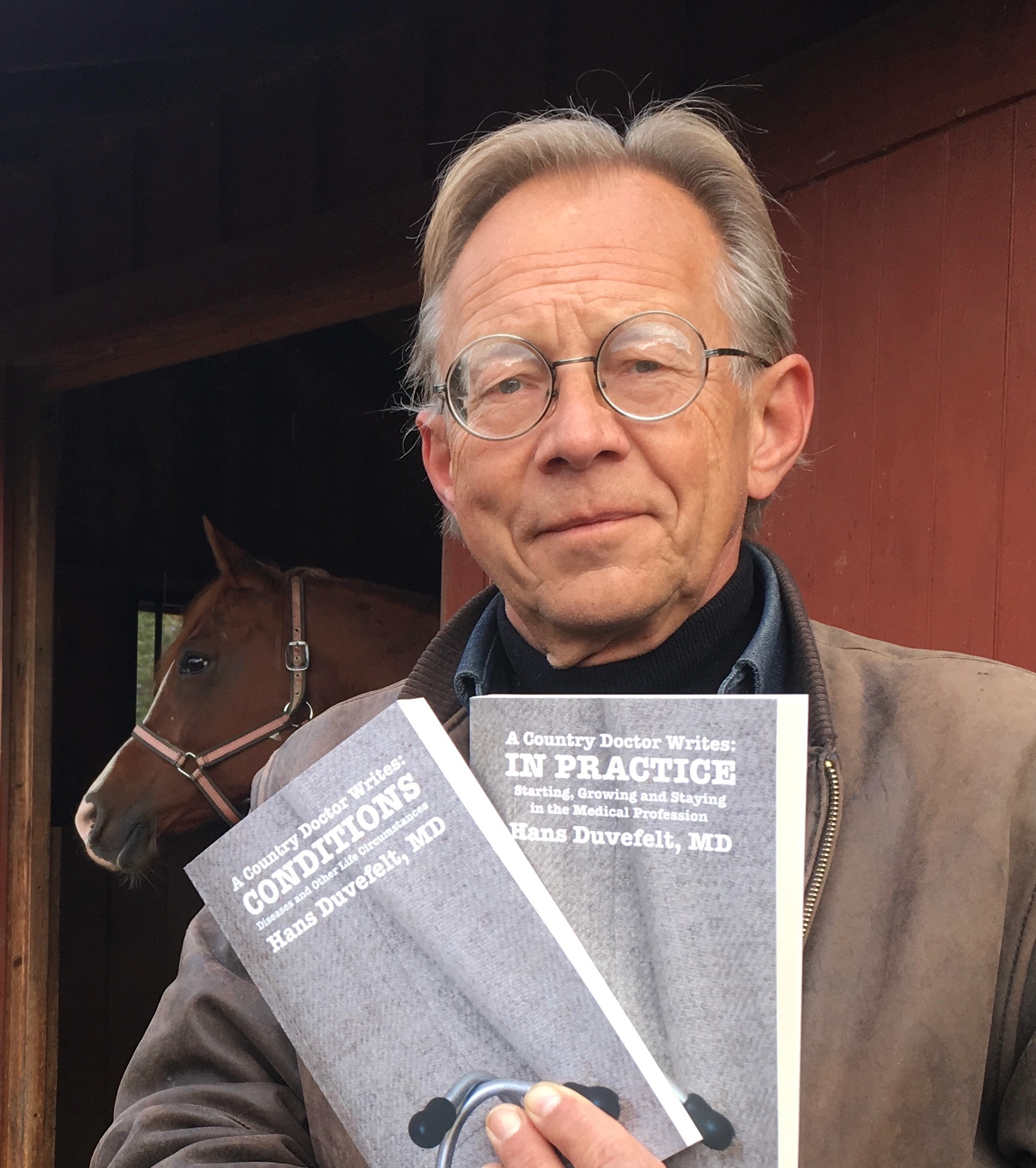
BOOKS BY HANS DUVEFELT, MD

CONDITIONS, Chapter 1: An Old, New Diagnosis

Top 25 Doctor Blogs Award

Doctor Blogs

Enter your email address to subscribe to this blog and receive notifications of new posts by email.

Mailbox

contact @ acountrydoctorwrites.com
Bookmark and Share
© A Country Doctor Writes, LLC 2008-2022 Unauthorized use and/or duplication of this material without express and written permission is strictly prohibited. Excerpts and links may be used, provided that full and clear credit is given.