Archive Page 3

Unsorted: Welcome to my World!

A patient appointment for a physical could yield a cancer suspicion or diagnosis. An appointment for chest pain could lead to an intervention for domestic violence. A quick visit for a skin rash could land a high school senior in the hospital for a leukemia workup.

In this business we can never assume that a visit will be about what we somewhat callously have been calling the “Chief Complaint”. You have to be prepared to shift gears, sometimes because the patient drops a hint or a bombshell revelation they didn’t tell the scheduler, front staff or medical assistant. And sometimes because you hear, see or palpate something suspicious.

In some ways, we always have to be triaging, before we settle into a “routine” visit. Triage comes from the French word “trier”, which means “to sort” or “to select”.

Primary care is messy. We have to sort who needs something done quickly for a high risk symptom or finding, who needs a different level of care, who needs simple reassurance and who needs a long term plan.

All of this without forgetting the screening and preventive health agendas, which is what we are graded on. There is no formal tool to evaluate our diagnostic acumen. So we are measured for what is easy to measure, the so called “street light effect”.

An Innocent Looking Rash

The Art of Listening: Beyond the Chief Complaint

Primary Care is Messy

Grandmotherly Advice, Avoiding Burnout and This Week’s Medical Mysteries

I posted this on my Substack in February 2023 and realized I never posted it here.

The trending post right now on Acountrydoctorwrites.Blog is about the unending stream of calls for medical advice we get in my office and, I’m sure, others like it. We get calls asking how to treat a cold. My suggestion is that we hire some grandmothers. Our own staff, even though most are wise grandmothers and mothers, are not allowed to give “medical” advice in the litigious climate we live in. And the medical providers don’t have a lot (read any) of wiggle room in their schedules to handle non-urgent calls in a timely fashion.

I also recently posted about what I recommend in treating the symptoms of a cold(note that there is no treatment for the cold itself; it’s going to run its course). I don’t know if that will make a difference in our call volume, but it’s worth a try.

All medical bloggers touch on or delve deeply into the pandemic of physician burnout. My 1/22 post, The Future of Doctoring is Already Here: Do More, Give Less or Burn Out,   is the most read in my blog’s almost 15 year history – well over 13,000 views and counting.  On 2/14, The New York Times picked up on broadly the same unsolvable equation (not to say they were inspired by my piece) in their article According to Medical Guidelines, Your Doctor Needs a 27-Hour Workday.

So, how do I, or any of us, stay sane in this crazy system?

I have found my curiosity to be my biggest defense against burnout. Asking why, looking for connections, not settling for I don’t know, but doing a quick google search instead, is my recipe.

This week, for example, I saw a new patient, 27 years old, with foot pain that had been diagnosed in the ER as plantar fasciitis, heel spur. But his pain wasn’t just under the heel, it went partway up toward his knee. And he couldn’t feel light touch there. I asked if he had back pain. “All my life”, he answered. So I tested the strength in his legs, definitely weaker than in a healthy 27 year old. Next I asked him to get off the exam table and sit in the chair with arm rests next to it. “Try to get up from the chair without using your arms”, I said. “I know I can’t”, he answered. He grunted and tilted to no avail.

I don’t have an answer yet to what ails him, but I ordered a bunch of tests. How could I not think my job is interesting and meaningful?

Another patient has low calcium from hypoparathyroidism. The only endocrinologist in northern Maine has been gone for a couple of years, so I am monitoring her lab values. She was running a little lower than the endo or I would want, but she said her calcitrol was so expensive that she skimped on the dose. The other day she told me that when she had Covid last month, she had two strange spells where her body seemed to stiffen up and get a little shaky. Seizure, critical hypocalcemia, I thought. A quick search revealed that the inflammatory response to Covid has triggered hypocalcemia in many cases. I told her she had been on the brink of a grand meal seizure, and she said, “I’ll take them the way I’m supposed to”.

And there were others, not as exotic, but in a handful of cases I was able to connect the dots.

A woman with low sodium was borderline  before and normal years ago. Her first drop happened when she started taking Prozac some time ago, and when her dose was increased recently, her sodium level tanked. That is a known side effect from the SSRI class of drugs. So we reduced her dose as a first step – some people don’t do well stopping medications like that cold turkey, although Prozac’s long half-life makes it less likely that she would have severe withdrawal symptoms.

To be honest, there are many such little pearls, or mental challenges, some of which I can’t even remember when the week is over. So far I’m still very happy to be a somewhat overworked primary care doctor in this underserved corner of our country.

One Disease With Many Names: Which One You Use Makes a Difference in the PA Process

Acetylcysteine is an old drug with two major uses. Orally it can lessen liver toxicity from acetaminophen (paracetamol) overdose. Inhaled, it is a powerful mucolytic (loosens phlegm for people with lung disease).

I have a patient with severe lung disease who is on oxygen 24/7. She had been using high doses of guaifenesin, but still couldn’t raise her phlegm. I haven’t used it in many years but remembered from the early days of my career that acetylcysteine is a powerful mucolytic.

It’s used in the hospital more often than in outpatient care. So I called the patient’s pharmacy and they don’t have it in stock, but they can get it and my insurance would require a prior authorization. So I sent in a prior auth request with the diagnosis of chronic respiratory failure with hypoxemia. My application was denied. It said that the diagnosis I gave them was not a qualifying diagnosis. They were kind enough to reference a website I could go to to see what might qualify. So I did. There, I saw that emphysema qualifies. Well, darn it, She has had a CAT scan of her lungs showing severe emphysema, but in my book respiratory failure with low oxygen is a more severe diagnosis than emphysema. This is one instance where I sort of wish that AI would be used. The insurance companies deny requests because there’s no common sense in the process. They have check boxes. Emphysema would be a check and respiratory failure with low oxygen would not be a check.

So I appealed the denial and we will see what happens.

Sense of Smell as a Predictor of Mortality

Soon after graduating from medical school, I stopped checking the sense of smell in my neurologic exam, just like most of my colleagues. It’s inconvenient to carry different smelly objects around on the hospital ward or in the clinic. So, “Cranial Nerves I-XII normal” turned into “Cranial Nerves II-XII normal”. There was a brief period during the Covid epidemic where we at least asked about our patients sense of smell.

Researchers at Sweden’s Karolinska institute did a 12 year longitudinal study of the sense of smell and the mortality data of more than 2500 participants with an initial average age of 72. The researchers used a 16 item odor identification test and classified the participants into three groups: Anosmic (0-6 correct answers), Hyposmic (7-10 correct answers) and Normosmic (11-16 correct answers).

At both their 6 and 12 year follow-ups the anosmic group had almost 70% higher relative risk of mortality than the normosmic group. For each wrong answer, the mortality increased 5-6%.

Interestingly, the only causes of mortality involved were neurodegenerative deaths (mostly Alzheimer’s disease), respiratory and cardiovascular diseases. There was no association with cancer mortality.

So, maybe it’s time to reintroduce the first item in the neuro exam we all learned in school…

https://jamanetwork.com/journals/jama/fullarticle/2833992

One Bad Habit

Nearsighted since age 6, I have a habit of holding things close to my face. I’ve had progressive everyday glasses for several years now as well as dedicated reading glasses. Before I got progressive lenses I used to take my glasses off to read the news on my small iPhone (my 13 mini may be the last iPhone I buy, because nothing bigger would fit in my left front pocket, even if I got rid of my cloth handkerchief).

My optometrist calls me an amateur, even though I have diagnosed my own vitreous detachment and many patients’ ocular emergencies, like acute angle closure glaucoma and dug out countless corneal foreign bodies with an 18 gauge needle. He said that my presbyopia shouldn’t get worse after 65. It is still getting worse in my early 70s. That means I’m now starting to take my reading glasses off and bringing my iPhone to my uncorrected focal distance, which is 5 finger breadths from my eyeballs.

But just a few moments ago, I checked the time on my Timex Expedition watch and realized that if I hold it 18” away, I see it super well and I can even read the tiny word Timex above Expedition. So technically I can still read emails, The New York Times and all my other news sites with my old reading glasses without getting new ones. I just have this one bad habit of wanting to read up close, closer than other people.

Altered Vision

Not On Call


I just realized none of the posts show on an iPad or a computer, but they do show on an iPhone. WordPress is working on this. In the meantime, please visit my Substack.


Osler said “Listen to your patient, he is telling you the diagnosis”. Duvefelt says “Listen to your patient, he is telling you what kind of doctor he needs you to be”.


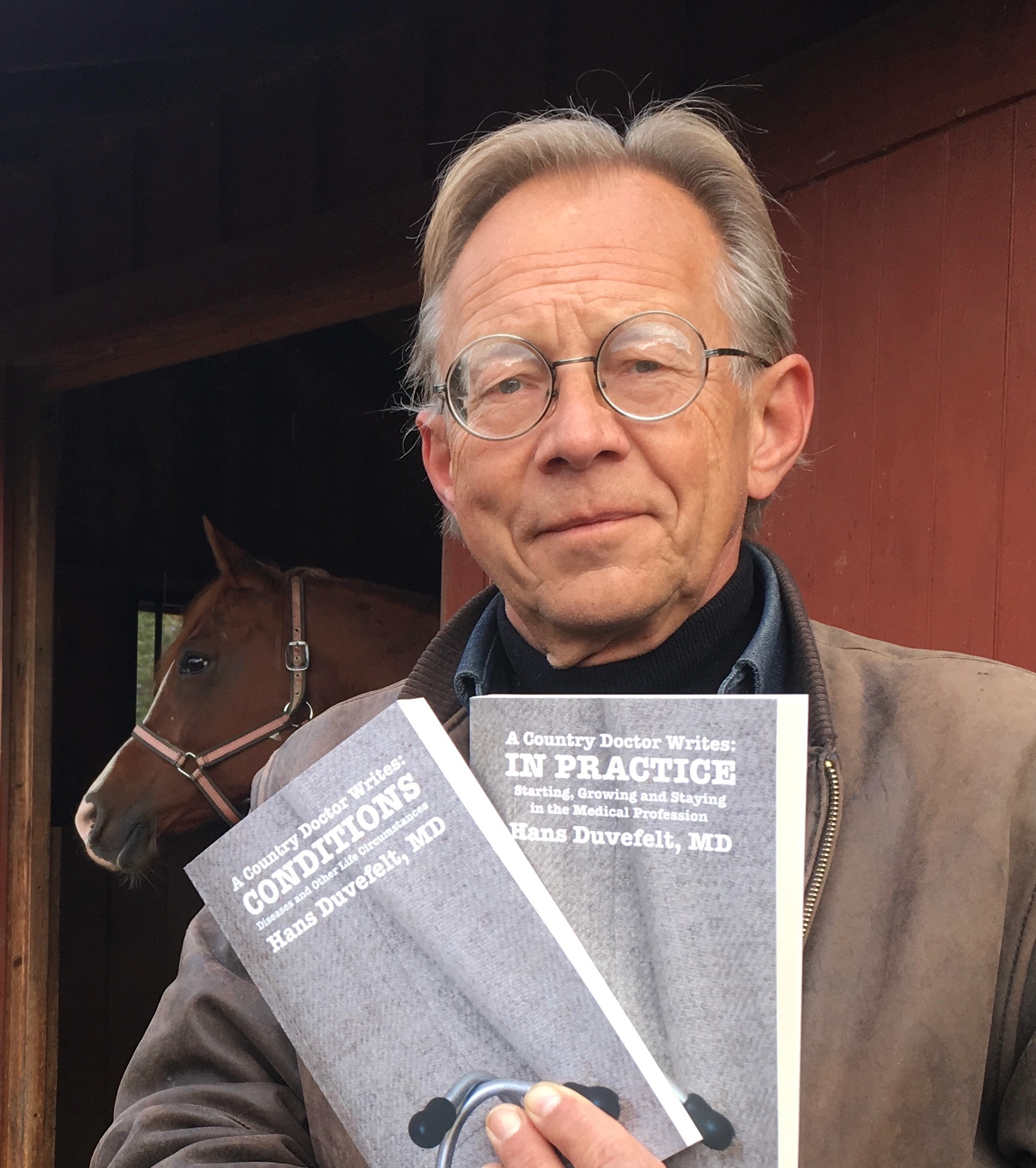
BOOKS BY HANS DUVEFELT, MD

CONDITIONS, Chapter 1: An Old, New Diagnosis

Top 25 Doctor Blogs Award

Doctor Blogs

Enter your email address to subscribe to this blog and receive notifications of new posts by email.

Mailbox

contact @ acountrydoctorwrites.com
Bookmark and Share
© A Country Doctor Writes, LLC 2008-2022 Unauthorized use and/or duplication of this material without express and written permission is strictly prohibited. Excerpts and links may be used, provided that full and clear credit is given.