I’ve been posting my thoughts and experiences on A Country Doctor Writes for over 15 years now and here are a few statistics:
The blog has had 687,308 views as of this writing and 366,807 unique visitors. I have published 962 posts, and the one with most views was in January of this year, with 13,730 views:
I have a red bump on my nose that started out looking like it was going to be a little skin cancer, but which now looks just like a hemangioma, a little blood vessel-filled lesion of mostly cosmetic significance.
Sitting in front of my laptop tonight I felt and saw blood dripping from my nose. I sometimes get nosebleeds, so I just pinched my nose and went in the bathroom. Looking in the mirror I saw this was no ordinary nose bleed, it was my little hemangioma that had sprung a leak.
I still reached for a cotton ball and saturated it with decongestant nasal spray, which is what I do to stop nose bleeds, and I just placed it outside my nose. Holding it there with some pressure, the bleeding slowed down after which I applied a styptic pen to cauterize it. I keep that around for the very rare shaving accident a man can have.
Simple tools to have around. Back to the computer…
Oh, that reminds me of when I diagnosed my own vitreous detachment of my eye while visiting family in Sweden.
I love medicine. I love being a doctor. I thrive on making diagnoses and treating disease. I find deep satisfaction in educating and empowering patients.
But, as I have said many times, I am a problem solver and not a bookkeeper.
Doctors today are required to do more and more EMR data entry in more and more stilted ways with less and less team support. All the while we are under pressure to be both productive in terms of patient volume and comprehensive in terms of both disease management and an ever increasing burden of public health that really shouldn’t require a medical degree at all.
We have become bottlenecks in the flow of information. Our electronic inboxes exist so that our EMRs can document exactly when we saw a test result and what we did about it. This creates a tight bookkeeping workflow but ignores the fact that we can’t be in two places at the same time: We are scheduled to see patients all day long, so our inboxes fill up with unsorted data, unseen by the nurses and medical assistants, who used to help prioritize incoming data before the EMRs changed all that.
I have finally made the decision to move away from working in this unsafe, unsustainable and wholly unsatisfying way. I am transitioning away from traditional fee-for-service Family Medicine.
I will be the lead physician in the entire state of Maine for a new kind of practice that eliminates the hamster wheel of counting face-to-face encounters. I will personally and through supervision be responsible for the care of a fairly small number of complex, high risk Medicare, and later Medicaid, patients. My organization will be paid per member per month. This will avoid unnecessary visits, and it will make it practical to use remote monitoring, phone calls, video visits, and any other means of communication to stay in touch with my patients.
The foundation is house calls. I loved doing house calls when I worked full-time in Bucksport many years ago. These days house calls are viewed as not very profitable because by the time you drive to somebody’s house and see them and then drive back to the office, you could have seen two or three people in the office. But with the capitated payment model, a house call will teach you a lot about how the patient lives, and what their circumstances are, and that will help you make better decisions for their future care.
I will document my process of getting to this decision and my progress in entering this new type of practice on my Substack in a post category titled PROGRESS NOTES. This is a learning experience for me and a growing experience. My patients will be those in managed Medicare, also called “Medicare Advantage”. I already have many patients with that type of insurance, and many of them are very complex. It has been difficult to give them everything they need because in the traditional type of clinic I work in, we don’t get paid more when we spend more time with the patient. Any visit is paid the same, so there is no financial reward for being comprehensive, except some minor bonuses for the practice when quality standards are met.
I have been skeptical of managed Medicare, in part because they are stingy with authorizing and paying for CT scans when I think my patient has cancer, but in terms of outcomes for chronic diseases, the statistics are clear, because of the extra support managed Medicare provides, patients with that type of insurance have better outcomes. One insurer, WellCare, even sends people healthy food through a program called Mom’s Meals.
In “PROGRESS NOTES“ I will document what I am learning and what I experience in this new phase of my clinical career. Please join me.
In spite of all the talk these days about health care teams and in spite of more and more physicians working for bigger and bigger healthcare organizations, we are becoming more and more isolated from our colleagues and our support staffs.
Computer work, which is taking more and more time as EMRs get more and more complex, is a lonely activity. We are not just encouraged but pretty much forced to communicate with our nurses and medical assistants through computer messaging. This may provide more evidence of who said or did what at what point in time, but it is both inefficient and dehumanizing.
Why do people who work right next to each other have to communicate electronically? Why can’t my nurse simply ask me a question and then document “Patient asked whether to take aspirin or Tylenol and I told her that Dr. Duvefelt advised up to 2,500 mg acetaminophen/24 hours”. It would be a lot less work for me, even if I have to sign off on the darn thing.
And just because it now takes us longer to do our work, there is less slack our day. This makes for less curbside consults, less sharing of clinical experiences between clinicians, less social contact with other staff categories.
All this leads to professional and social isolation.
And, you know me, this reminds me of a James Taylor song, Millworker:
Then it’s me and my machine For the rest of the morning For the rest of the afternoon And the rest of my life
There are a lot more choices these days for hypertension treatment than when I started out. Once several agents became available, we used to choose medications according to what type of patient we had in front of us: A person with leg edema and hypertension would be put on a diuretic, a type A personality with a high resting pulse would get a beta blocker, a patient with heart disease might get an ACE inhibitor and a person who might not show up for their bloodwork or follow up appointment would get a modern calcium channel blocker like amlodipine.
Then came the statistics that showed slightly better outcomes for diuretics and ACE inhibitors and all of a sudden we were supposed to take those small differences seriously enough to force all patients into the same treatment algorithm.
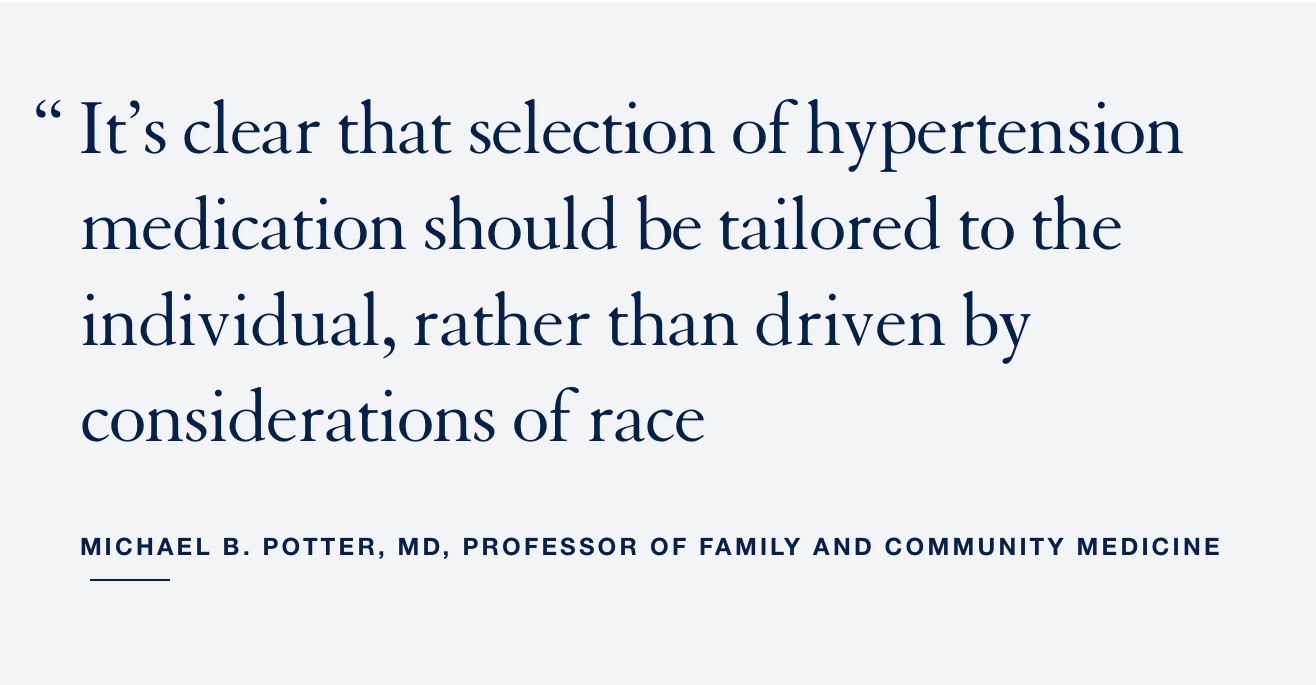
Some time after that came the data that showed that Black hypertensives respond differently to ACE/ARB drugs, which led to race based hypertension guidelines, which are now being debunked. Some people are now saying treat all hypertensives the same, while others are again suggesting making treatment decisions based on “individual factors”.
I, for one, still individualize based on what my patient looks like and their personal preferences and their likelihood of compliance with followup appointments and blood testing.
I will never forget Fran, the chainsmoking, hypertensive woman I started on lisinopril many years ago. This drug was not generic back then and she asked for a 90 day supply because that would save her money. I told her a couple of times how important it was to get the bloodwork after starting this drug and placed the order to check her kidney function within just a few weeks.
When I saw her back 3 months later, I knew immediately something was dreadfully wrong with her. She was in kidney failure and it turned out that she didn’t have renal artery stenosis, which is what we’re supposed to consider and do bloodwork to check for elevated creatinine shortly after starting lisinopril, but she had a coarctation of the aorta. The vascular surgeons cleaned out her plumbing and her kidneys recovered but that was an important lesson, actually two:
Lesson number one is to measure lower extremity blood pressure in new hypertension cases. Ankle Brachial Index, ABI, even has a CPT code and may be billable to the tune of about $78 where I work (I don’t worry about billing but I do use a pocket Doppler and a conventional sphygmomanometer to do it right).
Lesson number two is not to prescribe a bigger supply of pills than you feel comfortable with. I now only prescribe 30 days of a new ACE or ARB. When I get an instant (!) “patient requests 90day supply” request from Walgreens – because they want to sell more pills – I turn it down.
And, now that I think of it, there is a third (bonus) lesson with new hypertensives. If they have a very low potassium and no good explanation for it, like chronic diarrhea, I very quickly consider they might have hyperaldosteronism and check their renin-aldosterone ratio before I put them on an ACE or ARB, since they may be better off on spironolactone than the traditional blood pressure pills. And they may even need surgery.
I just realized none of the posts show on an iPad or a computer, but they do show on an iPhone. WordPress is working on this. In the meantime, please visit my Substack.
Osler said “Listen to your patient, he is telling you the diagnosis”. Duvefelt says “Listen to your patient, he is telling you what kind of doctor he needs you to be”.











 A Country Doctor Writes:
