Archive Page 215

Caleb Didn’t Limp Yesterday!

I had planned to write a slightly humorous post about how Caleb, our horse with a limp, has introduced me to alternative treatments, to which I, as an allopathic physician, normally don’t give much credit. However, recent clinical developments have made me write with a seriousness I had not intended.

The first veterinarian we took our horse to diagnosed bilateral knee problems. The treatment included steroid injections to both knee joints, which was costly but ineffective. Emma enlisted the help of a couple of alternative practitioners and designed a rehabilitation program, which started with Caleb walking over sticks in the indoor ring, while looking for treats we scatter all around, and now consists of him being led up and down hills and through tall grass while grazing, so he doesn’t feel like he is working.

Two days in a row Caleb walked normally, with no sign of a limp; he took out his full stride, albeit a little gingerly, with his right hind leg, and completely normally with the left one. After a while he became tired, and started to limp just a little.

Thus we know that the horse doesn’t have stiff joints, muscle contractures or permanent misalignment of his pelvis; he has sciatica. The horse chiropractor, , acupuncturist, SHEN practitioner, masseuse, the Bach Flower Essences, craniosacral therapy, yucca, glucosamine and the cautious exercise have already started helping  – physically and emotionally.

If my patients only knew…

Time’s Up!

I am very particular about time. My office visits start and end with near certainty on time, which isn’t common in my profession in this area. You might say I take pride in my punctuality. I even have a radio controlled wall clock, since it has always bothered me that different clocks in our office could be several minutes apart.

One day last week I noticed around four o’clock that my wrist watch ran late. I suspected correctly that the battery was giving out; the next morning my watch stood still.

I have three wristwatches. My everyday watch is made of a dull metal, aptly named Skagen Titanium. For more formal occasions I have a thin, Swiss watch with a black leather band. I also have a rectangular Skagen with a brown watch band for variety and matching brown shoes and belt.

My fancy watch had not been used for a while and also turned out to have stopped. Thus I picked brown clothes and the rectangular watch. Some upcoming Saturday I thought I’d take a trip in to town for two new watch batteries, but today I worked. We are open 8 – 12 on Saturdays. This afternoon I did chores around the house, and I marveled at my efficiency; I got so much done in just a couple of hours.

Then I realized suddenly that it had been three-thirty an awfully long time. Sure enough – my third wristwatch had also stopped! So Monday morning I’ll be going to work without a watch for the first time in my life.


Chocolate – Good or Bad?

My sister-in-law makes chocolate. She and her husband, my wife’s younger brother, make chocolate in a small house and café at the end of a dirt road on an island off the coast of Maine. Kate writes a blog about chocolate, and she has linked her blog to mine.

How do I handle this? Do I want to be associated with chocolate – isn’t it bad for you? 

Chocolate, or cocoa, was first found around 2000 BC in the Amazon, was used by the Mayas and the Azteks, and brought to Spain in small amounts by Columbus, who didn’t see much value in it, even though it was used as currency in South America. 

During Louis XIV’s reign, cocoa was viewed as an aphrodisiac. We now know cocoa contains phenylethylamine, PEA, which is associated with euphoria. Curiously, pickled herring contains more PEA than chocolate. (Did I mention I’m Swedish?)

Actually, there is a growing body of evidence about the real health benefits of cocoa and dark chocolate:

It contains flavonols, powerful antioxidants; dark chocolate has more antioxidant power than blueberries. 40 grams of dark chocolate is comparable to a glass of red wine. 

Dark chocolate contains stearic acid, a neutral type of fat, which does not raise levels of harmful LDL; it contains mono-unsaturated oleic acid, which raises levels of the good HDL cholesterol.

Cocoa has blood thinning and circulation enhancing properties similar to aspirin, and it has mild antibacterial properties. It has been said that people who eat chocolate regularly live a year longer!

So, I have no problem being associated with the making and eating of chocolate; we often get samples, and we eat them without guilt. I’ll even link back to Kate’s blog!      http://blackdinah.wordpress.com/

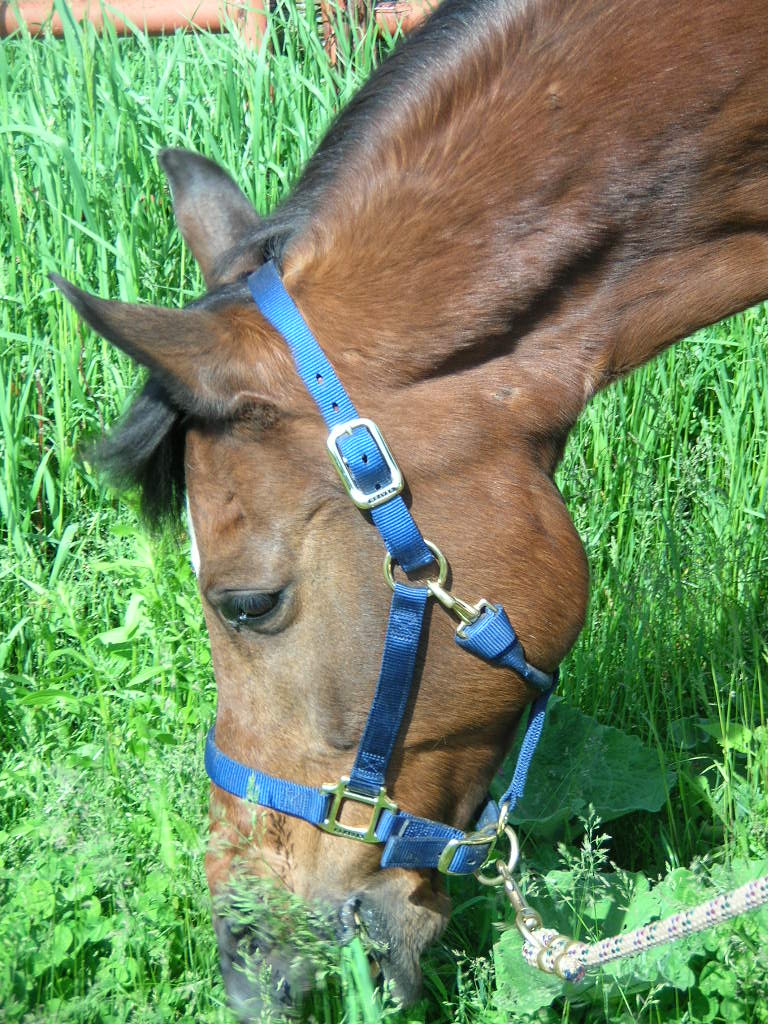
Caleb, Our Horse with a Limp

Caleb is nineteen years old, but very youthful. He is an Arab gelding, and from what I understand, Arabs are more compact than most horses and very intelligent. Apparently they used to sleep in their owners’ tents in the desert, and they were used to guard the tents as well as for transportation. Emma has owned him since he was born; her face was the first thing he saw. She rode him until he was nine. Then, when her career and marriage to a man without much acreage got in the way, she boarded Caleb at a farm six miles from here. For many years, Caleb was used in their riding school, but he was retired a couple of years ago when, for some reason, he developed a limp.

Now we have moved him to a place less than two miles from our house. We can see him twice a day, and we have started to think about what he might do next. He may be rehabilitable; an expert veterinarian will see him next week. But even if he cannot be ridden again, he might find a career as a therapy horse of some kind. We have read about horses used as therapy animals for children with autism or ADHD. It is obvious to us that Caleb is not ready to retire completely. He needs a job. He is so full of it, that already after a couple of days in his new home, he tossed toys our from his stall, and one day he ran around the yard with a piece of plastic that the wind had carried from the lumberyard across the street.

Emma has collected a couple of books on clicker training, which is being used for dolphins and many other animals. Our puppy, Moses, had some clicker training, but got a little too wound up by it. It does sound like an interesting option for the horse, though. Clicker training is based on rewards that are linked to the clicking of a small hand held device. This sound allows you to control the behavior of an animal across a distance.

One exercise we did in Moses’ puppy class involved one dog owner clicking when another dog owner did the right thing. The subject didn’t know what the desired behavior was – to sit down on the floor.

I happened to be the leader. When the subject looked at the floor, I clicked. She looked at the floor again. I clicked. She stretched her hand out toward the floor, and I clicked. She reached toward the floor and bent her knees; I clicked, and so on, until she sat down on the floor.

As I write this, Emma is reading a book that came in the mail today from amazon.com about a full blood horse with symptoms a lot like Caleb’s, who was clicker trained, and as a result became more or less rehabilitated.

All of this reminds me of Clarine, a patient who came to mean a lot to Emma and me; she married us. Clarine was bed bound for the last several years of her life. She was an English teacher, writing coach, editor, writer and an ordained minister. Even though she lost many of her physical abilities, she lived a rich life, in part because of the power of the computer at her bedside and the internet. People have a tendency to view physical handicaps as bigger and more insurmountable than they need to be. If Clarine could write and edit books from her bed in our little village, I am sure Caleb can find a new purpose in his life.


My Nurse’s Mother

My office nurse, Autumn, is a sweet kid, not much older than my own daughter. She grew up right here, and most of my patients know her from when she was little. The head nurse at our clinic gave Autumn her baby shots, and one time Autumn bit her afterwards. Now Autumn has her own two year old, so life is getting back at her.

Autumn has a way of making patients feel comfortable that I feel is a real gift. She’s still green in some respects, only a few years out of school, but she makes up for it with her great personality, her sense of who she is, and her knowledge of everyone in our community. After twenty-three years, I’m still figuring out who’s related to whom. Autumn already knows, because she’s related in some way to most of them.

The other day I ran into a patient who wasn’t at all feeling comfortable having Autumn check her in – her own mother, Brenda. Until recently, Brenda had been seeing another doctor in the area, who retired a few months ago. Brenda chose me to take over her care, knowing full well she’d have to deal with her daughter in her capacity as a nurse, instead of as her daughter.

Brenda and Autumn are very close, I can tell from the way Autumn talks about her. When Brenda was diagnosed with cancer a few years ago, Autumn was right there for her, and I overlooked the personal phone calls and the glassy eyed stare – I remember my own mother’s breast cancer scare when I was in medical school.

This closeness between mother and daughter turned out to be a problem the other day. Because Brenda has had some heart problems, her blood pressure has to be tightly controlled. I knew from her old records that she hadn’t been out of range for a long time, but the first day I saw her Autumn recorded a near-panic value for her mother’s blood pressure. Ten minutes later I recorded something more in the less than ideal range. Brenda had the answer; ever since her cancer, Autumn’s concern for her mother’s health has made Brenda in turn worry about her daughter’s reactions. If Brenda doesn’t take perfect care of herself, Autumn is all over her with worry. Suddenly, I have two new patients instead of one.

Sure enough, today I had Brenda stop in for a blood pressure check by another nurse, and it was normal!


I just realized none of the posts show on an iPad or a computer, but they do show on an iPhone. WordPress is working on this. In the meantime, please visit my Substack.


Osler said “Listen to your patient, he is telling you the diagnosis”. Duvefelt says “Listen to your patient, he is telling you what kind of doctor he needs you to be”.


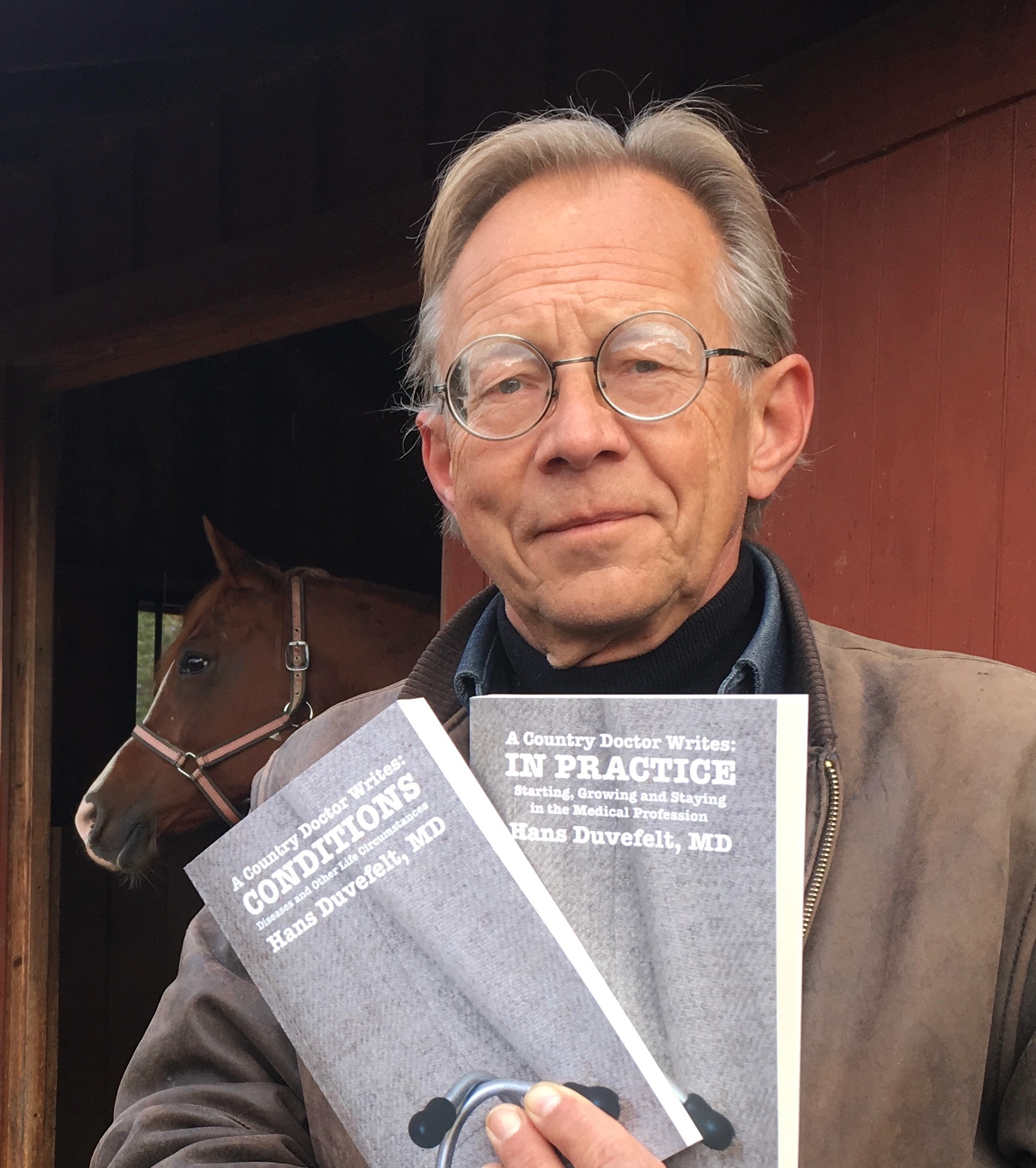
BOOKS BY HANS DUVEFELT, MD

CONDITIONS, Chapter 1: An Old, New Diagnosis

Top 25 Doctor Blogs Award

Doctor Blogs

Enter your email address to subscribe to this blog and receive notifications of new posts by email.

Mailbox

contact @ acountrydoctorwrites.com
Bookmark and Share
© A Country Doctor Writes, LLC 2008-2022 Unauthorized use and/or duplication of this material without express and written permission is strictly prohibited. Excerpts and links may be used, provided that full and clear credit is given.