Archive Page 210

An Anxious Daughter

Jeremy Doyle’s daughter, Sandy, was in for a sad visit yesterday. Jeremy is still holding on to the quality of life he has remaining, battling end-stage lymphoma and throat cancer. Sandy and my daughter were best friends for many years. At this point Sandy is holding down a full time job and helping out with the care of her father so that he never has to be alone.

Last weekend, after a rough night with her dad, Sandy was pulled over by the local police as her car swerved. She was actually talking on her cell phone (which is still legal while driving in our state) and dropped the phone. She reached for the phone on the floor, swerved the car, and was pulled over by a rookie police officer one year her junior.

Sandy suffers from chronic anxiety made worse by what is happening to her father. The young police officer asked her if she was “on anything”. Assuming he was referring to illegal drugs, she answered “no”, and the officer asked her to step out of her car while he searched it. Her bottle of Xanax was in the glove compartment.

The officer demanded an on-the-spot sobriety test. Sandy’s anxiety got the best of her, and she developed a tremor, heart palpitations, chest pain and shortness of breath – essentially a panic attack. She got all shaky and didn’t walk straight enough, so she failed her sobriety test. The officer handcuffed her and hauled her off to the police station for a urine drug screen, the results of which are still pending. It will show the Xanax she had taken, but won’t show how much of the medication she had in her system or if she was impaired by it. She was summonsed for operating under the influence of drugs based on her anxiety during the field sobriety test.

She was more than worried. Her arrest had been made public in our local newspaper. “I could lose my job just for that”, she declared. Her court date is in December. I promised to write a strong letter to the District Attorney explaining the circumstances.

I think this will all go away, but it made me think. Something most of us think of as simple, like a field sobriety test, can be too much to handle for a twentysomething girl with chronic anxiety and a father dying from a cruel and unjust disease.

My Senior Colleague

I have been a physician for more than half my life now, and not since the early nineties have I had any comments about looking too young to be a doctor. In fact, for the last ten years I have been the oldest doctor in town. That changed recently, and it has been a delightful experience.

I have mentioned Dr. Wilford Brown before. I chose him as my doctor when I turned 50, then he retired from his practice and chose me as his doctor earlier this year. Our paths became even more intertwined this summer when our clinic needed to hire a locum tenens, a part-time doctor to help out during summer vacations. Dr. Brown heard we were in the market for such a doctor, expressed his interest, and came out of retirement.

I now have the privilege of working with my former personal physician, a man twenty years my senior. I have worked alongside the same small group of doctors for several years now, and we seldom surprise each other. Having some fresh blood in the form of Dr. Brown has been very interesting. I have come to respect him even more than I did when he was my personal physician.

There is a wonderful sense of economy in how Dr. Brown works. He says just enough to handle the issue at hand, yet he connects with patients very quickly and his decision-making is quick and to the point. His office notes are concise, and he gets his dictation done immediately after each patient visit. His desk is always clear, and he seldom stays more than fifteen minutes after the last appointment ends at five. He never seems to get upset; if a patient tries to manipulate or bully him, he just calls it like he sees it and doesn’t seem to waste his energy fretting about it. At seventy-five, he sees patients every fifteen minutes with greater ease than most doctors I have observed.

Dr. Brown asks me now and then how I would handle a case and occasionally when he sees a patient of mine he will think of something I hadn’t thought of. He uses his extensive professional network to “curbside” (consult) specialists over the phone, and is razor-sharp about where his competence begins and ends. I am sure he sleeps like a baby at night. He also has a keen sense for the stories and human dramas we encounter as physicians. I have found a soul brother in him when it comes to finding the stepping-stones for personal and professional growth that practicing medicine provides. For the first time in many years I have a colleague who is both a friend and a mentor. 

He has accepted our offer to stay on as a part-time physician after the summer. I hope he doesn’t retire on me again too soon.

A Little Man

William R. Winters, Jr. was in for his 18 month Well Child Visit today. He brought his mother with him. I had done a weight check halfway between his one-year visit and today, just to make sure his weight didn’t slip. At a year old, I even checked his basic labs, lead and thyroid studies – all normal.

He is a tiny thing, not quite on the growth chart, but his mother is only 4’10”. Will also isn’t a voracious eater. Last time I saw him, he wouldn’t eat anything with texture to it – he would spit out jar baby food if it had lumps in it, and wouldn’t eat Cheerios or crackers. 

Today, as I walked in the room, Will was reading one of my car magazines while stacking blocks on the exam table. His little face was serious and determined-looking as he greeted me with a block in the air while repeating the word “block”.

I brought a peace offering – an age-appropriate book about a duck. He glanced at it, tossed it on the floor and went back to his/my car magazine. I turned to his mother for more history.

Will still nurses at night, but he has started to explore foods with lumps. He drinks from a cup, although he doesn’t show any interest in using a spoon. His weight is up a little. He knows twenty words, although he doesn’t combine them yet. Sometimes in public places like the supermarket he starts screaming just to get attention, and he’s enjoying the power of saying “no”. He is clearly working on soon being a healthy two-year-old.

After the physical exam, and after hearing me announce that no shots or blood tests were needed today, his mother said:

“You’ve got to help me with his dad.”

“What do you mean?” I asked.

“He’s threatening to buy Will a dirt bike as soon as his legs are long enough to reach the pedals”.

“But he doesn’t even know how to ride a tricycle!” I was at least as bewildered as she expected me to be.

We talked about how dirt bikes and ATV’s aren’t safe at any age, and how fathers, no matter how loving, sometimes don’t know how to handle babies.

The physical exam was straightforward. Will let me check his ears, throat and all the other required body parts. He is clearly just a very normal boy with a diminutive mother and a macho dad. I gave his mother some pointers on how to deal with an over-compensating father. I left the room to let them get his clothes and their stuff back in order. A few moments later they emerged into the hallway.

“Can I borrow this car magazine, he won’t let go of it?” she asked.

“Keep it!” I said.

I’m not sure what happened to the age appropriate duck book. I thought to myself:

“What a little man…”

Another Young Man

The medical record of another young man in our practice went into the office basement Friday after being stamped “DECEASED” across the front of the manila folder.

In all my years of practice in this community I cannot remember a single young male patient of mine who died from a disease like cancer or AIDS, but I have known over a dozen who shot themselves, jumped off the bridge, took a deliberate or accidental overdose, or died as a result of a motor vehicle accident.

This time it was a self-inflicted gunshot wound in the context of a failed marriage and a troubled new relationship that ended a young life. Several staff members knew Thursday morning what had happened to the young man I only met once about a year ago.  Someone had even heard it from an eyewitness, but the “DECEASED” stamp didn’t go on the record until the obituary appeared in Friday’s newspaper.

When adolescent or preadolescent males come in for physicals, we don’t often find new diseases. We’re certainly on the lookout for boys who might be developing hypertrophic cardiomyopathy and are at risk for collapsing during vigorous exercise. We also preach the importance of testicular self-examination. This is extremely important, since the majority of testicular cancers are discovered this way. I still remember the last case I saw, probably four years ago now. The young man felt a lump I wasn’t sure I could feel. I ordered an ultrasound, which identified the cancer and confirmed his self-diagnosis.

The most important part of the adolescent male physical is talking about the things that most often threaten or end the lives of young men. I have no illusions that we as physicians can stop suicides or deaths from risk-taking behaviors or accidents in even a fraction of cases, but what if some of us can do that even once? We don’t know when we might indirectly save a life by nudging someone toward better conflict resolution skills or away from situations like getting in a car with an impaired driver behind the wheel.

The young man who ended his own life Wednesday seemed like a decent fellow. I’ll probably never know what made him do what he did, but it does sensitize me to my role as a fiftysomething physician who has the privilege and responsibility of sometimes, however briefly, being in the position of elder or mentor for young men making their way into a complicated adult existence. Am I open and aware enough to offer my ear or my hand when it is wanted?

Orthorexia Nervosa – Too Much of a Good Thing

In Swedish, there is a word that just can’t be translated succinctly into English. “Lagom” means “just enough” or “adequate”, but it is saturated with overtones of moderation, contentedness and political, even social, correctness. “Lagom” is a way of life – moderation in everything. It is no surprise that Swedish newspapers seem to be on the lookout for stories about people who stray from that middle-of-the-road way of life. One story in Dagens Nyheter caught my eye (for interested/concerned readers, my right eye is almost back to normal) during the flight back to the States this morning. It sent me out on the Internet once I landed and got connected to the airport wireless network: “Exaggerated Healthfulness Can Lead to Serious Disease” is a feature about a 30-year old woman, who after eating a lot of junk food while living in the US started on a journey filled with strict diets and rigorous exercise. She never thought she was too fat, which is the defining feature of Anorexia Nervosa, but she somehow felt she had to eat extremely healthfully to compensate for her prior indiscretions. Her condition, Orthorexia Nervosa (obsession with healthy eating), described by Steven Bratman in 1997, although not officially recognized, is getting increasing attention. Its complications are not dissimilar from those of Anorexia Nervosa, as it can lead to malnutrition with all its consequences. I had not run into the term before – figures I would run into it in Sweden, the Mecca of Moderation. I can see that this is a culture-dependent variety of Anorexia Nervosa, which was first described in the late 1800’s as Fasting Girls. The culture was not focused on healthfulness the same way then as it is today. In Victorian times, fasting was of body image and spiritual interest, and Fasting Girls were said to have mystical powers. Our current DSM-IV (Diagnostic and Statistical Manual of Mental Disorders) classification of Anorexia Nervosa doesn’t mention restricting foods based on their healthfulness, and Orthorexia Nervosa isn’t recognized in it at all. I looked around for blogs on the topic, and found some, including “There’s no such thing as orthorexia nervosa, it’s only a fancy term for a health food junkie“. I like that title, because I think that whenever there is a “new” disease or when an “old” disease gets more attention, patients tend to over-report the symptoms of it and doctors have a tendency to over-diagnose it. While the DSM-IV has weight criteria that help keep the diagnosis of Anorexia Nervosa more objective, most psychiatric diagnoses hinge on value-laden words like often, intense or undue, which are all subjective to some degree. I have said before that there is a tendency (at least in the US) to medicalize the human experience. The last thing we want to do is start calling “health food junkies” sick; let’s not forget that “junk food junkies” have been well proven to get very bad complications from their food choices, too! I have made the observation a few times that the spectrum of what we call the human experience can be defined by what lies at the extremes or by the nuances within the range where most people find themselves. People say “I’m depressed” even if they know they are only experiencing a temporary sadness. They say “I have OCD”, even if they don’t meet the DSM-IV criteria. Going too far with our words isn’t always the most effective way to communicate. Now that there is a new medical term with no DSM-IV definition behind it yet, we all need to be careful how we use it. Let “health food junkies” be just that as long as they don’t suffer medical or social consequences. Let’s restrict use of the new medical term for people who, as Steven Bratman originally suggested, suffer negative consequences of their behavior. It is ironic that we now have a new disease for people who do everything they can think of to be healthy. This is where the concept of “lagom” comes in: Instead of holding perfect eating and maximum exercise as an ideal, we should all do as the Swedes, and aim for pretty good eating and pretty adequate exercise. I guess it’s always hard to see for yourself when you cross the line to extremism. As the old Swedish saying goes: “Lagom är bäst!”


I just realized none of the posts show on an iPad or a computer, but they do show on an iPhone. WordPress is working on this. In the meantime, please visit my Substack.


Osler said “Listen to your patient, he is telling you the diagnosis”. Duvefelt says “Listen to your patient, he is telling you what kind of doctor he needs you to be”.


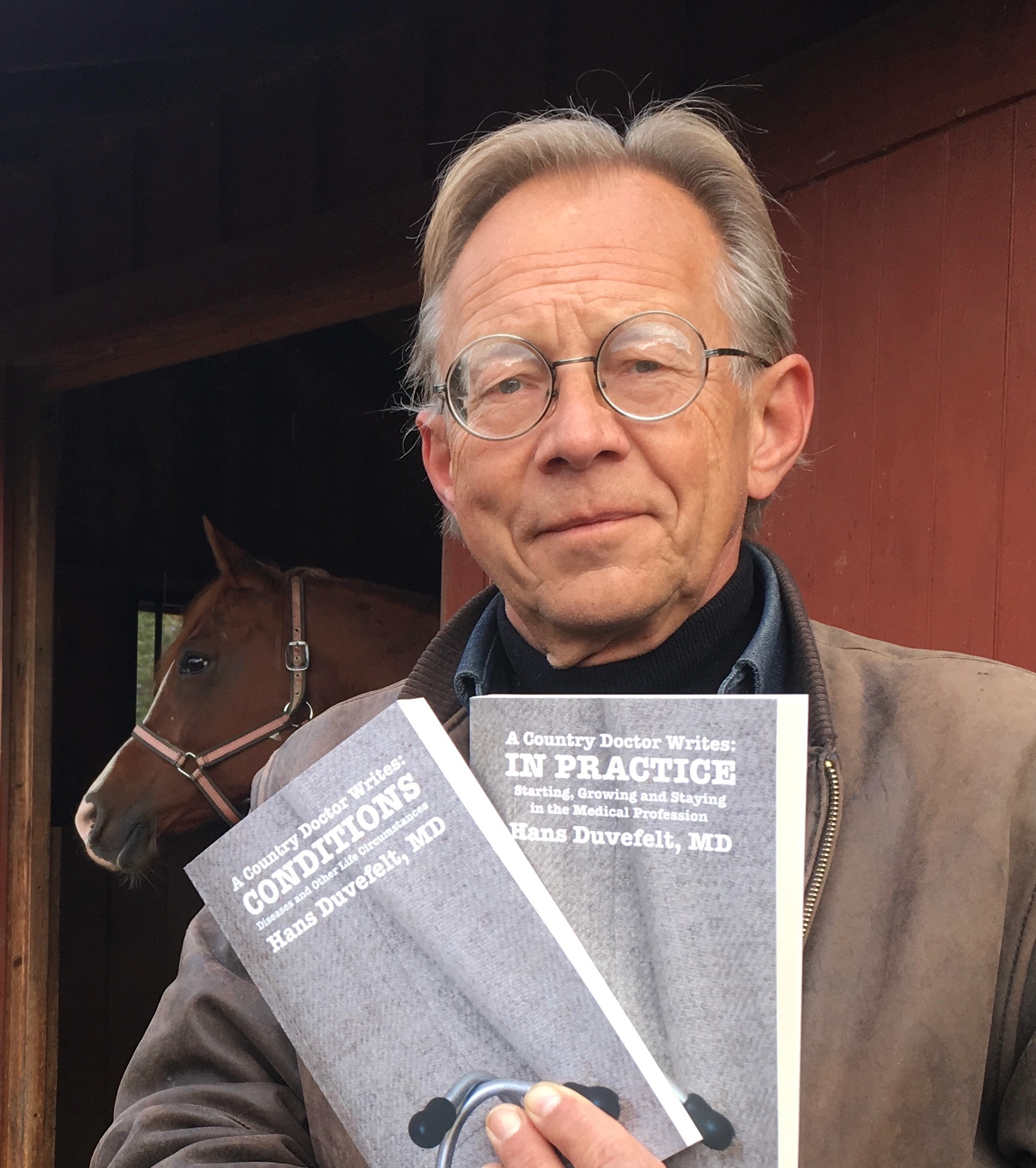
BOOKS BY HANS DUVEFELT, MD

CONDITIONS, Chapter 1: An Old, New Diagnosis

Top 25 Doctor Blogs Award

Doctor Blogs

Enter your email address to subscribe to this blog and receive notifications of new posts by email.

Mailbox

contact @ acountrydoctorwrites.com
Bookmark and Share
© A Country Doctor Writes, LLC 2008-2022 Unauthorized use and/or duplication of this material without express and written permission is strictly prohibited. Excerpts and links may be used, provided that full and clear credit is given.