Archive Page 205

Loss of Power

This country doctor lost power today in more ways than one.

During dinner tonight, with a hard rain beating against the windows and skylights of our family room and the wind howling outside, the lights flickered a couple of times and then went out. We always eat dinner with a kerosene lamp on the table, so we were not in complete darkness, and I quickly lit other kerosene lamps and the candelabra on the mantle of our Swedish ceramic tile stove.

Moments before this dramatic turn of events I had recounted for my wife this morning’s exchange with our clinic administrator, who had called me into his office to tell me that another physician at our clinic, five years my junior and with an internal medicine background, was vying for my role as Medical Director.

The way the administrator sees things, the future of our clinic depends on our ability to serve an aging population with increasingly complex medical problems. My colleague, the internist, prides himself in his ability to take complex internal medicine cases further before calling in specialists. Ironically, the way we get reimbursed is essentially at a flat rate, making longer visits a drain, while shorter visits are profitable for us.

The administrator told me in a roundabout way that my skills as a Family Physician in handling large numbers of acute visits involving pediatrics, GYN, minor trauma, orthopedics, ear-nose-and throat, ophthalmology and infectious diseases were needed to offset the costlier but less well reimbursed visits of the internist, but that I would be playing second fiddle to him because he deserves the title I’ve held for a dozen years.

My first reaction, I admit, had been one of anger. I helped build this clinic; in the first few years after I came here, our census doubled, and I created most of the programs and protocols in place today. After thinking about it some more, though, I admitted to myself that for any employed physician today, rural or urban, the non-medical people who run the clinics and medical offices we work in are free to bestow titles and “power” upon whomever they choose, and that is usually whoever serves the management’s purposes best.

I may not know what the ultimate purpose of our management is, and, as I was telling my wife just as we lost our electric power, the power I may have had as Medical Director was fickle, and subject to managerial whim, while my power as a physician and healer is something no administrator can take away from me; whether I see acute or chronic illnesses, I am following my calling in meeting my patients, one by one, where they are in their moment of need.

The one thing I will fight for isn’t the title, but my right to see my patients, the ones I have cared for almost a quarter of a century, as long as they choose to see me as their physician.

When I’m Sixty-Five

Leslie Dubrovnik turned sixty-five a few months ago. She has been an infrequent visitor at our clinic because of her lack of health insurance. Her husband is a disabled veteran, who runs a small used car dealership in the next town, and although they seemed fairly well off, she was always very cost conscious about her health care. She would come in once a year for a routine physical and she always got her mammogram, but when I suggested big-ticket items like a screening colonoscopy, she always declined.

“I’ll wait until I’m sixty-five”, she would always say.

At age sixty-five in the U.S., you qualify for Medicare, the government-sponsored health insurance. For many non-working and self-employed Americans, this is the only option for affordable health insurance. Many, like Leslie Dubrovnik, hold out until their Medicare benefits take effect. Soon after she turned sixty-five we scheduled her colonoscopy.

Tuesday I got Leslie’s report in the mail. She had a 3 cm tumor in her proximal colon. Thursday afternoon I got a call from the gastroenterologist who had done Leslie’s colonoscopy.

“I got the pathology report”, he said, “and it’s an adenocarcinoma. I’ve ordered her CT scans and I’ll have Dr. Beach see her for the surgery, but I thought I’d let you know right away so you can get her set up with oncology for possible adjuvant therapy.”

I called her up to go over what needed to happen. She sounded shaken, but okay.

“Doctor,” she said, “I want to thank you for nagging me about having a colonoscopy. Do you think I waited too long?”

What Do I Call You, Doc?

Physicians play different roles for different people and in different situations. We fix, educate, nurture, counsel, and sometimes just comfort. We inevitably broadcast our own feelings and values through our words, gestures and physical appearance.

Sometimes patients put us in the same sort of role as clergy; sometimes we take on a parental role.

I often see colleagues who insist on being called “Doctor”, even in non-medical situations. I also have colleagues in nearby towns that dress very casually and insist that patients call them by first name.

In the past few years I have read several articles about patients’ expectations and preferences in physician dress and titulature. The message seems to be that patients tend to prefer their doctors to be a bit on the conservative side.

Since I work in a small clinic, and also because I have been here for a long time, most people I see in my capacity as a physician know that I am a doctor. When I walk into the exam room, dressed in cuffed wool slacks, a crisp shirt and tie and an embroidered, long white lab coat with a stethoscope sticking out from my right coat pocket, I introduce myself by first and last name. I have never had anybody ask me if I really was a doctor in that situation. When I introduce myself to a child, I say, ” I am Doctor X—-“.

Some patients respond to my first-and-last-name greeting by repeating my first name and their pleasure in doing so doesn’t offend me. I simply let the patient decide how to address me, just the way I have to deal with what role they need me as a doctor to play in their illness or in their life.

I have found that even the most sophisticated patients appreciate when I speak plain English. I only use technical terms when I can introduce them and explain them; I never assume my patient is familiar with them.

I have found that comparing the workings of the human body to motors, household appliances and other everyday things helps establish a rapport with my patients and ensures I don’t get misunderstood.

One pet peeve I have is when doctors call patients by first name and themselves “Doctor”. I always found that to sound very disrespectful. We must be respectful of patients, who entrust us with their bodies and allow us to see their suffering and their fears.

Most patients are very respectful of me in return, except for the fact that many have trouble pronouncing my name; many adults and children alike call me by the initial of my last name, which, I guess, is a term of endearment in a way.

A Change of Heart

It was the day before Christmas 1996, and Betsy Billings was not the type to run to the doctor unnecessarily. She had been unusually busy since Thanksgiving, trying to get ready for Christmas, and the virus she had come down with in November seemed to have left her with a profound sense of fatigue.

For a few days she had noticed ankle swelling, which brought her to the office on Christmas Eve.

Betsy had always been a bright, cheerful woman, who seemed to take everything in stride. She spoke in a high-pitched, youthful voice at age 50, had a contagious smile that included a peculiar way of squinting, and she had the funniest way of acting out what she talked about, almost like playing charades.

Her leg edema was significant, and there was deep pitting that persisted after I removed my fingers. Her neck veins were a little distended, and her heart was enlarged on her chest x-ray. She admitted to sleeping on two pillows because of shortness of breath when lying flat, and she had put on weight.

I started her on fluid pills that day and ordered an echocardiogram. Her EKG didn’t look like she’d had a heart attack.

That day was the beginning of a long journey for Betsy, who almost to the day ten years later had to rush to Boston when her pager went off in the middle of the night because a donor heart was available.

During the ten years between her diagnosis of cardiomyopathy and her heart transplant she required more and more tinkering with her medications. She was my first patient on carvedilol, a beta-blocker specifically introduced for use in heart failure. When I was in medical school, beta-blockers were contraindicated in heart failure. When carvedilol was first introduced, patients had to be kept in the office to be monitored for dropping blood pressure after their first dose.

In the beginning of Betsy’s journey, I had to double check things with our local cardiologists, and as time went along, my backup shifted to her transplant team in Boston.

The transplant happened quicker than we had expected, because of the availability of a perfect donor match. During the next several months I didn’t see Betsy at all; I just got the reports from Boston.

When I first saw her after her surgery she was on high-dose prednisone and all kinds of immunosuppressants to prevent rejection. It was a strange experience. She was a changed woman. She was physically changed from the steroids, and she had none of her usual cheerfulness and optimism. She doubted she could ever lose the weight she had gained, and she suffered from anxiety I had never seen in her before.

The obvious explanation was the steroids; I have seen before how steroids can change a person’s psychological makeup. But in Betsy’s situation, I couldn’t help but wonder what it does to a human being to have another person’s heart beating in their chest. I don’t know that all of our personality is located in our brain, with all the talk about cellular memory and other such things we hear about today.

During Betsy’s first year of living with a new heart, and while on steroids, she struggled less successfully than before with her weight issues. She had a minor spending spree on one of the TV shopping networks, and her husband, Robbie, was sometimes perplexed by her moods. She even asked to be referred to a psychiatrist.

Last month I saw her again, and she looked great. She was on a low dose of prednisone, needed almost no heart medications, and mostly came to see me for a flu shot and some routine lab tests. She told me about her August vacation trip, when she had rented a bicycle and for the first time since she got sick gone on a bicycle picnic with her sister.

As she spoke, tears streamed down her cheeks, and her funny little squint was back. She made little body movements like charades again, and I saw the Betsy I had known before her transplant. She’s a new woman in a way, but also back to her old self.

A Nice, Clean Doublewide

Driving back from town this evening, I noticed that Marguerite Brown’s old farmhouse was gone. For two years now, Marguerite has been talking about how the old homestead was to be torn down, but there never seemed to be a timeline.

Two years ago, just before winter, Marguerite announced proudly that she wasn’t spending another winter in that cold, drafty old farmhouse of hers. I had been there years before and remembered it as untouched pre-world war II. The kitchen floor was made of unfinished narrow pine boards, the wooden cabinets were naturally darkened by age, and the woodstove was the only source of heat in that part of the house. The old furnace blew some hot air into the main portion of the house, but here, too, woodstoves made the temperature more bearable on cold evenings.

After Marguerite’s husband passed away, she took in a succession of old men as boarders. They got taken care of, and I’m sure it worked for Marguerite, too. That’s how I came to see the inside of her house, doing house calls for the elderly men she took care of. A few years ago, she gave up doing that, and soon after, she started talking about not wanting to spend winters in that house anymore. Like many people around here, she decided to get “a nice, clean doublewide”, essentially two mobile homes joined into one after delivery.

She sold the acreage in the way back of her property, had her new doublewide put up behind the old farmhouse, and for a couple of years, she chipped away at going through its contents.

“You can’t imagine how much junk you gather in sixty years”, she told me. She loved her doublewide, and she often told me how glad she was to be out of her old house, but she seemed to take an awfully long time going through its contents and getting ready for its demolition. I suspected it wasn’t just a matter of going through the physical contents of the house, but also saying goodbye to the memories of the place where she spent all of her adult life, raised her children, grew old, nursed her husband through the illness that took his life, cared for a succession of elderly boarders, and then spent years alone.

Three weeks ago her eldest daughter, Molly, succumbed to pancreatic cancer. As I drove past the pile of rubble that was left of Marguerite’s house today, I wondered if losing her first born child made her finally tear down the old homestead. One more painful memory associated with it…

When I saw her last, she had asked out loud why her daughter had to die, and not her. Then she had added: “No parent should have to bury a child”.

The house where Marguerite Brown lived all her adult life, raised her children and became a widow finally got torn down this week, but as she looks out the front window of her “nice, clean doublewide” I wonder if she still won’t see it, even now that it’s gone.


I just realized none of the posts show on an iPad or a computer, but they do show on an iPhone. WordPress is working on this. In the meantime, please visit my Substack.


Osler said “Listen to your patient, he is telling you the diagnosis”. Duvefelt says “Listen to your patient, he is telling you what kind of doctor he needs you to be”.


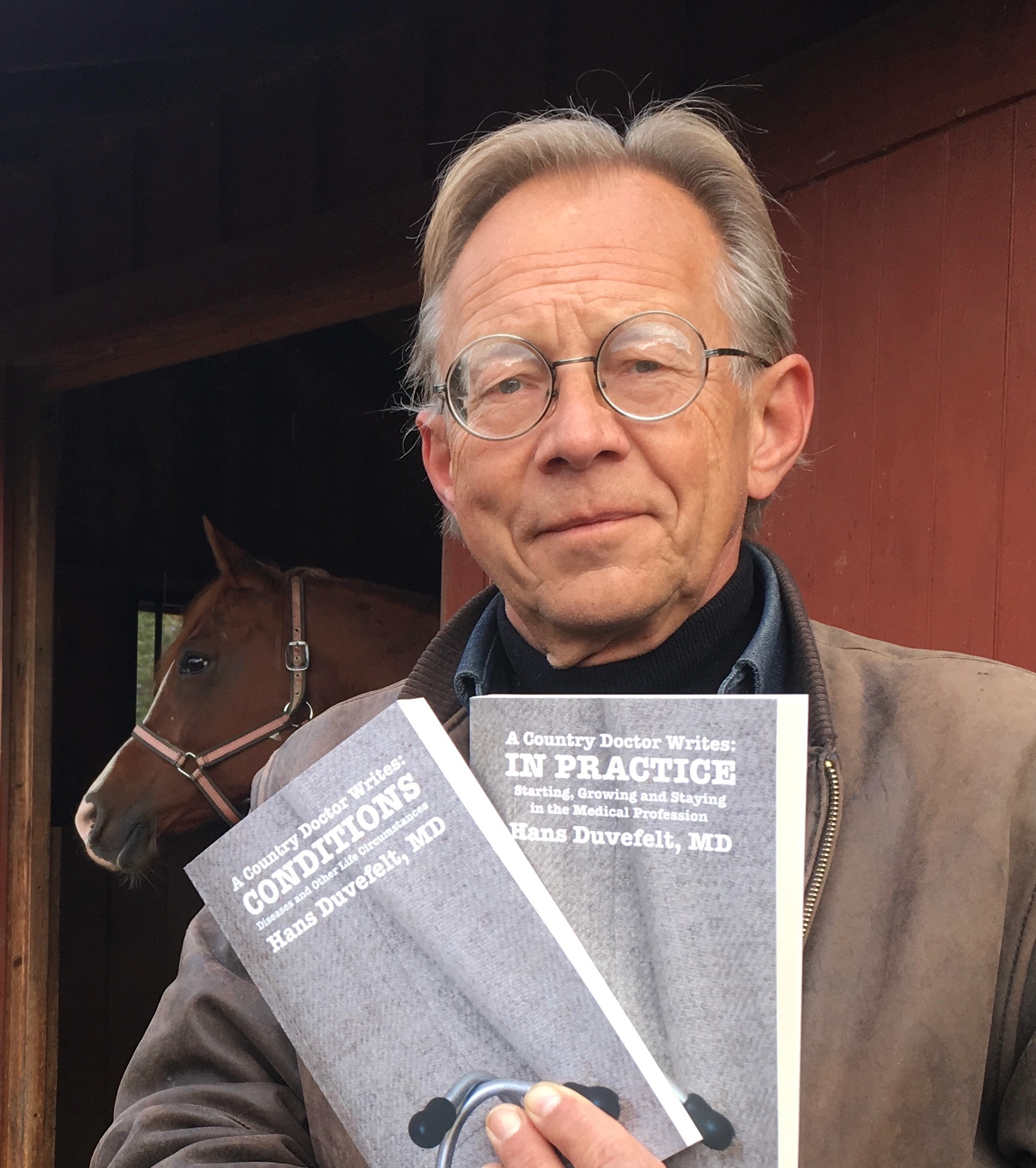
BOOKS BY HANS DUVEFELT, MD

CONDITIONS, Chapter 1: An Old, New Diagnosis

Top 25 Doctor Blogs Award

Doctor Blogs

Enter your email address to subscribe to this blog and receive notifications of new posts by email.

Mailbox

contact @ acountrydoctorwrites.com
Bookmark and Share
© A Country Doctor Writes, LLC 2008-2022 Unauthorized use and/or duplication of this material without express and written permission is strictly prohibited. Excerpts and links may be used, provided that full and clear credit is given.