Archive Page 203

My Annual Checkup

Yesterday I went for my annual physical at Cityside Family Practice, which is now part of Northside Hospital Health Systems. I have been with Cityside for years, but never really seemed to get a doctor there, who stayed with the practice or cared much for me as a patient. Dr. Wilford Brown was great, but he retired and later came to my own clinic, both as a patient and a part time physician; Dr. Royson became a Hospitalist, and Dr. Washburn seemed to be longing for the beach.

My blood pressure medicine needed to be renewed, and I was overdue for a checkup, so I called for an appointment several weeks ago. Dr. Washburn didn’t have any openings, but Dr. Bill McIntyre, one of the clinic founders, did. I took that appointment, and made arrangements to take the whole day off. This way, I could also get my car serviced, take care of some banking issues and get a new set of passport pictures.

Friday morning’s newspaper had a front page article about Medicaid reimbursement cutbacks and delays in payments to hospital-owned physician practices. There was also a story about layoffs at a small, rural hospital that was taken over by Northside Hospital Health Systems just a few years ago.

The last time I visited Cityside, they were an independent group. The waiting room was cold and uninviting, but the front desk area was buzzing with activity. This time things seemed to move a lot slower. The woman who took my insurance information appeared to be laughing at something. Finally she told me her computer was acting up, and this was a daily occurence since the new management put in a whole new system when they took over the practice.

In the exam room there were a few new posters on the wall and a laptop computer. Dr, McIntryre appeared without a paper chart in his hand and we took care of our introductions. We had met only once or twice before before, were well aware of each other’s professional reputations, but didn’t know anything about each other as human beings.

Bill quickly understood that I really didn’t need a lot of high-tech interventions from him. I am up to date on my health maintenance, and he agreed with me that my cholesterol isn’t high enough to worry about with my high HDL. Our conversation instead drifted toward the business of medicine in America today.

My annual checkup turned into more of a checkup on the status of primary care physicians today. Two mid-fifties physicians, one rural and one in a small city, compared notes. He had always been fiercely independent, and was now taking marching orders from a hospital Vice President and reporting to a Medical Director whose training and experience are in a subspecialty and not in primary care.

He surprised me a little by telling me that during all the years he had been working and building a practice in the small city north of my home town, he had actually lived near the ski slopes west of here, and “camping out”, as he put it, in the city.

“A year or two from now,” he confided, “I won’t be here. I’d like to start a small housecall practice and work out of my home in the mountains. I’ve had it with beureaucrats, insurance companies and big organizations.”

I quietly counted my own blessings, dealing only with a small beaureaucracy in a small town clinic five minutes from my home. I also made a mental note that, once again, I’d be looking for a new personal physician for my next checkup.

A Physician’s Funeral

Last week I attended a funeral service in another town for a physician, who died of cancer a few months after suffering a devastating stroke. He was clearly a good doctor, who saved many lives during his career, but the one thing his funeral service illustrated for me was that this doctor was an easy-going, kind and gentle man with a big heart.

He worked in the same town for twenty-five years, raised a family, went to church, sang karaoke and played a lot of golf. Friends, family and coworkers spoke at his funeral service, and their stories painted a picture that made me think about Dr. Samuel Baumgarten, who had tried to get my friend Barbara Brennan to slow down. Sam’s thoughtful, kind advice to patients and colleagues lives on, perhaps more than his medical and surgical triumphs.

As I reflect on my own calling as a physician and role as a member of my community, I am aware that there are times when I am so busy that I limit my engagement with other human beings to those contacts that go along with my job. I know there have been times when, after a long day of offering emotional support to patients, I offer less of the same thing to my wife and grown children, somehow thinking that they need less of that than my patients do.

Not usually one to make New Year’s resolutions, I resolved after the funeral that I need to be more present as a neighbor, parent, husband, son and community member. Being a good doctor is a fine thing, and I will always strive to be the best physician I can be, but first, I am a man. Doctors come and go, especially in this day and age, but my friends and family only have one me. 

This year I will take my life as seriously as I take my work.

Clinical Pneumonia or Virtual Health?

“So, are you saying Bobby really didn’t have pneumonia?” Mrs. Halstead asked. Her eleven-year-old son, a boy with multiple medical problems, had been in the office ten days before with fever, a bad cough, right-sided chest pain with each deep breath, and very loud crackles in the lower portion of his right lung. His blood count was normal and his chest x-ray looked almost normal – you could argue that it looked a little streaky in the right lower lobe, but the city radiologist who read his x-ray without actually listening to his lungs thought it was a normal set of pictures.

Bobby felt good at his follow-up appointment, and his lungs sounded clear. So, had I been wrong in diagnosing him with pneumonia when the radiologist didn’t agree with my interpretation of the films?

I remembered the case of Fanny Brown, my receptionist’s mother. She had a nasty cough and was losing weight. Her chest x-ray was normal, but her CT scan showed a tumor the size of a baseball – we all know a chest x-ray isn’t always the final word on what is wrong with a patient.

I tried to explain to Mrs. Halstead that a camera, even one used for x-rays, has its limitations.

“If you see a pretty rainbow and pull out your camera to capture it, but the picture doesn’t show the rainbow, does that mean you didn’t see a rainbow?” I tried.

There is an old Swedish military and Boy Scout joke, which I heard in both places: When the map and the terrain disagree, you go by the map in the military and by the terrain in the Boy Scouts. I spent more time as a Boy Scout than as a soldier – my inclination has always been to trust my assessment of the terrain.

I was on call for Christmas, and had a few days off around New Year’s. Catching up on my journals, I was delighted to find a piece in the December 25th edition of The New England Journal of Medicine by Abraham Verghese, MD, entitled “Culture Shock – Patient as Icon, Icon as Patient”. Dr. Verghese describes teaching residents, who seem more inclined to look at their patients through the “eyes” of the electronic medical record than through bedside clinical observation. He also talks about what to do when the map and terrain don’t seem to agree. He quotes Alfred Korzybski, the Polish-American philosopher credited with founding the theory of general semantics, who said, “the Map is not the Territory”. I’m not sure which of the two Korzybski thought was more real.

Bobby Halstead had been ill, and now he was well. I don’t know what his mother really thought of my diagnosis of his pneumonia, but it was a great illustration of what Dr. Verghese wrote about a short while later in “The Journal”: Our technology, invented as a way to document clinical reality, has almost become more real than the disease states it was designed to document.

A Negative Workup

Jonathan Blake is a hardworking 62-year-old janitor, who seldom complains. A few weeks ago I got several hospital reports about him.

He had gone to the emergency room with pain in the upper left portion of his chest, radiating down his left arm. He is a diabetic, who takes blood pressure and cholesterol medications, and he smoked cigarettes until five years ago. Needless to say, the hospital kept him overnight because he seemed such a high-risk patient for coronary artery disease, and put him through a stress test the next morning.

His nuclear stress test was normal, so he was discharged with a diagnosis of “non-cardiac chest pain”.

Almost two weeks later I happened to see his name on the computer screen at my workstation. Jonathan was in to see my colleague, Dr. Wilford Brown, who often sees patients the full-time doctors at our clinic cannot fit into their schedules. I always have full confidence in Dr. Brown’s ability to handle any situation, which also turned out to be the case this time.

I forgot about the whole incident until a few days later, when I, as Jonathan’s PCP (Primary Care Provider) had to sign an insurance authorization for a shoulder MRI. A few days later the MRI report arrived. Jonathan had torn a large portion of the rotator cuff of his left shoulder and he had also torn the long head of his biceps tendon.

Last week I saw him for his regular diabetes follow-up. By that time, he had already seen the orthopedic surgeon who will be repairing his rotator cuff. Jonathan showed me the telltale bulge in his upper arm, where the useless biceps muscle had contracted. At his age, that particular injury isn’t usually repaired, but the rotator cuff is essential.

“I can’t believe they didn’t pick this up at the hospital”, he said. “They didn’t listen to me. I told them all along my arm hurt, and all they worried about was my heart.”

Instant Feedback

My pager went off just after supper. The caller was Cindy Spofford, who works in a local real estate office, the patient was her four-year-old daughter Amanda, and the number was a cell phone. Their regular physician is Dr. Wilford Brown.

“Hi Doctor, thanks for calling me back. We’re down in the Capital City visiting my parents for Christmas. Amanda has had this terrible cough for two days and we just took her to the emergency room. They diagnosed her with bronchitis but didn’t give her an antibiotic. We wanted to check with you if that makes any sense.”

I inquired about her general condition. She didn’t have a high fever, had no trouble breathing, was eating and drinking fine, didn’t have any history of asthma, and her cough was dry and almost barking; I could hear her in the background, coughing in the back seat.

“Well, bronchitis is usually viral”, I explained. “Doctors have been quick to prescribe antibiotics for bronchitis for many years, but most of the time, they’re not necessary. Even ear infections are often caused by viruses, and can go away without antibiotics. You probably know how much trouble we’re having now with drug-resistant staph infections, right? They are such a problem because of all the antibiotics we have used unnecessarily over the years.”

I made sure that Amanda had had a decent physical exam and reviewed the warning signs that would warrant a return trip to the emergency room down in the Capital City.

Cindy thanked me. I wished her family a Merry Christmas and mused over how a reassuring voice on a cell phone from your hometown sometimes rates higher than an in-person opinion from a big city emergency room doctor.


I just realized none of the posts show on an iPad or a computer, but they do show on an iPhone. WordPress is working on this. In the meantime, please visit my Substack.


Osler said “Listen to your patient, he is telling you the diagnosis”. Duvefelt says “Listen to your patient, he is telling you what kind of doctor he needs you to be”.


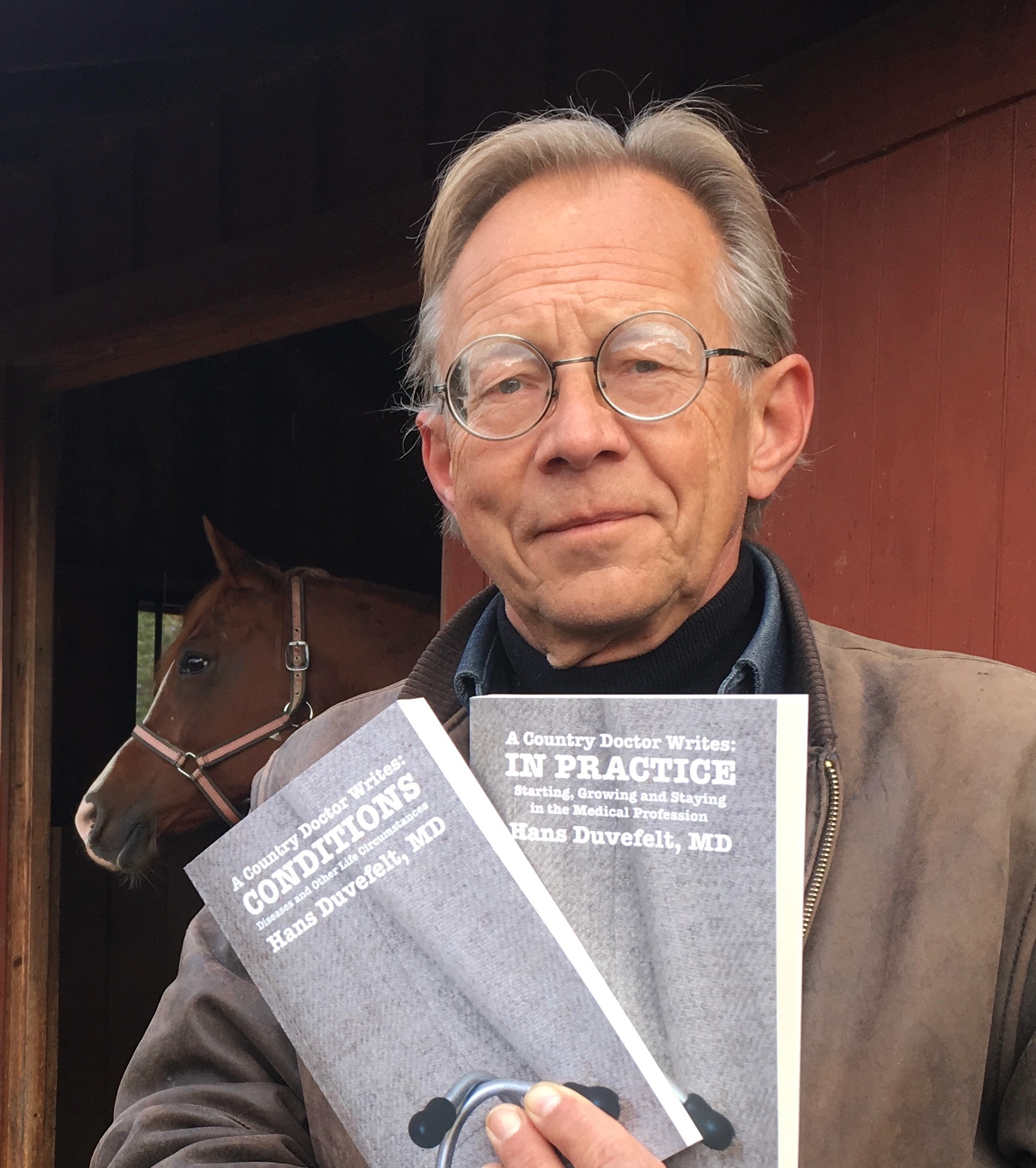
BOOKS BY HANS DUVEFELT, MD

CONDITIONS, Chapter 1: An Old, New Diagnosis

Top 25 Doctor Blogs Award

Doctor Blogs

Enter your email address to subscribe to this blog and receive notifications of new posts by email.

Mailbox

contact @ acountrydoctorwrites.com
Bookmark and Share
© A Country Doctor Writes, LLC 2008-2022 Unauthorized use and/or duplication of this material without express and written permission is strictly prohibited. Excerpts and links may be used, provided that full and clear credit is given.