Archive Page 201

An Empty Stall

Twenty-four hours ago, as my wife and I finished supper, I told her I wanted to change from my work clothes into my barn clothes and join her as she fed the horses their evening meal. We had spent a rainy but still relaxing three-day Fourth of July weekend, and by Monday night I was already missing our new barn and the horses.

Caleb and our newly adopted Arabian princess nickered as we entered with their grain mash. We watched them eat with obvious pleasure, said goodnight and returned to the house to make it an early night.

As I got in bed, my wife asked if I could hear a noise. There was a clanging and a thumping outside somewhere.

I stepped outside and immediately heard that the noise was coming from the barn. Caleb was down, thrashing around in his stall. I ran in to get my wife and we called the large-animal veterinarian and a neighbor up the road who also owns horses.

It looked like a case of colic, and we administered the Banamine after speaking to the veterinarian on his cell phone. We walked Caleb around his paddock. He went down a couple of times, but we managed to get him up each time.

By ten o’clock the vet was there and puzzled over the situation. He has been at it a few more years than the twenty-eight I have been in Family Medicine, but he is limited to the technology he can fit in his Dodge van.

We went over our options. Caleb looked like he had colic, but his pulse was slow and strong. He also had a long history of unexplained neurological and constitutional symptoms. Exploratory surgery three hundred or more miles down the road on a twenty-year-old horse isn’t undertaken lightly.

We listened to the vet as he shared his assessment. We agreed to treat Caleb’s pain and observe him for a while. The vet left, and we stayed with Caleb for several cold and windy hours in the pasture as a thunderstorm passed in the distance. Now and then he would get up and walk around, but there wasn’t much improvement in how he seemed to feel.

As the vet returned at dawn, we could see that Caleb was giving up. He lost his battle right there in his brand new pasture this morning as the first birds began to sing. I cut a few strands of hair from his mane for a keepsake, and we removed his leather halter.

It was only two weeks ago we all moved into our little red farmhouse with ten acres of land and a brand new Amish-built horse barn right outside the kitchen window. We left our house in the village partly so Caleb could be with us, instead of being boarded. We also adopted our little Arabian princess as a companion for Caleb.

After the cold, sleepless night out there in the pasture, we buried Caleb at the highest spot, overlooking our miniature farm. I stripped his stall and covered the orthopedic floor mat with new shavings.

As we stood there in his empty stall and walked through his empty paddock, we talked of what a big presence he was – a gregarious horse with a sense of humor and a taste for mischief, a thousand pound teddy bear, who loved to cuddle. It is humbling to have earned the affection of such an animal. In just a few hours we lost our biggest pet. We now have his empty stall right outside our kitchen window. We also have our new little Arabian princess, who just lost her new companion. We all feel a little lost.

Yesterday’s Children

Ethel Bray was in for her annual ear wash Friday. Ninety years old next month, she is one of the spunkiest, funniest women I know. Her youngest sister accompanied her to the office. Somehow we came to talk about Ethel’s remarkable vitality.

“You know the doctor didn’t think she’d make it,” her sister told me. “She couldn’t tolerate her mother’s milk, so she was raised on barley water.”

Ethel does all her own housework and credits her long staircase for her remarkable physical health.

“I get all my exercise going up and down those stairs half a dozen times a day,” she announced.

I know I cannot take any credit here; she takes no prescription medications and she hasn’t had any blood tests in the last decade. She never had a mammogram or a colonoscopy. If it weren’t for her recurring earwax buildup, I wouldn’t have the privilege of knowing her.

The day before I had seen another child nobody expected to live. Jonathan Buck is only seventy-five, a stocky, muscular man with a can-do attitude. His daughter, Wendy, told me last year that the doctor who delivered him advised his mother to put him in a dresser drawer and keep him warm, but not to get attached to him, because he probably wouldn’t live through the night, since his brain was bulging out through a soft spot in the back of his head. Mr. Buck still has an unusual looking bulge in the back of his head, but is a bear of a man in every other respect.

We must never underestimate what a child can overcome.

A Tale of Two Sisters

Jane Barker and Judy Swift didn’t look like sisters, and from what I understand, they didn’t spend much time in each other’s company. They had both been my patients for years by the time I learned that they were sisters.

The one thing they had in common was their smoking history. Jane was discreet about it, but Judy’s struggles to quit were obvious. She had tried every available smoking cessation drug. She had COPD and saw a pulmonologist regularly to help manage her chronic cough and shortness of breath.

Jane’s most pressing medical problem was always her touchy digestive symptom, and Judy came in a couple of times last fall for fatigue. Then just before Christmas, Jane developed a severe cough. Her chest x-ray was negative and the cough was non-productive. I told her it was probably viral, and prescribed inhalers for her. She called back asking for antibiotics and cough suppressants. I tested her for influenza and prescribed empiric antibiotics for mycoplasma, but she continued to be plagued by her dry cough. A repeat x-ray suggested a lesion in her right lung, and it looked malignant on CT scanning. I referred her to a pulmonologist and a thoracic surgeon.

Jane’s cough made the thoracic surgeon nervous, and her surgery was delayed several times because of the severity of her cough. Finally, in mid-February, she had her surgery. I saw her for a couple of postoperative visits, and although she felt terrible and continued to cough, her surgery seemed to have been a success. We spoke of her stubborn cough and how it probably saved her life.

In late February I saw her sister Judy again. She looked terrible, and she had lost weight. I had done all kinds of tests on her just before Christmas when she came in for fatigue. She had seen her pulmonologist not that long ago, but I sent her for a CT scan of her chest, even though her x-ray didn’t show anything new. The scan showed a plum-sized irregularly shaped tumor deep inside her right lung. She also had several enlarged lymph nodes.

I called Barry Wolf, her pulmonologist. I could hear him sigh when I told him what I had found.

“I’ll get her right in,” Barry said.

I received a couple of courtesy copies of her test results in the mail that told the rest of the story. Her pulmonary function tests were very poor, and she wasn’t a surgical candidate. There was a consultation note from a radiation oncologist, then nothing more.

Her obituary was printed in Saturday’s paper.

My Most Expensive Instrument

Doctors in other specialties treat their patients with exotic and expensive instruments to peer inside their bodies or rearrange minute and delicate body parts. Not so Family Practitioners. When I think about it, I am convinced that my most expensive, or, shall we say costly, instrument is my pen. Not the Montblanc my wife gave me for Christmas one year, but the disposable rollerball pen I buy by the box and use when I order tests and prescribe medications.

How often does a doctor reach for the prescription pad as a quick solution to a problem that really should be dealt with in a meeting of the minds between healer and patient? How often does a doctor order a test to document what is already evident through the history and physical exam?

I often hear patients ask for an MRI “just to know what’s going on in there”, and unless they have managed care that requires “prior authorization” for expensive tests, how much faster isn’t it to order the test than it is to explain to the patient that the test serves little purpose in a case of low back pain, for example, since science still hasn’t sorted out what causes most cases of that particular ailment.

We are constantly bombarded with advertisements and promotions for expensive medications that offer theoretical advantages over older, less expensive, drugs. And all the studies backing up the effectiveness claims of these new wonder drugs are double blind comparisons with placebos. How polite, not to compare them with the well established treatments they are hoping to replace.

We as physicians have an obligation to our patients to watch over their health, but also to help them get reasonable value for their health care dollars (or Francs, kronor, Pounds or Marks). One of our duties is to test and prescribe responsibly, and to strive for achieving a fair balance between protecting the individual patient’s interest and the collective interest of all our patients.

I often find myself comparing physicians’ work with that of other professionals, particularly lawyers. I imagine a lawyer, hired by one client to protect that client’s interests, can devote just about any amount of time that the client is willing to pay for, and that ultimately someone else within the legal system, be that a jury or a judge, will balance, arbitrate or adjudicate the claims of the opposing parties. As physicians, we usually can’t give a disproportionate amount of attention to a single patient, at least if we expect the insurance companies to pay us for our work. We also cannot usually practice with complete disregard for the greater common good. We need to be the ones to say “If I did this for all of my patients, what would happen?”

If I prescribe broad spectrum, expensive antibiotics for one patient who doesn’t need them, I need to ask myself what would happen if I did that for most of my patients. This is why we have multidrug resistance today. If I order unnecessary tests “just to be sure” in a few cases, what would the impact be if I extended that behavior to most similar situations?

Doctors in the United States often think that ordering more tests is a way of avoiding criticism or even malpractice litigation. Time and time again, we see that the biggest danger of such events is practicing in a hurried fashion without really stopping to listen to our patients.

Sometimes I reflect on the irony that even one month’s worth of any one of the new maintenance drugs I am asked to prescribe for restless legs, overactive bladder, migraine prevention or prostate trouble costs more and is less regulated than my fee for the time, effort and expertise required in choosing, prescribing and monitoring the treatment.

Unfortunately, my simple rollerball pen is a more expensive instrument than the diagnostic and therapeutic acumen I have developed over the years, at least in this economy.

Thicker Than Water

Tamara Zwyck changed her name to Samantha when the Millers adopted her at age six. She was tired of being a foster child and was eager for a new life and a new identity with her new mother and father. A lively brunette with dark eyes, a broad smile and a boyish haircut, she started to fuss with her hair and loved going through her adoptive mothers custom jewelry boxes. She liked school and joined the Sunday school and youth choir of her parents’ Methodist Church.

Bill and Barbara Miller were a childless couple in their early forties when Samantha came into their life. They values were old-fashioned and they were quiet, orderly people. They always seemed to be looking out for Samantha’s welfare and development, and seemed to be a very happy little family.

Samantha’s old foster mother kept in touch with the Millers, but the State social workers soon withdrew from Samantha’s case, since everything about this adoption seemed to go exceptionally smoothly.

Last summer I saw Barbara Miller for a routine visit, and she looked tired and sad.

“It’s Sam”, she said. “She’s rebelling against everything we say, and I’m afraid we’re losing her.” Samantha was almost sixteen then, and I hadn’t seen her for about a year.

“She’s skipping school and I think she’s doing drugs,” Barbara added. We talked about her options.

It wasn’t long before I got the first Emergency Room report on Samantha. Then there was a records release soon after she turned sixteen. She was in a shelter, and they needed her medical information.

When I saw Bill Miller a short while later, he told me Samantha was back with them, but still fighting them about their house rules and expectations. He told me Sam had been in contact with a biological aunt in the same town.

“Sam is playing her aunt against us,” he said, “and her aunt is telling her that if Sam goes to live with her, she will have the freedom to smoke, go out with boys, and anything else she wants.”

“She is saying things like we’re not her real family, and we don’t respect her for who she really is. We love her so much and we don’t want to lose her, but we don’t want to condone what we think is wrong just out of fear that she will run away again.”

I could literally feel his desperation. In our state you cannot prevent a sixteen year old from running away and living with someone else.

“I think all you can do is tell her you love her and explain what you want for her,” I started. “You can’t threaten her, because the law gives you no options to control her, and you know threats don’t work anyway.”

Bill’s blood pressure was too high and we started him on a new medication. He came back for a recheck a month later and told me Samantha had left the Millers to live with her aunt.

“She’s the only daughter we’ll ever have,” he said somberly, adding, “I never wanted to believe that blood is thicker than water.”


I just realized none of the posts show on an iPad or a computer, but they do show on an iPhone. WordPress is working on this. In the meantime, please visit my Substack.


Osler said “Listen to your patient, he is telling you the diagnosis”. Duvefelt says “Listen to your patient, he is telling you what kind of doctor he needs you to be”.


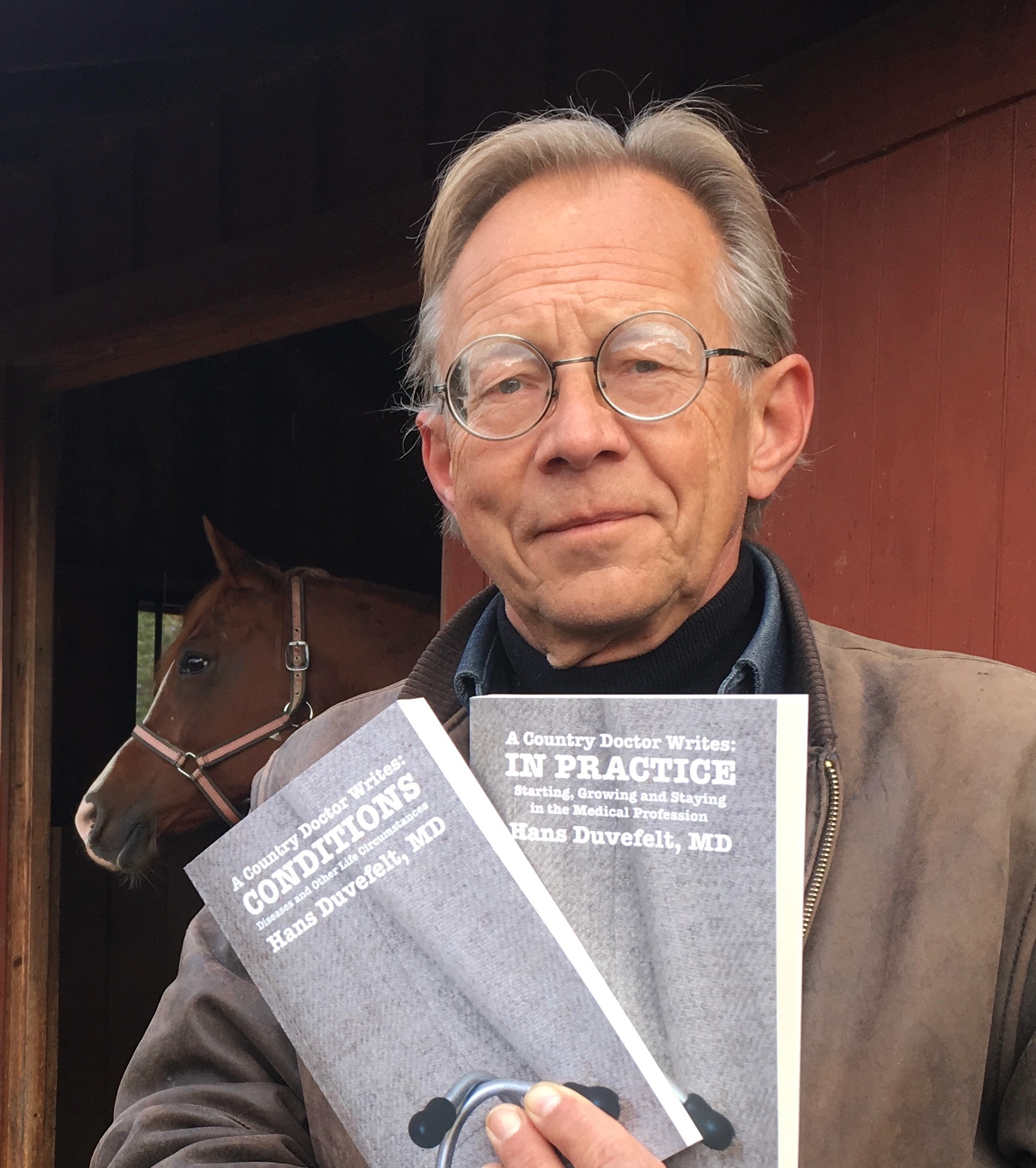
BOOKS BY HANS DUVEFELT, MD

CONDITIONS, Chapter 1: An Old, New Diagnosis

Top 25 Doctor Blogs Award

Doctor Blogs

Enter your email address to subscribe to this blog and receive notifications of new posts by email.

Mailbox

contact @ acountrydoctorwrites.com
Bookmark and Share
© A Country Doctor Writes, LLC 2008-2022 Unauthorized use and/or duplication of this material without express and written permission is strictly prohibited. Excerpts and links may be used, provided that full and clear credit is given.