Archive Page 20

Apropos My Recent Post About the Lack of Leverage in Primary Care (from the Washington Post)

I wrote in September about how surgeons’ time and expertise is leveraged in their specialties while primary care doctors are largely left to fend for themselves, doing many things that severely diminish their productivity and push them toward burnout.

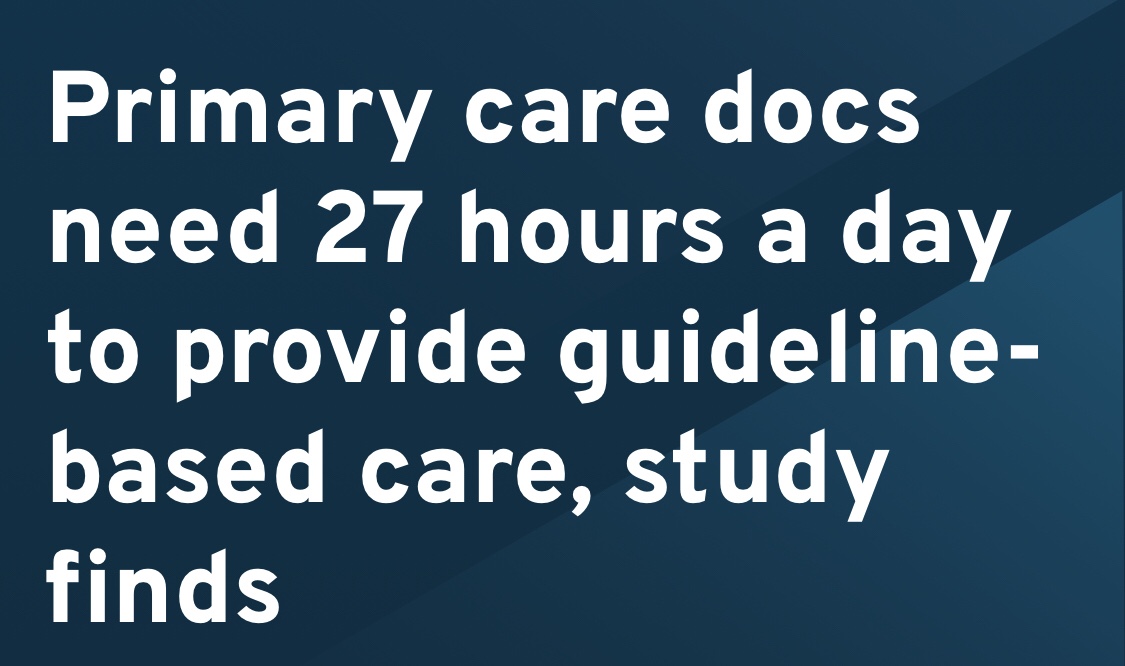
Shortly after I did that, I got an email newsletter that quoted and linked to an article in the Washington Post making the same observation and said primary care is at a tipping point. Today, only 25% of doctors are in primary care. This means there aren’t enough primary care doctors for everyone who needs a PCP (which many insurance companies even require).

The article points out that in 1980, almost 2/3 of medical visits were in primary care and 1/3 were in specialty medicine. By 2013, those statistics were reversed.

This is what the Post states has caused this switch, besides the income inequality between generalists and specialists:

“But the dispirited feeling that drives doctors away from primary care has to do with far more than money. It’s a lack of respect for nonspecialists. It’s the rising pressure to see and bill more patients: Employed doctors often coordinate the care of as many as 2,000 people, many of whom have multiple problems.

And it’s the lack of assistance. Profitable centers such as orthopedic and gastroenterology clinics usually have a phalanx of support staff. Primary care clinics run close to the bone.”

https://www.washingtonpost.com/opinions/2023/09/05/lack-primary-care-tipping-point/

Abundance is a State of Mind, Some Days Harder to Achieve than Others

Maine country road ©️Hans Duvefelt, MD

In 2014 I wrote a piece titled “Recapturing Abundance”. I was working hard and often feeling stretched, but this particular day I did a couple of house calls that brightened my day and lifted my spirits.

Recapturing Abundance

One visit was not at all an uplifting one, because my Alzheimer’s patient had moved closer to the end of his disease progression. But it was an important visit, best conducted in his home.

The other was quick, reassuring for me that my diagnosis was correct, and for him in that it showed how much I cared.

Both those housecalls energized me and I breezed through the rest of my day, even though it was busy and demanding.

That night, I reflected on the idea of abundance as a state of mind as I sat in the barn with the animals. My wife, in the house, left me a note with words of wisdom from the ancients. We are not together anymore, but even during years of drifting apart we often shared our readings from varied sources.

Now, nine years later, I experience the sense of abundance less and less often. Primary care is hard work, increasingly dominated by the computer at the expense of patients and providers both. Healing is hard to bring about without the time and human connection doctors of my generation have known through the earlier years of our careers. Those new in their profession don’t know the difference, because they never had the experience of uninterrupted eye and emotional contact during an entire patient visit.

I have now started to work part time in the housecall practice I mentioned a short while ago. Because it is a new practice, it is naturally slower. But the way it is set up, it isn’t necessary to keep a hectic pace just to stay in business. And it puts me on the road, where I can see the early fall foliage, and in patients houses and apartments, where I can see their pets and their families, where I see how they move around and what interests them. This is something I feel will help me recapture my sense of abundance more than just once in a great while. I love taking care of patients, but not always the way we have to do it these days.

This is what my new post category on SUBSTACK, “Progress Notes”, will document – in a roundabout sort of way.

As usual when I describe clinical encounters in my writings (it’s been 15 years since I started “A Country Doctor Writes”), I draw from my 44 years of practice in Sweden and in several different clinics in Maine. Everything is heavily fictionalized. Many changed details can still bring about the same emotion (and there will likely be a range of them), conclusion or realization that made me want to write each story in the first place

The Appalling Lack of Leverage in Primary Care

A surgeon evaluates patients and performs surgery. But surgeons don’t administer the anesthesia. They also don’t sterilize their instruments or fetch them during the operation nor do they hold the retractors while also cutting or suturing. They also don’t do all the dressing changes and repositioning of patients postoperatively. They move on to other surgeries.

A whole team is working alongside with the surgeon to help the operation go smoothly without wasting the surgeon’s (or patient’s) valuable time.

Contrast that with primary care.

Some of the other people on our team, like our medical assistants, used to prioritize incoming results, reports and messages to help us get to the most important ones first.

Those days are gone.

Modern EMRs are designed to have the provider be the one who receives everything and then delegates to the medical assistants to tell the patient or have the test repeated or whatever needs to be done.

Then we have new categories working with us – pre-visit planners is one of many names for them. Their job is to look for “care gaps” and then tell the providers they need to order mammograms, colonoscopies or whatever.

(Years ago, pre-visit planning used to have the purpose of making sure we had what we needed to carry out the visit: a visit like “Followup MRI” would mean checking if the patient has had the test and if we have the result, but that’s not what today’s pre-visit planners do.)

Neither of those job functions are meant to help the primary care provider do what only people with a license to practice medicine can do.

The surgeon’s expertise is leveraged but the primary care provider’s isn’t. We are doing more and more non-doctor work, in large part thanks to our EMRs.

This explains both the doctor shortage and the burnout epidemic. And it is a perpetual motion machine: more non-clinical duties means more of us quit, which makes those who remain even more likely to burn out and quit.

The solution is obviously simple:

Hire people to sort and prioritize incoming information so the provider doesn’t waste time on routine information when their attention should go to the most important information first.

(And for any non-medical readers out there, computer generated flagging of an abnormal chemistry profile is not helpful. There is a statistical expectation that 5% of lab results will be abnormal even in normal people and therefore a panel with 20 items would be expected to have at least one abnormal result, and thereby be flagged as a priority item in the physician’s electronic inbox. A modest amount of knowledge is required for this job.)

Give the pre-visit planners authority to check with the patients by phone or electronically if they want a mammogram or colonoscopy or whatever instead of ordering the provider to do that in their next visit, which is likely to also have a lot of other requirements, like depression screening, medication reconciliation, repeating any elevated blood pressures, checking desired gender identity and whatnot.

We aren’t trying to put ourselves above our team members when we resent doing what non-physicians could do. Our visits and the billing codes they generate pay all our wages and keep our clinic doors open. Why aren’t our skills and knowledge leveraged to their fullest extent these days? They used to be…

Status Report: 15 Years of Blogging

I’ve been posting my thoughts and experiences on A Country Doctor Writes for over 15 years now and here are a few statistics:

The blog has had 687,308 views as of this writing and 366,807 unique visitors. I have published 962 posts, and the one with most views was in January of this year, with 13,730 views:

The last one on this year’s list of posts with only 2 views is from 2014, when it had 156 views, and it is actually one of my favorites:

My best year ever was 2021, when I had 5 posts with over 8,000 views. They were about weight loss myths, doxepin, nonfasting labwork (a video), Primary Care and Walgreens pushing for 90 day scripts.

Be Prepared! Older Doctor and Former Scout Leader Stops Bleeding at Home.

I have a red bump on my nose that started out looking like it was going to be a little skin cancer, but which now looks just like a hemangioma, a little blood vessel-filled lesion of mostly cosmetic significance.

Sitting in front of my laptop tonight I felt and saw blood dripping from my nose. I sometimes get nosebleeds, so I just pinched my nose and went in the bathroom. Looking in the mirror I saw this was no ordinary nose bleed, it was my little hemangioma that had sprung a leak.

I still reached for a cotton ball and saturated it with decongestant nasal spray, which is what I do to stop nose bleeds, and I just placed it outside my nose. Holding it there with some pressure, the bleeding slowed down after which I applied a styptic pen to cauterize it. I keep that around for the very rare shaving accident a man can have.

Simple tools to have around. Back to the computer…

Oh, that reminds me of when I diagnosed my own vitreous detachment of my eye while visiting family in Sweden.


I just realized none of the posts show on an iPad or a computer, but they do show on an iPhone. WordPress is working on this. In the meantime, please visit my Substack.


Osler said “Listen to your patient, he is telling you the diagnosis”. Duvefelt says “Listen to your patient, he is telling you what kind of doctor he needs you to be”.


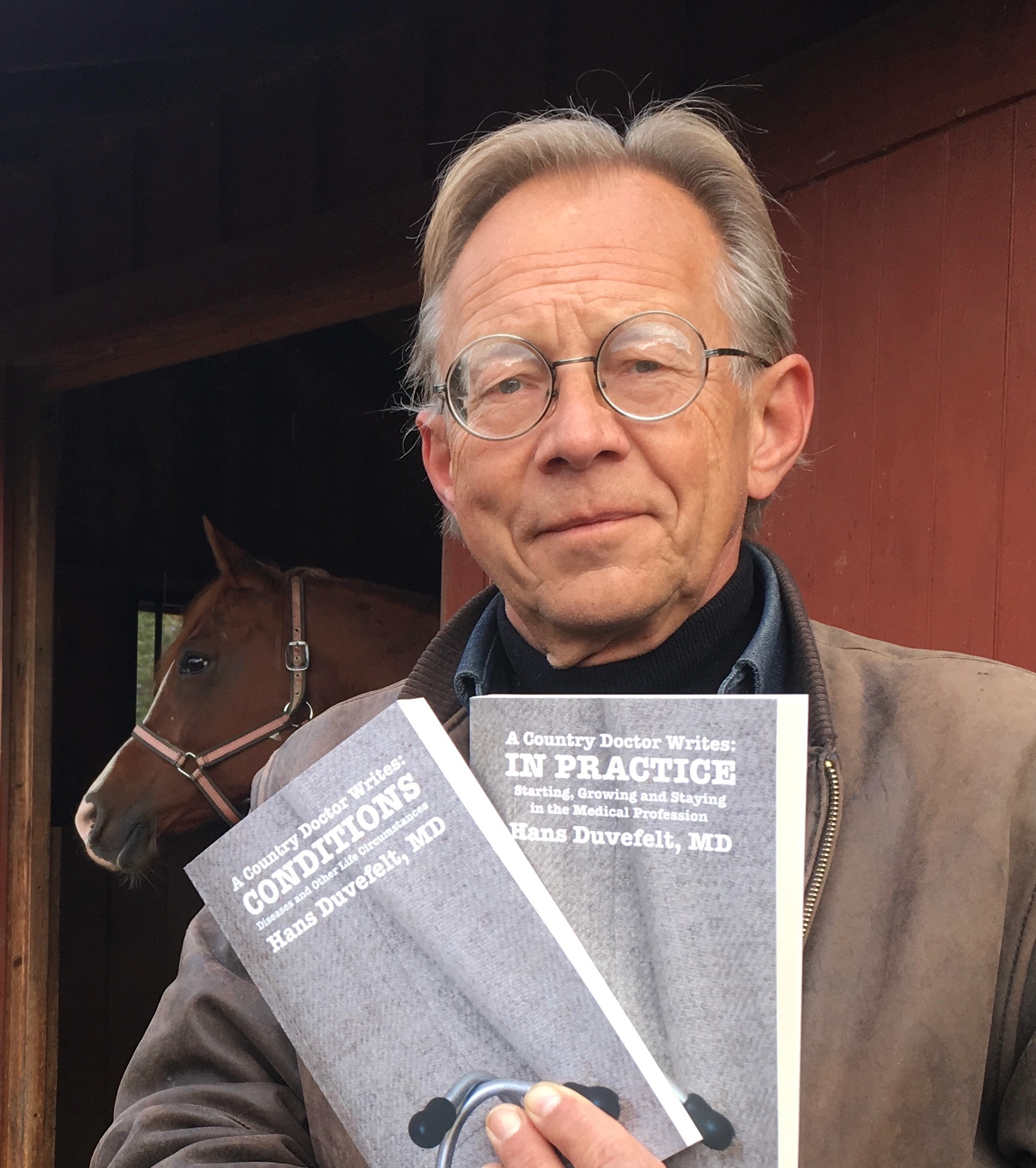
BOOKS BY HANS DUVEFELT, MD

CONDITIONS, Chapter 1: An Old, New Diagnosis

Top 25 Doctor Blogs Award

Doctor Blogs

Enter your email address to subscribe to this blog and receive notifications of new posts by email.

Mailbox

contact @ acountrydoctorwrites.com
Bookmark and Share
© A Country Doctor Writes, LLC 2008-2022 Unauthorized use and/or duplication of this material without express and written permission is strictly prohibited. Excerpts and links may be used, provided that full and clear credit is given.