Archive Page 193

Invisible Ties

Kirk Donner has been my patient for eighteen years, ever since his adoptive parents brought him home at age two weeks. He is their pride and joy, very wise for his years, talented in languages and sports and strikingly handsome. He is taller than his parents with olive skin, curly dark hair and brown eyes, contrasting with their fair complexions and reddish blond hair.

He had known he was adopted from early on. At his well-child visits he would explain to me that he didn’t grow in his mother’s belly but in her heart as she longed for a baby to love some day.

His parents told him his birth mother was very young and wasn’t able to take care of him. She placed him for adoption because she wanted the best for him, they had explained.

Kirk often wondered what she was like and if they had a lot in common. His adoptive parents knew very little about her. They had a medical history questionnaire and a short biographical sketch from the adoption agency. They knew her first name was Suann.

A few times in moments of anger he had lashed out at his parents: “You don’t love me! I wish I could live with my real mother”, but most of the time he was happy with his life and didn’t even think about being adopted.

For several years before his eighteenth birthday the Donners had promised to take him to the State Capital if he wanted to go to the adoption registry. He knew that by registering there, he might be able to find his birth mother.

Kirk hesitated. He was very curious about her, but he also worried about what it would be like to meet her. Would she be someone he could respect and how would she feel about him? His eighteenth birthday passed and he still wasn’t sure.

Then a classmate’s mother had a car accident and was nearly killed when a moose ran into the road in front of her car. Kirk decided to make the trip as soon as possible.

With his adoptive mother he decided on a day and they made a date of it with lunch at a nice restaurant across the street from the registry. Kirk enjoyed the food but didn’t eat with his usual appetite. They had agreed that he would go alone while Beth Donner had coffee and they would meet back at the car when he was done.

Kirk took the elevator to the fourth floor. He was alone. As the door slid open, he stepped forward and almost collided with a tall, dark-haired woman with designer jeans and a plain, white blouse. Her eyes met his as he stopped and apologized. They were large and kind. She flashed a smile as he swerved around her, embarrassed and eager to get to the registry.

He walked up to the receptionist and stated his errand with words he had practiced in his mind the whole trip.

The clerk handed him a form and as he reached for a pen he saw a stack of similar forms in front of her. Reading the top one upside-down he saw the name:

Suann Walker.

A Work Excuse

Bibi and Dwight, both in their mid-sixties, always move as a unit. They have been married for forty years. Early on, they were athletic and adventurous, but over the past five or six years Dwight has developed macular degeneration and a fairly severe case of arthritis.

I have seen him once a year for a physical and usually no more. At his last two physicals, Bibi brought up her concern that Dwight was tired. She has always been present for his visits, even before his eyesight started to fail him. He always downplayed his fatigue and blamed it on his age.

This time I focused my exam on different causes for fatigue and ordered several blood tests. Bibi seemed pleased, but Dwight seemed distant and unengaged. I suspected he might be depressed about his arthritis and near blindness. We agreed to have a follow-up to go over the test results.

The only remarkable thing about his results was a borderline low thyroid function, which usually doesn’t cause any symptoms at that level.

As it happened, Bibi had her own appointment with one of my colleagues at the same time as Dwight came back to go over his test results.

After greeting him, I started:

“Well, Dwight, all your blood work looks fine…”

“I was sure it would”, he interrupted. “Listen, Doc, I know why I’m tired”, he said with a tone of frustration in his voice.

“I love Bibi, but she’s not like you or me”, he began whispering. “From the crack of dawn till way past anybody’s normal bedtime, we have to work. In the spring and summer it’s the gardens. We grow more vegetables than we could possibly eat. In the fall it’s the raking and the firewood. We are three years ahead on wood now. In the winter we dust and reorganize all her books and knickknacks. We never relax; we never sit down and talk. She always has to be busy. She’s wearing me out, Doc!”

He raised his arms in a gesture of exasperation.

“Help me, Doc!”

Just then, there was a knock on the exam room door. Autumn, my nurse, peeked in and said:

“I’ve got Bibi here, are you ready for her to join you?”

I glanced at Dwight. His eyes sank to the floor as he nodded.

“So, how is my boy?” Bibi said as she sat down next to Dwight while I quickly gathered my thoughts.

“Well, it’s nothing serious”, I said, “but Dwight has subclinical hypothyroidism, which is due to an autoimmune process in the thyroid. Some people get quite tired with that, more than you might expect from the thyroid numbers alone. Coupled with his arthritis, I expect Dwight to be more tired both physically and mentally than he was a few years ago.”

Both Bibi and Dwight had their eyes on me as I came to my concluding statement:

“I think with more rest built into his day, he should be good for many more years.”

As we said good-bye, his knotted hand squeezed mine quite hard for a person with arthritis.

Decision Support, Professionalism and the Lost Art of Healing

Health care in the United States is struggling to redefine itself. We have been spending twice what other countries spend on health care, yet our citizens are less healthy. We now have legislation to create more or less universal insurance coverage, and we are about to embark on a technology-driven quest for quality and uniformity. At the same time, Americans are increasingly turning to alternative health care practitioners, mostly at their own expense, because the health care system is not meeting their needs.

In the three decades since I entered this profession the typical role of physicians has changed dramatically. In the 1980’s most doctors were self-employed and received payment directly from their patients. Now most doctors are employees who receive their salaries from organizations that collect payment from insurance companies on behalf of the patients.

With this arrangement patients have lost the power that came with directly paying doctors for their services. Doctors now have to answer not only to their patients, but also to their own employers and to the insurance companies, whose profits are carved from the difference between insurance premiums collected and medical care delivered.

Medicine has until now been considered one of the three learned professions along with Law and Theology. These three professions are said to require advanced learning and high principles. Physicians, lawyers and clergy study and interpret their material. They sometimes find themselves in a position where they are forced to disagree with others of similar training, who draw different conclusions from the same text.

It is very tempting to think that there is only one right way to do things in medicine. After all, medicine is a science, and we spend a lot of money on doctors, tests and treatments. For those who remember, Marxism was also touted as a science, yet the planned economies of the world collapsed because their scientific theory created systems that were too large and rigid to manage effectively, let alone meet the needs of their customers.

Every day I read about medical errors that only computers could avoid and alleged epidemics of unprofessional conduct, negligence and incompetence among physicians. The solution is made to seem obvious: Change the role of physicians from intellectually independent professionals to generic health care providers. Put them in front of computers that offer “Decision Support”, which is jargon for suggesting to them what to do, and then measure their compliance with the computer’s suggestions.

Even the New England Journal of Medicine recently printed an article that suggested that computers could make unnecessary the “master diagnosticians of past eras”.

Is it any wonder that so many hard-working, decent doctors are dissatisfied with their careers? Is it any wonder that the primary care specialties are having recruitment problems?

Doctors will happily do the right thing, if we show them what the right thing is, President Obama inferred after the United States Public Health Service recommended cutting back on mammography screenings.

This is an example of where we, unfortunately, stand with “Evidence-Based Medicine” (EBM) in the United States today. The mammography recommendations were changed, not because the evidence changed, but because the task force looked at the data differently.

“Evidence Based Medicine”, in my opinion, requires individual physicians to continue to act as professionals, read the literature and expert opinions with a discerning eye, look for bias and ultimately help individual patients with unique situations take the best action.

The proponents of uniformity, today’s capitalists or yesterday’s Marxists, have both failed to understand the art in what we do. Health care is like food, wine or music. The ingredients, even the recipes, may look similar, but the interpretation and delivery makes it what it is. Two different doctors can deliver the same care in theory but get different clinical results and different patient satisfaction. And two patients with the same stage of a disease may respond differently to the same treatment.

In 1996 Nobel Prize winner Bernard Lown wrote “The Lost Art of Healing”. It is still missing in many places.

No matter how technologically advanced medicine gets, and no matter what financial or administrative pressures doctors are subjected to, ours is a healing profession. Our duty is to maintain our professionalism and use our scientific training, never forgetting that patients come to us to be healed or comforted. Even our Evidence-Based treatments are sometimes only marginally better than placebo, for example antidepressants. A therapeutic relationship between doctor and patient can sometimes do more for a patient’s health than a hastily delivered, computer-generated prescription.

Physicians need to take pride in their work and act like doctors, not health care drones, who blindly and mindlessly toil for the big health care machine.

Off The Record

Gwen and Dan Olsen were a handsome couple with a stunning blonde eight-year-old daughter, Trina. They had just moved to the town where I did my residency and over the course of their first six months there I saw all three of them for routine health care needs.

One day Gwen came in for nausea. She didn’t look well and I could see in her facial expression that something was dreadfully wrong. Thinking unplanned pregnancy and morning sickness, I glanced at her problem list, where her husband’s vasectomy was listed, in my own handwriting, as her method of contraception.

“I’m pregnant”, she burst out, tears suddenly streaming down her cheeks. I sat quietly for a while. She didn’t say anything.

“Dan had a …”, I started.

“He’s not the father”, Gwen said.

Wiping her tears she described how she had gone back to her parents for a visit, run into an old boyfriend and found herself doing the unthinkable.

“Does Dan know?” I asked.

She nodded.

“What do you want to do?” I didn’t say the A-word, but she understood.

“We’ve talked it over and we’re going through with the pregnancy as if it were Dan’s baby”, she began. “He’s promised me he will love us both just as much as if he were the father. We’ll just tell people the vasectomy must have failed.”

“Those things happen”, I said.

“Will you be my doctor for the pregnancy?” she asked.

“Of course”, I nodded.

“And please don’t put anything in my medical record about it not being Dan’s.”

“Of course”, I reassured her.

That fall I delivered a beautiful baby boy to two of the nicest, proudest parents I know. I was able to see him, his parents and his sister through two years of well baby visits, shots and minor childhood illnesses during the last two years of my residency.

Several years later I happened to run into the four Olsens again. Little Brad looked just like his mother.

Today I read in a journal that a large percentage of patients won’t tell their doctor sensitive information if they believe their information might be shared electronically with other doctors, hospitals or insurance companies.

Some things are better left off the record.

What Are We Doing?

Two encounters today made me pause and reflect about what we really are doing to our patients and to the health care system.

The first one was a pharmaceutical representative in the clinic hallway. He tried to engage me in a conversation about the latest medication for overactive bladder.

“How much does it cost?” I asked innocently.

“It’s covered by most insurance companies”, he replied.

“I don’t care, I’d like to know what it costs”, I insisted.

“I don’t know”, he said.

“Even medications that are covered by insurance have a cost to somebody. In the end we all pay for medications. I never prescribe anything without knowing roughly what it costs, because I have a responsibility to my patients and to the system to know that and keep it in mind when I choose a medication.” I surprised myself a little with the emphatic tone in my voice. After all, didn’t I leave Sweden twenty-nine years ago because of being fed up with socialized medicine?

“I’ll have that information next time”, he said meekly.

“Never mind, I’ll get it online”, I said. One minute later, as he was packing up his laptop and his handouts I saw him again as I passed down the hall on my way to the next patient.

“$139 a month”, I told him.

“Oh”, he said sheepishly.

The second encounter  was a new patient visit. Mrs. Schmidt had just moved here from downstate to be closer to her daughter. A stylish woman in her mid-seventies, she had a fairly straightforward history and medication list. The only unusual thing I noted was that she was taking a combined estrogen-progesterone pill at her age. 

“What is the reason for your hormone treatment?” I asked. “Did you have trouble with hot flashes?”

“No, my doctor thought it would be good for my heart and my cholesterol”, she answered.

“Well, that was the thinking, but we now know that hormone replacement therapy can increase a woman’s risk for breast cancer, and doesn’t protect women from heart disease. It actually seems to increase the risk of strokes and heart attacks”, I said, not sure how she would take my disagreeing with her previous doctor.

“Well, then I’m happy to stop it”, she said. “I’m only taking half of a tablet anyway. 

“Great, one less medicine”, I concluded. I made a mental note of the fact that her doctor had continued to refill this prescription for seven years, even after the Women’s Health Initiative study found that such hormone treatment did the opposite of what the medical establishment had believed.

Postmenopausal hormone treatment has been around for fifty years, and many people saw estrogen as a wonder drug that promised prolonged youth and vitality. It is very humbling that it took half a century, longer than the careers of most physicians, to find the truth.

I often wonder which of today’s wonder drugs will ultimately be proven not only useless but actually harmful. There are a few I worry about.


I just realized none of the posts show on an iPad or a computer, but they do show on an iPhone. WordPress is working on this. In the meantime, please visit my Substack.


Osler said “Listen to your patient, he is telling you the diagnosis”. Duvefelt says “Listen to your patient, he is telling you what kind of doctor he needs you to be”.


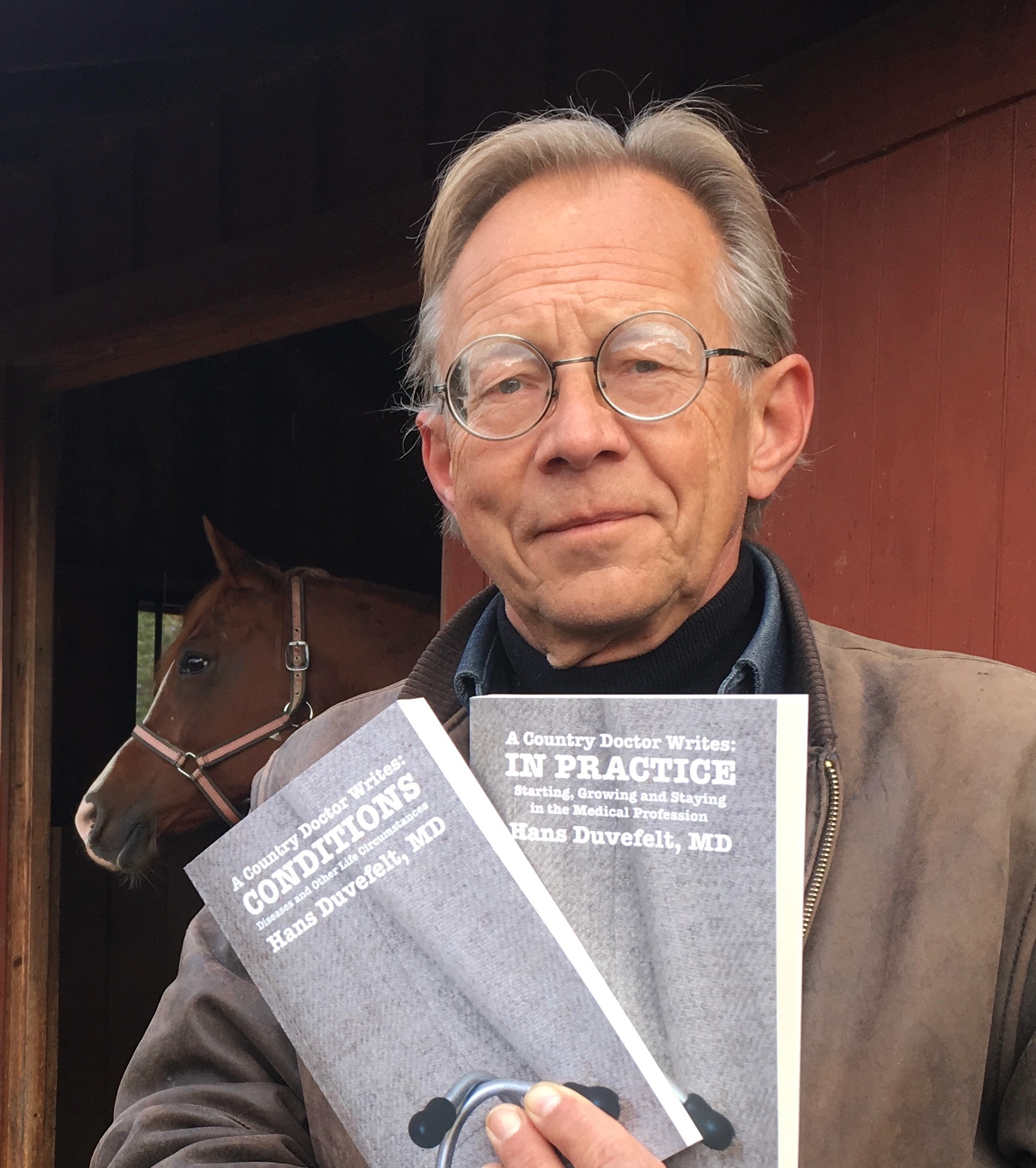
BOOKS BY HANS DUVEFELT, MD

CONDITIONS, Chapter 1: An Old, New Diagnosis

Top 25 Doctor Blogs Award

Doctor Blogs

Enter your email address to subscribe to this blog and receive notifications of new posts by email.

Mailbox

contact @ acountrydoctorwrites.com
Bookmark and Share
© A Country Doctor Writes, LLC 2008-2022 Unauthorized use and/or duplication of this material without express and written permission is strictly prohibited. Excerpts and links may be used, provided that full and clear credit is given.