Archive Page 189

“You Give Me Hope”

This morning was a whirlwind of patients, paperwork and phone calls from specialists and home health nurses. It was also one of those mornings when nothing went the way I had hoped. Mr. Fielding’s liver biopsy results were nowhere to be found, Mr. Carlson’s CT scan had been done without intravenous contrast even though we had specifically ordered it with contrast, and Ms. Grondin who is on chronic narcotics for back pain had been seen playing Frisbee and doing the limbo at the county fair last weekend. At one point near the end of the morning I was starting to think that I was treading water and not really helping anybody.

My last patient before lunch was Joe Salvino. He was in for a blood pressure check and a refill of his pain medications. He has been talking about giving up his career because of his worsening neuropathy pain. He works more hours per week than I do and admits he can’t say no when his manager asks him to do more. He has researched Social Security Disability and he knows most people don’t get it the first time they apply, and nobody gets it unless they have been unable to work for a long time.

Joe’s blood pressure was finally under control with his expensive combination pill. He didn’t smell of cigarette smoke today. He told me he smokes well under a pack per day now. He still has high cholesterol, but we haven’t tackled that yet. Joe told me a while back he wasn’t ready, but today he told me he is eating better.

I gave him refills for his medications and even though we were running late, I got philosophical with him.

“It isn’t necessarily an all or nothing situation, Joe. Instead of going for disability you could work fewer hours. You don’t always have to be a good sport and make things work for others at your own expense. If you always play the hero, why would your boss not keep piling on more for you to do? ‘Give it to Joe, he never says no.’”

“I know…”

“If this boss won’t meet your needs, there may be others who would.”

“You’re right…”

“I’m not telling you to quit. I’m telling you that you have options, and that things can change. You need to figure out what you need and ask for it where you are or look for it somewhere else.”

I ended the visit by getting up from my chair and handing him the follow-up instructions for the receptionist. Finally, I shook his hand and said:

“I’ll see you in a month.”

His hand squeezed mine back long and hard and he looked straight at me and smiled.

“I like coming to see you. You give me hope.”

Too Good to be True

Stuart Green had lost his career as a lobsterman due to his bad back. His wife divorced him and he lost his boat and his home on the water. Land-locked and lame, he walked with a cane and had been on chronic narcotics for years.

When I first met him twenty years ago, he had just started seeing a psychiatrist. Stu told me he had hit rock bottom shortly before and there was nowhere to go now but up. His disability had gone through and that gave him health insurance and a steady if modest income.

His pain was partly mechanical with bone-on-bone grinding in his lower back, but also nerve related with relentless burning and weakness in his right leg.

His psychiatrist had him on a mood stabilizer and an antidepressant. These medications seemed to help his depression and also helped take the edge of the nerve pain.

I gave him a low dose of methadone, which did wonders for his pain. His spirits were clearly improved.

Two months into our acquaintance, he told me he had decided to restore his sister’s old boat, similar to the one he had given up, but much older. It now sat behind her barn on her farm near our clinic. He hoped to use it for charter some day.

Over the next few months, Stu got more and more involved with his restoration project. He would come in for his prescription refills regularly, but would never complain about his pain, even though he worked long hours. He had a purpose and seemed to thrive on it. He almost didn’t limp anymore.

I asked about his psychiatrist appointments. Stu told me Dr. Chasse was really helping him feel better about himself.

As winter drew nearer, Stu cancelled a couple of appointments and rescheduled them for bad weather days, so he could get more work done. He was working on the boat outside and was hurrying to get as much done as possible before the first snow.

The week of our first storm, Stu called the office three or four times to rearrange his appointment, but the day he was supposed to come in came and went with no sign of him.

The next day I had a call from the Deputy Sheriff, who had found him.

Weeks later the toxicology report showed that Stu had died from an overdose of methadone and his antidepressant. There was no trace in his blood of the mood stabilizer he had been prescribed.

(Up to 50% of bipolar patients attempt suicide, and 15-20% of people with bipolar illness die from completed suicide.)

Why Not to be an Early Adopter

New medicines are like new fashions in clothing. They are introduced with great fanfare. Most turn out to seem fairly ordinary after a few years. Some are quickly forgotten or discarded and make us say: “What was I thinking?”

Evaluating a new drug is difficult, for the pharmaceutical and scientific communities as well as for us clinicians. It often takes years of general use before a drug can really prove its safety or usefulness.

As physicians with responsibility for our patients’ lives and well-being, we need to balance our desire to provide the best treatment with our obligation to avoid unnecessary risk. Unfortunately, many new drugs turn out to be less safe than we are told when they are first introduced. The increasingly common sources of drug information, advertisements and pharmaceutical representatives, also don’t tell you what the serious journals say about new medications. It is our duty as practicing physicians to keep up with the leading medical journals.

I may sound old-fashioned at times when I question new treatments or hold off on using them for a while, but I have seen enough new drugs hit the market and soon be withdrawn because of safety issues that were not known or understood when the medicines were first approved.

Most people still remember Vioxx, the arthritis medication that wouldn’t cause ulcers. Early on we heard about high blood pressures and fluid retention. The heart attack risk was apparently kept secret for a while before the drug was withdrawn.

I prescribed a fair amount of Vioxx, because all the other arthritis medications could also cause fluid retention and Vioxx seemed to work quite well. I had also almost lost a patient to a sudden intestinal hemorrhage from indomethacin once, so the stomach safety seemed like a valid selling point.

Before Vioxx, there was Duract, an anti-inflammatory pain medication for short-term use. It was eliminated through the liver instead of through the kidneys, like other anti-inflammatory medications. I never had time to prescribe it. I held off, because it was a new type of drug, and it was soon withdrawn amid reports of liver failure.

Some medications for Type 2 Diabetes bother me. Rezulin was the first drug in a new class, which makes the body more sensitive to its own insulin. Before I had warmed up to prescribing it, the drug was withdrawn. It was linked to liver toxicity. The two newer drugs in the same class, Avandia and Actos, seem safer on the liver, but from early on, there were concerns over fluid retention and heart failure risk. In 2007 Avandia was shown to increase heart attack risk by over 40%. Actos has so far looked safer, but I am still very nervous about it.

When the Scandinavian Simvastatin Survival Study (4-S) showed that deaths from heart attacks could be reduced by 30% with Zocor, I felt fairly comfortable prescribing it for patients with high cholesterol.  I had not really used the statin drugs that came before it, because there was no proof they reduced heart disease risk. I was still cautious with Zocor, because the cholesterol-lowering drug that came before the statins, Atromid-S, was associated with a surprising and unexplained increase in death rates by over 40%.

With every statin drug that came after Zocor, I stubbornly waited for “outcomes data” of some sort. One by one, the newer drugs proved themselves to fight atherosclerosis and heart disease, and I have ended up using all of them.

Baycol came along and made claims of having less risk for muscle damage, rhabdomyolysis, than the other members of the class. I tried it, but as it didn’t have outcomes data yet, I reserved my use of it to patients who couldn’t tolerate the other statins. Ironically, Baycol was taken off the market because it had a much higher risk of rhabdomyolysis than the other statin drugs.

I have seen many new drugs come and go, from diet pills like Redux to antibiotics like Omniflox, Tequin and Ketek during my thirty years in medicine. I also vividly remember the Thalidomide-induced limb deformities of my classmate in Junior High School in Sweden. Thalidomide was marketed there as a safe drug for morning sickness.

One of my professors in medical school said about medications for high blood pressure that they needed to have no serious or annoying side effects and be less dangerous than the condition for which they are intended. I have held on to his wisdom all these years.

A patient with an acute, life-threatening condition may be very willing to accept a certain risk if the treatment is effective. Even an unproven treatment may be the best option when older treatments are known to be risky or not very effective.

I question the value of being an early adopter of new drugs under normal circumstances, when slightly older drugs are still useful. Why use our patients for guinea pigs?

“Dog Ain’t Right”

Over the years I have developed a friendship with our local small animal veterinarian. He has seen us through joys and sorrows with our cats and dogs and we have shared dinners and some family outings.

Inevitably, we have often ended up talking shop. Medicine is very much the same, whether your patients are adults, children or beagles. We have found that we do very much the same things for the same conditions, but we have a running competition about who has the toughest job.

Calvin C. Carruthers, DVM, C-3 for short, is a highly energetic and charismatic man. He insists his job is tougher than mine because pet owners in this part of the country tend to be less than forthcoming with medical history and useful information when their animals are ill. Calvin’s favorite patient complaint is “Dog Ain’t Right”. He tells me those three words are sometimes the only help he will get from an owner when diagnosing a sick dog. He doesn’t believe me when I tell him some of my patients don’t offer any more details than “I just don’t feel right, Doc”.

Calvin’s job is easier than mine in that he has developed a habit of often taking three and four day weekends and “signing out” to a vet in the next town over, about 20 miles away. He does the same thing when he goes on one or two longer vacations every year. We have accepted these inconveniences, because he is an excellent veterinary surgeon and a good friend. As of this fall, there will also be another veterinarian joining him, which will make his practice independent of call-sharing.

About two months ago our youngest beagle, thirteen-year-old Snickers, developed some swelling of her nose. We were concerned she might have a tooth abscess as Calvin had wanted to do a “dental” on her for some time. That was the week of the North American Lindy Hop festival, and Calvin and his wife were off somewhere in their spectator shoes, grooving to 1940’s music. His office answering machine directed us to the covering veterinarian, who after a fairly quick examination concluded that this seemed more allergic than infectious. We were relieved, but still wondered if this was the correct diagnosis.  

Snickers nose seemed to get better, but two weeks ago she acted a little lethargic and stopped eating. This time, Calvin was in Chicago at a veterinary convention and the young assistant veterinarian of the practice in the next town was the one on duty. He seemed baffled, and speculated Snickers might have had a stroke. He offered to do some bloodwork, but couldn’t get blood from her little legs. At that point we decided to bring the dog to the Emergency Veterinary Clinic in Capitol City.

The Emergency Clinic vet was sure she had a severe tooth infection with early sepsis, or blood poisoning. We agreed to start intravenous antibiotics and after the weekend we saw Calvin, who did the dental surgery last Tuesday morning.

Snickers’ recovery has been slow, but today we see a healthy appetite and a fair amount of tail wagging. She is still weak from her ordeal, but she is on the mend. We regret our delay in getting her teeth done in the first place and for wanting so much to believe the covering veterinarian, who thought Snickers’ swelling was harmless and would go away by itself.

Our seventeen-year-old, otherwise extremely youthful male beagle has started to act strange in recent months. He is drinking a lot of water, pants when we take him for a walk, and is showing a bit of a potbelly even though he has lost some weight. We took him to Calvin for an exam and some bloodwork. Stormy’s blood sugar and thyroid tests were normal and Calvin didn’t think there was any heart failure. Some of the liver tests were a little elevated, which could be transient or the beginning of something serious, so we didn’t have a diagnosis yet.

The other night I was reading from the book I got for my birthday, Harvey Cushing’s biography of Osler. My wife started talking about what might be the matter with Stormy. I closed my book and as we talked about the dog, my right hand came to rest as if I were pointing to the name Cushing on the cover. Suddenly she stopped talking and put her index finger near mine on the book.

“That’s it! Stormy might have Cushing’s! He’s panting, he’s got heat intolerance, increased thirst, potbelly and an elevated alkaline phosphatase. And remember he didn’t shed out this spring. Those are all symptoms of Cushing’s disease.”

My Nurse Practitioner wife may have figured it out first; I just knew the dog wasn’t right.

Happy Birthday, Country Doctor

July is my birthday month. This year is one year past my halfway mark; a year ago I had lived half my life in Sweden and half in the United States.

Over the past few years my interest in medical history and the philosophy of medicine has deepened. It may be something every physician goes through at my age, or it may just be my way of dealing with the ever-quickening pace of change and the seeming loss of values in medicine today.

I recently bought Osler’s “The Evolution of Modern Medicine” and had been contemplating getting Harvey Cushing’s Pulitzer-prize winning biography of Osler. Somehow I never got around to buying it, and life got busy enough that I forgot about it.

My birthday came, and my wife gave me a small gift. “Your big gift didn’t come yet”, she said. In a remote, small town you do a fair amount of shopping through catalogs or the Internet. I waited for a week, and then, talking to my wife on the phone at lunch, she happened to be going down to the mailbox while we were on the cell phone.

“Your birthday gift came”, she said. “Wait while I open the package”. Next, I heard rustling of paper, followed by “Oh, wow”, after which she said nothing for a long time.

“You are going to be so pleased”, she said, but she wouldn’t tell me anything more. I had waited a week for my big birthday present, and now I had to wait until the end of the day.

After supper, I unwrapped two big packages that were obviously books. I, too, said “wow” when I opened the second one. The first one was Volume II of Cushing’s biography of Sir William Osler. The second package contained Volume I, signed by Harvey Cushing himself! The used-book dealer had not even listed the book as signed by the author.

Looking at the massive, two-volume work by the founder of modern neurosurgery, I was touched by how much time and effort must have gone into it and by the obvious respect Cushing had for Osler. I was struck by Osler’s wide-ranging interests, passion for medical education and commitment to the medical profession. I have struggled my entire career with finding a balance between seeing patients and feeding my soul by studying and creating. Clearly, the giants of modern medicine took time for other things, and that did not diminish the importance of their clinical work.

As I now sit here, a 57-year old physician who has spent the last 31 years in this profession, I hold in my hand a book about Osler, signed by the author, Harvey Cushing himself, in 1926. I feel a renewed commitment to my life’s work, the only profession I ever considered from the age of four.

I feel very fortunate, indeed.


I just realized none of the posts show on an iPad or a computer, but they do show on an iPhone. WordPress is working on this. In the meantime, please visit my Substack.


Osler said “Listen to your patient, he is telling you the diagnosis”. Duvefelt says “Listen to your patient, he is telling you what kind of doctor he needs you to be”.


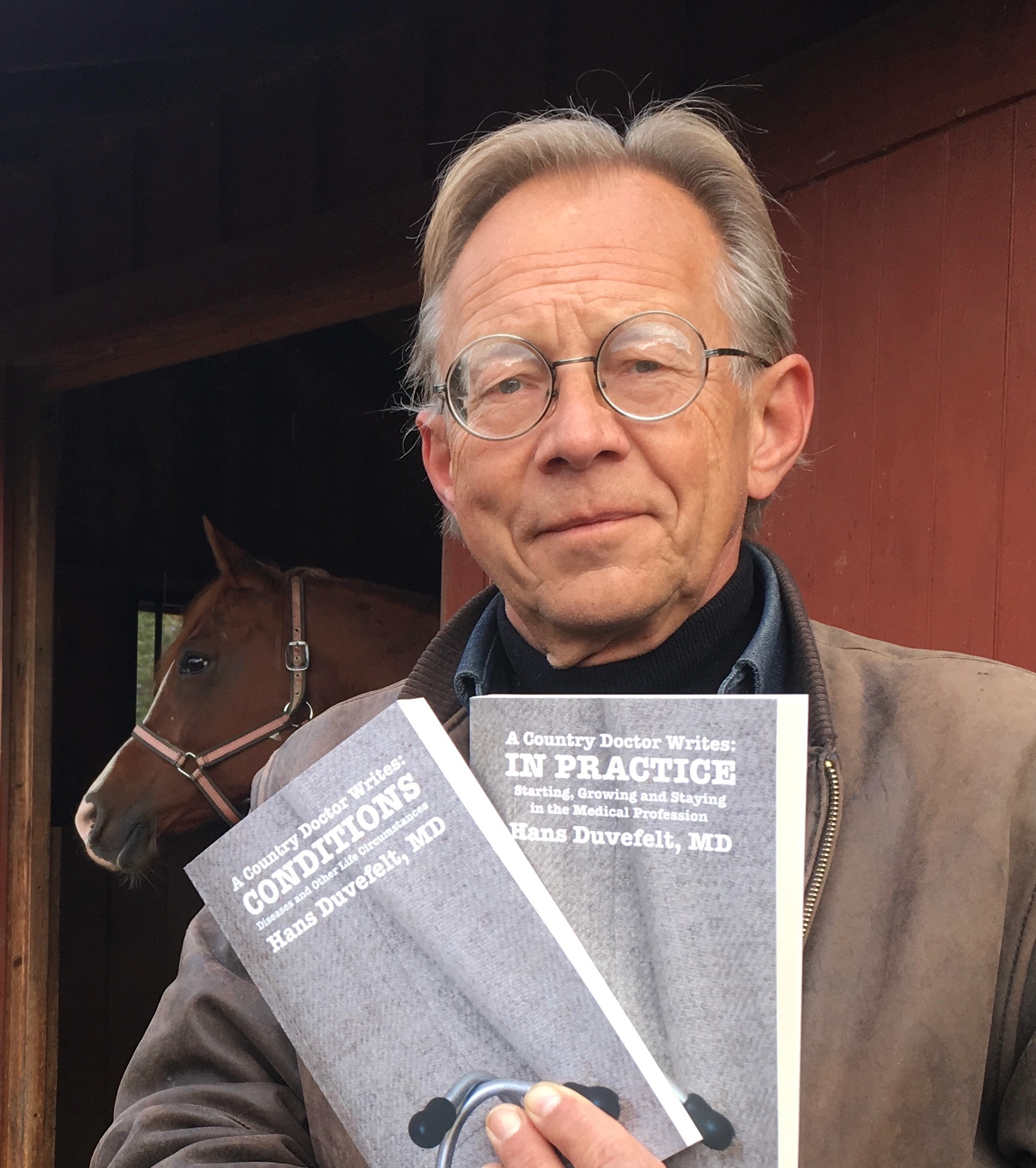
BOOKS BY HANS DUVEFELT, MD

CONDITIONS, Chapter 1: An Old, New Diagnosis

Top 25 Doctor Blogs Award

Doctor Blogs

Enter your email address to subscribe to this blog and receive notifications of new posts by email.

Mailbox

contact @ acountrydoctorwrites.com
Bookmark and Share
© A Country Doctor Writes, LLC 2008-2022 Unauthorized use and/or duplication of this material without express and written permission is strictly prohibited. Excerpts and links may be used, provided that full and clear credit is given.