Archive Page 188

Shooting From The Hip

“Doctor Pete” was fifty-one when I started my residency in Family Medicine. “Family Practice” we called it then, and I think I liked that name of our specialty better. It implies continued learning and brings to my mind visions of practicing a down-to-earth craft.

I had interviewed with his predecessor the summer before and was really impressed with him and the program. I ranked it as my first choice in the match. Fortunately, they ranked me number one or two, so I was accepted, even though I may have seemed like a wild card as their first foreign-trained physician.

In the spring, a few months before I was due to move from Sweden to the United States, I got a letter in the mail with the news that the residency director was moving on after getting the program off the ground. “Doctor Pete”, his Associate Director, would be taking over. He assured me that things would continue the way they were and hoped to get to know me soon.

“Doctor Pete” was a congenial, relaxed yet energetic man with strong, hairy arms, weather-beaten cheeks and a Midwestern accent. He exuded confidence and common sense. He was one of the first Board Certified Family Practitioners in our state, and he had been chief of Family Practice, Obstetrics and Coronary Care at a small hospital a hundred miles away before joining the residency program three years before my arrival.

He spoke from experience. If he hadn’t seen it, he had at least seen something pretty close, and he always knew what to do. He was always ready to help you out, not by taking over, but by nudging you in the right direction. His pride when you mastered a difficult new situation was like a father’s pride. He had raised five adopted children, and you were just one more – that’s how it felt.

I remember a session when we had to give feedback to the faculty of our residency program. I told “Doctor Pete” that even though I really admired his experience and clinical skills, I sometimes wished he would back up his answers to some of my questions with more scientific literature. I thought he had a tendency to make things seem a little too simple sometimes. With his slight drawl, I thought of him as slightly cowboy-ish, and I remember describing his style as sometimes “shooting from the hip”.

I don’t remember his response, but I remember my critique seemed to roll off him. We continued to enjoy the most powerful mentoring relationship I ever had in my training.

I am now older than “Doctor Pete” was the day he grabbed and shook my hand at our graduation ceremony. I remember he slapped my back and made some wisecrack in his raspy voice as if trying not to get too sentimental.

I find myself quoting more scientific articles when I talk with patients or younger colleagues than “Doctor Pete” used to, but not always. When the chips are down and something needs to be done fast and without dilly-dallying or when I feel a little stuck and the details of a case don’t fit together quite the way they ought to, I have this tendency to just follow my instinct. Don’t ask me how I get to my decision in those situations. I could justify things afterwards, but I have to admit it: There are times when I seem to hit the bull’s-eye just shooting from the hip.

Just like you, “Doctor Pete”!

(In Memoriam WRP, MD, 1930-2008)

The Minimum Effective Dose

“I think I’ve tried every medication there is for my OCD”, Debbie Kurbitz said as she pulled out a large notebook from her canvas bag. “I’ve had reactions to all of them.”

Her record keeping was consistent with her diagnosis of obsessive-compulsive disorder. Listed on the pages of her notebook were the doctors she had seen, all the usual medications in our armamentarium they had prescribed and the particular side effects each drug had caused.

I already knew Debbie truly needed something done. She was struggling with rituals like counting everyday objects, words and even the steps she took.

It was clear that Debbie hadn’t done well with SSRI’s, the serotonin reuptake inhibitors we typically use for OCD. She had listed all the side effects I could think of off the top of my head. I concluded she must be very sensitive to these medications

“What doses of these did you try?”

She hadn’t listed the doses she had taken, but her recall was impeccable.

I looked at her list for a few moments before I spoke again.

“I think you might be helped by any one of these drugs, but in much lower doses than you tried before.”

“How much lower?”

“Well, I think Lexapro, escitalopram, would be worth trying again, but I would prescribe the liquid form and start you off with one milligram per day instead of ten, which is what you started with and didn’t tolerate.”

She raised her red eyebrows and put her chin in her hands.

“Take one milligram per day for three or four days. Then, if you don’t feel nauseous at all, go to two milligrams. If that agrees with you, go to three milligrams, but if you are the least bit nauseous, stay with that dose until you feel OK. Work your way up to no more than five milligram per day, and I’ll see you in two weeks.”

“OK…”, she said, but her green eyes almost seemed to roll back in disbelief.

Two weeks later those same green eyes were sparkling under her bushy red hair and eyebrows.

“I feel fine. Not a speck of stomach upset, and I’m not counting anymore!”

I smiled.

“How did you know this would work, or did you just guess?”

“I’ve been around. There are serotonin receptors in the stomach and they make you nauseous the first week on an SSRI like Lexapro. If you can get beyond the first week, you generally don’t have to worry about nausea unless you increase the dose.”

“But I only needed five milligrams…”

“Well, Lexapro has what we call a flat dose-response curve. Many people have the same effect from five as from twenty milligrams, just fewer side effects.”

“So a lot of people are taking higher doses than they need?”

“Possibly. When new drugs are introduced, the drug companies often look for a dose that is effective for the largest possible number of patients. Not everybody has serotonin receptors in their stomachs and brains as sensitive as yours. I suppose if you started everybody off at a very low dose, many people would get impatient and draw the conclusion that the drug wasn’t working and the drug company would lose a sale.”

“I can’t thank you enough. Now, do I still need to see the counselor you talked about?”

“I still think it would be worth your while.”

(The concept of prescribing the minimum effective dose goes back to Greek medicine, including Hippocrates. Many have interpreted his “First, do no harm” as a warning not to be heavy handed with medications.)

“Would You Take Me Back?”

Eleanor Burrill reminded me Friday that she turns 90 next month. She has been a patient here as long as I remember, even though she lives in the next town and has to drive 20 miles to get here. We see her once a month or more, because she has to get her bloodwork done to regulate her blood thinner.

She has always been an inspiration because of her vivid intellect and never-ceasing curiosity about how things work, not just her blood sugar, pulse and blood pressure, which she diligently records every day in her monthly planner. Eleanor has a hunger for knowledge and even surfs the Internet. There, she also keeps in contact with her great-grandchildren.

She has always maintained a dignity and a certain distance. I have always thought of her as quite a lady.

She looked serious this time, and after we had taken care of her prescriptions, she told me:

“You know I’ll be ninety next month. I’m afraid I might be getting too old to be driving through moose country to come and see you, especially with winter coming…”

“I can understand that.”

“So I have made an appointment to see the new doctor at Tall Pines Medical Group at the end of next month. Believe me, it was not an easy decision, but I know it’s time. I wish you were closer.”

“You know, I think that’s a wise decision. It will be so much more convenient for you.”

“I didn’t want to hurt your feelings. You have been so good to me.”

“I don’t take this personally at all. You need to be practical and do what works best for you. I hope it works out well for you.”

We both got up from our chairs and shook hands. As I opened the exam room door for her and stepped aside to let her leave the room first, she turned back towards me.

“Thank you. I have a question, though.”

“Yes?”

“If I don’t feel comfortable with Dr. Selig, would you consider taking me back?”

“Of course I would!”

She smiled, turned away and made her way down the hall.

I should have hugged her.

“You Give Me Hope”

This morning was a whirlwind of patients, paperwork and phone calls from specialists and home health nurses. It was also one of those mornings when nothing went the way I had hoped. Mr. Fielding’s liver biopsy results were nowhere to be found, Mr. Carlson’s CT scan had been done without intravenous contrast even though we had specifically ordered it with contrast, and Ms. Grondin who is on chronic narcotics for back pain had been seen playing Frisbee and doing the limbo at the county fair last weekend. At one point near the end of the morning I was starting to think that I was treading water and not really helping anybody.

My last patient before lunch was Joe Salvino. He was in for a blood pressure check and a refill of his pain medications. He has been talking about giving up his career because of his worsening neuropathy pain. He works more hours per week than I do and admits he can’t say no when his manager asks him to do more. He has researched Social Security Disability and he knows most people don’t get it the first time they apply, and nobody gets it unless they have been unable to work for a long time.

Joe’s blood pressure was finally under control with his expensive combination pill. He didn’t smell of cigarette smoke today. He told me he smokes well under a pack per day now. He still has high cholesterol, but we haven’t tackled that yet. Joe told me a while back he wasn’t ready, but today he told me he is eating better.

I gave him refills for his medications and even though we were running late, I got philosophical with him.

“It isn’t necessarily an all or nothing situation, Joe. Instead of going for disability you could work fewer hours. You don’t always have to be a good sport and make things work for others at your own expense. If you always play the hero, why would your boss not keep piling on more for you to do? ‘Give it to Joe, he never says no.’”

“I know…”

“If this boss won’t meet your needs, there may be others who would.”

“You’re right…”

“I’m not telling you to quit. I’m telling you that you have options, and that things can change. You need to figure out what you need and ask for it where you are or look for it somewhere else.”

I ended the visit by getting up from my chair and handing him the follow-up instructions for the receptionist. Finally, I shook his hand and said:

“I’ll see you in a month.”

His hand squeezed mine back long and hard and he looked straight at me and smiled.

“I like coming to see you. You give me hope.”

Too Good to be True

Stuart Green had lost his career as a lobsterman due to his bad back. His wife divorced him and he lost his boat and his home on the water. Land-locked and lame, he walked with a cane and had been on chronic narcotics for years.

When I first met him twenty years ago, he had just started seeing a psychiatrist. Stu told me he had hit rock bottom shortly before and there was nowhere to go now but up. His disability had gone through and that gave him health insurance and a steady if modest income.

His pain was partly mechanical with bone-on-bone grinding in his lower back, but also nerve related with relentless burning and weakness in his right leg.

His psychiatrist had him on a mood stabilizer and an antidepressant. These medications seemed to help his depression and also helped take the edge of the nerve pain.

I gave him a low dose of methadone, which did wonders for his pain. His spirits were clearly improved.

Two months into our acquaintance, he told me he had decided to restore his sister’s old boat, similar to the one he had given up, but much older. It now sat behind her barn on her farm near our clinic. He hoped to use it for charter some day.

Over the next few months, Stu got more and more involved with his restoration project. He would come in for his prescription refills regularly, but would never complain about his pain, even though he worked long hours. He had a purpose and seemed to thrive on it. He almost didn’t limp anymore.

I asked about his psychiatrist appointments. Stu told me Dr. Chasse was really helping him feel better about himself.

As winter drew nearer, Stu cancelled a couple of appointments and rescheduled them for bad weather days, so he could get more work done. He was working on the boat outside and was hurrying to get as much done as possible before the first snow.

The week of our first storm, Stu called the office three or four times to rearrange his appointment, but the day he was supposed to come in came and went with no sign of him.

The next day I had a call from the Deputy Sheriff, who had found him.

Weeks later the toxicology report showed that Stu had died from an overdose of methadone and his antidepressant. There was no trace in his blood of the mood stabilizer he had been prescribed.

(Up to 50% of bipolar patients attempt suicide, and 15-20% of people with bipolar illness die from completed suicide.)


I just realized none of the posts show on an iPad or a computer, but they do show on an iPhone. WordPress is working on this. In the meantime, please visit my Substack.


Osler said “Listen to your patient, he is telling you the diagnosis”. Duvefelt says “Listen to your patient, he is telling you what kind of doctor he needs you to be”.


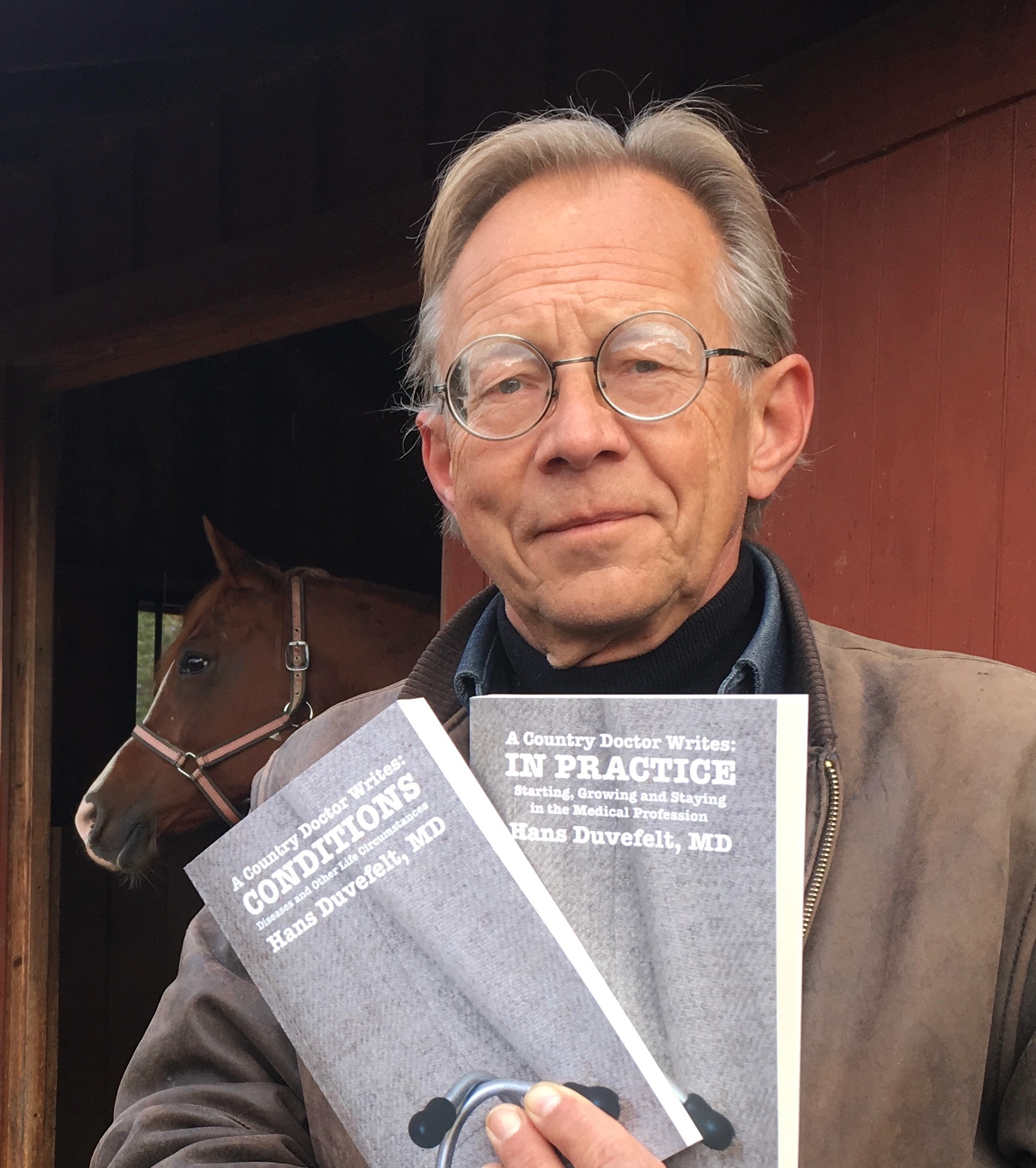
BOOKS BY HANS DUVEFELT, MD

CONDITIONS, Chapter 1: An Old, New Diagnosis

Top 25 Doctor Blogs Award

Doctor Blogs

Enter your email address to subscribe to this blog and receive notifications of new posts by email.

Mailbox

contact @ acountrydoctorwrites.com
Bookmark and Share
© A Country Doctor Writes, LLC 2008-2022 Unauthorized use and/or duplication of this material without express and written permission is strictly prohibited. Excerpts and links may be used, provided that full and clear credit is given.