Archive Page 185

One Track Minds

I agree with those who say that men only think of one thing – at least only one thing at a time.

Every week I hear male patients tell me their wives say they don’t listen, especially when they are occupied with reading or watching the news.

Many women, on the other hand, seem to have no trouble doing two or three things at the same time.

Certainly, multitasking has been a necessity throughout history for women, who kept house, raised children, cared for animals and did all kinds of farm chores.

In many early cultures dating back thousands of years, men would go out to catch the tiger or some other dangerous beast. That sort of endeavor was more likely to be successful if the hunter put all other random thoughts and projects out of his mind right then until the tiger was successfully taken care of. 

Today’s men generally operate very much like prehistoric man. If we split wood, we only do that, and if we mow the lawn, we don’t stop in the middle to split some wood or balance our checkbooks, unless we have Attention Deficit Disorder, or ADD.

When I grew up, there was only one channel on Swedish TV (I was five when I first saw a TV program). We played games that followed the pace of our minds and bodies, and we played them one at a time.

The generations born after me have been subjected to far more simultaneous sensory inputs, and they have played games that set the pace for the players; computer games often don’t slow down for the player, who needs more time. Children also often play games while watching TV in the background.

I, who no longer have a TV at home, was reminded at the airport recently of the flood of sensory inputs we can subject ourselves to today. The TV monitors had a news anchor occupying most of the screen. To the right was a live feed from the latest disaster scene and along the bottom of the screen was a ticker-type text with completely unrelated headline stories. A young couple was standing near a monitor, busily talking while each was texting on a Blackberry.

Modern society seduces us into trying to do more than one thing at a time. I often wonder what that does to a developing nervous system.

Are some young brains better equipped to select which outside inputs to process and which ones to ignore? Are some just unable to prioritize, and do they therefore rarely find the level of engagement necessary to complete tasks? It is well known that boys with ADHD can hyperfocus and do extremely well in high-risk situations, where dopamine is released within the central nervous system. But are low dopamine levels at the root of this condition?

What about the simultaneous rise in rates of Asperger spectrum disorders? Are they Attention Excess Disorders? Asperger children are in many ways doing the opposite of ADD children; instead of “taking it all in” and doing everything at once, they “tune out” many inputs others think of as important and focus their attention on details others might think of as irrelevant. Instead of always checking how their peers are reacting (Is anybody laughing at me, the Class Clown?), they fail to read the reactions of others, and tend to be socially awkward.

Or is our society less tolerant of these different coping mechanisms to an increasingly unhealthy environment? Is it so, that as our society becomes more intense, more and more people will fall outside the norm for what we think is an acceptable way to deal with the barrage of sensory inputs?

Amy Laughs With The Angels

Nell and Gary Ruggles praised God for their firstborn after years of hoping and praying for a child. She was a small-boned and petite waif of a girl, with blonde fuzz on her head, a slightly reserved attitude and cautious, measured body movements. When Amy was happy, she blossomed, and could make the world smile with her musical laughter, but when she was unhappy, her weak little cry was heartbreaking.

The two of them gave Amy everything a little girl could want, and they showered her with love. They sang, read, played and did everything they could to offer her the best start in life she could have.

When Amy was a little over a year old, Nell became pregnant again, this time with twins. Gary couldn’t have been more pleased. Coming from a large family himself, he pictured his children having the same experiences he cherished growing up with many siblings.

Around the time Sarah and Seth were born, Amy seemed to regress. She seemed less social, and she seemed to need more help than she had just the month before. She cried more, and seldom showed her exuberant side.

Their regular doctor suggested Amy might be jealous of the twins and just temporarily regressing, but Gary and Nell worried. A second opinion with a pediatrician in the city nearby concurred with their own doctor and suggested they give Amy more one-on-one time with each of them.

A few months later, Amy’s deterioration was undeniable. Both doctors they had consulted now agreed there was something different about Amy, but didn’t know what.

The doctors at City Pediatric Specialists were baffled. By now, the twins were catching up with Amy’s development. Finally, a developmental specialist, who had studied under Dr. Andreas Rett, diagnosed Amy with Rett Syndrome just a few minutes into their consultation.

Just as they had been told, Amy became socially uninterested, almost always turned inward. She never smiled anymore. She developed unusual ways of holding her wrists and hands, chewed her fingers, stumbled and shuffled when she walked. She had already lost the ability to control her urine and bowels, and she stopped speaking. Her cry became even more heart shattering than it was in her infancy.

Today Amy is eight and a half. Her almost seven-year-old twin siblings help their parents take care of Amy. They keep the diaper supply stocked in the bathroom, bring toys within reach of Amy where she sits, put her mitts on when her hands get irritated by her gnawing, and take turns feeding her.

Amy seldom cries anymore. She shows little pleasure or displeasure. She shows almost no interest in Sarah and Seth, even when they clown around, trying to make her laugh.

But sometimes, in the middle of the night, Nell and Gary can hear her laughing in her room, a melodic laughter that sounds almost like bells chiming in the distance. As they listen hard, they sometimes even think they hear more than one note at the same time. They say Amy laughs with the angels.

All is Well; Over and Out

You were never a chatterbox, Dad. You always chose your words carefully and didn’t say anything you didn’t mean. You were sometimes extremely brief in your communications, perhaps to balance Mother’s tendency to talk much more than you did.

Especially on the telephone, you always were a master of brevity. Calling home from payphones while traveling around Europe, or from the U.S. back when calling overseas was rare and expensive, all I’d get out of you was sometimes: “All is well; over and out”. Those few words really said everything I needed to hear, though.

I started out emulating your style of communication, but have had to learn to say more on the telephone over the years. These days I sometimes even wear a Bluetooth earpiece and talk with my wife while driving or walking through stores shopping if we can’t be together.

Sitting with you, watching the sunset at camp or spending time together during the Holidays, there were always long stretches of silence between us. I always felt the connection, even without any exchange of words. I felt it also at the very end of our time together here on Earth.

Sitting by your bedside during your last few days and nights, I said all those things to you that I had not said often enough before. Unable to answer me because of your end-stage Alzheimer’s disease, you looked at me and the peace in your eyes conveyed to me all I needed to hear back: “All is well”.

Roger that, Dad: All is well. Rest in Peace. Over and out.

Finding the Way

As a child, dozing in the back seat during long drives back to my Grandmother’s house in our old home town, I would look out the car window and ask:

“How can you find your way?”

My mother always answered, “We just do”.

Returning to the U.S. ten years ago, after a summer sojourn at camp and a train trip to the Arctic Circle, my wife and I needed a ride to the train stop on the outskirts of town. The express trains bypass the small city on the far outskirts of Stockholm, and travelers have to make it up on a platform on a large railroad bridge, visible in the distance from my parents’ apartment.

My father drove and my mother co-piloted their Volvo. He seemed to have trouble finding the way, so my mother reminded him that they had been there just recently. We were right near the newest shopping center. He eventually got us to the train stop, not quite recognizing any of the landmarks along the way.

Many years before, my mother had asked me to promise that if anything happened to either one of them, I wouldn’t put them in a nursing home. I answered her with a question: How can we predict now what will be the right thing to do in an unanticipated situation years down the road? She accepted my unwillingness to predict the future.

As it became obvious, years later, that my father had dementia, my mother adapted to their new circumstances. She learned how to care for him, reluctantly also letting strangers into their home to assist her. When his disease advanced, she found her way to acceptance of a nursing home placement for him.

Every day my mother went to visit my father at the nursing home. At first she walked, resorting to riding the bus only in bad weather. Over the course of his years on the dementia ward, she started using a walker, but still climbed on board the noon bus every day to spend the afternoon with my father.

She always found a way to see him, sometimes took a taxi, sometimes even got a lift home from the staff when no taxis were available. The nurses and aids became part of our extended family, caring for my father as if he were their kin.

My mother has always praised the nursing home and the care they provide for my father. She knew in her heart that she had done the right thing by making the choice she said she would never make.

My father never complained. He seemed puzzled why my mother wouldn’t stay for supper and overnight, but he delighted in her arrival every day. He was never restless, never frustrated. As the years passed, he stopped speaking and gradually stopped moving his limbs. He stopped feeding himself and soon also stopped swallowing even pureed foods. Soon, even liquids wouldn’t go down.

Searching online for flights to Stockholm, I found my way back in time to sit by his side, hour after precious hour. As I listen to his respirations, the physician in me registers the significance of their waxing and waning, the son hears his dad still breathing, still with him.

My father was never very demonstrative with affection, although I never doubted his love for me. I, in turn, didn’t tell him often enough that I loved him. Last night, as the hours passed, I held him and told him again and again what a good father he is, how proud I am to be his son, and how much I love him. His blue eyes softened and kept looking right at me with an expression of peace and contentment.

You are sleeping peacefully now, Dad, and I have told you that everything is okay. I have told you that you can hold on or let go, either way. I have told you that I will always love you.

At my age, I am still learning things from you. I am learning patience and acceptance, seeing how you handled your fate.

Whatever happens to me next and down the road, Dad, I hope that just like you and Mom, somehow, I will always find the way. 

The Long Journey

I woke up somewhere over England. My mouth felt like I had walked through a desert sand storm. Everyone else in the cabin was asleep and the stewardesses were not within my eyesight. I waited silently for them to start the breakfast service. When, after an eternity, they did, I asked for a glass of Seltzer water, downed it and asked for another. I had a third, and orange juice and coffee within short order.

The Stockholm airport, the rental car place, the Volvo wagon and the highway hadn’t changed much. My father, now bed-bound and nonverbal, had.

As I entered his room, so familiar after three and a half years in the dementia unit, I saw a face that was radically changed from my last visit. No longer able to eat, barely taking sips of fluids for the past week, the father I greeted was even thinner than I had understood from my mother’s description.

His eyes locked on to mine and his lips moved in the way I was told they always move, but they made the movement you would make if you say my name in Swedish.

The nurse affectionately stroked his head, combed his long, silver hair and offered him Seltzer water from a heavily soaked oral sponge swab. Again and again, his mouth closed eagerly around the swab and he sucked hard on it and gulped down the still slightly fizzy liquid.

For half an hour, my father never took his eyes off me. Over and over his lips formed my name. I told him I was well, explained why my wife wasn’t able to make it this time, told him about his grandchildren and great-grandchildren.

Finally, he fell asleep with my hand on his. Every once in a while he woke up, looked straight into my eyes with his sunken-in, clear blue ones. He looked restless. I told him I loved him and told him what I had heard about my mother’s condition. It wasn’t until I said I was doing well and that I was happy that he finally seemed to relax.

I spent a few hours with my father before driving over to the hospital to see my mother. I drove through the town where I was born, where I lived for the first six years of my life and always returned to visit my parents after they retired in 1986. They chose to move back ‘home’ to where they spent their youth and where all their family still lives.

I happened to pass the pink stucco apartment building that housed my preschool; it is now a funeral parlor. I still remember walking across town to preschool there.

At the hospital, my mother, too, looked little. We kissed and hugged. She asked about my father, cried and thanked me for stopping there first.

The first leg of what seems to hold the promise of being a very long journey for the three of us is over.


I just realized none of the posts show on an iPad or a computer, but they do show on an iPhone. WordPress is working on this. In the meantime, please visit my Substack.


Osler said “Listen to your patient, he is telling you the diagnosis”. Duvefelt says “Listen to your patient, he is telling you what kind of doctor he needs you to be”.


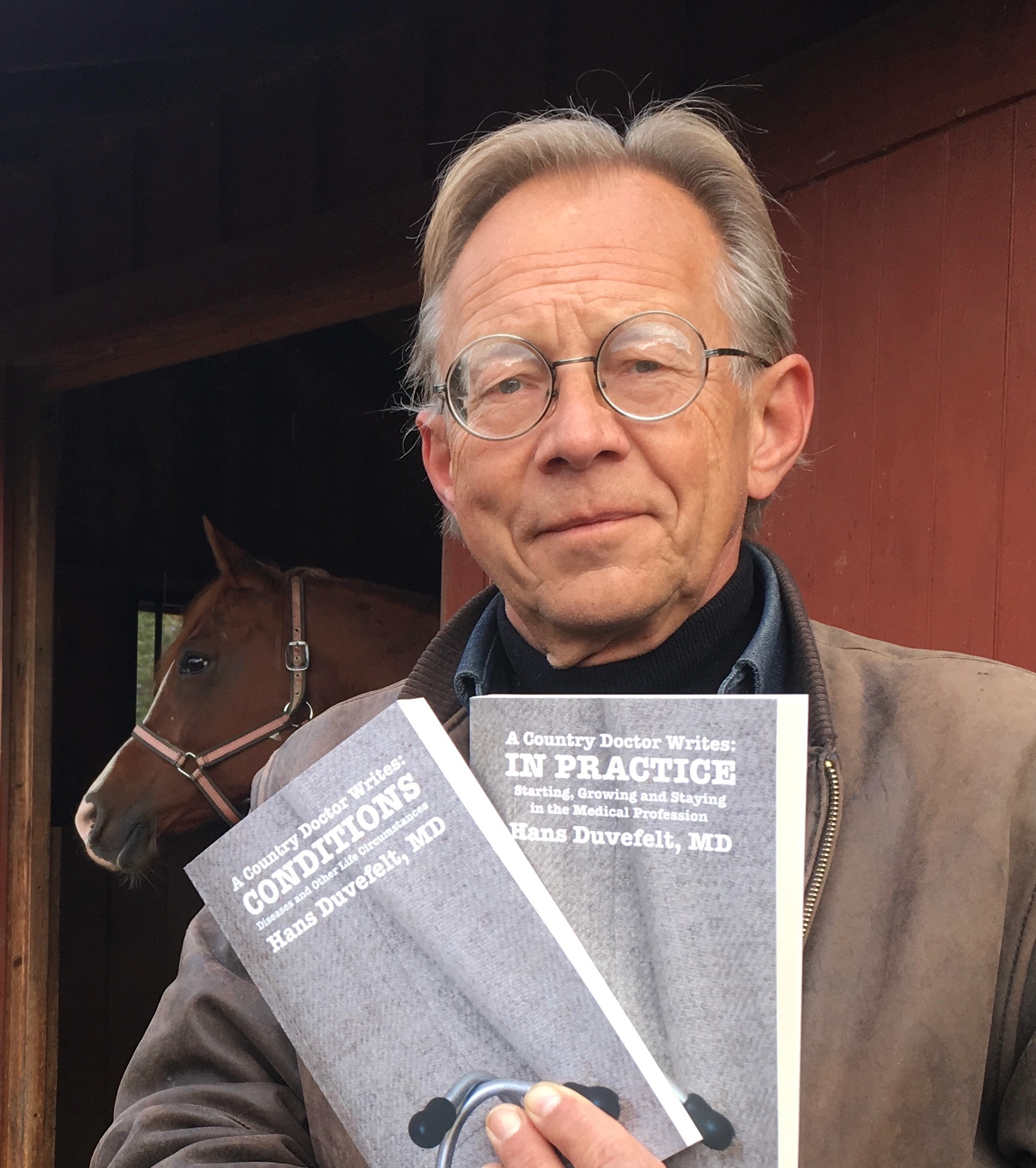
BOOKS BY HANS DUVEFELT, MD

CONDITIONS, Chapter 1: An Old, New Diagnosis

Top 25 Doctor Blogs Award

Doctor Blogs

Enter your email address to subscribe to this blog and receive notifications of new posts by email.

Mailbox

contact @ acountrydoctorwrites.com
Bookmark and Share
© A Country Doctor Writes, LLC 2008-2022 Unauthorized use and/or duplication of this material without express and written permission is strictly prohibited. Excerpts and links may be used, provided that full and clear credit is given.