Archive Page 183

Changing the Subject

Mrs. Blouin was new to our practice. Her previous doctor, in the next town up the road, had left the area just over a year ago. Her presenting complaint was “Wants Reclast infusion”.

Reclast is a once-yearly $1,200 intravenous infusion for osteoporosis, primarily for patients who cannot tolerate the older treatment alternatives.

I have many misgivings about osteoporosis treatment, and have not yet prescribed Reclast. It has a long list of drug interactions and side effects, and it is still very new.

It didn’t take me long to realize that there were other issues afflicting Mrs. Blouin. She was fatigued, her blood pressure was very high, she had no idea what her cholesterol was, and she had a foreboding family history of cancer and heart disease.

Dr. Greyson’s notes mentioned her blood pressure being up a bit, ongoing fatigue, breathing problems and several other symptoms. Reading through them, I wasn’t sure how osteoporosis came to be the predominant concern.

“How did you and Dr. Greyson come to focus on your bones?” I asked.

“I don’t know”, she answered. “I guess he thought they were really that bad.”

“It sounds like we need to look at the whole picture right now. You couldn’t get your infusion now anyway without some fresh bloodwork. We might as well see if we can find out why you’re tired, check you for anemia and thyroid problems. We could also check your cholesterol if you’d like. And I’d like to check your blood pressure one more time, since it’s higher today than it was last year at Dr. Geyson’s.”

I had moved the focus of our visit away from what Mrs. Blouin had come to see me for. So had Dr. Greyson, but in the opposite direction.

Physicians change the subject of patient visits all the time. Sometimes we do it because we feel there is a more pressing issue than the one a patient came to see us for, like correcting a high blood pressure or screening chronically ill patients for depression, which may be a barrier to achieving better health. Other times we may be guilty of shifting the attention away from a symptom we are unfamiliar or uncomfortable with in favor of something we find easier or more satisfying to deal with. Sometimes we may avoid or postpone issues that aren’t easily solved in a fifteen-minute-visit.

I sometimes hear patients say about other doctors: “He didn’t seem concerned about my symptoms”. Some people may say that about me too; I know I don’t pay as much attention to arthritis pain and old sports injuries as some patients might expect when they come in for physicals and have unmet screening needs for cancer and cardiovascular risk that I feel a need to cover in my half-hour with them.

But where do we draw the line? When is it fair to change the agenda for a patient visit and when is it not? When are we doing the right thing by steering our patients toward issues they may not have thought of as priorities, and when are we doing the wrong thing by not making them equal partners in their own health care?

Night Flight

I never did get my haircut for Christmas. The past few weeks, things seemed to be going at warp speed. Yesterday, my half-day at the office dragged on past two o’clock, and then there were two admissions, two 60-day reviews and several sick visits at the nursing home to take care of.

The week was interspersed with e-mails from my cousin in Sweden about his father. December 3rd, at my own father’s funeral, R., his youngest brother, sat in his wheelchair in the center isle of the chapel. Afterwards, in the parish hall, he said “next time it will be my turn”. He felt a strange chill, but refused the black knitted throw his wife had brought with her.

Two weeks later, his doctor predicted he would be gone within hours. My cousin’s e-mails brought back memories of my own father’s passing. My father used to call me R., then correct himself when he realized I was his son, not his younger brother. I took it as a compliment, a sign that he sometimes saw me as a member of his own generation.

My uncle lingered on, and my cousin’s e-mails grew more philosophical. My replies contradicted their young doctor’s attempts at predicting the course of life’s biggest mystery.

Day by day, sometimes hour by hour, the messages told the story of my uncle’s changing neurologic condition and his family’s winding journey between extremes of hope and despair but inevitably away from the way things used to be.

As Christmas drew nearer, new snow fell outside while the family’s vigil continued. The e-mails arrived at a steady pace. My uncle’s breathing took on the familiar pattern I had listened to as I sat through long days and nights at my father’s bedside.

When the snowfall stopped and my uncle’s coma deepened, my cousin wrote metaphorically: “Fine flying weather, but no traveler yet.”

My day at work continued; there were so many things to take care of before we closed for the Holiday. Finally I arrived at home some time after seven o’clock with a couple of last-minute grocery items and a stack of Christmas cards from the office.

After a Swiss fondue and some Chianti we tried to watch a Bing Crosby movie, but we both kept nodding off, so we decided to postpone the movie until the next day.

Even though today was a Holiday, we woke up at five. Over coffee in bed I checked my e-mail. My cousin had written:

“The night flight departed at 0330 hours. The traveler disappeared with a broad smile on his face.”

I finished my coffee, got dressed and headed outside toward the barn with warm mash for the horse.

Walking across the yard, dimly lit by the almost full December moon, I paused to listen to the perfect silence of the Christmas Eve morning. I noticed the blinking lights of a small airplane moving across the sky. My eyes suddenly grew moist and I lost sight of the plane.

I thought of my cousin’s metaphor about his father’s passing, remembered my own father’s last breaths, and wondered if the two brothers had hoped to meet again. My father never spoke about what he really believed. 

The chill of the early morning crept inside my leather jacket and I hurried to get inside the barn door.

B.C.

B. C. and his wife came in for his diabetes follow-up the other day. His blood pressure and blood sugar have been out of control for over six months now, but he has refused to try new blood pressure medications and he won’t consider insulin. He even hates pricking his fingers, so he had ordered a glucometer that uses blood samples from the forearm.

“I feel good”, he always says.

Even though we have seemed to be at a medical standstill, I have enjoyed our visits together. He has told me many things about the wildlife around here and he has helped me understand our male dog’s reactions to the wolves and coyotes that surround us.

“Here, this is for you”, he said as he handed me an oblong envelope. Inside was a Christmas card with a picture of the two of them – she in a long dress, he in a colorful costume with a bearskin draping his back and the bear’s head on top of his.

“That’s me in full regalia”, he said proudly.

His face in the picture was quite pale.

“How’d your face get that that white?” I asked, wondering if he was starting to feel poorly some of the time.

“Grease paint.”

I thanked them for the Christmas card and got down to business.

“Have you checked any blood sugars after meals?” I asked.

“No, my new machine hasn’t come yet, so I’ve only checked a few times, but my sugars are down”, he smiled.

The three readings he remembered were actually in a good range.

“Are you eating differently?”

He shook his head. “I eat about the same.”

“No, we got rid of all the junk food”, his wife corrected him. I noticed he had lost a few pounds.

“I went to he herb woman”, he said, “and she gave me a mixture of thirty-two herbs that I’m supposed to take with each meal. It tastes like salt, but there’s no salt in it. I’ve also been taking my cinnamon.

“And I’ve been reminding you about your pills”, his wife interjected.

He ignored her comment.

“Between that and the fenugreek my blood sugars have really come down and I feel great; I have so much more energy.”

“Well, I’ve got to hand it to you. I don’t know exactly how the stuff lowered your blood sugar, but it sounds like you should keep taking it.”

He grinned proudly and gave his wife a triumphant glance.

“But, just to be safe, I hope you’ll keep taking your regular pills, too. And watch the junk food, okay?”

“I will”, he said, rising from his chair.

“Merry Christmas my friend”, he said, offering his big hand in a firm shake.

“You too”, I said, “both of you.”

His wife, now standing behind him, looked into my eyes and silently formed the words with her mouth:

“Thank you.”

Holiday Cheers

Mrs. Rizzo called the other day to ask if it was all right if she had half a glass of wine with dinner around the Holidays.

This time I knew enough to say no. A year ago I didn’t know her very well and made the mistake of leaving a vague answer via Autumn, my nurse, amounting to ‘Probably’.

Did I ever live to regret that! Just a few days after that initial query, the reports started coming in: Mrs. Rizzo was causing a ruckus at her seniors’ apartment complex; Mrs. Rizzo was verbally abusive with her husband; Mrs. Rizzo was making annoying phone calls to former acquaintances, who no longer wanted anything to do with her.

Last year’s binge lasted several weeks and took a great deal off effort and diplomacy to untangle myself from.

This year I returned the call myself. I made very sure to politely point out to Mrs. Rizzo that things didn’t go so well last year and that the half glass of wine had turned into far too many. I reminded her that she had said and done things back then that she later regretted. The fact that she now didn’t remember some of them also suggested that her brain was sensitive enough to alcohol that she seemed to have had some blackouts.

Hopefully this year’s firmer stand will help prevent another Holiday disaster at the Rizzo home.

My old friend Dr. David Duggans told me about a patient of his, who never used to touch alcohol at all until Dr. Duggans put the idea in his mind.

Old Sumner Tardif was a quiet man, who for two years had been grieving his wife. One day last winter Dr. Duggans suggested that Sumner do something about his “cabin fever” and get out of the house more, perhaps with the “boys” in his neighborhood.

Soon afterward, there were reports of Sumner buying drinks around the house at the Sports Bar several nights a week.

One snowy night last March Sumner skidded off the road on his way home from the Sports Bar. He hit his head badly enough to end up with twelve stitches and a concussion. The legal ramification of his episode of driving under the influence was a lengthy driving suspension.

Fortunately his neighbor up the road, Glenda Maas, took pity on him and offered to chauffeur him anywhere he needed to go. Widowed herself, she seemed to enjoy the company.

Soon, you saw the two of them not only at the grocery store and Wal-Mart, but occasionally also at Olga’s Restaurant and the Sports Bar.

Wouldn’t you know it – Sumner asked Glenda to marry him and they had a small wedding ceremony over Thanksgiving with Dr. Duggans as one of the guests of honor!

Brand Name Drugs and Generic Prescribers

There was a time when patients knew their doctor, but knew little about their medication until their physician chose it, prescribed it and explained its purpose.

Today, in many cases, it’s the other way around. Doctors come and go and many patients have stronger relationships with their prescription medications than with their prescribers.

It is common to have patients request medications they have researched online or seen advertised on TV, before an agreement even on the diagnosis has been made.

“Ask your doctor if Superpill™ is right for you”, goes the slogan, and that is literally how the subject gets broached sometimes. That is also the way some patients approach diagnosis; instead of describing their symptoms and letting the doctor choose the best diagnostic test and the best treatment, more patients today come with a specific test and a specific treatment already in mind, but without the benefit of considering the differential diagnosis.

How did things get this way, what does it mean, and can we do anything about it?

Did we as doctors allow ourselves to be viewed as pawns in the big health care game being played out between the pharmaceutical and insurance companies, did we lose our personal relationships and our professional standing with our patients, or are we simply victims of an unstoppable tsunami of advertising and an information explosion brought on by the Internet?

Curiously, I am now starting to see more and more patients looking for my “take” on some of the new information, as the volume and diversity of opinions seems to increase exponentially in the media. Somehow, the tide is starting to turn, and patients are turning back to their trusted Family Doctors to help them sort through the massive amounts of information available to them.

I think the backlash is partly fueled by people’s reactions to the many recent withdrawals of former blockbuster drugs that turned out to be medical lemons.

I also think that we, as a society, may be starting, at least to some degree, to mature in our relationship to all this new information. Information has no value without knowledge, and knowledge is not the same as wisdom.

Going back to how doctors are trained, the information is out there for anyone and everyone to read, medical school gives you the knowledge how the information can be applied, and residency and practice gives you the experience and wisdom to actually take new information and apply it to real situations and real people.

So, while many of my patients are still enamored with the latest and greatest, I see a growing need for doctors like me, the somewhat older, wiser Country Doctor type, to help patients sort through the hype and help them find the real story behind today’s wonder drugs and medical news.

As the information explosion continues, the need for clinical wisdom grows. Wisdom cannot only be learned, it must also be earned.


I just realized none of the posts show on an iPad or a computer, but they do show on an iPhone. WordPress is working on this. In the meantime, please visit my Substack.


Osler said “Listen to your patient, he is telling you the diagnosis”. Duvefelt says “Listen to your patient, he is telling you what kind of doctor he needs you to be”.


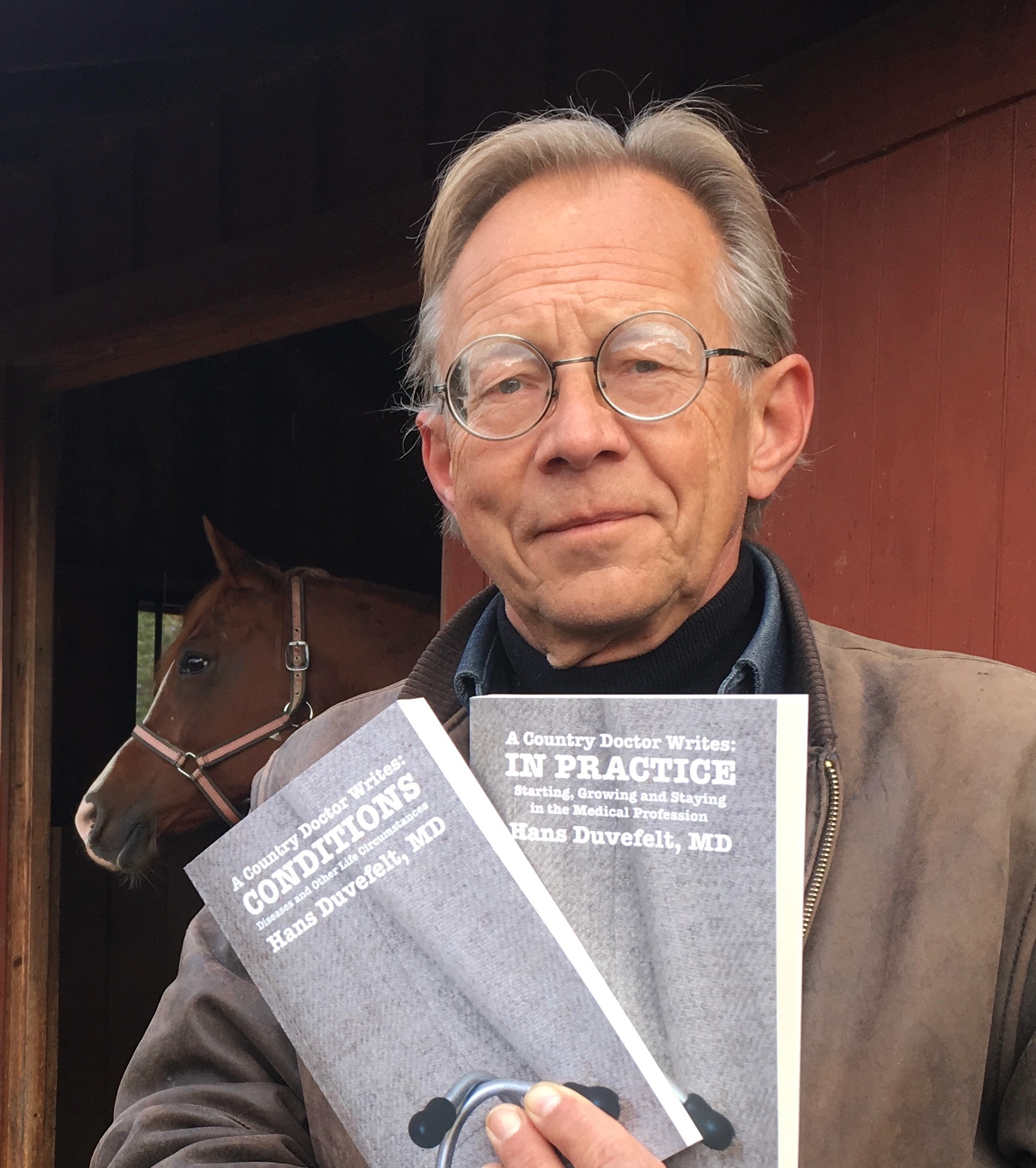
BOOKS BY HANS DUVEFELT, MD

CONDITIONS, Chapter 1: An Old, New Diagnosis

Top 25 Doctor Blogs Award

Doctor Blogs

Enter your email address to subscribe to this blog and receive notifications of new posts by email.

Mailbox

contact @ acountrydoctorwrites.com
Bookmark and Share
© A Country Doctor Writes, LLC 2008-2022 Unauthorized use and/or duplication of this material without express and written permission is strictly prohibited. Excerpts and links may be used, provided that full and clear credit is given.