Archive Page 178

“I Know Your Type”; Doppelgänger and Archetypes in Everyday Medicine

“So when did you get hooked on opiates?” I asked matter-of-factly.

The young man’s low-hanging black jeans were frayed at the bottom. He wore a black hooded sweatshirt – lightweight, but still out of place in the hot weather. His earlobes were pierced and stretched out with black hollow cylinders big enough for me to look through and out the window behind him.

I had seen dozens of his kind before, in my son’s junior high school class, at the skateboarding rink and around town. I figured I knew what kind of music he used to listen to and how he had acted toward his parents and teachers. I wondered if he had dropped out of school.

His clothing style seemed a little young for being at the opiate replacement clinic, where most of the patients were in their mid-twenties or older and weren’t rebelling against anything anymore. Had he arrested in teenage rage somehow?

“I started in high school”, he began. “I was angry at everything and everybody. I grew up having all kinds of skin infections, and then I was diagnosed with Chronic Granulomatous Disease. I had all these painful abscesses, and the doctors gave me hydrocodone. But it was in college I became addicted. I started my own software company and made lots of money. We partied a lot.”

He was bright, articulate, ambitious and successful, except when it came to conquering his drug habit. I realized I had typecast him because of his appearance.

At the end of our visit he paused on his way to the door.

“May I ask where you are from?” he said.

“Sweden”, I answered.

“Oh. You look exactly like my great-uncle Dieter from Germany. You’re an absolute Doppelgänger, but you are a lot nicer to deal with!”

“Definitely not your average kid”, I thought to myself as he described his great-uncle, a stern and meticulous clergyman, who sounded like a character in an Ingmar Bergman movie.

The young man had misjudged me just as much as I had misjudged him when we first met.

It got me thinking about how we instinctively and automatically form opinions of others based on general appearance or similarities with people we know. We need to be aware of this tendency that we all have and careful not to let it go too far, but I don’t think it is altogether useless or undesirable.

The “types” we recognize when we “typecast” each other often represent ancient and fundamental life-roles, or archetypes. Just like the characters in classic fairy tales remind us of people we know and tell us something about ourselves and our own time, we can sometimes understand our fellow human beings better if we look for similarities between them and the archetypes we all carry in our collective consciousness.

Jungian psychology uses archetypes to make sense of human behavior and emotions. Archetypal medicine goes further, by viewing symptoms as physical manifestations of emotions and the archetypes they represent. In archetypal medicine there is no difference between symptoms of the mind and symptoms of the body. A gut-wrenching experience and an intestinal blockage are one and the same process, the ultimate form of psychosomatic medicine.

Jung challenges us as physicians to see the epic drama behind the everyday internal and external conflicts our patients grapple with. The young man dressed in black in his revolt against a family of white-clad clergymen could be a character from Shakespeare or an even older literary master. Jung’s picture of health is a balance between conflicting subconscious forces, as when the young man can finally wear both black and white, and even gray.

Archetypal medicine would ask what the painful boils represent in the tragedy of the talented young man with his opiate addiction. “Illness as Metaphor” has long been the purview of alternative health practitioners. We allopaths aren’t usually willing to go that far, but I have read some thought-provoking treatises about common diseases like asthma viewed in such a way.

Archetypes, in everyday medicine, can offer glimpses into possible causes for behaviors and emotions. In a fifteen-minute visit for anxiety, headache, heartburn or opiate addiction they sometimes offer a deeper understanding than the typical questions we now ask. Does it really matter if a patient has generalized anxiety or panic disorder? Migraine or tension headache? Hiatal hernia or poor dietary habits? Or would we be better served by getting a thumbnail sketch of what the basic issues are that drive a fellow human being toward poor health or dis-ease?

Dear Patient,

Dear Patient,

You and I have been working together for many years now, and we have had both triumphs and disappointments. You have looked to me for guidance and advice about many different medical issues, and sometimes also about life’s other challenges.

I hope I have been helpful most of the time, but I know there have been times when I have misled you. In the years since I came to this area, fresh out of residency, many things have changed – in medicine as in life in general.

I told you to put your first baby to sleep on her belly, because that was what medical science thought was best then. Now we believe that to have been bad advice, but Emily still grew up to be a healthy young woman, who now has a beautiful little girl of her own.

I told your husband to go on a low fat diet and to eat less salt to help manage his weight and high blood pressure. It seemed like such obvious, medically sound and commonsensical advice at the time, but it turned out to perhaps be the wrong thing to do. As I learned more, I told him to cut the carbohydrates and increase his intake of heart-healthy fats and that did seem to help his numbers. Eventually, Jim ended up on blood pressure and cholesterol pills as we both entered middle age. I am proud that the two older medications we started have stood the test of time and both proven themselves again and again to lower heart attack risk. I hope they will help Jim stay well and avoid his father’s fate.

I told your mother to consider estrogen replacement in her fifties, because it seemed to offer so many benefits beyond just relief of hot flashes. We will never know if that is why Sandra developed breast cancer. I am just grateful we caught it early and that she has stayed healthy and cancer free through her eightieth birthday.

I am grateful that your father never suffered any harm from Duract or Vioxx, the two arthritis medications I prescribed for him in the belief they were safer and more effective than ibuprofen. I had him stop taking them long before they were withdrawn from the market, because I followed the literature, but I know now I was too quick to prescribe them for him.

Your mother-in-law’s diabetes seemed difficult to control and she wanted to try the newest medications. I should have been more conservative, but thought Rezulin seemed reasonable to try. Just like your father’s arthritis medication, it was eventually taken off the market. When I shared my concerns about it, she accepted my suggestion to start insulin. Her blood sugars have been well controlled since then.

When we first met, I seemed to be the one who provided you with background information on your family’s medical issues, but now you have already read up on symptoms, diagnosis and treatment on the Internet before you see me. These days I feel more like an interpreter than a repository of medical information. I have enjoyed the transition, even if it has exposed how much more there is for all of us to know. I think I can help you look at different sources of information and help you weigh them against each other when they seem to be in conflict.

Over the years I have become more humble about my medical knowledge, even as I have learned many new things and gained more experience. When I first came to this country I had to quickly adapt to the relatively slight differences between medical practice in Sweden and in the US. I quickly realized there was more than one truth, more than one way of doing things. Now, after watching dozens of seemingly immutable truths shatter or fall in and out of fashion several times during my thirty years of practice, I know not to take any fact as absolutely certain.

I appreciate you staying with me as I have tried to apply what I have learned to your and my other patients’ benefit. As medical knowledge expands and treatment options multiply, I will do my very best to stay current without being swept away by unfounded enthusiasm for ideas and medications that may turn out to be short-lived fads.

I am not old yet, but my line of work is ancient. One of my medical school professors told my class we were there to learn how to learn. I never imagined then how many things I would learn, unlearn and relearn in the years to come.

You know by now I am not infallible, but I try very hard to do right by you. Thanks again for trusting me to be

Your

Country Doctor

The Counterintuitive Concept of Burnout Skills

“Burnout skills are the actions at which you excel, that people identify as your strong points but which drain you of motivation. They are unable to energise you and therefore deplete you without refueling you.”

                                                                                                                                                     Claire Burge

Physicians solve problems. We always look for ways to make bad situations better. We rarely say that we can’t help a patient at least in some fashion, even if we can’t cure them. More often than not, we treat patients within the confines of financial or administrative limitations we have no control over.

Physician burnout is a common topic these days. Doctors blame patients, insurance companies, healthcare administrators and the government for their job dissatisfaction.

When thinking about what might put me at risk, I have always thought of burnout as a consequence of external forces or immovable obstacles.

The other night I suddenly realized I have always had the wrong perspective on how burnout occurs. It doesn’t happen to us, we bring it on ourselves.

My wife and I have taken to reading daily reflections after dinner. One of our choices the other night was provocatively titled “Not Every Skill Is Profitable”. The subtitle was even more provocative: “In fact, some will just burn you out.” The writer referred to a South African blogger and businesswoman, Claire Burge, whose words in one instant changed my understanding of burnout:

“Burnout skills are the actions at which you excel, that people identify as your strong points but which drain you of motivation. They are unable to energise you and therefore deplete you without refueling you.”

Claire Burge was experiencing burnout and met with a career psychologist, Aine Mahony, who encouraged her to look at the difference between those skills that can drain you and those that can motivate and energize you. Burge writes:

My entire career to date has been made up of my burnout skills and I have continually pursued these areas with intensity because everyone has always told me to work within my strengths. Aine states that this is why I am where I am.”

I realize now that my strength as a tenacious problem-solver can be a burnout skill if I choose to take on problems that are ultimately unsolvable or go beyond my scope or authority as an employed primary care physician. When I can’t fix such problems, I feel frustrated and drained. My strengths as a diagnostician, communicator and motivator are my energizing skills. I need to use and cultivate them more in order not to risk burnout in my career.

Three months after her first meeting with Mahony, Burge felt alive and energized by her career and the new direction she was taking it. Her blog post ends:

“Tonight over barbecued hamburgers and grilled mushrooms I tell Calvin about my day. My last words end something like this: It didn’t really feel like work today. I was having so much fun.”

How many physicians today say that over dinner with their spouse?

A Memorial Day Memento

I had seen Eldon Beauford almost every week for the last six months to monitor his congestive heart failure. Every time his weight went up, I temporarily increased his diuretics, and every time his heart rate was faster or slower than ideal, I adjusted the medications we used to rate-control his atrial fibrillation. Sometimes he would have episodes of shortness of breath with exertion that sounded more like atypical angina, in which case I adjusted his nitroglycerin regimen.

Eldon would move slowly as he began his day, weigh himself, then take a nitroglycerin before shaving and washing up. He followed a severely salt-restricted diet, and he took almost a dozen different pills.

His vital signs changed with every visit, and we patiently tinkered with the medications we had collected as tools to treat his ailing heart. He always seemed to want to be part of the decision-making process; I would explain my assessment, and he would generally agree to my plan, but not without double-checking my rationale.

He was no longer taking blood thinners for his atrial fibrillation after two hospitalizations for intestinal bleeding. The gastroenterologist and anesthesiologist who saw him in consultation both felt he was too frail to tolerate the anesthesia or endoscopy procedures to diagnose the bleeding. To continue with blood thinners in the face of ongoing intestinal blood loss would have been too risky, so we chose the less dramatic risk of leaving an almost 90-year-old man with atrial fibrillation without blood thinners, but with an increased risk of stroke.

Some visits I knew Eldon was getting better. He would tell me about places he had been and things he had done. Other visits, we seemed to be slipping backward in spite of all the medications we were using. He knew how precarious his situation was, and his expectations were small. He always seemed able to celebrate even the smallest victories.

A while ago, he took the bus downstate to spend a week with his daughter and son-in-law. He hadn’t seen them since Christmas, and spoke for weeks about his excitement to see them, their children and grandchildren.

Shortly after his return, his congestive heart failure flared up, and he suffered a fatal stroke. In the days that followed, I couldn’t get him out of my mind. He was such a gracious man, who lived life to the fullest within his severe limitations. I so wished I could have helped him more.

In Friday’s mail I got a card, with a postmark from near the southern border of the state.

The card read:

Thank you for the wonderful health care you provided for my father, Eldon Beauford. You always treated him with respect and compassion. You successfully managed his heart failure and enabled him to live the best quality of life that he possibly could. We were lucky to have you there for him. 

Sincerely,

Diana Daigle

I tucked the card away with others like it I keep in a drawer, mementos of patients and families whose lives I have been fortunate enough to touch over the years.

An Angry Diabetic

Lester Croppe never did come back for his follow-up two months ago. He did show up this week, however, with a big frown on his perpetually tanned, furrowed face.

I immediately got the sense that Lester was upset or unhappy, although I wasn’t sure why.

“It’s been a while”, I said tentatively. “Last time we talked I gave you an insulin pen to start getting those blood sugars down….”

“Before you go any further, I need to tell you something”, he interrupted.

“Yes?” I said.

“I didn’t like what you said last time about me having to go on the needle.”

“I can understand that”, I offered.

“So I got mad and decided to do something about it.”

I glanced at his vital signs. His weight was down almost twenty pounds and his blood pressure was better than I’d seen it before. I asked:

“What did you do?”

“I gave up drinking beer, cut back on snacking and made my servings smaller than before”, he thundered.

“Looks like it paid off!” I said. “What kind of blood sugars are you getting now?”

“Nothing over 220, and my fasting readings are perfect.” His stern face broke into a contented smile. “I wanted to prove that I didn’t need insulin”, he said, triumphantly.

“And prove it you did! Congratulations….”

“Thank you”, he said, offering his enormous, calloused right hand in a firm handshake. “At first, I got mad at you, but then I knew it was really my diabetes I was mad at.”


I just realized none of the posts show on an iPad or a computer, but they do show on an iPhone. WordPress is working on this. In the meantime, please visit my Substack.


Osler said “Listen to your patient, he is telling you the diagnosis”. Duvefelt says “Listen to your patient, he is telling you what kind of doctor he needs you to be”.


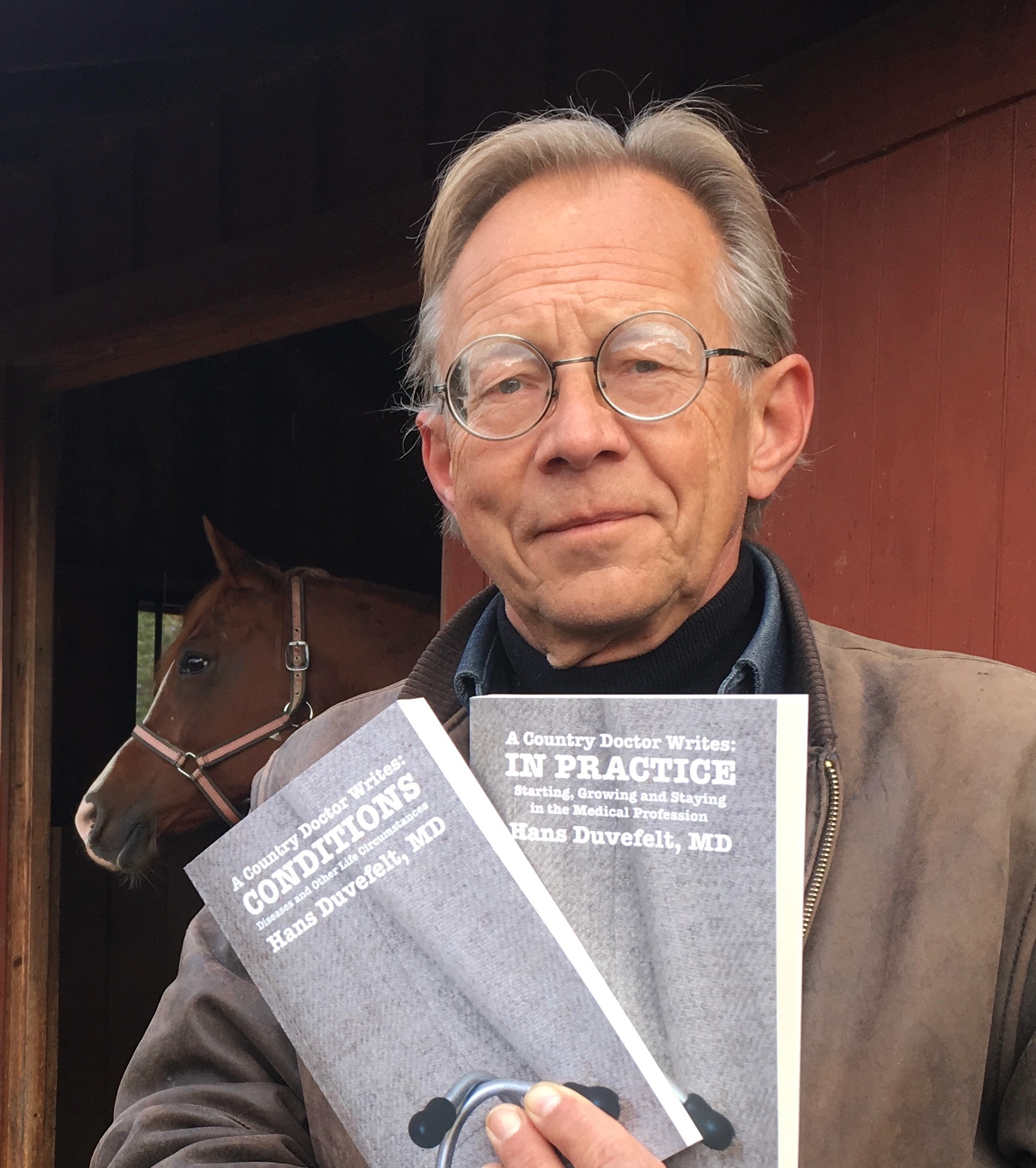
BOOKS BY HANS DUVEFELT, MD

CONDITIONS, Chapter 1: An Old, New Diagnosis

Top 25 Doctor Blogs Award

Doctor Blogs

Enter your email address to subscribe to this blog and receive notifications of new posts by email.

Mailbox

contact @ acountrydoctorwrites.com
Bookmark and Share
© A Country Doctor Writes, LLC 2008-2022 Unauthorized use and/or duplication of this material without express and written permission is strictly prohibited. Excerpts and links may be used, provided that full and clear credit is given.