Archive Page 177

Following the Path of the Soul

In February 1995 I must have seemed overworked and headed for burnout. Clarine, my bed-bound patient who always encouraged me to write down my thoughts and experiences as a country doctor, gave me a copy of Thomas Moore’s 1992 bestseller “Care of the Soul”. She ran a small book editing and publishing business from her sickbed. Her vision was poor by then, but with the help of the adjustable settings on her computer, she could still do her work. When she inscribed the book with her thick fountain pen, she accidentally turned the book around and inscribed the back of it:

“With love and every good wish –

Preread & reviewed by

Clarine”.

Soul is not the same as spirit. While the spirit looks toward heaven, the soul has to do with our roots, the messy depths of our psyche. Thomas Moore explains that soul is in attachment, love and community; it is in food, music, art and experiences that touch our hearts.

In “Care of the Soul”, Moore points out that we cannot think ourselves out of the modern split between body and spirit, because “thinking is part of the problem”. He quotes fifteenth century writer Marsilio Ficino: “What we need is soul in the middle, holding together mind and body, ideas and life, spirituality and the world”. Moore goes on to say: “Care of the soul is not solving the puzzle of life; quite the opposite, it is an appreciation of the paradoxical mysteries that blend light and darkness into the grandeur of what human life and culture can be”.

I remember reading parts of the book, but hurriedly and not with an open mind. It sat in my bookcase for years, and I often glanced at the title on its spine.

In February 2007 my Nurse Practitioner wife and I registered for a Cape Cod summer seminar with Thomas Moore. We were working very hard, side-by-side, and we were feeling a bit stretched. We had a cleaning lady, who also did our grocery shopping, a laundry service, a lawn-mowing service and a handyman. Our spare time was occupied with dancing; in just four or five years we had become accomplished ballroom dancers. We took private lessons and practiced at least three nights a week and several hours every weekend in a rented studio. We used to joke that while we worked and danced, other people were living our life.

July 23rd, just after we came home from a surprise retirement party for one of our dance instructors, where we had done a humorous tango exhibition, our 15 year-old German Shepherd got sick. She was a cancer survivor, and we made arrangements to have her seen at Angell Memorial Hospital in Boston on our way down to the Cape. The diagnosis and prognosis were grim; she had a grapefruit sized tumor in her chest.

That week in August, beginning four years ago today, turned our lives around. Our dog’s health failed rapidly, and my wife stayed with her in our rented cabin while I attended the Thomas Moore seminar. The topic was soulfulness in clinical practice and in one’s life. Moore took the principles from his book and put them in the context of being a clinician, a healer.

Back at the cabin we dragged the mattress off the bed and slept on the floor with our dog and our little Persian cat. I would update my wife on the day’s discussions and we worked on our assignments together.

In class, Moore showed a strobe-like black and white movie of C.G. Jung carving his inscriptions into a big rock at Bollingen. As the gentle waves of Obersee lapped against the shore, one of the fathers of modern psychiatry tirelessly and with great pride carved a stone when he could have written another book or lectured at foreign universities. Instead, he chose to do this, creating something that was important to him and could last for thousands of years. Were we, my wife and I, doing something really important to us or were we just working hard without purpose? We knew we had to get off the merry-go-round we had created for ourselves.

At the end of the week, Moore signed my old copy of his book – inside the front cover, which Clarine had inadvertently left blank when she gave it to me:

”Help us save the soul of the world.

Best Wishes,

Thomas Moore”.

Within weeks our dog died in her favorite spot in our kitchen. Two months later another Shepherd was given to us. He had been born July 23, the same day Callie got sick. Six months later my wife’s health caused her to leave her career as a Nurse Practitioner. We reassessed our priorities and vowed to take care of our own health the way we had always told our patients to.

I have developed an undeserved, strong bond with our recently adopted 23-year-old rescued white Arabian horse. She has made me the first human being in years that she dares to trust, because I ask nothing of her. I have read that Martin Buber, author of “Ich und Du” first became aware of the true nature of I-and-Thou relationships when he befriended a gray mare at age eleven.

Without all those other people running our life we are doing the soulful chores couples have done on small farms for countless generations – “chop wood, carry water”. We cook together and we read out loud after supper and talk about health, disease and doctoring. My wife studies other forms of healing and I write about my life as a country doctor. Dancing isn’t an exhibition sport for us anymore; we think of it as an expression of our love for each other.

Earlier this week a package came in the mail with my latest online purchase: Thomas Moore wrote a new book last year, “Care of the Soul in Medicine”. I opened the package eagerly, weighed the hardcover book carefully in my hands and reluctantly put it down on my desk. I haven’t had a chance to start reading it until this weekend.

How will I grow – as a man and as a physician – from his words this time?

Patient Centered or Evidence Based Medicine – Can we really have both?

“The conflict between evidence-based medicine and individuals is at the core of the struggle to reduce the cost of care.  I fear it is intractable and will remain so… We need to talk about the tensions and uncertainty, with respect for each other and with open minds. I’m not sure what solutions are possible but without an ongoing, messy discussion, we won’t find out.”

Jessie Gruman

“In a recent experiment, the average effects of the opioid remifentanil were either doubled or extinguished by manipulating subject expectations; functional magnetic resonance imaging scans showed that regulatory brain mechanisms differed as a function of these expectations. Does this mean that we might double our gas mileage if we wished for it hard enough? Well, no. But people are not machines, and we shouldn’t treat them as such.”

Daniel E. Moerman, Ph.D.

“Patient Centered Medicine” sounds ethical and humane. It almost seems like an obvious thing to strive for, but it is far from universally accepted. Many stakeholders and quite a few opportunists in today’s health care system are working hard to shift power further and further away from the patient-physician decision-making that takes place in the exam room.

In every patient visit there are at least two more parties represented besides the doctor and the patient:

Since the majority of patients are covered by health insurance, the insurance company is always present in any decision that involves money. It would be naïve to expect anything else; that is what happens when someone else pays the tab.

In recent years we have also started seeing “experts” of various kinds judging or prejudicing the medical provider’s performance. Most of the time, these “experts” make recommendations and publish “guidelines” without much authority behind them, since there are often competing guidelines for doctors to choose between. Lately, though, through stronger associations between payors and “experts”, “guidelines”, now re-introduced as “Evidence Based Medicine”, are increasingly used to control what happens in the exam room.

The notion of practicing “Evidence Based Medicine” is not new; doctors study the basic sciences in medical school, read scientific journals and attend continuing education courses to keep up with new developments in their field. What is new is the notion that doctors somehow cannot be trusted to weigh all the available evidence, like other professionals, and sit down with individual patients to discuss how the evidence applies to each unique case.

The “Evidence” seems to have lost its plurality, which is more consistent with the thinking of statisticians and insurance actuaries than with science. The more we learn about diseases and the human body, the more we understand that people are different. Genetics and neurobiology are beginning to explain why treatments that work in some patients may not work in others, and may even be harmful to some.

Jesse Gruman, in her springboard article for Better Health’s Grand Rounds, writes about the inherent conflict between Patient Centered and Evidence Based Medicine in cancer treatment. In each such case, the personal and financial stakes can be enormous.

On July 14, The New England Journal of Medicine published a study comparing inhaled albuterol, the Evidence Based, time-honored treatment for mild asthma attacks, with placebo inhalers, sham acupuncture and doing nothing. Only the albuterol inhalers improved patients’ breathing test performance, but the patients who received placebo inhalers and sham acupuncture experienced the same amount of symptom relief. Only the patients who received nothing were unimproved.

Daniel Moerman, in his editorial, comments on the study:

“For subjective and functional conditions — for example, migraine, schizophrenia, back pain, depression, asthma, post-traumatic stress disorder, neurologic disorders such as Parkinson’s disease, inflammatory bowel disease and many other autoimmune disorders, any condition defined by symptoms, and anything idiopathic — a patient-centered approach requires that patient-preferred outcomes trump the judgment of the physician… Usually the control is designed to convince the doctor yet is irrelevant for the patient and patient-centered care. Often the very assumption that there is a correct control simply is not the case… Maybe it is sufficient simply to show that a treatment yields significant improvement for the patients, has reasonable cost, and has no negative effects over the short or long term. This is, after all, the first tenet of medicine: “Do no harm.”

Moerman’s words challenge us practicing physicians and scientists to be prepared to reconsider the purpose and priorities of many of the things we do on a daily basis. His words must be even more unsettling to all the non-clinicians who make their living trying to tell us what to do.


A Cleansing


“Joel, let’s not kid ourselves. Whatever we diagnose, most patients, if they don’t die, get well by themselves. Our job is mainly to try to make them feel better. Do no harm.”


Leonard Quinhagak, the Healer (Northern Exposure)

I never enjoyed covering for Dr. Ferguson. She was a nice woman and her patients adored her. She advised them on not only their medical conditions and their treatment, but also recommended vitamins, supplements, herbals and macronutrients. A patient who came to see her for a simple cold usually left with half a dozen prescriptions or recommendations for over-the-counter remedies.

When she was out of the office and I happened to see any of her patients for some type of respiratory infection, I always had the feeling they were disappointed and confused. They seemed to expect more than my minimalist treatment suggestions for their self-limited problems.

In my view, no treatment is entirely harmless. Decongestants can stimulate the heart. Antihistamines suppress young children’s breathing. They can also thicken mucous and cause sinus infections, and in older men they can cause urinary retention. Cough suppressants can cause psychiatric side effects. And antibiotics can cause everything from yeast infections to allergies to superinfections.

The allopathic physician community has gradually started to turn away from prescribing unnecessary antibiotics for respiratory infections, but many of us are instead recommending Echinacea and other non-prescription remedies, often without experience or formal training and without basing their use on the same kind of evidence we base our allopathic treatments on.

My brother-in-law and sister-in law are both chiropractors. We don’t talk shop a whole lot, but I remember vividly how they handled their little boy when he was miserable with cold symptoms. They would wipe his red and congested little nose and tell him he was going through a cleansing. They made it sound like something good, almost as if it would leave him a healthier person after he was through with it.

How refreshing, providing a context, framing the experience, rather than suppressing it with substances that could easily backfire.

In Northern Exposure, the TV drama series from the early 1990’s, a young New York physician ends up in a Public Health Service position in a small community in Alaska. He clashes with the Native American healers now and then when he claims to have a monopoly on treating his patients. Many of them freely seek the advice of both the medicine man and Dr. Fleischman.

When a young female patient develops a scaly, itchy rash over most of her body, Dr. Fleischman diagnoses an allergy and prescribes steroids.

Leonard says to Dr. Fleischman:

“It’s wonderful how quickly you can make a diagnosis.

I, on the other hand, spend hours with patients. Sometimes days.

I go fishing with them. I eat with them.

I spend the night in their homes.

It’s not just time consuming.

It’s taxing.”

Shelly continues to be miserable. Leonard, the Healer, spends time listening to her stories and memories and helps her see her rash as a renewal process, a shedding of her old skin, and not something frightening. Her condition resolves and her skin becomes smooth and healthy again.

In the TV episode, Leonard had asked to observe Joel at work, but it is the young physician who has the most to learn from the older Healer’s visit to his office.

Lifetime Nutritional Balance

The last time I rented a car at the Stockholm airport, I felt a little nervous filling up the gas tank. The brand new Volvo was a flex-fuel car and the Swedish gas pumps had more choices than I was used to. After fretting about it for a few moments, I still chose the familiar unleaded gasoline over the E85 ethanol, which I had heard of but not run into in my rural home state in America.

Our bodies are even more adaptable than modern car engines. Yet, there is a lot of controversy about which fuel is best in certain situations. Not long ago there was a new official edict, replacing the latest version of the food pyramid with an image of a properly stacked dinner plate.

Last week, my mother in Sweden asked me if I had heard that you could lose weight by eating bacon and eggs for breakfast. I reminded her that when I was a vegetarian, between the ages of twenty and thirty-five, my weight climbed steadily as I filled up on oatmeal (I should write more about the oatmeal fallacy some day), cheese sandwiches, rice and pasta. She remembered that my weight dropped when I reintroduced some more protein in my diet.

My mother was recently diagnosed with Type 2 diabetes. She, like many of my patients over here, hears from her diabetes nurse that she needs to take in a steady dose of carbohydrates, because “her body needs them as fuel”.

It seems that many Swedish and American dietitians share the same idealistic view of what diabetics should eat.

The trouble is that some people’s bodies aren’t flex-fuel bodies anymore. Their Type 2 diabetes makes their carbohydrate burning terribly inefficient, so they actually run better on protein and fat. The dietitian community gets the heebie-jeebies about this, because they prefer to prescribe a “balanced diet”.

If the manual of that rented Volvo said to fill it up with gasoline every other time and E85 every other, and the car sputtered and stalled every time I filled it up with gasoline, I would ignore the manual and drive it on E85 all the time.

I tell my diabetic patients that I agree with the notion that a balanced diet is generally best, but that their diet so far has probably been unbalanced enough to stress their carbohydrate burning system. It is as if they have already had their lifetime supply of carbohydrates and they now need to correct that imbalance.

If a diet that works well for non-diabetics sends Type 2 diabetics’ blood sugar through the roof, it can’t be the right diet for them. This is where my patients get to practice their own evidence-based medicine; I ask them to check their blood sugar two hours after their most common foods and to start modifying their meal choices according to their blood sugar results. Then we check their weight, long-term blood sugar and cholesterol profiles. When every single parameter looks better, we know that together we have taken a step in the right direction.

In reality, even Type 2 diabetics have some remaining flex-fuel capability. The challenge is not to use up this ability, but to maintain it as long as possible by limiting carbohydrate intake enough to keep blood sugars reasonably low without relying on drugs, which never work as well as the right kind of diet.

Food pyramids and popular diets come and go, and the theories behind them may seem confusing. But every patient with Type 2 diabetes has the tools (their lancet, glucometer, pencil and paper) to see what type of diet actually works when the “usual” way of eating just continues to make things worse.

A Drug Launch Lunch

There were two “suits” and several boxes of free pizza in the lunchroom when I stopped in to grab some coffee the other day. The enthusiastic young drug “rep” spoke rapidly while our staff ate. His regional manager watched and listened.

Drug “reps” are the only people you ever see in a doctor’s office around here wearing suits. The younger man’s three-button narrow-lapel suit was black and a little shiny, his permanent press point collar shirt a classic French blue, but his striped tie definitely too large for his narrow collar. His senior colleague wore a pinstriped double-breasted dark gray suit with a white spread collar shirt, a perfectly tied half Windsor knot and tasseled loafers.

The two men seemed very out of place in our rural clinic, and so did the medication they were promoting.

The new drug, first in its class, won’t make patients feel any better, live any longer or breathe significantly better. Statistically, it will help reduce the number of exacerbations of chronic obstructive lung disease in patients already on maximum medical therapy.

Most insurance companies don’t even cover the drug, but the fast-talking young “rep” rattled off several things we might want to write down on Prior Authorization requests in order to get it approved. He suggested we refer to the GOLD treatment guidelines, which mention the new drug class without specifically recommending it.

“Side effects? Some people – excuse me for mentioning this while you are eating – experience diarrhea, and some get psychiatric symptoms, which would be a reason to stop the drug.”

At that point I almost choked. Not that I am the least bit squeamish about the mention of bodily functions while I eat or drink, but because of the overly casual mention of the risk of psychiatric side effects.

If a medicine for chronic bronchitis with an unknown mechanism of action can make patients suicidal, it seems to me that a small group of country doctors in remote, rural America should not be among the first ones to prescribe it. It sounded to me as if we must have been the second choice for a drug launch because the pulmonologists downstate wouldn’t pay enough attention to the “suits” representing it.

I excused myself and went back to my office.

I racked my brain. Medical school was a very long time ago. Phosphodiesterase? Cyclic AMP? Viagra, what else? My computer had some more answers.

Phosphodiesterases (PDE’s) were first isolated in rat brains forty years ago.

Xanthines like caffeine and theophylline (an almost outdated COPD drug with a lot of toxic side effects) are non-selective phosphodiesterase inhibitors.

Sildenafil (Viagra) is a PDE-5 inhibitor, and it has found some use in severe pulmonary disease (Revatio).

The new drug is the first PDE-4 inhibitor in clinical use. Earlier compounds in the same class were shown to have severe psychiatric effects and never turned into useful medications.

PDE-4 inhibition stimulates pyramidal cells in the brain, but it is not exactly known what the clinical effect of that might be. People have looked for psychiatric uses for this type of chemical, but the results of that research are still inconclusive.

I also found a less than flattering review on an internal medicine website that summed it all up nicely for me.

So there I was, having listened to a sales pitch for a drug that essentially does very little for only the sickest of COPD patients but might be opening Pandora’s box as far as brain chemistry goes. Not my cup of tea.

I turned to the pile of mail on my desk. On top was a faxed sample offer for a new drug to treat travelers’ diarrhea. I turned to my computer again: Average retail price $300. I stopped right there and tossed the piece of paper in my wastebasket.

By that time it was one o’clock and my first patient of the afternoon, a 75-year-old man with severe COPD, was ready to be seen.


I just realized none of the posts show on an iPad or a computer, but they do show on an iPhone. WordPress is working on this. In the meantime, please visit my Substack.


Osler said “Listen to your patient, he is telling you the diagnosis”. Duvefelt says “Listen to your patient, he is telling you what kind of doctor he needs you to be”.


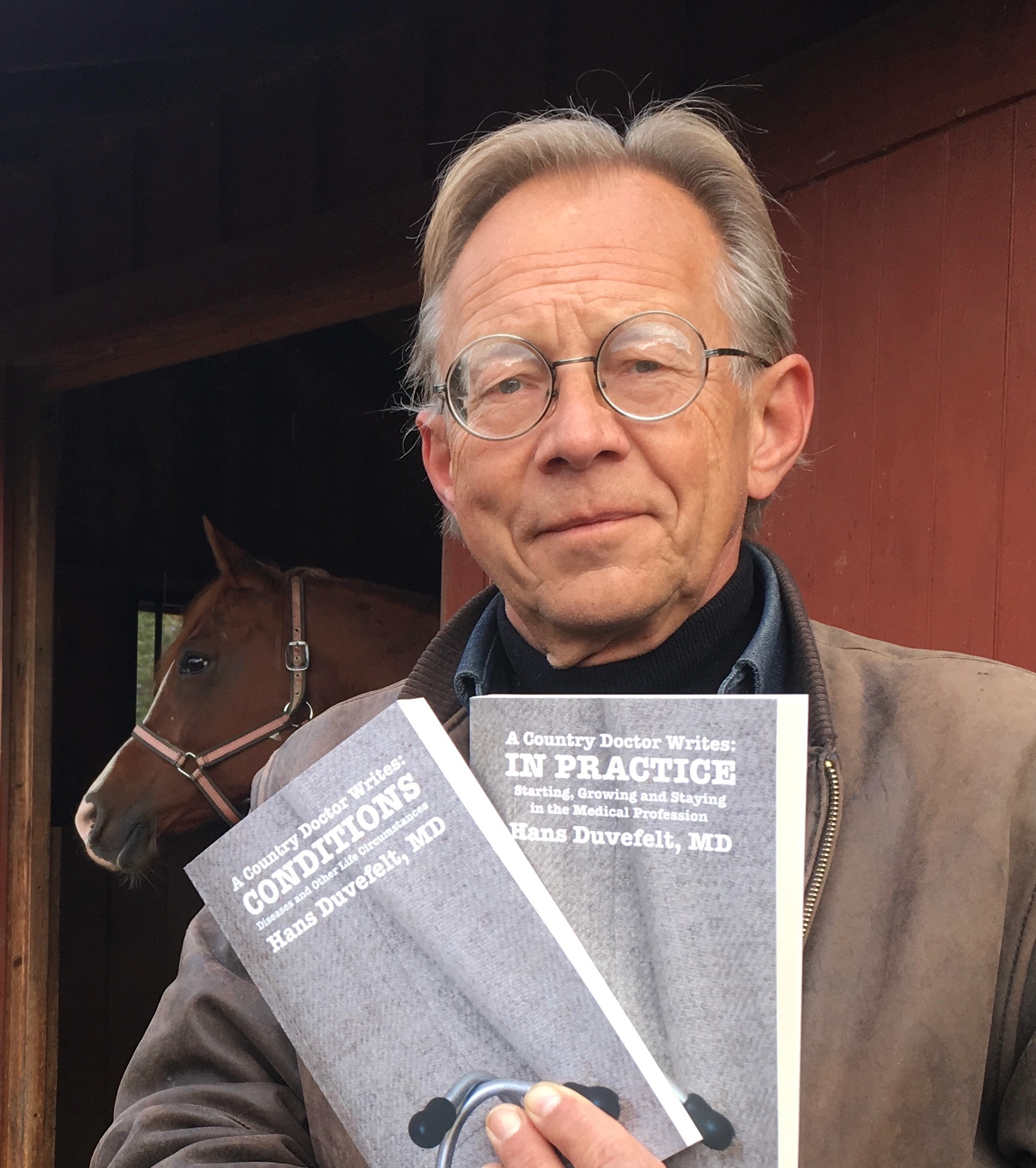
BOOKS BY HANS DUVEFELT, MD

CONDITIONS, Chapter 1: An Old, New Diagnosis

Top 25 Doctor Blogs Award

Doctor Blogs

Enter your email address to subscribe to this blog and receive notifications of new posts by email.

Mailbox

contact @ acountrydoctorwrites.com
Bookmark and Share
© A Country Doctor Writes, LLC 2008-2022 Unauthorized use and/or duplication of this material without express and written permission is strictly prohibited. Excerpts and links may be used, provided that full and clear credit is given.