Archive Page 173

Life and Death

Elmer Ladd built the little pink house at the end of our road just in time for their wedding on New Year’s Eve 1953. The pre-cut Aladdin home caught Elmer’s eye when he first saw the catalog. Eileen picked the color and the two of them knew from the day they moved in that they would always live there, close to his work at the train station. Every day after the 12:05 had left, Elmer came home to eat lunch with Eileen. At precisely 12:50 he put his cap back on and left to greet the 1:05 southbound Express. Every afternoon when their daughters returned from school, Elmer was home again to spend a few minutes with them before returning to the station for the next train.

After Elmer retired from the railroad, he and Eileen spent all their time together at home, caring for the little pink house and the small garden. For the first few years he would still listen for the trains, but eventually he learned to ignore them. Ten years after his retirement the trains stopped running through our town and weeds grew quickly between the abandoned tracks.

One day a stray dog wandered into their yard, an off-white spaniel mix with brown spots scattered over her back. Eileen thought the dog looked like a large mushroom when she first noticed her through the kitchen window. They called her Mushroom, and she quickly filled the void they had both felt in their life.

With Mushroom two paces ahead, behind or to the side, Elmer did the rounds around town morning and afternoon. The sweet-tempered dog made friends along the way, and Elmer tipped his old uniform hat to passers-by and shopkeepers as they walked. He had found a purpose and a routine again, and he was thriving. He constantly talked with or about the dog, and called her his little girl.

Then the seizures began. The veterinarian was not able to control them with medication, and Eileen worried that Elmer wouldn’t be able to get the dog back home again if she were to have a seizure on one of their walks. They stayed closer to home and Elmer’s world got smaller again.

Mushroom, sweet and gentle as ever, seemed content to stay inside the house or in the yard. On warm summer afternoons she dozed under the white porch swing while Elmer and Eileen sipped lemonade in the shade. More and more often and without warning, the dog would suddenly start convulsing to the point of losing control of her bodily functions, and the helpless elderly couple would kneel beside her and quietly pray for each spell to end. After she came to, Mushroom would seem confused, docile and grateful to be near them. She would wag her tail quietly and put her muzzle in the nearest hand or lap and fall asleep.

Summer turned into fall, and then winter. As the seizures worsened and came more often, Eileen broached the subject of putting Mushroom out of her misery.

“But does she suffer?” Elmer asked.

“I don’t know, but we mustn’t be selfish if there is any chance that she is”, Eileen replied.

“It’s not for us to play God. He gives life and only He can take life away from any of his creatures.” Elmer’s voice almost failed him as he spoke back to his wife.

Weeks passed, and the seizures grew in intensity. On a cold January morning, Mushroom collapsed at the end of the driveway and seized more violently than she had ever done before.

“Elmer, you’ve got to take her to the vet. You can’t let the poor dog suffer any longer.” Eileen sobbed: “Can’t you see it’s time?”

Without saying a word, Elmer put on his hat and jacket and trudged through the freshly fallen snow to the dog who lay quivering down the hill from the house.

He lifted Mushroom and walked slowly back up the hill. As he approached the car, Eileen ran out to open the back door for him.

His face was dusky, his breathing wheezy, and he moaned quietly as he leaned into the vehicle with Mushroom, whose limbs hung flaccidly as he coaxed her into the crowded back sat of the small sedan. The dog snored and exhaled loudly.

Silently, Elmer put his arms around Eileen. She sobbed. Then he opened the driver’s side door and sat down behind the wheel. Just as he turned the ignition, he took a deep breath as if he meant to say something. Then his head slowly nodded as his body fell, lifeless, over the steering wheel. The horn blared and the dog raised her head in the back seat.

Eileen reached in and tried to pull him away from the steering wheel. She managed to turn off the ignition and as she did, she knew her husband was gone. She acted quickly, but the ambulance crew pronounced the love of her life dead at the scene.

Mushroom came prancing down the street this afternoon, her spaniel tail and feathers waving in the warm breeze of what felt like the first day of spring. Ten paces behind came Eileen. The two of them make their rounds every day now the way Elmer and Mushroom used to. The new veterinarian in the next town seems to have found the right medication to control the dog’s seizures, and life somehow goes on for Elmer’s two girls.

A Country Doctor Practices Telemedicine

Walking gingerly, one small step at a time like an old man, I slowly made my way down our icy driveway to the mailbox this morning. The cold wind circled around my neck and the sleet pounded against my cheeks. March was surely coming in like a lion here in the Northeast.

Inside the black metal mailbox were the usual bills and journals, but also a small post card. I brought it closer to try to read it through my wet eyeglasses. It was from a company looking for primary care physicians for telemedicine services.

Telemedicine is an integral part of rural health care. When an accident victim has a CT scan of the brain or cervical spine in the middle of the night, a radiologist in a different time zone reads the images while our own radiologist gets his well-deserved sleep. The specialists who fly or drive here to do consultations sometimes use the hospital’s teleconferencing capabilities for virtual follow-up appointments. We even have telepsychiatry with doctors from Boston and the southern parts of our state.

“Telemedicine for primary care doctors”, I thought as I inched my way up the slippery driveway in the bitter cold sleet storm. I imagined myself in my slippers and cardigan, comfortably doing telephone consultations by the fire. I saw myself poolside in my swim trunks, sipping from one of those parasol drinks, making money on the phone while working on my tan.

I have already done some telemedicine. Last weekend my daughter sent me a picture on my cell phone with the question what kind of rash my grandson had. It was a classic case of erythema annulare. He happened to have an appointment with his doctor a few days later, and I understand the diagnosis was confirmed in person then.

Then I remembered I had been less successful a few weeks before that when my granddaughter had a host of symptoms, including a fever and, as my daughter added: “She won’t eat”. It all sounded pretty viral to me, so I gave the usual advice. A couple of days later, I found out the child had a flaming case of strep throat.

I asked sheepishly “How sore was her throat?”

“Real bad, didn’t I say that?” My daughter seemed puzzled.

“I only heard that she wouldn’t eat”, I said.

“Yeah, because her throat was so sore”, she answered.

A visual would definitely have helped there. If it was that hard to diagnose my own granddaughter over the phone, I can imagine the challenge of trying to do more than the simplest triage over the phone with a complete stranger who is paying for the call.

I kicked the snow off my boots and entered the glassed-in front porch. My eyeglasses were frosted on the outside and fogged up instantly. I took my boots off, put the journals on my reading pile and the bills on the staircase to the upstairs. I turned the post card over one more time, shrugged to myself, put it in the kitchen trash and poured myself another cup of hot coffee.

The Art of Listening: Narrative, Hermeneutics and the Electronic Medical Record

Doctors tend to speed read. We are often in a hurry to extract the salient points from the large amount of information we receive every day in the form of journal articles, discharge summaries, imaging and consultation reports – and we often bring the same trait to our verbal history taking in the office or at the bedside.

In the past, before Electronic Medical Records, people argued over how many seconds the average doctor listened before interrupting the patient, but the point was clear – we often prefer to receive information on our terms, when we want it and in the order we want it. In part this is because we often imagine that this is faster than letting the patient speak uninterrupted. In part it is because it helps our pattern recognition, which can be a useful way of making a diagnosis but it may also be a counterproductive way of pigeonholing our patients without trying to see the uniqueness of their condition.

Osler said, “Listen to your patient, he is telling you the diagnosis”. But there is more to listening than making a diagnosis. All communication requires listening. Physicians today are not asked to diagnose patients as often as Osler’s contemporaries were. Our patients come to us looking for relief from anxiety, insomnia, overweight or depression. They sometimes ask our help in obtaining disability benefits instead of diagnosis and treatment. Those situations are not at all like making a diagnosis of myxedema or an infectious disease. In those situations we need to understand what motivates our patients.

The concept of Narrative Medicine has been around for a dozen years. It is not only the patient with a psychological or psychiatric complaint who needs to tell the story that goes with the symptoms. Many patients cannot reduce their experience of any illness to clear-cut, easily catalogued clinical factoids.

In the days of dictated office notes, many of us put the patient’s chart somewhere within reach but then gave all our attention to the patient. We would use eye contact and body language to encourage continued communication and we would listen for the untold parts of the story that unfolded. Not until after the visit was over and the patient gone from the clinic would we reach for the microphone or digital recorder and create our office note, which would summarize both the clinical details and the narrative.

Today, with real-time documentation into medical records built around structured data entry, doctors who used to sit back and listen are leaning over keyboards and mouse pads. Instead of savoring and contemplating their patient’s unique words, doctors are now choosing between adjectives in drop-down menus, as in a reverse paint-by-numbers process.

With fewer nuances and less detail in the digital narrative, there is greater risk that we may never understand what a symptom or disease means to a patient: Hermeneutics, mostly thought of in the context of Bible interpretation or philosophy, is an emerging area of exploration in medicine, just when our electronic clinical notes are starting to look more and more similar from one patient to the next. At the same time the revolution of modern genetics is creating the potential for what some call Precision Medicine, referenced in a recent issue of The New England Journal of Medicine. This is the science that lets doctors know in advance which patient will respond to what treatment. It has even been suggested that one could pick antidepressant medications based on biochemical testing.

It is ironic that the medicine of the future promises to be exquisitely personalized in the biochemical sense, but more and more depersonalized from a humanistic, hermeneutic point of view:

Picking antidepressants based on genetics – instead of listening to the patient? Maybe if we listen more, we might prescribe less.

The Gift of Healing: Pastor Graf and Henri Nouwen

My last encounter with Pastor Graf was brief, a few words exchanged on a windy sidewalk. I, a young hospital intern, was on a quick lunch break errand downtown. He, an aging, slightly disheveled country minister, was in town to visit his 94-year old mother.

I have carried the image with me ever since then of the tall, heavy-set man with his unbuttoned overcoat flapping around him. I remember his dark, peaceful eyes and his full, carefully moving lips as he spoke. I can still hear his soft, yet penetrating voice. I had listened to him speak so many times – in his little village church on Sunday mornings and during midnight masses, driving along dirt roads at breakneck speeds in his Peugeot station wagon and over tea with scones in the vicarage.

I was his assistant for a couple of summers, an unpaid job that evolved from my position as junior leader at a co-ed Scout confirmation camp.

Pastor Graf needed an assistant and I didn’t mind a closer look at the life of a country preacher. My own confirmation classes had been anything but inspiring. I attended Saturday classes in my parish church with a bunch of boys, who did their best to sabotage the aloof, prim and occasionally ill-tempered minister. I never heard anyone in the neighborhood say they had been inspired or helped by Pastor Berglund.

Pastor Graf was anything but aloof. He spoke plainly with people from all walks of life. He knew about fishing and farming. He took a deep interest in everyone in his rural parish, and had a hand in most community events. He knew everybody by name. Day or night, he was always available to listen to anyone’s sorrows or worries. He was a healer of troubled souls.

He was a man with many interests, loved music, art and history. Technical things, from cars to stereo equipment, fascinated him. He was also an entrepreneur who brought in royalties for his church from sales of liturgical items he had created.

What I didn’t know when I signed up to work for him, but what made me respect him more and more during the years I knew him, was that in spite of his gifts and standing as a clergyman, he wasn’t on top of the world. He worried constantly about his elderly but healthy mother and he was tormented by religious doubts and feelings of inadequacy in doing God’s work. And although I never saw him drink alcohol any other time, he always poured a very full goblet for communion and savored what was left when the service was over.

Later I would hear of him, not by name, but I knew he was the one people at the hospital talked about; local minister in the Emergency Room with a manic episode, respected pastor dropped off by police to avert OUI charge. My understanding of the man beneath the white collar deepened, and my admiration for him grew even more as I learned about his challenges and heard others speak of him disparagingly.

I understood then, more than when I was with him, that through his own angst and his own doubts he found the common ground to connect with the people in his community. I also understood that his God, the one he asked to strengthen his faith, had chosen him as His vehicle because of all his weaknesses, not in spite of them.

I didn’t have the words for it then, but years later I heard of Henri Nouwen’s book “The Wounded Healer”, which was written during the time I worked with Pastor Graf. It was one of those titles that can instantly change how you see the world before you even open the book. I actually didn’t read it until recently. Nouwen doesn’t say that a minister needs to have deeper wounds than his parishioners or that he needs to expose his own suffering in order to be effective. He does say that it is through his own wounds that he can relate to the suffering of humanity all around him.

People have taken Nouwen’s concepts into the arena of medicine as well, although he didn’t specifically include physicians in his thesis. I believe there is no difference between spiritual and physical healing; all healers must know suffering personally in order to be effective. It doesn’t mean the physician’s suffering needs to be the same as the patient’s, nor does it mean that the physician, any more than the minister, needs to show his wounds publicly.

It does mean that those among us, ministers and physicians, who are unaware of or deny their wounds and weaknesses, cannot fully use the great gift of healing that isn’t their own but only passes through them. For that to happen they need both self-awareness and empathy.

“The Wounded Healer” made me think of Pastor Graf when I first heard the title. Now, many years later, I finally know for sure that the book is about people like him.

Jumping to Conclusions

Muffy Wahl slipped backwards on her icy porch and landed on her right hip. Bruised and sore, she took it easy for a few days but she still went to her exercise class the following Thursday. The petite sixty-three year old was determined not to let a silly little fall set her back, and she did her jumping jacks to the loud, fast music with more determination than usual. She could barely drive herself home afterwards.

After dinner Thursday night she didn’t know what to do with herself; she shifted her weight back and forth, but the pain was just as bad no matter how she positioned herself. Getting ready for bed she noticed the bruises were bigger and now reached around to her groin.

Even flat on her back she was in pain. It was a constant, relentless, nauseating pain unlike anything she had experienced before.

Friday morning she got a call from her twin sister, Mary, who had just been admitted to the hospital with a hip fracture. Muffy promised to go and see her, even though it meant a twenty-mile drive. She took some ibuprofen and drove off to see her sister.

After the two women had visited for a while, Mary noticed Muffy’s pained expression as she shifted her weight in her chair. Mary suggested that Muffy get herself checked out downstairs in the emergency room. Muffy hesitated, still thinking it was just a bad bruise. Besides, she had never had any dealings with St Bartholomew’s Hospital; she always went to Cityside.

Mary insisted, and soon Muffy was downstairs, wearing a hospital gown and being wheeled into x-ray.

“The x-rays were normal and they said it was just a bad bruise”, Muffy told me Monday afternoon in the office “Then they gave me a shot for pain that wouldn’t make me tired. I drove myself home later on.”

“And then…” I asked.

“I noticed the welts Saturday morning. I’ve been in agony all weekend.”

“Welts?”

“Yes, I thought it might have been an allergic reaction to the shot they gave me, but they were only around my right hip.”

“Let me see”, I said.

She exposed the skin around her right hip. There were bruises, red blotches, and the unmistakable blisters of Herpes Zoster – shingles.

“This is shingles. Did anyone look at your skin?” I asked.

“No, they checked how my hip moved and took the x-rays through the hospital gown”, she answered.


I just realized none of the posts show on an iPad or a computer, but they do show on an iPhone. WordPress is working on this. In the meantime, please visit my Substack.


Osler said “Listen to your patient, he is telling you the diagnosis”. Duvefelt says “Listen to your patient, he is telling you what kind of doctor he needs you to be”.


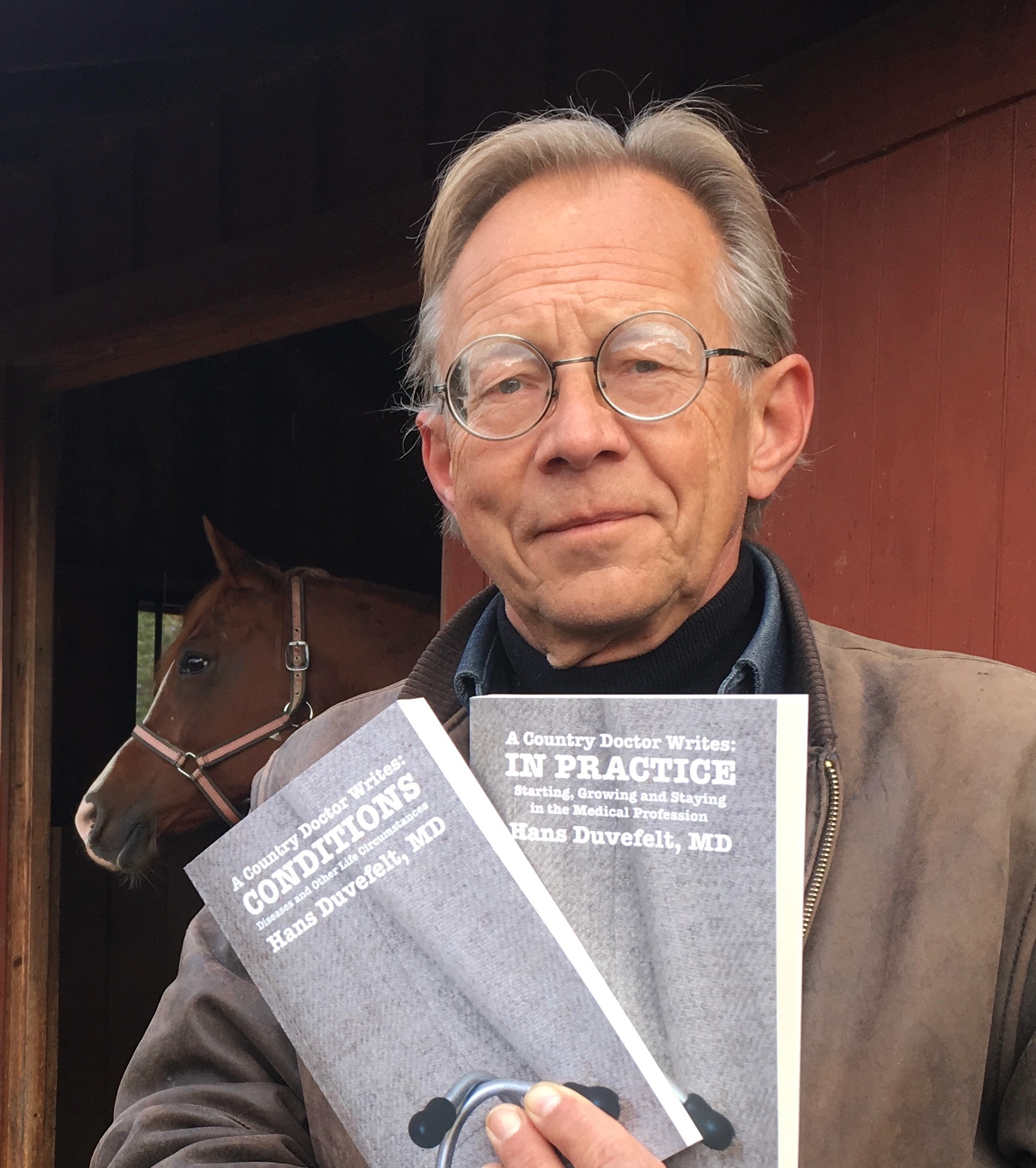
BOOKS BY HANS DUVEFELT, MD

CONDITIONS, Chapter 1: An Old, New Diagnosis

Top 25 Doctor Blogs Award

Doctor Blogs

Enter your email address to subscribe to this blog and receive notifications of new posts by email.

Mailbox

contact @ acountrydoctorwrites.com
Bookmark and Share
© A Country Doctor Writes, LLC 2008-2022 Unauthorized use and/or duplication of this material without express and written permission is strictly prohibited. Excerpts and links may be used, provided that full and clear credit is given.