Archive Page 170

A Minute of My Time

Countless times during the course of my day, some person, entity or task vies for my time and attention.

“If I could just have a minute of your time” begins a request to also see the spouse of a scheduled patient, a sales pitch from a pharmaceutical “rep” or home oxygen vendor, a phone call from a visiting nurse, a message from a far away relative of an elderly patient in tomorrow’s schedule or a plea to complete the form Mr. Henderson forgot to bring with him for yesterday’s appointment. Unspoken, the same request lies behind every email, fax, memo, journal and invitation that finds its way to my office. A minute of my time doesn’t seem like too much to ask.

In years past I would consider such requests with a constant awareness of how much my time was worth to my employer. “Seven dollars a minute”, I would say, only half joking, when non-patients asked for a minute of my time. That is the “opportunity cost” for a minute of a family practitioner’s time in today’s American health care industry.

Lately, and probably not a minute too soon, I have started to very seriously ponder what each minute of my time is really worth. And I now understand better that time isn’t measured in dollars. Sometimes it isn’t even measured in minutes.

To the patients that entrust me with their care, a minute of my time could make the difference between a good visit and a less than satisfying one. It could make the difference between making the right diagnosis in the first visit or much later. To the far away relative, a minute could mean the difference between needless worry, calm reassurance, or planning a last trip to see their loved one before it is too late.

The emails, memos and invitations obviously pale in comparison to the things I originally went into medicine for, but I have tended to become distracted by the interruptions. And the dollars-per-minute way of thinking is really a very large distraction, too: Again and again I have found that when I don’t watch the clock I am more effective as a physician and more powerful as a healer. I diminish the value of my professional skill, experience and wisdom by thinking of my work in flat rate terms. A minute at a bus stop isn’t the same as a minute at the Symphony, is it?

And, thinking of my employer’s “opportunity cost” – what about my own? My organization will probably be there long after my time is up, so how much is a minute worth to me, since I have fewer of them? I know what the real answer is, I have just had trouble claiming it for myself: My time is invaluable, priceless.

When our horse started to colic today and I left the office early, four patients with routine appointments had to be rescheduled. I made sure they were safe before I drove home to help my wife handle the situation. In years past I would have struggled with guilt, but today I didn’t.

I have come to realize that your days are numbered in the pressure cooker that medicine today can be if you aren’t well rounded in your life. You can’t help others if you aren’t taking reasonable care of yourself. This doesn’t mean that one should be selfish, but it also means one shouldn’t be forever self-sacrificing.

Every time I watched the “safety on board” presentation before takeoff, I have startled at the idea of putting your own oxygen mask on before helping others with theirs. But it is good advice.

My goal is to live long and work until the end in my profession. I want to be the kindest, wisest physician I can be. I also want to be the kindest, wisest human being I can be.

It was about time I let go of my dollars-per-minute yardstick for the value of my time at work. It is also high time for me to think of all of my remaining minutes, 13 million if I live as long as my parents, as absolutely priceless.

The horse is doing fine. The goats are chewing their cud. The barn is warm and cozy under the starlit late winter sky. It is well below freezing and the crusted snow crunches under the cleats of my winter boots as I walk back across the yard to our little red farmhouse.

My stay-at-home vacation has started. I intend to spend it wisely.

The Art of Prognosis

“It appears to me a most excellent thing for the physician to cultivate Prognosis: for by foreseeing and foretelling … the present, the past and the future, he will be more readily believed to be acquainted with the circumstances of the sick; so that men will have confidence to intrust themselves to such a physician.”

Hippocrates: “The Book of Prognostics”, 400 B.C.

This time of year, many of my patients make public announcements, at least to me, of their intentions to quit smoking, eat less of certain kinds of food, exercise more and so on. In many cases, this year’s New Year’s resolutions are the same as last year’s.

Physicians sometimes also walk around making promises that are more optimistic than realistic. Sometimes we do it as a way to invoke the placebo effect, for example when we prescribe a new antidepressant for someone who has “failed” on several others. Other times we do it because neither the patient nor the doctor is ready to admit that the disease seems to have the upper hand.

We need to be careful with our promises. Those of us who treat children know that “This won’t hurt a bit” makes for unhappy and mistrusting patients for years to come. Honest predictions like “This will hurt for just a couple of seconds, and then you won’t feel any pain at all” makes young patients more trusting and courageous the next time.

Promising recovery in a case that proves fatal is a far more serious error than to be proven wrong when predicting a patient’s death from their disease. Still, many doctors make vague promises in the name of hope and encouragement.

Little Amy Ruggles’ family doctor and consultant pediatrician more or less promised she would catch up in her development when she, in fact, had Rett syndrome (“Amy Laughs with The Angels”).

William Sykes’ pulmonologist predicted his alpha-1-antitrypsin deficiency would claim his life within 18 months (“Adverse Effects”), but Bill lived another ten years, haunted by his carelessly delivered death sentence.

One physician I know has made an art form of preparing his patients and their families for the worst possible outcome. Andy Spoerri is a brilliant infectious disease specialist, who was one of my teachers in residency. Every time he admitted or consulted on a patient with pneumonia, he called a meeting with the family. In his animated style of speaking as if time was running out, he would explain the mortality rate of pneumonia. Even in the most routine case, Andy would explain that the patient had a one-in-ten chance of dying from their condition. When the patient recovered without complications, the family would praise Andy as a genius and a lifesaver.

I have never been totally comfortable with Andy’s approach. I sometimes struggle with finding the right level of caution, of under-promise and over-delivery, without making the situation seem more serious than it is.

As physicians, we need to be aware of the power of our words in giving hope and encouragement. We need to be judicious and never promise what we cannot deliver or predict what we cannot know. We need to cultivate the skills of clinical observation and prognostication in the tradition of the old masters. And we need to be humble.

Hippocrates also wrote:

“Medicine is of all the Arts the most noble; but, owing to the ignorance of those who practice it, and of those who, inconsiderately, form a judgement of them, it is at present far behind all the other arts.”

Those words were penned over 2,000 years ago, and the body of medical knowledge has grown exponentially since then. Are we perhaps so focused on keeping up with new technical information, statistical averages and Kaplan-Meier curves that we sometimes forget the tremendous variability among individual patients? Are we sometimes neglecting the value of our own experiences as clinicians when trying to deliver a prognosis?

(An earlier version of this post was published in January 2011)

Touching the Mezuzah

First published in 2012.

A mezuzah (Hebrew: מְזוּזָה‎ “doorpost”; plural: מְזוּזוֹת mezuzot) is a piece of parchment (often contained in a decorative case) inscribed with specified Hebrew verses from the Torah.

ט וּכְתַבְתָּם עַל-מְזֻזוֹת בֵּיתֶךָ, וּבִשְׁעָרֶיךָ. {ס} 9 And thou shalt write them upon the door-posts of thy house, and upon thy gates. {S}
                                        Deuteronomy 6:9

It’s almost 4:30 and I have three more patients to see before my Christmas mini-vacation can begin. Snow and sleet are beginning to fall outside. Our lab tech, who leaves between 3 and 3:30, just called from home to warn the rest of us that she had seen nine moose on Route 1, probably attracted by the road salt.

“Three encounters in thirty minutes”, I think to myself, “and neither of them completely straightforward”. I used to shudder when healthcare administrators called medical office visits “encounters” , but the more I have thought about it, the truer the word rings to me. Two people meet briefly and try their best to communicate in spite of sometimes very different viewpoints and agendas. I remember the phrase “Marriage Encounter” from my first visit to this country in the early 1970’s – an event where couples learn to see each other with new eyes and communicate more effectively.

I have three fellow human beings to interact with and offer some sort of healing to in three very brief visits. Three times I pause at the doorway before entering my exam room, the space temporarily occupied by someone who has come for my assessment or advice. Three times I summarize to myself what I know before clearing my mind and opening myself up to what I may not know or understand with my intellect alone. Three times I quietly invoke the source of my calling.

4:35 – In Room 1 sits Bill Boland, the fellow who always sasses me for my habit of knocking on the exam room door before I enter. He had been in with pneumonia and his x-ray came back suspicious for a tumor. The purpose of today’s follow-up visit is to make sure he is feeling better and to tell Bill he will need more testing. I raise my hand in an automatic door knocking gesture, but catch myself and instead touch the doorframe briefly and take a slow breath before entering the exam room, ready to deliver the disturbing news.

4: 50 – In Room 2 sits Wally Parker, here to talk about his blood sugars. His wife is in the hospital with a lower GI bleed, and her colonoscopy showed an ulcerated tumor that is almost certainly malignant. “Why is he here tonight instead of at Mary’s bedside?” I ask myself as my hand reaches for the doorframe. At the same time I try to clear my mind of my own clutter and my guesses why he has chosen to keep this appointment under these circumstances.

5 o’clock – The child in Room 3 is an 11-month-old with a fever. He belongs to the pediatric group in town, but probably the slick roads and the late hour are the reasons he is here. A new patient, and a sick child at that, requires me to be unhurried and receptive. I must be aware of how well we connect, so neither this child’s young mother nor I miss something important in our encounter. In this case, the child has an ear infection and the mother is a registered nurse with an older child at home who has recurrent ear infections.

At 5:15 I wish Autumn and the new receptionist a Merry Christmas before I leave through the back door.

Route 1 is covered with snow and the large flakes coming right at me make it impossible to see with high beams. I drive slowly with only my low beams, and don’t see a single moose.

Our house is all lit up for Christmas. In one of the sunroom windows shines the metal star-shaped lamp that hung in my bedroom window when I was a child. I remember coming home from school in the dark, looking up at my star on the third floor of our Swedish apartment building, even closer to the Arctic Circle than where I live now.

I can see my wife in the kitchen window, but she can’t see me in the darkness outside. I quickly stomp the snow off my boots on the wooden steps outside the door. My hand touches the doorframe for balance, physical and spiritual, and as a brief gesture of love and blessing:

I am home. It is Christmas.

The Secret Of Life

The secret of life is enjoying the passage of time”

                    James Taylor

One of my wife’s mentors has a 104-year-old aunt, who on her 100th birthday was asked to reveal the secret of her longevity.

“I always have something to look forward to” was her answer.

Wisdom, happiness and longevity aren’t confined to people in cathedrals or ivory towers. They can be found in seemingly ordinary people in the most ordinary places. James Taylor, in his song “Secret O’ Life”, goes on to say, “any fool can do it”. Similarly, the Bible tells us to be more child-like (Matthew 18:4).

That doesn’t mean you have to be childish or think like a fool to enjoy life. It does mean that finding happiness is not complicated, and we sometimes get so wrapped up in our own thinking that we fail to see the simplicity in some of the universal truths about life as well as the beauty of life itself.

Observing which of my patients live well and handle age, illness and adversity the best, I see the power of this every day.

Jungian therapist Robert A. Johnson describes in his book, “Transformation: Understanding the three levels of masculine consciousness”, how the male psyche evolves from simple man (exemplified by Don Quixote), who asks “What’s for dinner?” to complicated man (Hamlet), who asks “What does it all mean?” to enlightened man (Faust), who asks “What’s for dinner?”

Too many of us dwell on the past – what we lost, what we never had, what we should or shouldn’t have done. Too many of us spin our wheels over-analyzing the present. Too many of us fritter away our days and our lives imagining or pining for distant futures at the expense of the present moment.

There is nothing wrong with thinking about the past, but we must each find our own way of making peace with it. There is nothing wrong with trying to understand our present circumstances, but not all of it will make sense to us now. Sometimes it takes years or a lifetime to understand the things we go through in life. There is nothing wrong with having dreams and goals, but we must somehow find joy in the journey towards those goals without feeling that we are wasting our time in our present life, since for some of us, that is all we’ll ever have.

Wisdom, like happiness, can’t be bought or taught. It is only occasionally learned in formal education settings through rigorous study and practice. More often it is earned through hardship and experience. It is gained when we look deep inside ourselves and acknowledge what we see. In the words of C. G. Jung, One does not become enlightened by imagining figures of light, but by making the darkness conscious”.

In medicine, wisdom is partly gained by being wrong, or at least humbled by facing the limitations of our knowledge. But clinical wisdom must be paired with human wisdom as well as some of that simple joy of life James Taylor sang about, so that we can truly be of help to our patients. Nietzsche, in words that could have been written for practicing physicians, said:

“There is one thing one has to have: either a soul that is cheerful by nature, or a soul made cheerful by work, love, art, and knowledge.”

That is the hope I carry, that my love of medicine, of my wife, my family, and of the arts and the beauty around me will help me be joyful in my daily living. I hope that love will sustain me as the alarm continues to ring at 05:10 on bright summer mornings as well as dark, howling winter ones, this year and for many more years to come.

A Country Doctor Watches Marcus Welby, M.D.

The year is 2012. A 58-year-old veteran Family Physician who has just finished a day with more human heartaches than clinical triumphs settles down among the pillows with his wife in front of his MacBook to watch a movie, delivered wirelessly over the Internet:

The year is 1969. A 62-year-old veteran General Practitioner who has just seen his health threaten to fail him, speaks passionately to a group of doctors about how general practice is not dead and general practitioners are not dinosaurs. For the next 98 minutes he proves how much he cares, how well he knows his patients, and how often he is willing to go out on a limb when he feels there is an ethical stand to be taken.

The pilot episode of “Marcus Welby, M.D.” was called “A Matter of Humanities” (how often do you hear that word in medical circles today?). In his passionate speech to the young doctors at the hospital where he had just been treated for his heart attack, he said (and I paraphrase):

We aren’t treating a this or a that, we are treating our patient.

That is pretty much what Family Practitioners say today, and we still aren’t dinosaurs. In fact, the “new” or re-born idea of the Patient Centered Medical Home and other such political reforms may make us more central to the health care machine than we have been since the days when the big HMOs wanted us as “gatekeepers”. Regardless of how our standing with the politicians and insurance companies has come and gone, our patients have kept on coming to see us.

In 2012 more than a few people speak disdainfully about how “the days of Marcus Welby are long gone”. Google has 17,600 search results for that exact phrase, if that is any indication. But many people seem to speak of him without actually having watched or at least remembering much of the show.

I have heard people scoff at his clinical understanding, and I remember once seeing an episode where he used a car battery to deliver a shock to a patient’s heart. But, this was Hollywood fiction – let’s not forget that Marcus Welby himself was a fictional character – and defibrillation and cardioversion were relatively new inventions.

Marcus Welby and his fictional colleagues obviously practiced with the medical knowledge of that time. We may smile at how his attending physicians kept him in the hospital for twelve days or more for a simple heart attack. That may seem archaic by today’s standards, but it may actually have been more humane than what we are doing today with our same-day surgeries and drive-by deliveries.

The purpose of most episodes of Marcus Welby, M.D. was not to illustrate the clinical aspects of a particular disease or its treatment. Most of the stories were about how disease affects people and how a wise and caring physician can help his patients, even in situations when there is no cure to be offered.

An interesting theme in the show is the mentor relationship between Welby and his young associate, Dr Kiley. In spite of his youth, fashionable (for his time) hair and motorcycle, the younger physician represents a more conservative view than Welby. The older physician is more liberal, less distrustful of human nature, and more altruistic than his protégé.

It is obvious that doctors in 1969 had less advanced tests and treatments to offer their patients than we have today, but the ironic thing to me is that Marcus Welby’s patients got a lot more in a way because of his exceptional personal involvement, passion and courage. In that sense, the shows are totally refreshing. Medicine today, with its focus on guidelines and measurable data, has become a rather faceless bureaucracy. I think I know why many people still remember and mention the Marcus Welby character by name. He gave medicine a face, a personal flavor that people still want today. There is a lot of talk and theorizing these days about how medical care is organized and delivered. For example, we read about Accountable Care Organizations; whatever happened to accountable individuals?

Medical knowledge is always subject to change, but the ethics of medicine are a lot more timeless. Marcus Welby, M.D. tells the human stories as they relate to the medical facts of that era, and they are still captivating and thought provoking 43 years later.

My wife and I will be back for more of Marcus Welby, M.D.


I just realized none of the posts show on an iPad or a computer, but they do show on an iPhone. WordPress is working on this. In the meantime, please visit my Substack.


Osler said “Listen to your patient, he is telling you the diagnosis”. Duvefelt says “Listen to your patient, he is telling you what kind of doctor he needs you to be”.


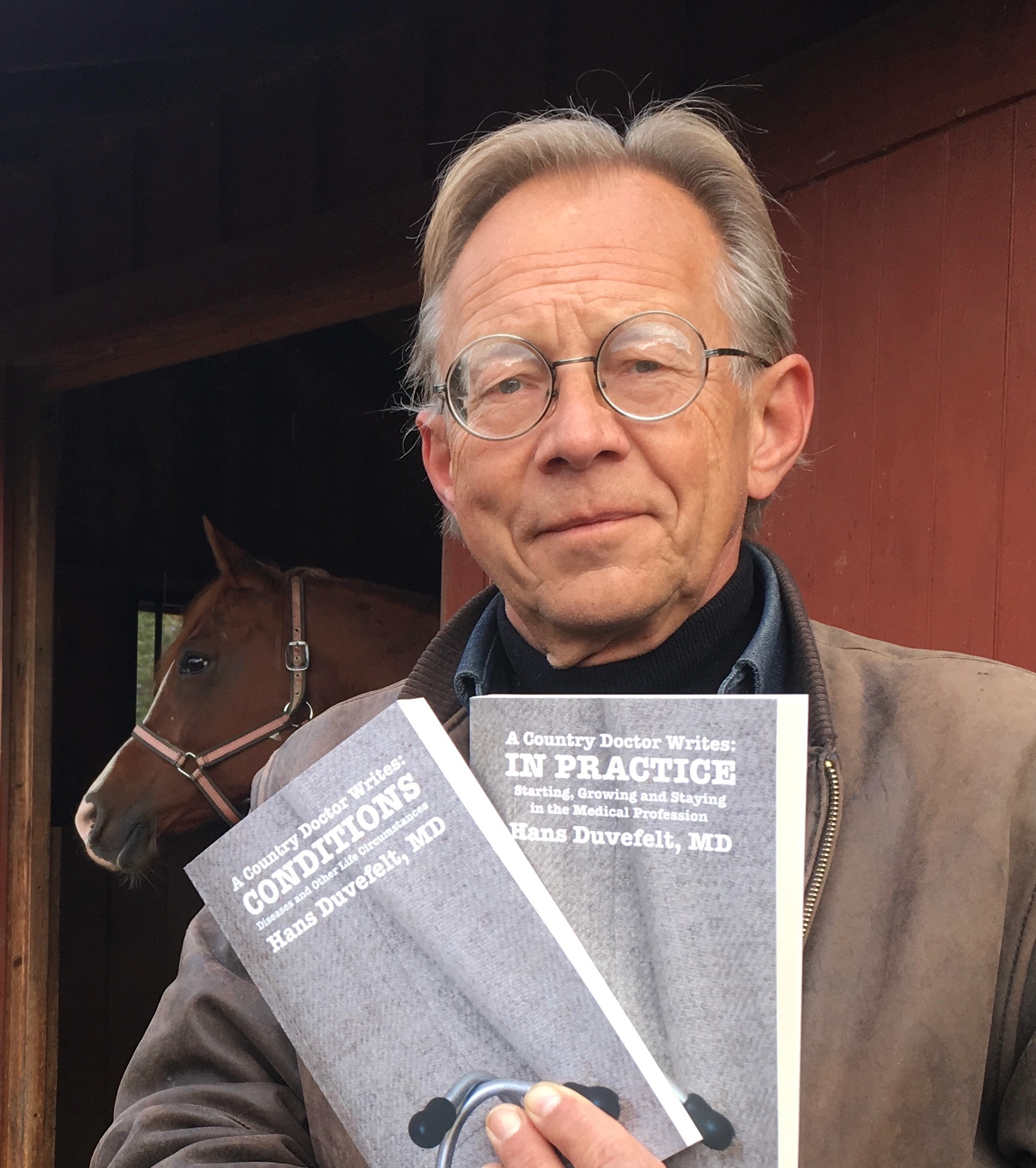
BOOKS BY HANS DUVEFELT, MD

CONDITIONS, Chapter 1: An Old, New Diagnosis

Top 25 Doctor Blogs Award

Doctor Blogs

Enter your email address to subscribe to this blog and receive notifications of new posts by email.

Mailbox

contact @ acountrydoctorwrites.com
Bookmark and Share
© A Country Doctor Writes, LLC 2008-2022 Unauthorized use and/or duplication of this material without express and written permission is strictly prohibited. Excerpts and links may be used, provided that full and clear credit is given.