Archive Page 163

Epicrisis

My ninety-three year old patient and friend Arsène Voisine died last week. I have written about him before in a post titled “Attitude!”, and in the four years since then, his spirit never faltered. Funny and inquisitive as ever, he lost only a small fraction of his razor-sharp wit and analytical power as time passed. He did stop driving to the big city dance hall on Saturday nights, but we still talked ballroom dance favorites every time I saw him.

His heart condition worsened and he had a small stroke a year ago. In spite of my efforts to reduce his risk, he had another stroke last week and died a few days later surrounded by his family.

Friday afternoon, our office fax machine printed up his discharge summary. It made me think about how awkward this term is. My hospitalist friend, Dr. Harris, didn’t discharge Arsène Voisine. He was just witness to the end of a ninety-three year old life, a life lived well, filled with joie de vivre until in one instant his brain could no longer make jokes, remember cha-cha steps or question the doctors’ treatment strategy.

Arsène left us with only our vivid memories of his joy and vitality. He left into the arms of the God he sometimes spoke about, but Dr. Harris didn’t discharge him. The summary of what happened during his two and a half day hospitalization is better described by the word we used for discharge summaries in Sweden – “epikris”. This word is derived from the Ancient Greek word for “determination” or “judgement”. The 1881 edition of Sweden’s largest encyclopedia defines the word as “a scientific account of an illness, pertaining to its cause, course and outcome”.

The corresponding English word for “epikris”, “epicrisis”, is almost never used for discharge summaries in the U.S. and I don’t believe it was ever commonly used. But perhaps we should use it when we don’t discharge patients ourselves, but they leave in spite of our efforts, on their own or God’s accord.

The Art of Being Sick

Almost daily, I get messages like this one: “What can I take for a cold?”

My answer is usually in the negative. The more time I have or the needier the request seems, the more I might elaborate, but the bottom line is that I don’t recommend anything for “fighting a cold”. In fact, I recommend surrendering to it.

Why take an antipyretic like acetaminophen/paracetamol, when such drugs have been proven to prolong viral illnesses? Why take antihistamines or decongestants when they thicken mucus and increase the risk of developing a sinus infection? Why take a cough suppressant if there is sputum to be eliminated? Why hide the symptoms of a contagious illness only so you can go to work and infect others?

My weekend of preliminary symptoms came into full bloom when the alarm went off at ten past five this morning. Coffee with sugar and half-and-half never felt so good going down my throat, even though I could barely taste anything. I coughed so hard that the cat, who usually sharpens her claws on my chest in the morning, decided to keep her distance.

A text message to my office manager and out to the barn with warm water and grain for the horse and the goats, then I was back in bed.

I read The New York Times on my iPad and paused after reading the article about the blood pressure medication Benicar (olmesartan) causing a celiac-like diarrhea. Isn’t that what Mr. Waddell is on, the man who stopped his stomach pill, omeprazole, to no avail? And I had been trying to tell him to give up beer, since that was the only thing I could blame his symptoms on. I resisted the temptation to log into our electronic medical record system to check his medication list; I can do that when I get back to the office in a day or two.

I dozed for an hour or so, then I made amends with the cat. I managed to sign the grandchildren’s Valentine’s Day cards before it was time to let the barn animals out in the pale February sunshine.

I reflected on the last time I was sick. That time I had a mysterious and rather unnerving illness that made me a little concerned I might have something serious. Only my profound fatigue and suppressed brain activity kept me from actually worrying about it. This time, everything is utterly familiar, and I have simply settled in for a few days of submission; my life has to slow down, and there is really nothing I can do about it.

The day inches on. I sleep, read and cough. I hear my wife fixing supper downstairs. She is playing Mozart. But why “Requiem”?

Wrestling the Rooster

“I used to be strong, I wrestled the bull”, Sumner Ball said, “but now I can’t even wrestle the rooster”.

On the far side of eighty years old, he looked lively and trim, and his weathered face hinted at a smile as his blue eyes peered straight into mine.

“I think these cholesterol pills are hurting my muscles”, he declared. “I don’t think they’re good for me”.

“Is it your back?”

I scanned through his last few visits and saw he had mentioned some low back pain while gardening this summer.

“No, Dr. Tom took care of my back”, Sumner said, referring to our local chiropractor. “My arms and my legs hurt, even my shoulders hurt.”

Years ago, Sumner had developed polymyalgia rheumatica, and it took almost two years to get him through it with the help of gradually decreasing steroid doses.

“Let me get a blood test, and why don’t you stop the cholesterol pills for a while and see how you feel”, I offered. We agreed to have a follow-up visit in a few weeks.

Three weeks later, Sumner Ball was a changed man. His faint smile was now a big grin.

“I knew that medicine was not good for me. I feel better now, not so many muscle aches. And I stopped the other one too. It was making me dizzy.”

“What about the blood thinner?” I asked.

“No, that one I take. I know it can keep me from having a stroke. But I know my body, and I know what my body needs, just like when I had goats and horses – they knew what to eat and not to eat.”

“My goats don’t always know the difference”, I said. Sumner grinned as he continued, “and we didn’t have the vet come out all the time. We treated them with herbs, good feed and common sense.”

His blood pressure was still OK, but his pulse rate was just under 100, a little high for someone with atrial fibrillation.

“Your diltiazem was keeping your heart from going too fast”, I reminded him.

“I feel good now. I like to stay this way. Do you think I am making a mistake?” His penetrating, small blue eyes told me he didn’t want me to disagree with him.

“Your heart could start racing”, I warned him. “Let me see you in a few weeks to make sure you’re not going into heart failure.”

Two weeks later, Sumner had gained five pounds. His legs were swollen, he was short winded and his irregular pulse was 130.

“Your heart is missing the diltiazem”, I said.

“I can’t take it”, Sumner answered. I knew he had already tried a beta blocker a few years ago, and his pulse had dropped to 40 on the lowest dose.

“How about trying something natural?”

His eyebrows rose. I continued: “There is an old herbal remedy, made from foxglove, called digitalis. It may slow your heart down enough to get you out of trouble.”

A week later, Sumner looked like he’d take on something much bigger than the rooster again. His pulse was 80 and his weight was back to its baseline. Leaning back in his chair, he said:

“The third day I took your medicine, I could feel my heart slow down. I knew that herb medicine would be good. You do all right by me.”

“I figured something more natural might work for you”, I answered. “Besides, it was the only other thing I could think of.”

“I like you. You have common sense”, he said as he offered me his large hand.

It was the firm handshake of a man who had worked hard all his life.

From Scribbles to Scribes: Newspeak and Foma in the Medical Record

“In George Orwell’s Nineteen Eighty-Four, the fictional language Newspeak attempts to eliminate personal thought by restricting the expressiveness of the English language.”
Wikipedia

In my youth, I read George Orwell and Kurt Vonnegut, Jr. I remember thinking that “1984” seemed very far into the future – I would be over 30 then!

Well, 1984 came quickly; it was the year I started practicing medicine. I did a lot of thinking about language around that time. I was refining my use of English, my second language, and working on striking a balance between medical jargon and newly learned Maine colloquialisms.

In my residency, our progress notes were transcribed and cosigned by our faculty, but things were different among practicing physicians. Medical records at that time were handwritten in most offices I had contact with. Our notes were brief and to the point with word choices and symbols that conveyed nuances that made sense mostly to the writer and other medical colleagues. Few outsiders ever read our office notes. Specialists usually had their consultation notes transcribed, and there was often a richness and literary grace in their language. Here also, the notes often contained a metatext of subtle meaning that illustrated impressions and opinions without seeming blunt or offensive to uninitiated readers.

Our notes were our working tools for documenting our observations and our thinking. In my practice we often wrote down contingency plans and differential diagnoses for our benefit and our covering partners’, like “consider X” or “switch to Y if ineffective”.

We rarely elaborated the obvious. I remember my awe at the brevity of Rick and Dave, two pediatricians at the hospital where I trained. Many of their office notes simply read: “LOM. Amox” (Left Otitis Media. Amoxicillin). It made sense; what else was needed? The dose followed the child’s weight, and most ear infections were straightforward medical problems. No wonder they could see more than forty patients per day without getting bogged down.

Over the years, office notes became interesting to “outsiders” who had claimed a central spot in the doctor-patient encounter: insurance companies sought to control cost and quality, and we had to start writing our notes so that lay people would find them useful.

Writing mostly for non-physicians meant stating the obvious, so chart notes became much longer. This forced physicians to start using transcriptionists, as typing your own notes seemed a waste of time to most of us.

Now, with electronic medical records, we are finally doing our own typing. However, in order for the EMR to be really useful to the organizations we work for and for the government and insurance companies, we are discouraged from free texting our own words. Instead, we are choosing standardized, built-in words from click boxes or drop down menus. The industry jargon for this is “discrete data entry”. It is more quantifiable than allowing doctors to choose their own words or quote colorful descriptions by patients, but like George Orwell’s Newspeak, it reduces human experience and expression to a color-by-numbers exercise.

Even with the power of today’s EMR’s, click boxes, drop down menus and text macros, many busy physicians find the documentation process too cumbersome. Transcriptionists don’t seem to be the solution for most, because each EMR is different and entering the “discrete data” differently in each product isn’t the same skill set as speed typing and knowing how to spell medical words.

Enter scribes, the latest category of support staff in the medical office; a non-provider (now, there’s some Newspeak, as Orwell would have said) who listens in on the conversation between doctor and patient and documents it in the EMR by choosing the right preloaded words in order to translate the visit into computerspeak.

I read rave reviews about scribes, but shudder at the thought of having one more layer of possible distortion between what is said and what is documented. The patient says one thing, the scribe chooses the closest thing from the computer menu, and the doctor or a colleague, insurance reviewer or malpractice attorney later reads the non-medical person’s chosen word and concludes something totally different from what the patient and doctor had understood in the visit.

The whole concept reminds me of the parlor game “whisper down the line”, where people get to laugh at the change in meaning a message can go through as it is relayed from one person to another and another.

Kurt Vonnegut Jr’s spirit, like Orwell’s, thrives in today’s medical records, whether typed, clicked or still transcribed.

Not only did the increased readership of medical records among non medical “stakeholders” (more Newspeak) lead to documentation of what used to be obvious and understood by and between physicians. It also made room for what Vonnegut called “foma”, harmless untruths; lies that, if used correctly, can be useful (quoted from Wikipedia).

Medical records routinely contain the acronym “PERRLA”, which stands for “pupils equal, round, reactive to light and accommodation”. Yet almost no doctor actually tests whether the pupils change size when the patient focuses on a close object. The acronym is just too handy to resist, as it implies a thorough exam of the pupils was done with almost no effort in documentation.

Another white lie is “cranial nerves normal”, as only neurologists seem to carry a vial of ground coffee for testing patients’ sense of smell. The rest of us at most only check cranial nerves II through XII.

EMR’s make it irresistible to pump up chart notes with foma; one simple click can elegantly declare that a patient was counseled on this, that or he other.

The sad result of the proliferation of Newspeak and foma in modern medical records is that it is harder to find the salient points of medical history, exam, assessment and plan. Maybe the back-end users, those who pull statistical reports of how many heart attack victims have crushing versus squeezing chest pain are having an easier time, but busy doctors reading each others’ notes often secretly reminisce about the days when medical records only said “LOM. Amox.”

Good, Strong Heart Beat – 140 and Regular

“Welcome back. How was your trip? Or exile… you were away for a long time.”

“Almost a year”, my nine o’clock patient answered. A woman just over forty, she looked tan and physically strong. Her short hair was peppered with gray, different from the last time I saw her. She had gone abroad on assignment for a magazine and a film production company, and before she left, she had joked that she would have to be her own doctor until she could come back to see me again.

“So, what’s going on”, I asked.

“I’m pregnant, pretty far along. I thought it was early menopause, like my mother and my sister, but that doesn’t come with morning sickness. And I can feel my uterus.”

“And you haven’t seen a doctor?”

While getting ready on my exam table, she told me about her work in small villages far away from clinics or hospitals and her decision not to seek care until she came back home.

Her uterus almost reached her navel. I took out the hand held vascular doppler we use to measure blood pressures at the calf of people with circulation problems. I changed the probe to the one used for fetal heart tones, an attachment I had never used; I stopped doing obstetrics the day I graduated from my residency thirty years ago.

“I never thought I would be pregnant again after my miscarriage when I was twenty-five”, she said with sadness in her voice as I applied gel to her abdomen and turned on the device.

There was the loud, swoshing sound of the placenta following her own elevated pulse rate. I pressed deeper and aimed the instrument downward with all kinds of static from the movement against her skin. Then, suddenly, there it was, rapid and perfectly regular; a sound I hadn’t heard for thirty years.

“Is that the baby?”

“Sure is.” I counted. “Good, strong heart beat, 140 and regular”.

She reached down and grabbed my hand.

“Please leave it there. I want to listen to it longer.”

Her eyes moistened and her lips began to quiver. She placed her top teeth on her lower lip as if to keep it still. I rested the probe and we both listened in silence.

I remembered that sound, the rapid heartbeat of unborn babies, from many long nights on duty during the sleep deprived years of residency. I remembered catching a few moments’ rest in the on-call room down the hall from two or three monitors with intertwining rhythms of babies waiting to be delivered.

Vividly, I remembered my first delivery, a precipitous double footling breech with no other doctor on the ward than this frightened first-year resident. Just in time, as I stood there with my right hand assessing the situation, old Doc Walker appeared in his street clothes in the delivery room door.

“What’ya got, son? Nurses tell me you got two feet there.”

“Yessir,” I tried not to quiver.

Doc Walker’s slow and gentle words calmed the young mother and guided my hands as they in turn guided the baby, feet first, across the symphysis and onto his mother’s belly.

As the doppler continued to tap out its rhythm, I remembered faces with smiles and tears, happy couples and frightened, single young mothers in the delivery rooms. I remembered blue babies, me slipping in umbilical catheters, the neonatal intensivists watching and supervising.

I remembered my own son, hooked up to an apnea monitor at my own hospital. Years later, as a new grandparent, I was a visitor, strangely out of place in a different neonatal intensive care unit, watching my granddaughter through the walls of an incubator.

Thirty years since I heard that kind of heart sound, and it still touched me in inexplicable ways. I remembered, my whole body remembered, the mixed feeling of dread and excitement when my pager used to go off in the middle of the night: “Call 2350 STAT.”

Thirty years ago, I saw more births than deaths. Now I only attend departures. For a minute or two that morning I was again participating, ever so briefly, in the greatest miracle a physician is privileged to be part of.


I just realized none of the posts show on an iPad or a computer, but they do show on an iPhone. WordPress is working on this. In the meantime, please visit my Substack.


Osler said “Listen to your patient, he is telling you the diagnosis”. Duvefelt says “Listen to your patient, he is telling you what kind of doctor he needs you to be”.


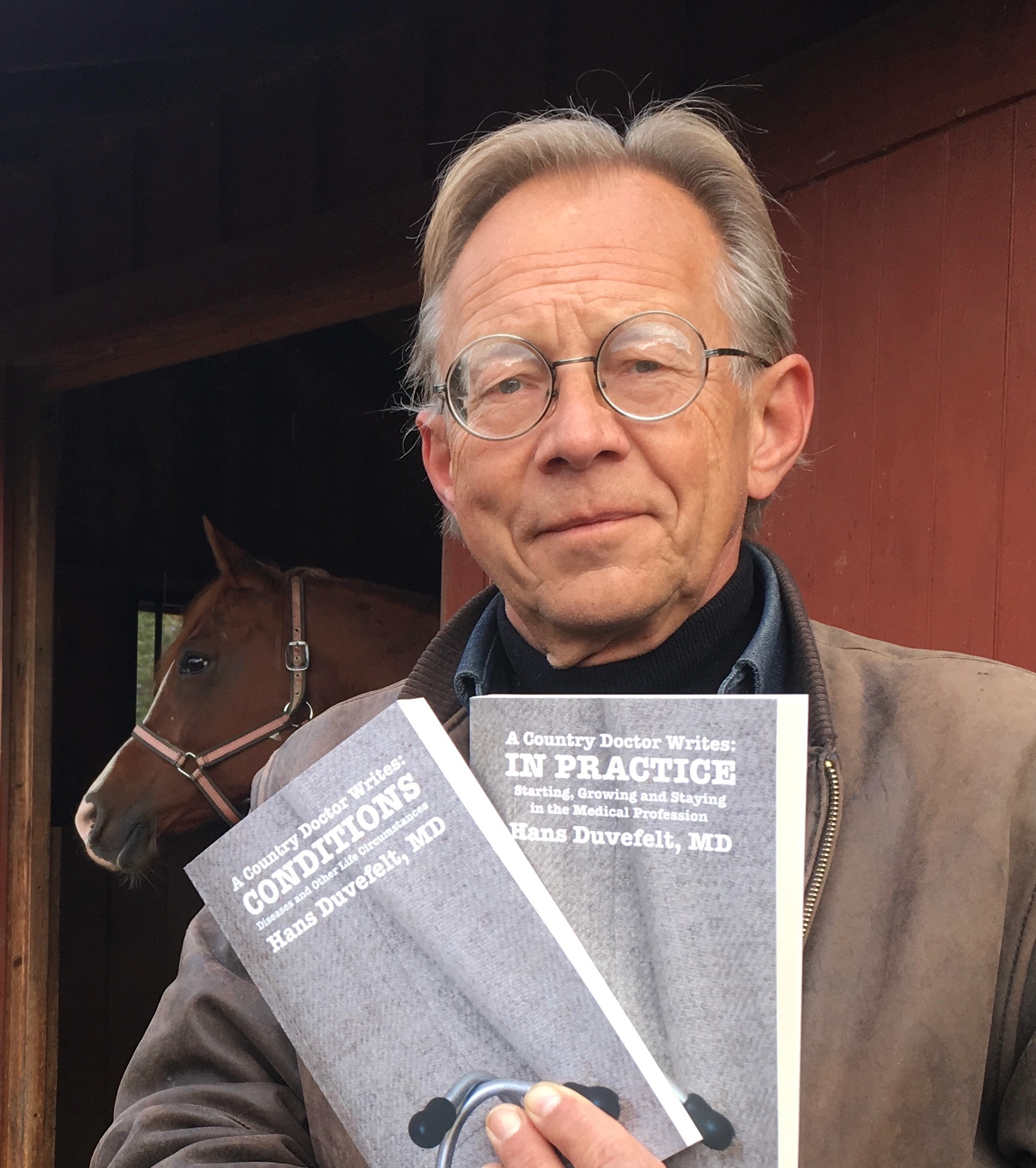
BOOKS BY HANS DUVEFELT, MD

CONDITIONS, Chapter 1: An Old, New Diagnosis

Top 25 Doctor Blogs Award

Doctor Blogs

Enter your email address to subscribe to this blog and receive notifications of new posts by email.

Mailbox

contact @ acountrydoctorwrites.com
Bookmark and Share
© A Country Doctor Writes, LLC 2008-2022 Unauthorized use and/or duplication of this material without express and written permission is strictly prohibited. Excerpts and links may be used, provided that full and clear credit is given.