Archive Page 157

Primary Care isn’t Brain Surgery

A brief exchange I had with a neurosurgeon in the comment section on KevinMD the other day left me pondering the diversity of skills needed in different types of medical specialties, and also how differently technology has impacted various specialties during my years in medicine.

Neurosurgeon F. X. Wall disagreed with the post author, Dr. James Aw, about the value of old-fashioned physical exam skills, because in neurosurgery the anatomical accuracy of interventions has approached 100% as a result of new technology.

I can see that in neurosurgery and many other surgical specialties the advances in imaging have made clinical exam skills too inaccurate to guide treatment in this day and age, just like few cardiologists would forego an echocardiogram in evaluating a heart murmur.

My reply to the neurosurgeon was:

“Good points, but possibly more relevant in specialty care. When a patient in primary care has nonspecific symptoms, like shortness of breath, we need doctors with enough clinical exam skills to notice pallor, prolonged expiratory phase, JVD, irregularly irregular pulse, tachycardia and all the other clues that help us decide what tests to order first.”

The more I thought about it, the more fundamental this seems to me: In primary care, we don’t have many technologies that make clinical exam skills entirely obsolete. When I see a patient in my office 20 miles from the nearest X-ray machine, when a simple lab test won’t be resulted for 6-24 hours, when there is almost no way I could get a same-day echocardiogram or MRI, clinical exam skills are essential.

Time and distance aside, primary care doctors also need enough clinical skills to either make the diagnosis without technology or at least to know which diagnostic possibilities to pursue before others; if we did every possible test in every case, we would obviously waste a lot of resources. Just like in my example of shortness of breath above, almost every presenting complaint in primary care has many diagnostic possibilities, ranging from trivial or self-limited to serious or even life-threatening.

The broad range of differential diagnoses to consider when we evaluate both common and unusual symptoms people see primary care providers for is something to consider when we look at what type of clinician we assign to front-line duty. In many practices, this task falls on the least experienced providers. This is also the case in some freestanding urgent care centers. Having more seasoned doctors available as back-up isn’t necessarily a good system if the clinician on the front line hasn’t seen enough to know what he or she doesn’t know.

There have been many attempts to use technology as a substitute for clinical experience in front-line medicine. In my opinion none have really emerged that can compare with the technological revolution we have seen in imaging, microsurgery or laboratory diagnosis.

Systems that require the clinician or the patient to enter data in order to produce differential diagnoses, for example, are clumsy and either simplistic or bogged down with detail, and assume that everybody shares language and values they in fact don’t. In real practice, the patient who says “it only hurts a little”, but whose pained or panicked facial expression makes the hairs stand up on the back of a seasoned doctor’s neck is not likely to be better diagnosed by today’s available technology.

Even in more technology dependent specialties, there are good reasons to cultivate low tech proficiency. What does a doctor do during a hurricane or an ice storm, during a war or on a foreign assignment when there is no technology available? Why would we not listen to hearts, lungs and peripheral blood vessels and then compare our impressions with the results of the imaging?

And, without excellent clinical exam skills, how do we evaluate unexpected or conflicting technology-derived results?

Ultimately, we need both hands-on and technical assessments in health care. But on the front lines, we are perhaps more dependent on our clinical assessment skills. I never get praised for ordering lots of tests, only for ordering the right one.

Exit Diagnosis

Dwayne Tarlov came to see me today for pain in his right wrist and left ankle for the past month and a half.

There hadn’t been much swelling, and he had no morning stiffness to suggest rheumatism. He had not had any fever or cold symptoms, and he absolutely denied any injury or new activities that might have brought on his symptoms.

His exam revealed his usual habitus, a slender, fine-boned fifty five year old man with gray hair, a tightly cropped beard and a new stud earring in his left ear.

His right wrist had normal range of movement, but localized swelling and tenderness near the extensor tendons of his thumb. There was no clicking or catching with thumb movements and I felt no crepitations.

The ankle was puffy on the outer, lateral, side and Dwayne was a little tender. Turning his ankle outward was painful.

I ordered X-rays, prescribed ibuprofen and recommended a wrist splint. We agreed to see how he is doing in two weeks. I asked again, and Dwayne could not remember anything he could have done to cause his pains.

I went back to my office to check messages and touch base with Autumn. A few moments later I was startled by a loud motor exhaust. Looking out the window, I saw Dwayne on a large Harley-Davidson motorcycle. His right wrist revved the gas, he squeezed the clutch and with his left foot, he kicked the bike into gear and roared off across the parking lot.

I typed an addendum to his office note to remind me about my exit diagnosis of his wrist and ankle pain.

The Art of Diagnosis

Arthur and Tom both had low testosterone and were prescribed testosterone by their doctors.

In Arthur’s case, it later turned out his low testosterone was just the tip of the iceberg; he was eventually diagnosed and treated by a Boston neurosurgeon for a pituitary tumor.

Tom’s low testosterone, he found out too late to save his life, developed because his pituitary and almost every organ of his body was poisoned by iron due to hemochromatosis.

Early in my career I diagnosed Fran Dennison with hypertension and put her on lisinopril. She asked me to write her a 90-day prescription to save her money. As I always did, I ordered a creatinine and potassium level to be done the following week, and I asked her to come back in two weeks for a followup visit.

Three months later, I saw Fran again. She had never gone for the blood tests I had ordered. Her blood pressure was normal, 130/80, but she looked gravely ill. She was tired and nauseous, complained of leg cramps, had lost weight, and her skin had a peculiar yellow color. Unlike the last time she was in, her arterial pulses at the ankles seemed weak. I put my blood pressure cuff around her right calf and with my fingers on her posterior tibial artery I pumped the cuff up. When the sphygmomanometer reached 120, she winced, but I kept pumping, as the ankle pressure is usually significantly higher than the brachial pressure. In Fran’s case, the ankle systolic pressure was 90 at best. As I listened with my stethoscope on her abdomen I heard a faint bruit over the aorta. I couldn’t remember if I had listened the first time; there was no documentation of it in her chart.

Fran was in kidney failure from having a low blood pressure in the entire lower half of her body due to atherosclerotic narrowing of the aorta above the renal arteries. Before my blood pressure prescription, her leg muscles and kidneys had been adequately supplied with blood. If she had come in for her blood test, there would likely have been signs of early kidney stress, and she would have been spared months of suffering, but we did not track overdue lab results back then.

I stopped Fran’s lisinopril, sent her for some STAT labwork and called the vascular surgery office at Cityside Hospital. They operated on her the next week, and her blood pressure normalized without treatment. I have been more diligent about listening for abdominal bruits and checking blood pressures at the ankles since then. I even got a Doppler soon after that in order to get the most accurate ankle blood pressure readings. I also never prescribe 90 days of lisinopril until the followup visit when I have seen the labwork.

Martin Brandt almost lost his leg one night in a small emergency room on the opposite side of Cityside Hospital. He was in the area visiting his sister when his left leg started hurting. The emergency room doctor ran many tests and gave Martin intravenous morphine, but even that barely controlled the pain. The surgeon on call finally made the diagnosis of an arterial embolus and almost six hours after his leg pain started, Martin had surgery at Downstate Hospital to remove the clot. He followed up with the vascular surgeons at Downstate and seemed to do well.

Four months later, when I saw him for a scheduled visit, I asked him if he was trying to lose weight. He had lost 20 lb. and admitted to feeling run down. He also had a possible hint of jaundice. His lab work confirmed that his bilirubin was elevated and after a CT scan showed dilated bile ducts and a possible pancreatic mass, I referred him to Cityside Gastroenterology for an ERCP. The stenting done during his procedure relieved the bile obstruction, but the biopsy showed pancreatic cancer. It isn’t likely his prognosis would have been different if his tumor had been diagnosed along with his blood clot, but it is possible that it would have. Both arterial and venous blood clots can be paramalignant phenomena, but not every doctor thinks of that possibility.

There is an intense focus on the technical aspects of treatment in today’s healthcare. The art of diagnosis is viewed as a quaint historical vestige in this era of advanced imaging and treatment protocols, and there seems to be less discussion about differential diagnosis than in years past.

We get caught up in the traps of self diagnosis or single dimension “diseases”, like “low T” and irritable bladder. Even such common “diseases” as hypertension are really groups of diseases with similar symptoms but frighteningly different treatments and prognosis.

In today’s fast paced medical office environment, how do we find the time and the mental space to step back and consider what might seem temptingly obvious with fresh and critical eyes – how do we manage to still practice and hone the Art of Diagnosis?

The chronicler of the vignette about Tom, the “low T” patient who died from his hemochromatosis, David A. Shaywitz, M.D., put it as well as anyone I have heard:

“The need to look beyond a patient’s immediate clinical symptoms and to search intensively for deeper meaning has been and must always remain a defining quality of the medical profession.”

Recapturing Abundance

Even though I had been up until midnight, I was awake before my 5:10 alarm and out the door just after 7:30. Somehow I felt more energetic and more philosophical at the same time. All day, I felt more generous, and less pressured than I had all week, even though my schedule was jam packed and the phones kept ringing.

I had happened to read about a patient who switched doctors after what she described as a near miss due to inattention by her long time family doctor. The physician is known far beyond her service area as a competent and caring doctor, and I was surprised by what I read. The essence of the patient’s complaint was that the doctor didn’t listen to her concerns. Reading the account of the doctor’s actions left me with the impression that this doctor was pressed for time and had, at least temporarily, lost her ability to engage, acting far below her usual standards. Possibly she was suffering from some degree of burnout.

My thoughts before falling asleep were about how fine a line we sometimes walk between working at full capacity and being stretched too thin. Often the difference lies within ourselves.

Driving to work I delighted in the warm sunshine and thought about my first patient of the day, a Hospice patient with Alzheimer’s Disease, one of my regular housecall patients. His wife is such a diligent caregiver, and the two of them have done well in spite of their family living so far away.

I also wondered about Mr. Donnell, the man I had slipped out to see a couple of days earlier. His warm, swollen and exquisitely tender knee had looked like a typical gout attack and since he had a remote history of gout, I had put him on a short course of steroids and some pain medication. I had asked Autumn to call him the next day to see how he was doing, but she must not have remembered. As I was driving up “Moose Alley”, I remembered my broken promise and decided to swing by his house on my way back from my scheduled home visit.

Mrs. Thurlow, met me at the front door of their tidy little home. I could tell from her face that there had been a major change. Her husband had stopped eating, and was barely taking fluids. He was also becoming increasingly restless. The hospice nurse had already used her authority to start some of the “comfort pack” medications. Together, Mrs. Thurlow and I went through her husband’s medications and stopped everything nonessential. I wrote down the changes on a prescription pad and asked her to call me after noon with an update.

As I left, my first office visit was already due to begin, but I still stopped in at Jack Donnell’s. I felt unfettered by the clock and thought more about the purpose of my workday. He waved from his perch by the kitchen window.

“Well hello, young man, how are you”, he grinned with nicotine stained teeth.

“That’s my line”, I said. “How’s that bum knee of yours?”

It took me less than five minutes to make sure that my diagnosis had been correct and that he was on the mend and I was back in the car. I arrived at the office less than fifteen minutes late.

Throughout the day, I found it easier than on some other days to feel connected with each one of my scheduled patients and keep the focus on them, and not on the peripheral things that sometimes fill my awareness: the schedule itself, the EMR, the insurance paperwork, the number of prescriptions to authorize. I found myself thinking more about the patients needing the medications than the work aspect of renewing them in the system.

I offered Autumn to contact more patients myself than I usually do. On days when I feel more pressured, I rely more on the electronic messaging system and give her instructions on what to tell the patient. This is one of the things my colleague downstate had done when the patient really needed to hear directly from her doctor.

I spoke with Diana Brooks about her continued side effects after we had stopped the medicine I thought was the culprit and I personally made sure she was on board with stopping her amlodipine and restarting her valsartan-hydrochlorothiazide.

I also grabbed the phone and told poor Jimmy Forthmeyer that his D-dimer from yesterday was positive, so he did need to have that ultrasound done of his leg to look for a blood clot. I already knew he would have to take the bus to the hospital for the test and it doesn’t run every day, so I had to e-prescribe an injectable blood thinner for him. I arranged for him to pick it up at the drugstore and bring it to the office so we could show him how to give himself the daily injection until the ultrasound. When Jimmy showed up without the medication, saying “I guess it needed a prior authorization or something”, I grabbed my cell phone and called the pharmacy from the exam room. “Try the brand name, Medicaid sometimes prefers brand over generic”, I told the rookie pharmacist. Sure enough, the brand name went through, so Jimmy had to hoof it back over to the pharmacy and get the prefilled syringes. Good thing it was a nice and sunny day outside.

George Hincks still hadn’t heard about his follow-up with the visiting pain specialist, even though his second MRI, this one with sedation, had been done a month ago. Again, I grabbed my cell phone and called the Specialty Clinic. “Dr. Brooks is here today, and he has a cancellation at 3:30. Can Mr. Hincks be here by then?”

And so it went. I don’t mean to say that I don’t usually reach out, connect and engage with my patients, but I often feel more on guard than I did today, and today I felt unfettered by the system and more directly connected to the souls who have entrusted me with their care.

I still got just about all my chart notes done in real time and when I left the office at 5:20, I felt energized by my day and was able to fully notice and again delight in the warm sunshine I had enjoyed on my drive to work almost ten hours earlier.

Over dinner, Emma and I talked about how we can choose to approach life with a sense of lack or with a sense of abundance. This is a choice we all have, and it determines the course of our lives. Think of yourself as an overworked, powerless cog in the big healthcare machine and all you will feel is frustration and exhaustion; give generously of your gifts of healing and comfort, view the system as peripheral to your higher purpose, and feel the reward of your engagement with each patient renew you and replenish you.

“What you did today was practice mindfulness, and out of that grows compassion and healing, both for you and your patients”, Emma said. She told me about a book she was reading by Thich Nhat Hanh, “Living Buddha, Living Christ”, where he compares mindfulness in Buddhism, the Holy Spirit in Christianity and Jewish piety.

“This book gave me a different and much deeper understanding of mindfulness – it is not just being aware of everything in the moment, but putting a sense of sacredness into everything you do”, she said. “You might want to read it, too.”

It is almost eleven o’clock. My index fingers tap quietly on the virtual keyboard of my iPad. The goats are chewing their cud and making contented little grunting noises. My white Arabian horse dunks her hay in the pink bucket hanging on her stall wall and eats with smacking lips. The night sounds fill the air in the barn through the screen windows. One week after Midsummer it is dark outside here, unlike in Sweden, but the fireflies are out, painting short lines against the night sky.

I am content; tonight I view life with a sense of abundance. I know that there will be days when there are more things weighing on my shoulders than I can carry without feeling pressured, but I must not let those days flavor my whole outlook on the life I have chosen.

I close up the barn and walk the short distance back to the house. Just like last night, Emma is probably asleep already. Tomorrow is Saturday and I can look forward to two days of farm chores in the sun.

Emma is asleep, but she emailed me this quote while I was down in the barn:

“A mind committed to compassion is like an overflowing reservoir – a constant source of energy, determination and kindness. This mind can also be likened to a seed; when cultivated, it gives rise to many other qualities, such as forgiveness, tolerance, inner strength, and the confidence to overcome fear and insecurity.”

Dalai Lama

Be Prepared

When I knock on the exam room door, after an ever-so brief pause to clear my mind from the constant mental clutter of my busy office, I want to focus only on my patient, and I want to be prepared.

That can be a struggle in today’s healthcare machine.

When a patient takes the initiative and asks for an appointment, the staff member on the phone can make the visit smooth instead of chaotic by making sure if there is something we have to get in preparation for that visit – an out-of-town emergency room report from the patient’s recent cross country trip, for example. Once the visit has started, the chances of getting records from an out-of-state hospital within 15 minutes are less than zero.

When I have asked the patient to come back, it is my team’s responsibility to be prepared. That means having a purpose for the visit stated in the schedule to give each of us a rough idea of what we need to do, and at least one of us will need to read the previous few office notes’ “Plan” to check the details.

We use words in my schedule that help define the visit. “FU (Follow-up) diabetes” means the quarterly visit with a glycohemoglobin drawn in advance with other lab tests or done with a fingerstick in the visit. “FU blood sugars” means we have already done the three-month visit and are bringing the patient back in to check the blood sugar log after some sort of treatment change.

“FU HBP” means a periodic, bigger, blood pressure visit that may involve other cardiovascular issues. “FU BP” is a quicker in-between visit to recheck a blood pressure that was high or to monitor a medication change.

Our EMR only offered scheduling options like “3 mo FU” and “1 mo FU”; that doesn’t help us prepare for the visit, so we worked around the vendor’s workflow to fit our practice.

The biggest challenge is to find the time for someone on our team to read the plan; it may mention tests we will do in the followup visit, an insurance or handicap form we promised to do next time, or it may mention that by the time I see a patient the next time, their long-awaited neurology consult should have taken place. If the report isn’t in, we still have a chance to get it in time for the visit if we call for it the day before or first thing in the morning.

We have had informal sessions before the first patient of the day for as long as I can remember. I have likened it to what a sports team or an airplane crew does before their job starts. Lately, in healthcare, the word “huddle” has become a staple in office workflow discussions. But not everyone in the business has embraced the idea of actually reading the last few office notes in each patient’s chart in preparation of each visit. In fact, some people seem to feel that only doctors should read the chart, even with all the talk about healthcare teams today!

Another big issue in reading the electronic chart is to review those items that are stored away from the clinical notes and test results; phone calls, at least in our system, are documented in a separate corner of the EMR, so that if I gave a patient a new blood pressure medication last month (lisinopril) and the patient called back saying their tongue swelled up, and I stopped the medication and maybe even prescribed a new one, that information is not part of the office visit sequence where I spend most of my time and attention. In a fifteen minute visit, many valuable minutes may be lost retracing such steps and events if the doctor walks into the exam room unprepared. Chart “prep” can make every visit smoother.

Today’s EMR notes can be challenging to read. For example, where in the old days I would dictate “Continue current medications and add amlodipine, 5 mg daily”, an EMR note today may automatically and with seemingly equal emphasis list seven refills and the new medication, so what is new drowns among the old. Unless I free-text in “add amlodipine to current regimen” or something similar, I can stare at the “plan” for a long time before discovering what was really new in the last visit.

Most patients probably think doctors remember things even without the record. I actually remember a lot more than I admit; I just don’t want to rely on my memory when a patient’s life and welfare is at stake and I have a million dollar system that is supposed to do the remembering for all eternity for me.

And, speaking of eternity, I have had a personal motto for many years, even before my temples started turning gray:

I try to add enough of my personal thinking, typed with two fingers after all the click-boxes have been checked off, so that if I should happen to meet my maker or perchance that big bull moose on Route One some day, my medical record and my team will make it easier for the next doctor in my position to take care of my patients.


I just realized none of the posts show on an iPad or a computer, but they do show on an iPhone. WordPress is working on this. In the meantime, please visit my Substack.


Osler said “Listen to your patient, he is telling you the diagnosis”. Duvefelt says “Listen to your patient, he is telling you what kind of doctor he needs you to be”.


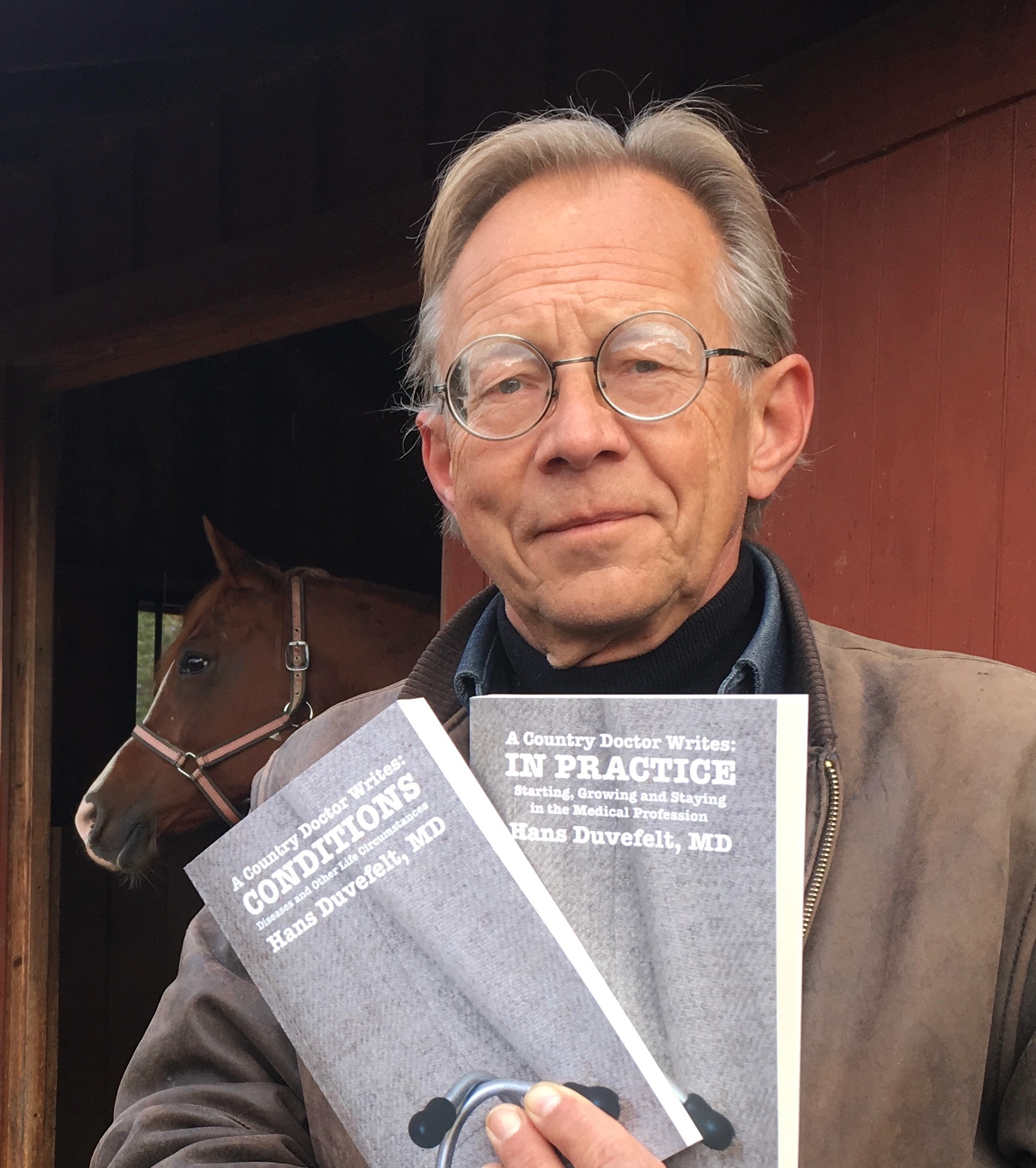
BOOKS BY HANS DUVEFELT, MD

CONDITIONS, Chapter 1: An Old, New Diagnosis

Top 25 Doctor Blogs Award

Doctor Blogs

Enter your email address to subscribe to this blog and receive notifications of new posts by email.

Mailbox

contact @ acountrydoctorwrites.com
Bookmark and Share
© A Country Doctor Writes, LLC 2008-2022 Unauthorized use and/or duplication of this material without express and written permission is strictly prohibited. Excerpts and links may be used, provided that full and clear credit is given.