Archive Page 156

Med School, Day One (1974)

The corpse, laid out on a gurney and covered with a white sheet, was wheeled onto the stage by two women in long, white lab coats. A middle aged man with a bow tie welcomed us, the incoming class of the spring semester, to Uppsala University and the Biomedicine Center, where we would spend the next two years in “pre-clinicals”, until we knew enough to start our three and a half clinical years at the Academy Hospital.

The Biomedicine Center was almost brand new, a glass and concrete labyrinth with a large sculpture depicting Watson and Crick’s DNA molecule by the front entrance. The vast complex lay near S-1, the Uppsala military regiment. The brick buildings diagonally across the street were very familiar to me as the place where I had met the biggest failure in all my twenty years only months before.

As I sat in the large lecture hall with the corpse on the stage, I glanced over at L., my buddy from the Swedish military’s elite division, the Interpreter School, where we had also sat next to each other on the first day, when the Captain in charge told us:

“Soldiers, you may all have been the smartest kids in your school, but it’s different here. Most of you won’t make it, and will be culled over the next two months. The Interpreter School accepts eighty recruits and graduates twenty to twenty-five. If you don’t have what it takes, don’t waste our time or yours!”

L. and I had both thought that learning Russian would be a neat way to spend our compulsory year and a half in the military, but just barely more than a month after that harsh introduction, we were both on our way back to our respective home towns to figure out what to do until we would be able to start medical school. Our military service was put on hold until we could return as medics.

The man with the bow tie went on to introduce our guest professor, on loan from the University of Bavaria. As we all knew, the Germans had been the greatest anatomists since the last century, and all of us had already been to the University book store to purchase Hafferl’s “Topografishe Anatomie”, which would be our constant companion for the next five months.

“Hopefully, most of you took several years of German in High School,” the man continued, “but those of you who chose French instead and only took one year of German are encouraged to take advantage of our German night classes, every weekday from 8 to 9 pm in Hall B next door.”

With that, he gestured to the Bavarian guest professor, who bowed and began speaking as the first slide was projected behind him. He had the most peculiar accent, and spoke in a slow drawl. I strained to get a handle on what he was saying. L. cocked his head and as I turned toward him, I saw many heads shaking.

With every new slide, the German speaker seemed to increase the tempo of his speech and as the slides behind him changed faster and faster, more and more heads were shaking in the lecture hall. Soon, all of us had given up trying to understand as the staccato voice from the stage pounded the syllables faster than a sports commentator and the rapidly changing slides became more and more filled with details. Heads were shaking, many people were talking, some stirred and rose from their seats and turned toward the exit doors.

Then, suddenly, everything turned dark, the speaker stopped talking and all the chatter in the lecture hall ceased. We sat in darkness and silence for maybe a minute. Then, a faint tune from a small flute rose from the dark stage and dim lights began to illuminate the two women in white lab coats. One was playing the flute, the other picked up a clarinet and began to play.

As the lights continued to brighten, the sheet suddenly flew off the corpse, who sat up, pulled a trumpet to his mouth and belted out a tune like something from a Mardi Gras parade.

The stage filled with upperclassmen and the “German” professor took a bow as they all applauded in his direction.

Then, from a side door, a tall man with a very straight back, white riding pants, tall black riding boots and a whip appeared. Everyone fell silent as he began to address the students in the lecture hall.

“I’d like to introduce myself. I am professor A. of the Department of Anatomy. I just came back from riding in the fields beyond here. I want to welcome you all.”

L. and I looked at each other and shrugged – was this part of the joke?

Professor A. continued:

“So, you made it to medical school. And if you really want to, all of you will make it out of here with a diploma. Just work hard, enjoy Uppsala, and don’t worry about the German classes – all lectures will be in Swedish!”

He was right, all of us who wanted to made it all the way through. My friend L. chose to leave medical school for a life as a writer, but he often writes with great insight about doctors.

I remember that first day as if it were last week, but it was forty years ago. It was the beginning of a journey of learning I can’t imagine ever reaching a final destination. In 1974 there was no HIV; we had only Hepatitis A, B and non A-non B; Sweden didn’t have a single CT scanner; mammography screening was just beginning; Tagamet, Prozac, “statin” cholesterol drugs and clot-busters weren’t invented; low-dose aspirin wasn’t known to reduce heart attack risk, and so on.

In spite of all that has changed in medicine since I started, the way I learned at Uppsala how to evaluate scientific information, to elicit a disease history, to examine patients, and to approach them as individuals, not “cases” – that has not had to change in forty years of doing the only work I could ever imagine doing.

(Originally published on The Healthcare Blog, where my friend L. read it and thought I made it sound as if we were “culled” from the elite military school. We chose to drop out. Everything else happened just the way I wrote it…)

P.S. This is my 300th post on “A Country Doctor Writes”.

Medicine is Easy, but Metamedicine is Hard

Knowing what to do when faced with a sick patient is relatively straightforward. We learned a lot of it in medical school, picked more up by experience, and usually have the opportunity to look things up quickly on the Internet. Even when faced with a brand new situation, we can usually fall back on our general knowledge of science and medicine.

But in today’s practice of medicine, that’s not enough. Physicians, PAs and NPs all live in two parallel universes these days, the World of Medicine and the World of Metamedicine.

The world of Medicine was created through understanding of Life itself. It is vast and complex, and growing exponentially. Its rules tend to follow scientific principles.

The world of Metamedicine was created by humans with limited understanding of Life, but with vast experience in actuarial calculations and bookkeeping. It is growing faster than medicine itself. Its rules follow a logic not taught in medical school.

Imagine a well trained physician faced with a patient who has gained some weight and complains of swollen legs. The doctor notices that the patient seems just a little short of breath. But our patient also admits to eating more than he used to and he has been on his feet more than usually in hot weather. He wonders if that may have caused the swelling.

Our wise physician knows that right-sided heart failure predominantly causes edema, whereas left-sided heart failure more affects breathing. Suspecting heart failure, he orders a BNP, a relatively new, fancy screening test for heart failure.

The overlords of the Metamedicine universe, in their infinite and inscrutable wisdom, have determined that Medicare will pay for BNP testing in cases of shortness of breath, but not in cases of leg swelling. Our doctor orders the BNP in good faith for the diagnosis of “edema”, but the next day the lab notifies him the test was not run because there was no covering diagnosis.

Yours truly had a patient the other day with new onset of atrial fibrillation and a Left Bundle Branch Block (LBBB) on his EKG. They teach us in medical school that a new LBBB in many cases signals a blockage of a coronary artery. I ordered a stress test. The diagnosis I assumed would cover this test was my patient’s LBBB.

Wrong. Today I got a fax from the EKG department, stating this diagnosis didn’t cover the test. Presumably because of some Metamedicine Code of Ethics, they did not tell me what would, but they were kind enough to include several pages of diagnoses that would qualify my patient for a stress test.

Frustrated, I perused the list. Nothing seemed to fit, and of course you can never use “suspected” or “rule-out” as a qualifying diagnosis. That is one of the ground rules of the Metamedicine dimension. Then, there it was: The very last qualifying diagnostic option was ICD-9 code 794.31, “Nonspecific abnormal EKG”. Now, why didn’t they teach me that in medical school instead?

Also today, I had a fax from the pharmacy about a Medicaid patient with anemia and evidence of blood in the stool. She had recently undergone an upper endoscopy that showed gastritis and a duodenal ulcer. I had prescribed omeprazole, an inexpensive acid blocker. She was already on even less costly iron pills for her anemia. Medicaid required a Prior Authorization. The reason for this is that, theoretically, iron is better absorbed if the stomach environment is acidy. If you have bleeding from too much acid, this is not a worrisome drug interaction. But Medicaid has enough time and resources to micromanage everyday clinical judgements like this one. I scribbled “Aware of theoretical interaction. Will monitor”, as I always do in these cases. The PA always gets approved. I am doing my job and the folks at Medicaid are just doing theirs.

Every day has more examples like these. Unlike the laws of Medicine, the rules of Metamedicine seem arbitrary, at least to a medical mind, and there are fewer handy resources for looking things up. Besides, people like me sometimes fall into the trap of doing what makes sense to us without looking up what diagnosis covers what in the world of Metamedicine. But, how much double checking can you do in 15 minutes?

I have long thought of myself as bilingual, speaking pretty good English and even better Swedish. I’m also learning the language of Metamedicine. That is becoming more necessary in my everyday dealings than my rusty German and rudimentary French.

Here’s a quiz:

Which diagnosis covers a lipid profile?
A) Screening for lipoid disorders (V77.91)
B) Screening for other and unspecified cardiovascular disorders (V81.2)

Give up? The correct answer is B. See what I mean…

Primary Care is Personal and Passionate

It’s been thirty years since Dr. Pete shook my hand on graduation day and slapped my back, his gravelly voice mumbling a wisecrack that couldn’t quite hide his emotions. I was the first foreign medical school graduate in our small residency program and he had trusted me, just as I had trusted him, through three years of hard work and many challenges.

Our residency program was only a few years old, and my specialty was only twelve when I started. Family Practice had begun with the realization in the 1950’s that fewer and fewer medical school graduates chose to enter general practice after their internship year, but instead went on to specialize. With the knowledge explosion of the twentieth century, the need for well-trained generalists gained acceptance and the void left by retiring GPs was filled by the graduates of three-year Family Practice residencies focusing on 1) first-contact care; 2) continuous care; 3) comprehensive care; 4) personal care (caritas); 5) family care; and, 6) competency in scientific general medicine.

Medicine has changed a lot, and America is not the same as when I first came here. Primary care is more complex, with more demands from forces outside the physician-patient-family constellation we thought and talked so much about thirty years ago.

In the early 1980’s CT scanning had just been introduced, but there were no MRIs in our state yet. We didn’t have EMRs, there were no Prior Authorizations, no direct-to-consumer drug advertising; we didn’t even have the Internet.

What we did have when I started out was a generation of young doctors with a shared passion for clinical, albeit low-tech medicine, and for taking care of patients and families in their small communities.

My generation had sit-ins over minor injustices in High School. We wore bell bottoms and sang songs about love, peace and justice. We wanted to make the world a better place. Those of us who wanted to become doctors watched Marcus Welby, M.D. – I did, as an exchange student, on a large console TV in my Massachusetts host family’s suburban living room. My determination from a year of illness in early childhood to become a doctor gelled right then, in 1971, into a vision of what I have been fortunate to actually be doing for the last thirty years.

I have better tools now than Marcus Welby had, and the technical standard of care has made huge leaps since my residency days. But something has gone missing. The idealism and passion of physicians has become worn and frayed as a result of the paradigm shift toward the manufacturing view of healthcare. Healthcare is now becoming impersonal. It is organized, delivered and measured like industrial output in automobile plants. It is mass produced and valued by its consistency and conformity, even though no two patients are exactly alike.

Most of our patients still come to us looking for personalized care, but they feel the pinch of our newly imposed agendas in their fifteen minutes with us. We are more and more put in the role of public health officials, collecting data for Government and insurance companies and promoting their population-based agendas.

But when we really engage with our patients we can see the power of the traditional doctor-patient relationship that many others in healthcare have tried to negate.

The passion and commitment of doctors have been de-valued as we are instead building entire systems to do what Marcus Welby and his nurse did, day in and day out, when they practiced their professions and held themselves to their standards and ideals.

But no “system” can replace human effort and commitment. Doctors, nurses and everybody else in healthcare need to be at the center, side by side and face to face with their patients and the “system” needs to capture, rekindle and support their passion, not suppress and replace it.

Family physicians were trained to be capable in areas where our ability to keep up is now challenged, just like the General Practitioners’ sixty years ago. Fewer and fewer primary care doctors now set fractures, deliver babies or perform even minor surgeries and procedures.

Increasingly, we are instead taking on the role that the journal Canadian Family Physician calls “broker of choices”. With the Internet and all the media exposure about medical issues, we are no longer patients’ primary source of medical information, but we are the ones that are best suited to help them sort out information and compare alternatives.

This actually builds on our specialty’s founding principles. We are still the glue that holds the parts together, even when other specialties are involved. We provide the first contact, the continuity, the personal focus and the family view of the patient and their support system; it requires our solid competency in general scientific medicine; and it is comprehensive in the ancient meaning of the word as it derives from comprehendere – ‘to grasp mentally’; we help our patients with the big picture while we attend to their everyday medical needs.

Primary Care is not General Motors

When Uncle Will needed a hip replacement, he chose an orthopedic surgeon, Jason Brockman, and Mountain Memorial Hospital because of their excellent reputations for low complication rates and satisfied patients. The process reminded him of when he bought his first brand new truck.

Norm and Clara Anderson chose Dr. Wheeler as their family doctor once they had made the decision to relocate to Maine and raise their family away from the big city. The process of choosing a doctor reminded them of working out where to live. That was twenty years ago, and Dr. Wheeler has seen them and their two daughters through childhood illnesses, one heart attack, two cancer scares, Clara’s bouts of depression and irritable bowel syndrome, and their youngest girl’s struggles with migraines. A graduate school student near Boston now, Holly still checks in with Dr. Wheeler when she visits her parents. The Andersons sometimes reflect that Dr. Wheeler is like a pastor and a friend, and not just their family doctor.

Dr. Brockman is part of a big group of orthopedic surgeons now, and Mountain Memorial has merged with Countywide Health Systems. Uncle Will’s children know that Dr. Brockman still does top-notch work, because his outcomes are posted on the Internet.

Dr. Wheeler also works for Countywide Health Systems these days. He sometimes jokes that he is a healthcare factory worker now, and the Andersons get to rate him every year in Countywide’s patient satisfaction survey. Asked if they thought Dr. Wheeler delivered high quality care, they answered unequivocally yes.

Dr. Wheeler gets graded on how many of his patients reach targets like immunization rates, blood pressure levels and average blood sugars. He also gets graded on how many of his diabetic patients are prescribed ACE inhibitors, and how many men with heart disease, like Norm, are taking aspirin and beta blockers.

The Andersons understand the importance of these quality metrics but they are confused about why Dr. Wheeler’s diagnostic skills aren’t on his report card. He was the one who diagnosed Clara’s IBS after two of her previous doctors failed to do so. He also found Clara’s pheochromocytoma, the very rare tumor that presented as a slight vibration Norm could feel when he put his arm around Clara’s waist in bed at night. He also seemed to know the diagnosis the instant Norm arrived at the clinic with his heart attack, even though his only symptom was nausea and even though Norm had passed a stress test for work the month before.

Clara thinks Dr. Wheeler has worked miracles with Holly, her youngest daughter. She was a shy and insecure girl with crippling bouts of vomiting. Dr. Wheeler diagnosed the spells as migraines, tried and succeeded in preventing them with medications and he gave Holly a sense of control over them by helping her identify her triggers. He seemed to spark a scientific talent in Holly that is now becoming her career and life passion.

On TV the other night, Norm and Clara saw the Chief Executive of Countywide Health Systems talking about the future of healthcare. He pointed to statistics from their surgery department that outperformed every other health system in the region. Then he spoke of primary care. He showed the rates of compliance with dozens of guidelines, and he pointed out that the new systems Countywide had begun to put in place throughout all of its primary care offices were going to bring quality in primary care to new and even higher levels.

The executive went on to say that healthcare cannot rely on mom-and-pop individual doctors offices or exceptional efforts by superclinicians to deliver the quality healthcare America needs now and into the future. Just like in aviation and manufacturing, process design and quality measurements are the key elements that will raise quality standards and eliminate human error as well as unnecessary variability in healthcare.

Next up on the evening news was an in-depth story on the corporate culture within General Motors that allowed faulty ignition switches to be installed in millions of cars over so many years.

The next story was about the Veterans Administration scandal over forged waiting lists that had tried to cover up the long waits for access to healthcare in the VA system.

Right before the weather was a piece about how long it has taken this country to recover from the collapse of the banking industry and the fines paid by some of the top banks in recent years.

“I wonder how all this corporate medicine and process design talk will affect Dr. Wheeler. They may not think they need superclinicians, but I’m grateful we’ve had one for the last twenty years”, Clara said and turned to her husband.

Primary Care is Messy

Primary care is a messy business. Nobody has just one simple problem and no patient has all the typical symptoms for their diagnosis. Most don’t even tell us everything that’s going on. And most don’t follow their treatment plan completely. But this may be O.K., since we often change our minds about what is right or wrong in the practice of medicine.

Knowing what constitutes success in frontline medicine is not easy. Let me illustrate:

A middle aged smoker comes in for a follow up on his blood pressure treatment and mentions that he would like to try Chantix (varenicline) to help him quit. My nurse has already secured our practice credit for documenting his smoking status. I can use certain billing codes to document my counseling on the subject, and I can get credit for printing out the drug information, even though the pharmacy also provides a printout. This is a successful visit, it might seem.

But I also ask, “Ron, what makes you want to quit at this particular point in time?”

“Well, I’ve had this funny cough, like a dry hack, for the last two weeks whenever I take a deep breath”, he answers.

Ron turns out to have a very small, resectable lung cancer. My question about the reason for his request probably saved his life, and catapulted us from shallow administrative success to probable or at least possible clinical victory, without making any further difference in my own quality metrics.

Another patient, Ellen Wurtz, a diabetic in her late fifties, makes me look like I am treading water. Her blood sugar, blood pressure, weight and cholesterol are all above target, and she never brings in her blood sugar logs. She has nonspecific side effects from every new medication I prescribe for her. But she keeps all her appointments. We talk about how she can best help raise her granddaughter, now that Ellen’s daughter is in rehab, and we talk about how she can support her husband’s self esteem after he lost his job at age 61. Am I wasting her time and mine, or am I part of the safety net that helps her keep her family going through difficult times that threaten to shatter their lives?

Joe Parva, a 65 year old with high cholesterol and two previous heart attacks, never reached his LDL target of 70 or less, and both his triglycerides and HDL were out-of-range. I just kept him on his Lipitor. I didn’t prescribe Zetia (ezitimibe) to push his LDL to target, and I never gave him niacin for his HDL or a fibrate for his triglycerides. We talked about it several times, and when I told Joe that Zetia and niacin had never been shown to lower heart attack risk, he chose not to try them. After hearing that there were no studies comparing heart attack risk on 80 mg of Lipitor alone versus Lipitor plus a fibrate, and after hearing that the combination increases the risk of side effects, he elected not to be a guinea pig. If we had done quality metrics around lipid treatment during the last half dozen years, Joe would have made me look pretty bad, but after the introduction of last year’s new guidelines, Joe’s care has been top-notch all along.

When my own children were infants, we laid them on their bellies to sleep because science had shown that infants sleeping on their back had an increased risk of Sudden Infant Death Syndrome (SIDS). My grandchildren were placed on their backs instead, because by then science had shown that infants sleeping on their bellies had an increased risk of SIDS.

Every primary care provider’s day is filled with moments of opportunity to do the right thing or not; we are almost always walking that fine line between failure and success. Sometimes the balancing act is about noticing clinical signs, sometimes it is about setting the right priorities, sometimes it is about weighing guidelines versus actual evidence and applying it all to individual patients. Much of the time we won’t know if we did the right or the wrong thing until much later, and in many cases we’ll never know. All we can do is be diligent, do our best and be willing to learn and re-learn.

Just like tightrope walkers, we can’t focus our attention on the hard surface beneath us should we falter and fall, but on what’s straight ahead, or we will lose our courage and our concentration.

A career on the frontlines of medicine requires that you are comfortable with uncertainty, because primary care is very often messy and quite seldom completely straightforward.

In the words of Elbert Hubbard:

“The line between failure and success is so fine. . . that we are often on the line and do not know it.”


I just realized none of the posts show on an iPad or a computer, but they do show on an iPhone. WordPress is working on this. In the meantime, please visit my Substack.


Osler said “Listen to your patient, he is telling you the diagnosis”. Duvefelt says “Listen to your patient, he is telling you what kind of doctor he needs you to be”.


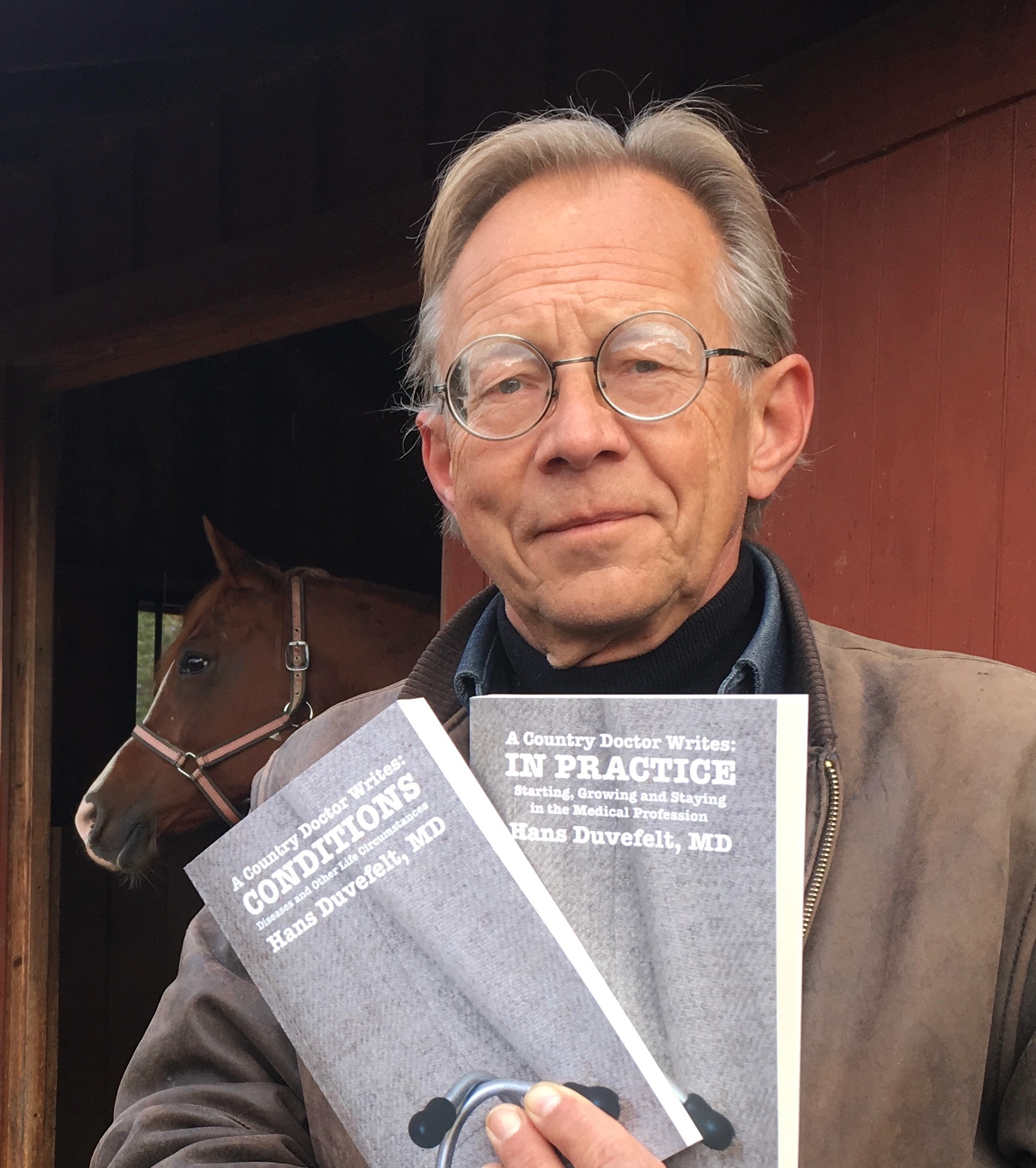
BOOKS BY HANS DUVEFELT, MD

CONDITIONS, Chapter 1: An Old, New Diagnosis

Top 25 Doctor Blogs Award

Doctor Blogs

Enter your email address to subscribe to this blog and receive notifications of new posts by email.

Mailbox

contact @ acountrydoctorwrites.com
Bookmark and Share
© A Country Doctor Writes, LLC 2008-2022 Unauthorized use and/or duplication of this material without express and written permission is strictly prohibited. Excerpts and links may be used, provided that full and clear credit is given.