Archive Page 155

Is it the Devil or God in the Detail?

“We must bear in mind the difference between thoroughness and efficiency. Thoroughness gathers all the facts, but efficiency distinguishes the two-cent pieces of non-essential data from the twenty-dollar gold pieces of fundamental fact.”

Dr. William Mayo

The practice of medicine involves a lot of details, but details without the big picture are meaningless at best and distracting at worst.

The expression “The Devil is in the Detail(s)” implies that the details can trip you up, whereas the original, older, idiom “God is in the Detail(s)” conveys the importance, even beauty or virtue, of paying attention to the details when trying to do good work.

I think medicine has lost sight of the big picture when it comes to its thoroughness and its pursuit of efficiency. And I don’t see much beauty or virtue in today’s medical charts.

This was going on before electronic medical records, but quantum leaped with the switch from transcribed dictation to click boxes and copy-and-paste functionalities.

The root of this problem lies with the Evaluation and Management (E&M) coding that literally gives points for how many questions a doctor asks about a symptom – onset, character, duration, severity and so on. Points are also given for documenting which symptoms a patient doesn’t have. In earlier times, we used the phrase “pertinent negatives” for items a reasonable physician would want to know in order to work through the possible differential diagnoses for a particular symptom

With the reimbursement system we now have, the number of questions and physical exam items, regardless of whether they are relevant or just filler material, drives physicians’ income and practices’ bottom line.

It was often possible when reading an old-fashioned, dictated, narrative to relatively quickly sort through the irrelevant items, particularly if the style and grammar were used to provide emphasis. For example, when dictating, you had the option of grouping all the negatives together and of keeping the positives separate and emphasized. With an EMR, the items in structured data entry fields tend to come in a predetermined order, making it much harder for the reader to find the relevant items.

The forest of details in today’s medical record serves purposes other than the efficient documentation for doctors to remember their own inquiry and thought processes. It also isn’t primarily designed for doctors to communicate to each other what they have observed and how they propose to treat it.

Today, under the new Government edicts, medical records have to contain hoards of details doctors never thought were relevant, but politicians and insurance actuaries do and future generations of researchers might. Plaintiffs’ lawyers and medical boards might need them, and patients need to be able to read them, so we can no longer create notes that efficiently document our findings, conclusions and plans. It is as if the conductor’s sheet music at the Symphony could no longer have musical notes, G-clefs and technical terms like “mezzo forte”, in case a non-musician wanted to follow along with the orchestra.

It is a bizarre situation: Imagine the Ministry of Culture requiring that all poetry contain certain elements about the beauty of America and the threat of global warming. Similar things have happened in countries that shall not be named here.

This is where the religious analogy really plays out: Which higher power decides the relative importance of what details in medical records? I have a theory.

Details, details, details…

Neither Doctor nor Priest

It is the year of Woodstock. The motorcycle accident victim lies quietly in his hospital bed. By all accounts, the surgery has gone well and Richard’s initial prognosis had been good. But his vital signs are deteriorating and he seems distant and despondent.

Marcus Welby knows the trouble isn’t physical. He calls on the parish priest, who seems slow to respond. The priest, twenty years younger than Welby, is also his patient, and has been suffering from asthma attacks. Welby believes they are due to Father Hugh’s struggles with feelings of inadequacy as a priest.

Richard turns the priest away and appears to be dying. The priest feels ready to give up the priesthood.

Marcus Welby, who had been urging the younger priest to take a break because of his asthma, now urges him to get to work. He tells Father Hugh that he has also failed many times, but failures are no excuse for quitting. The gravity of the situation mobilizes new strength in Dr. Welby, and his humanity and passion inspire Father Hugh to admit to himself and the young accident victim that, even though he is a priest, he struggles like all human beings. That honesty makes young Richard open up to Father Hugh and he begins to recover.

What neither doctor nor priest could do alone, the two men working together are accomplishing. This is what happens in a December 1969 episode of Marcus Welby, M.D., “Neither Punch nor Judy”.

The cars seemed more old-fashioned than I remember them from those days, and the 1969 medical standards of care are definitely as old-fashioned as the cars, but the struggles of the three men from three different generations are timeless.

I decided to watch this episode after rereading my post “The Apostolic Nature of our Profession” when I linked to it the other day. The video illustrates many things about medicine that we are no better at today than 45 years ago, or 2,400 years ago, for that matter:

“The cure of the part should not be attempted without treatment of the whole. No attempt should be made to cure the body without the soul. If the head and body are to be healthy you must begin by curing the mind…for this is the great error of our day in the treatment of the human body, that physicians first separate the soul from the body.”

Plato

A Country Doctor in his Sixties


“Once you start studying medicine you never get through with it.”

Dr. Charles Mayo

Marcus Welby, M.D. was 62 in the first episode of the TV series. My father, not a physician, retired at 62. As I am now beginning my sixty-second year, I seem to be thinking a lot about my place in time and in medicine.

Thirty years ago people often told me I looked too young to be a doctor, and I felt I had to work extra hard to seem wise. I developed a habit of carefully explaining what I understood of each patient’s condition, what I saw as the options for further testing and treatment, and what I expected the outcome to be. I also made a point of being respectful and seeking out each patient’s views and preferences.

That is still how I work, but I have found that over time, as my appearance more and more plainly suggests my years in the business, patients are more and more willing to take my advice with fewer explanations. They are also more openly seeking my opinions, support and advice in matters that go beyond the purely medical aspects of life.

It is an honor and a humbling responsibility to be in that position. It comes from not only looking like you have lived through a lot, and I have, but also from being privileged to see up close the joys and travails of so many fellow human beings.

Few professions see as much of the human condition as we physicians, and especially in these secular times, our role can sometimes have similarities with that of the village priest, especially because we deal with matters of birth, life and death.

Early on, I wrote a post titled “The Apostolic Nature of Our Profession”. The older I get in my vocation, the more I see of that; I feel more kinship and indebtedness to the ancient physicians and to my own mentors that guided me to where I am now, and I feel more tangibly the responsibility that goes with years of practice, suddenly graying hair and the earnest requests from some of my patients to fill their archetypal need for the services of a physician.

At the same time, I feel a strengthening of my desire to understand more of medicine. This truly is a lifelong pursuit, and every year I know more, but also wish for deeper and deeper knowledge than I have achieved. Dr. Charles Mayo said it succinctly in the quote above, and Sir William Osler elaborated eloquently:

“The hardest conviction to get in the mind of a beginner is that the education upon which he is engaged is not a college course, not a medical course, but a life course, for which the work of a few years under teachers is but a preparation.”

Like Osler, I believe medicine is a genuine calling for many physicians, but unlike him, I believe it can be practiced into old age, as long as we have the physical and mental vigor this kind of work requires.

I bring the enthusiasm of a young man and the experience of a sixty-one year old to my remote clinic five days a week, and most nights and weekends I read, think and write about doctoring.

I hold these words by Dr. William Mayo close to my heart as I imagine myself following in the footsteps of mentors like my senior colleague Dr. Wilford Brown, III:

“The keen clinician, as he grows in experience, becomes more and more valuable as age advances.”

In order to be as valuable as I can be to my patients thirty-five years after medical school, I need to read a lot. I need to read the major medical journals not only to learn what applies directly to my everyday work, but also to be cognizant of how the basic sciences are evolving. I need to translate my life experience and what I have learned from well over 100,000 patient encounters into a language with many dialects that I can use in familiar and unfamiliar situations with patients from a multitude of backgrounds. I need to continually learn about psychology, philosophy and religion in order to be a support to patients who face life altering circumstances and diseases.

I need to maintain my equanimity through busy clinic days in our tumultuous national health care environment, so that my patients don’t become pawns in the system any more than they have to. I need to maintain my sense of proportion in everything I do: in differential diagnosis, in helping patients set priorities, in managing agendas imposed on me by “the system”, and in my own expectations as only one mere human.

This is what I hope to continue to bring to work with me every day for as long as I can do it well.

Context, Always

Question: What do you do when presented with abnormal lab results?

Answer: Ask lots of questions.

The nursing home just sent over a urinalysis on a patient of Dr. Carlyle. I am covering his practice for a few days. The test showed that an 82 year old woman had 3+ white blood cells in her urine. “NKDA” was written in the margin, indicating she had no allergies.

I sighed internally and called the nursing home. The charge nurse seemed a little surprised at all my questions.

“What are the symptoms? What is the patient’s kidney function? Is she on blood thinners or any other medications that might interact with an antibiotic?”

The presence of bacteria or white blood cells in the urine should not usually be treated if there are no symptoms. That’s not always been our belief, but most doctors agree with this approach today.

Looking at a test result without knowing the story behind it, we cannot decide whether or how to act.

Last week we got a critically high potassium result on a patient with normal kidney function and no prescription medications in her profile. I did nothing about it, except order a repeat test that was normal. The obvious explanation was hemolysis; red blood cells contain more potassium than the serum that transports them and if the cells break during blood draw or handling of the vial, serum potassium will be falsely elevated.

A seizure patient of Dr. Carlyle had a high phenytoin level. I pestered the nurse to give me several past results and to track any previous dose changes. It turned out this patient had stable levels for a year and a half and suddenly had a low level last month. Dr. Carlyle raised the dose. In retrospect, the patient probably had missed a few doses, and would have been fine staying on the same dose. I dropped the prescribed dose back down and expect the patient to do fine.

A hypothyroid patient, Diane Green, was hospitalized with abdominal distention and constipation. She is nonverbal, and fearful of medical procedures. The hospitalist checked her thyroid function, as undertreated hypothyroidism can contribute to constipation. The test suggested Diane needed a higher dose, so she was discharged on a substantially increased dose of levothyroxine. As soon as I saw her again, I reversed the medication change; her TSH had been normal one week before her admission, and a severe illness or traumatic experience can affect thyroid values. I figured the hospitalist did not notice Diane’s old TSH result in the hospital computer.

Context is crucial when deciding what to do with abnormal test results. But doctors are often pressed for time, and finding the story behind the results takes time. Even when all the data is in our electronic medical records, it takes time to see the patterns: The test results are usually in one place, the prescriptions in another, the office notes in a third, and the phone messages in a fourth. My own EMR can produce flowsheets with lab results, but each test is identified by the date it was ordered instead of the date it was performed, so correlating lab values with prescription dates becomes confusing, for example when following thyroid cases.

In times past, when solo practice physicians cared for their patients in the office, hospital and nursing home, they kept the threads of context and continuity together more easily. Today, with more providers sharing the care, and with other office staff also interacting with patients and their families, there is more room for errors, gaps and confusion. The tools we have right now are not always as effective as we would like, and they certainly can be cumbersome and slow to use. Reading each other’s notes can take a while, as the EMR format is primarily built for coding and not for ease of following the clinical “story”.

A few words doctor to doctor, doctor to nurse or doctor to patient can sometimes do what half an hour on the computer might not. Treatment without context is essentially just random reflex actions: Killing the innocent bacteria, lowering the falsely elevated potassium, treating the lab value and not the patient – none of it does anybody any good, and probably will cause harm to some unfortunate patients.

Our temptation to view test results as obvious facts in a predictable process instead of possibly misleading clues in a complex mystery reminds me of these words from a Sherlock Holmes novel:

“There is nothing more deceptive than an obvious fact.”

Sir Arthur Conan Doyle

Med School, Day One (1974)

The corpse, laid out on a gurney and covered with a white sheet, was wheeled onto the stage by two women in long, white lab coats. A middle aged man with a bow tie welcomed us, the incoming class of the spring semester, to Uppsala University and the Biomedicine Center, where we would spend the next two years in “pre-clinicals”, until we knew enough to start our three and a half clinical years at the Academy Hospital.

The Biomedicine Center was almost brand new, a glass and concrete labyrinth with a large sculpture depicting Watson and Crick’s DNA molecule by the front entrance. The vast complex lay near S-1, the Uppsala military regiment. The brick buildings diagonally across the street were very familiar to me as the place where I had met the biggest failure in all my twenty years only months before.

As I sat in the large lecture hall with the corpse on the stage, I glanced over at L., my buddy from the Swedish military’s elite division, the Interpreter School, where we had also sat next to each other on the first day, when the Captain in charge told us:

“Soldiers, you may all have been the smartest kids in your school, but it’s different here. Most of you won’t make it, and will be culled over the next two months. The Interpreter School accepts eighty recruits and graduates twenty to twenty-five. If you don’t have what it takes, don’t waste our time or yours!”

L. and I had both thought that learning Russian would be a neat way to spend our compulsory year and a half in the military, but just barely more than a month after that harsh introduction, we were both on our way back to our respective home towns to figure out what to do until we would be able to start medical school. Our military service was put on hold until we could return as medics.

The man with the bow tie went on to introduce our guest professor, on loan from the University of Bavaria. As we all knew, the Germans had been the greatest anatomists since the last century, and all of us had already been to the University book store to purchase Hafferl’s “Topografishe Anatomie”, which would be our constant companion for the next five months.

“Hopefully, most of you took several years of German in High School,” the man continued, “but those of you who chose French instead and only took one year of German are encouraged to take advantage of our German night classes, every weekday from 8 to 9 pm in Hall B next door.”

With that, he gestured to the Bavarian guest professor, who bowed and began speaking as the first slide was projected behind him. He had the most peculiar accent, and spoke in a slow drawl. I strained to get a handle on what he was saying. L. cocked his head and as I turned toward him, I saw many heads shaking.

With every new slide, the German speaker seemed to increase the tempo of his speech and as the slides behind him changed faster and faster, more and more heads were shaking in the lecture hall. Soon, all of us had given up trying to understand as the staccato voice from the stage pounded the syllables faster than a sports commentator and the rapidly changing slides became more and more filled with details. Heads were shaking, many people were talking, some stirred and rose from their seats and turned toward the exit doors.

Then, suddenly, everything turned dark, the speaker stopped talking and all the chatter in the lecture hall ceased. We sat in darkness and silence for maybe a minute. Then, a faint tune from a small flute rose from the dark stage and dim lights began to illuminate the two women in white lab coats. One was playing the flute, the other picked up a clarinet and began to play.

As the lights continued to brighten, the sheet suddenly flew off the corpse, who sat up, pulled a trumpet to his mouth and belted out a tune like something from a Mardi Gras parade.

The stage filled with upperclassmen and the “German” professor took a bow as they all applauded in his direction.

Then, from a side door, a tall man with a very straight back, white riding pants, tall black riding boots and a whip appeared. Everyone fell silent as he began to address the students in the lecture hall.

“I’d like to introduce myself. I am professor A. of the Department of Anatomy. I just came back from riding in the fields beyond here. I want to welcome you all.”

L. and I looked at each other and shrugged – was this part of the joke?

Professor A. continued:

“So, you made it to medical school. And if you really want to, all of you will make it out of here with a diploma. Just work hard, enjoy Uppsala, and don’t worry about the German classes – all lectures will be in Swedish!”

He was right, all of us who wanted to made it all the way through. My friend L. chose to leave medical school for a life as a writer, but he often writes with great insight about doctors.

I remember that first day as if it were last week, but it was forty years ago. It was the beginning of a journey of learning I can’t imagine ever reaching a final destination. In 1974 there was no HIV; we had only Hepatitis A, B and non A-non B; Sweden didn’t have a single CT scanner; mammography screening was just beginning; Tagamet, Prozac, “statin” cholesterol drugs and clot-busters weren’t invented; low-dose aspirin wasn’t known to reduce heart attack risk, and so on.

In spite of all that has changed in medicine since I started, the way I learned at Uppsala how to evaluate scientific information, to elicit a disease history, to examine patients, and to approach them as individuals, not “cases” – that has not had to change in forty years of doing the only work I could ever imagine doing.

(Originally published on The Healthcare Blog, where my friend L. read it and thought I made it sound as if we were “culled” from the elite military school. We chose to drop out. Everything else happened just the way I wrote it…)

P.S. This is my 300th post on “A Country Doctor Writes”.


I just realized none of the posts show on an iPad or a computer, but they do show on an iPhone. WordPress is working on this. In the meantime, please visit my Substack.


Osler said “Listen to your patient, he is telling you the diagnosis”. Duvefelt says “Listen to your patient, he is telling you what kind of doctor he needs you to be”.


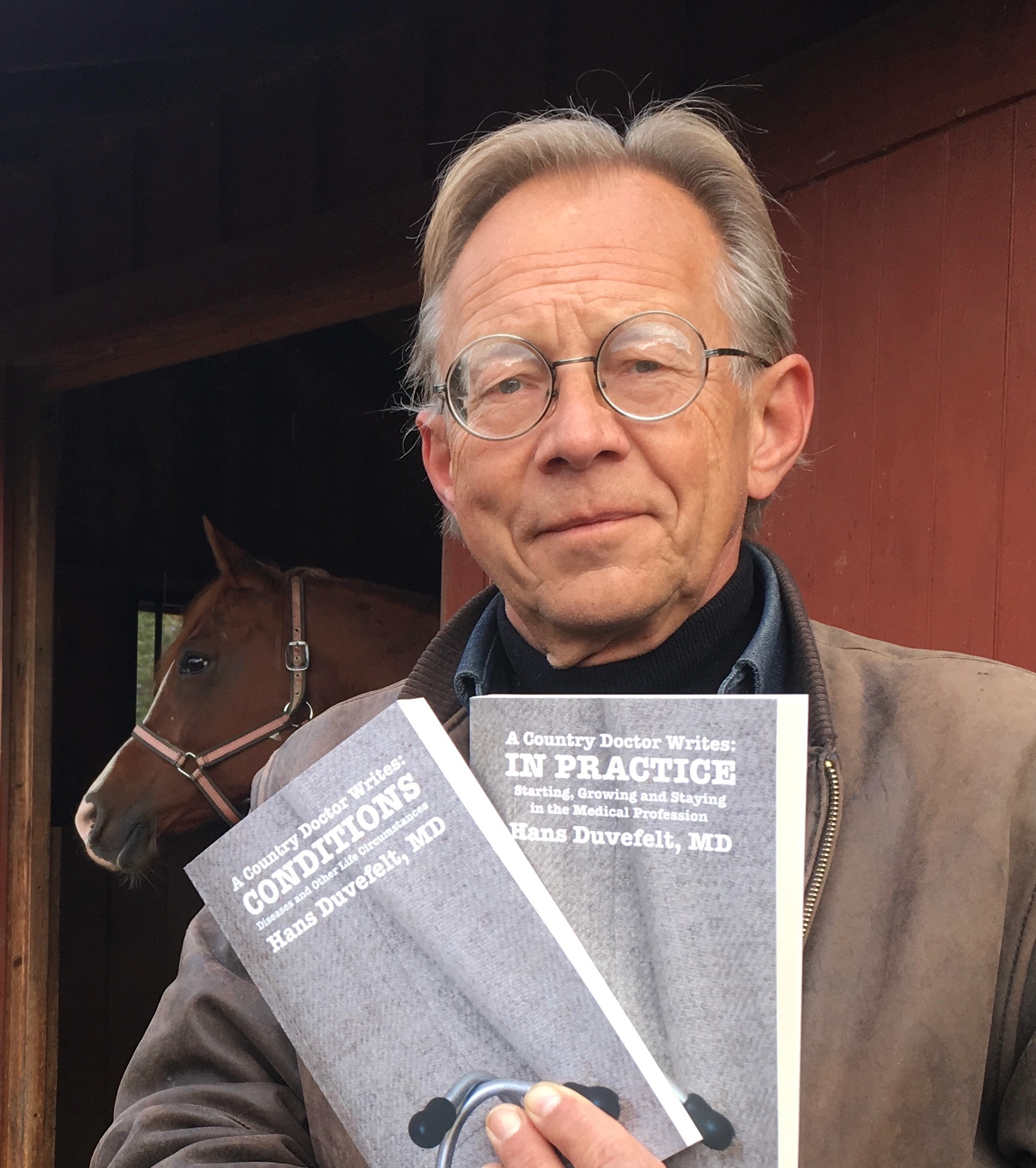
BOOKS BY HANS DUVEFELT, MD

CONDITIONS, Chapter 1: An Old, New Diagnosis

Top 25 Doctor Blogs Award

Doctor Blogs

Enter your email address to subscribe to this blog and receive notifications of new posts by email.

Mailbox

contact @ acountrydoctorwrites.com
Bookmark and Share
© A Country Doctor Writes, LLC 2008-2022 Unauthorized use and/or duplication of this material without express and written permission is strictly prohibited. Excerpts and links may be used, provided that full and clear credit is given.