Archive Page 148

The Man With the Shrinking Lung

I see some odd things in my clinic. One recent diagnostic dilemma was a man in his late fifties with shortness of breath.

He had been born with a Ventricular Septal Defect and had undergone surgery for this in his infancy. During his lifetime, he had seldom gone to doctors, and always thought he was in fairly good health, maybe just of a weak constitution. A smoker since age 13, he had a morning cough and got a little winded running up and down the basement stairs or shoveling snow in the winter.

A while ago he came to see me because he felt he was getting more short of breath over the winter. On exam, his vital signs were normal and his oxygen saturation was 97%. He had a systolic heart murmur and his breath sounds were diminished in his entire left lung. I didn’t see any swelling of his legs and his neck veins were not distended when he laid down flat on my exam table. His EKG was normal.

I ordered a chest X-ray and some basic blood work. His X-ray report said his left lung looked normal but his mediastinum was shifted a little to the left. His heart was not enlarged. Routine labs were normal.

The day he came in to follow up on his testing he looked ashen. He had suddenly become much more short of breath the day before, just brushing snow off his car. He had had some vague chest pressure that lasted ten or fifteen minutes.

His physical exam and repeat EKG were essentially unchanged; perhaps he had even weaker breath sounds in his left lung. This time his oxygen saturation was only 90%.

I ordered a chest CT with contrast for later the same day and also put in for a chemical stress test and an echocardiogram.

A few hours later, one of the radiologists called me. The man’s IV had infiltrated and most of the contrast ended up in the subcutaneous tissues of his right arm. His Pulmonary Embolism protocol CT scan would have to be postponed.

“Ok, have him stop by the office on his way home”, I said.

I gave him samples of one of the new anticoagulant medications that just got approved for initial treatment of blood clots in the lung and gave him a lot of detailed instructions.

Over the next two weeks, I received a normal stress test and an echocardiogram report that said something about decreased flow across the pulmonic valve. I wasn’t sure what to make of that in the context of my working diagnosis of one or multiple pulmonary emboli, and called radiology to please get the chest CT rescheduled.

Finally, this Monday, he had his CT scan done. The chief if radiology called me immediately after the study.

“Your Mr. Faulkner, he doesn’t have a PE, but he has agenesis of his left pulmonary artery.”

I sat back in my chair. I’d never heard of this condition. All his life, I thought, his underdeveloped left lung has been without functioning blood supply, and that’s why his mediastinum was shifted to the left and his breath sounds were so diminished. Finally, all this caught up with him, and he ended up in my clinic one day.

I did an Internet search for pulmonary artery agenesis. It is extremely rare, and usually diagnosed earlier in life. Some cases are diagnosed after an incidental abnormal routine chest X-ray. Symptoms are shortness of breath and productive cough or recurrent respiratory infections, all common concerns among middle aged smokers in this part of the country during the winter months.

I saw him back to explain what I had found, stopped his blood thinner and told him I wanted him to see a cardiologist at Cityside Hospital. He wasn’t so sure he wanted to travel that far, but said he’d think about it.

As a rural frontline primary care doc, you just never know what’s going to walk through your door.
Humming Jeopardy

The last few days have been really busy, but they still felt controlled, almost leisurely and smooth. Patients have been seen on time, my office notes have been completed in real time and my superbills have been submitted before each patient reached the check-out station. Things were really humming.

The new nurse, who is orienting with Autumn, noticed that I was humming each time I dashed back to my desk to grab a printout, my tuning fork or something else. I, too, realized I was doing it again and again – humming the theme song of Jeopardy, the television quiz show.

I haven’t watched Jeopardy since TV went digital a decade ago and we refused to upgrade. But I still find myself humming its theme now and then through the day. In fact, I’ve been doing it ever since, in a gesture of generosity and solidarity, I volunteered to try fifteen minute visits during a lean spell in the clinic about twelve years ago.

Primary care is a lot like Jeopardy. You have to quickly think of the right answer, which is often disguised as a question, and then press the buzzer as fast as you can before you are presented with the next challenge:

Is it the thyroid? What will the EKG show? Have you traveled to West Africa? Am I meeting my Meaningful Use targets?

Every day I walk the fine line between well oiled efficiency and letting patients take the time they need to tell their stories. Again and again throughout my day, I switch from nudging things along to slowing them down as my experience and clinical intuition guides me in my work.

The patients who were squeezed in for acute problems appreciate my efficiency in getting them in and out. Those with complex medical problems or maladies of the soul expect me to give them the time it takes to grasp what’s important to them. When I can’t tell the two types of appointments apart I fail miserably in carrying out the visit, and kick myself for my misjudgment.

I guess what I do is like like many other things in life that I personally have never experienced much of first hand, like sailing – you’ve got to consider the elements and never try to go completely against the wind or the current, but find the correct angle, know how to rig your sails and be prepared to zigzag a little to get to your destination.

The challenge in what I do as a primary care physician is to accept the changing winds of each clinic visit, to see time as something more fluid than a Swiss watch, and to remain a little bit above it all – just enough so I don’t feel completely stuck in the muddy waters of our modern healthcare bureaucracy.

I do have to stop humming Jeopardy, though. It completely sets the wrong mood.

Normal Blood Pressure

Dwight Frost had all the risk factors, plus he had already had a stroke several years ago. His blood sugars were too high, his lipid profile was near the top of the class, he still smoked a cigar now and then, and his blood pressure hovered around 200. He also seemed a little vague about which medications he actually took and which ones he didn’t.

He spoke rapidly with a slight tremulousness in his voice and seemed to be eager for the visit to be over.

On his second visit he brought a big bag of medications, not just the neatly written list his wife had sent him in with the first time. Some of the bottles were marked on the lid “AM” or “PM”, others said “BP”, “sugar” and some had a rubber band around them, which seemed to mean he was definitely taking them as prescribed.

His thyroid function and other routine labs were normal. At both visits I recorded his blood pressure in both arms; I had him sit and stand; the first time I saw him, I also checked the pressure in his right leg.

His wife was a retired nurse, he told me, and she also checked her own blood pressure with a stethoscope and a manual sphygmomanometer. She had recorded almost daily blood pressures, all under 140, that she had done on him between his two visits with me. She couldn’t come in with him, because she was actually bedridden from severe arthritis. She rarely got out of the house to see her rheumatologist, the only doctor she had.

I thought for a moment. There was only one way I could resolve this, so I asked:

“Would you mind if I stopped in next Friday afternoon to check your blood pressure when you’re relaxing at home?”

“Anytime, were always home“, he answered.

Friday afternoon I drove across town in a light snowfall. The faint February sun filtered its way between the snowflakes, which seemed to sparkle and rotate in the air ahead of me without ever hitting the windshield.

The Frost home was a tidy ranch house with an ell connecting it to the garage. Dwight saw me drive up and greeted me at the door.

Ada, his wife, was lying on a day bed near a pellet stove in the paneled room. A large Persian cat was sleeping at her feet.

Dwight walked over to a Canadian rocker near his wife’s bed and sat down. As we made small talk, the majestic cat woke up and moved over to Dwight’s lap. Slowly, almost absentmindedly, Dwight patted the cat and told me she was almost twenty years old.

I noticed that Dwight spoke without the tremor in his voice I had heard at the office, and he exuded a calm that I had not seen in him before.

As I watched from the chair he had offered me, a slow ritual unfolded before me. With the cat in his lap, Dwight placed the blood pressure cuff on his arm and gave the stethoscope to his wife. “Ready”, he said to Ada, and when she nodded, he pumped the cuff up and then slowly deflated it.

“134/82”, she said.

I walked over, put my own cuff on his arm instead and pulled out my own stethoscope from the pocket of my tweed jacket.

As I pumped up the cuff, Dwight patted his cat, who started purring, and leaned his head back against the back of his chair.

Slowly deflating the cuff from a high of 240, I listened in anticipation. At exactly 132, I heard the first Korotkoff sound. I continued to deflate the cuff and finally had my answer.

“Your blood pressure is fine”, I said, and reached down to record the numbers. “It’s just high when you come in to the office. So, why don’t you come and see me in three months, and just bring your readings from home.”

I gathered my equipment. As I looked up again, Ada and Dwight were holding hands. He was not the same anxious man I had seen in the office twice before. The cat was still in his lap, sleeping.

Medical Anamnestics

“Listen to the patient, he is telling you the diagnosis.”

William Osler

Sir William was right, but listening for the diagnosis when patients speak isn’t quite as straightforward as it may seem. This is particularly the case in the fifteen minute universe of American health care today.

In America we call it “history taking”. Our use of the word “history” somehow implies that there is something very objective about it. This has led people in the medical field to even delegate the listening to and documenting of patient histories to non-professional office staff.

In Sweden we used the word “Anamnes”, derived from the Greek words “ana” (back again) and “mimnesco” (remember). “Anamnesis” is found in Plato’s teachings about memory. There is a subjective quality to the use of the word “anamnesis” for patient or case histories, as the word in English can also mean, simply and non-medically, “recollection”.

Taking a patient history or anamnesis can require a fair amount of finesse.

Sometimes a patient comes in with a diagnosis already in mind. He or she will outline their differential diagnostic thought process and resist getting into what the actual symptoms are, as if they’ve moved beyond that stage. They act as if they wish I would please catch up with where they are. My usual reaction and tactic in such situations is to let go of any seeds of frustration I might feel and declare my inability to skip over any steps in the diagnostic process. I usually say something like “I’m a little slow…” in order to not seem to be challenging my patient’s preliminary efforts.

Other times, I run into patients who offer neither symptoms nor interpretation, but tell convoluted narratives about what others have said about them and what happened years ago that might have set the stage for whatever may be happening now, although I haven’t yet become the least bit aware of any of their present symptoms. Before I became aware of the condition now called alexithymia, I would easily become frustrated with this kind of narrative. Now I am more able to consider this kind of “anamnesis” a warning sign that my patient truly might be unable to recognize and describe both emotions and physical symptoms.

I worry about the idea of delegating listening to someone else; even a highly trained colleague could obtain a slightly different history, and every clinical decision is to some degree based on nuances that go beyond the mere “facts” of the case. It often seems that the way a patient’s history and his demeanor appear congruent or dissonant can move the diagnostic process forward quite dramatically.

I also worry about the therapeutic consequences of eliminating or abbreviating the listening process. I couldn’t count the times a patient has seen a well respected specialist who delivered technically excellent care and come back telling me “he didn’t even listen to me”. Patients have again and again told me that they value simple listening in me and other health care providers they see.

This ties in with something I read recently about the difference Between Care and Cure.

My wife ordered a book a few weeks ago by Henri Nouwen, called “Bread for the Journey”. It was published posthumously and contains daily reflections. Nouwen is perhaps best known for his writings about the “wounded healer”. This morning over coffee, Emma asked me to look at today’s reflection, titled “Care, the Source of All Cure”:

“Care is something other than cure. Cure means “change”. A doctor, a lawyer, a minister, a social worker – they all want to use their professional skills to bring about changes in people’s lives. They get paid for whatever kind of cure they can bring about. But cure, desirable as it may be, can easily become violent, manipulative, and even destructive if it does not grow out of care. Care is being with, crying out with, suffering with, feeling with. Care is compassion. It is claiming the truth that the other person is my brother or sister, human, mortal, vulnerable, like I am.

When care is our first concern, cure can be received as a gift. Often we are not able to cure, but we are always able to care. To care is to be human.”

Nouwen was absolutely right. I think the way we take each patient’s history, the way we elicit their stories and recollections – their “anamnesis” – is at the very foundation of “care” in health care.

Border Doc

IMG_0018Driving to work, I sometimes tune in the Canadian morning news on my car radio. It feels so comfortable to this old Swede to hear the weather forecast with temperatures measured in degrees Celsius – Anders Celsius was a professor of astronomy almost 300 years ago at Sweden’s Uppsala University, my Alma Mater.

Everyone’s memories are smattered with numbers that carry great significance; I once had a 40.2 degree fever (104 F), my bedroom temperature was 13 degrees (55 F) one January morning, and so on. Numbers you grow up with carry more emotional weight than ones you learned as an adult.

The Swedes and the French-Canadians have many similarities, not just the metric system. I feel very much at home with the way my older patients here on the border view health care. Just like the Swedes, they often question medical interventions, and they believe in their bodies’ ability to heal without the help of medicines and procedures. This is the classic view, dating back to Hippocrates’ writings, far from today’s notion that most processes in the human body are diseases that should be treated or regulated with blockbuster drugs. Many French-Canadian patients are relieved to hear that their infections can be managed without antibiotics, while more mainstream Americans often question why they can’t have a prescription “just in case”.

When I first moved to this country, I needed to polish my English. Finding the right balance between medical terminology and common words, sometimes learning the colloquialisms, took some work. In Maine, we use words like “spleeny” for being squeamish or less than heroic in medical situations, and “bunch” for any unknown tumors, lumps and bumps on the human body.

Here, on the Canadian border, my one year of High School French was nowhere near enough to understand conversations in the grocery store or the local diner. Even a more proficient French speaker would have had trouble understanding the local dialect. Some of the purely local “Valley French” words are also used in English here. People often come in, saying things in English like “every time I eat broccoli I get the flu”, which means broccoli gives them diarrhea. Many English words have made their way into Valley French, like “une appointment avec le docteur”; neither “appointment” nor “docteur” are proper Parisian word choices for saying that you have a doctor’s appointment.

On a typical day at my border clinic, which actually overlooks the river that separates our two countries, more than half my patients have French surnames. Many slip French words into our conversation. And often, when family members speak together in French, they throw English words in here and there. Some of my older patients feel more comfortable receiving all their instructions in French rather than in English.

I also feel the French-Canadian presence when I move around within the clinic or sometimes just lean too far back in my office chair, and my cell phone vibrates with a text message that announces that I am now connected to a Canadian cell phone tower, and roaming fees may apply.

This connectivity issue gets in the way of using my EMR on my little tablet computer during housecalls. We have to maintain parallel paper and computer records for our home bound patients, who live where there is no cellular internet connection.

In our little store, Canadian money is always welcome, but there are strict limits on how many eggs, how much meat and how many bottles of wine our neighbors can bring back across the river.

The Credit Union gladly exchanges Canadian money also, and the stores in much of Maine accept Canadian dollars.

Some of my patients cross over to Canada to shop for their medications. Prices are government regulated there and sometimes much lower than here. I and many other doctors in our state have a “border license”, which makes our prescriptions valid across the border. Prescribing for Canadian pharmacies requires some knowledge of the differences between what is available here and across the river. Some brand names are different, and some drugs are available only here while some only exist there.

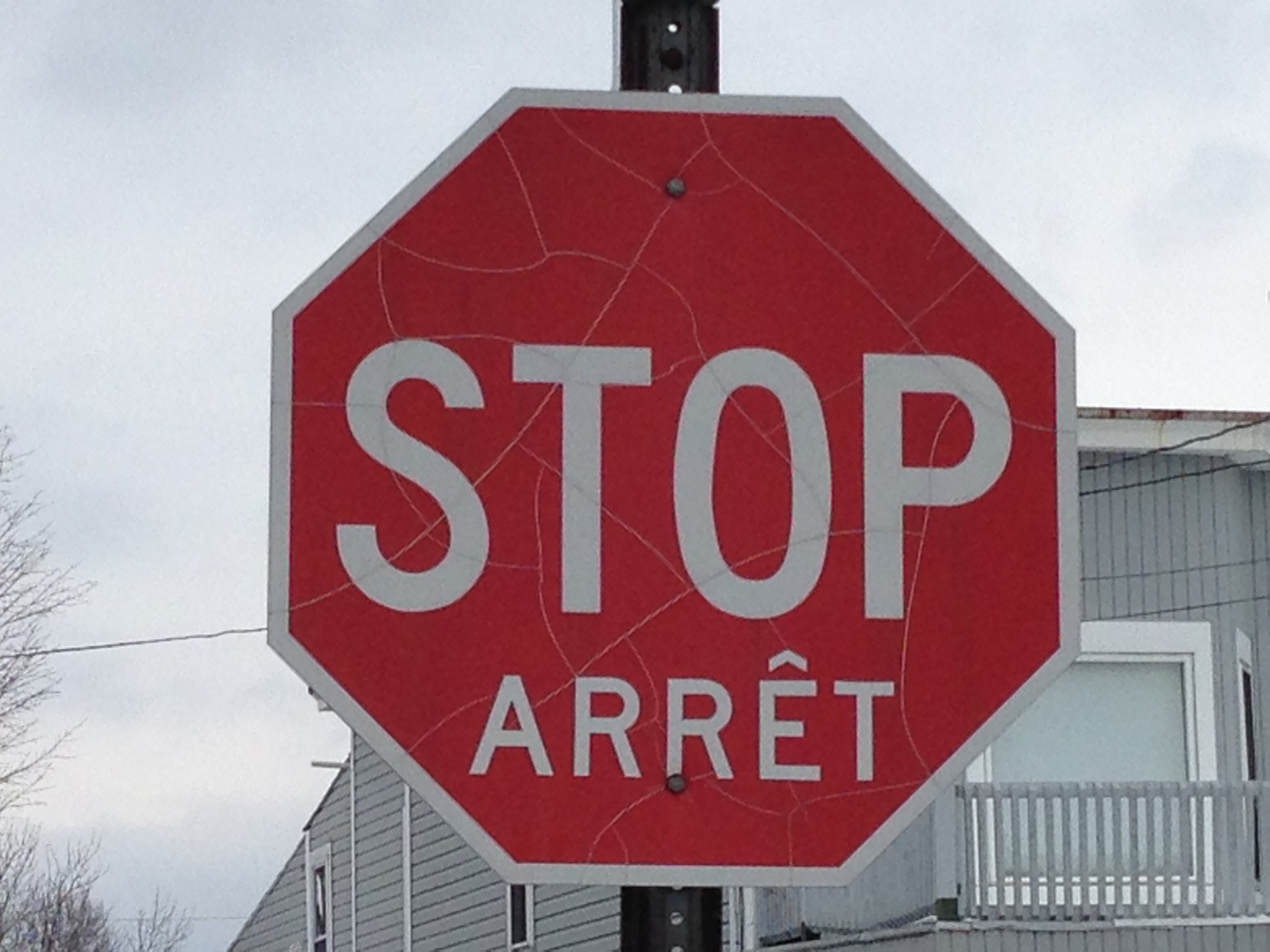
Driving through town, I stop at a bilingual Stop/Arrêt sign before pulling out into the modest traffic. Minutes later, as I drive down the stretch of Route One we call “Moose Alley”, I slow down for a hesitant four legged jaywalker and then set the cruise control to 56 miles per hour. With the push of a button on my steering wheel, the dashboard display reads 90 km/h. That feels very familiar and comfortable.

My commute takes me through the dense pine forest and over the hills with their long vistas across to the mountain ranges of Canada and towards the south. There, almost two hundred miles away, are the specialists I have referred my patients to for thirty years, colleagues I know by first name and often speak with over the phone, but rarely see in person. That’s how far my patients have to travel to see a gastroenterologist or a vascular surgeon, or to have a PET scan, stress echo or a balloon angioplasty.

After the last stretch, on a snow covered back road, my little red 1936 farmhouse gradually appears in view. Seeing it, with its Swedish flag by the front door, you could think you were three thousand miles away in Sweden, in the village where my father was born, and his father and grandfather before him.

I sometimes ponder that this area looks a lot more like the Sweden I grew up in than the modern day Sweden I have visited in recent years. It also doesn’t look like the increasingly congested suburban America I first visited forty years ago, near where the Pilgrims landed south of Boston. Time somehow passed faster elsewhere than it did in these remote northern towns and villages where I live and work, on the very outskirts of America. My office is in the only town in this country where McDonald’s opened and later closed a restaurant due to a lack of customers. It is an environment with fewer distractions than most places, closer to nature and to the timeless essentials of life. It is a place where doctors shoulder big responsibilities but also get to feel a unique closeness to and appreciation of the patients who depend on them.


I just realized none of the posts show on an iPad or a computer, but they do show on an iPhone. WordPress is working on this. In the meantime, please visit my Substack.


Osler said “Listen to your patient, he is telling you the diagnosis”. Duvefelt says “Listen to your patient, he is telling you what kind of doctor he needs you to be”.


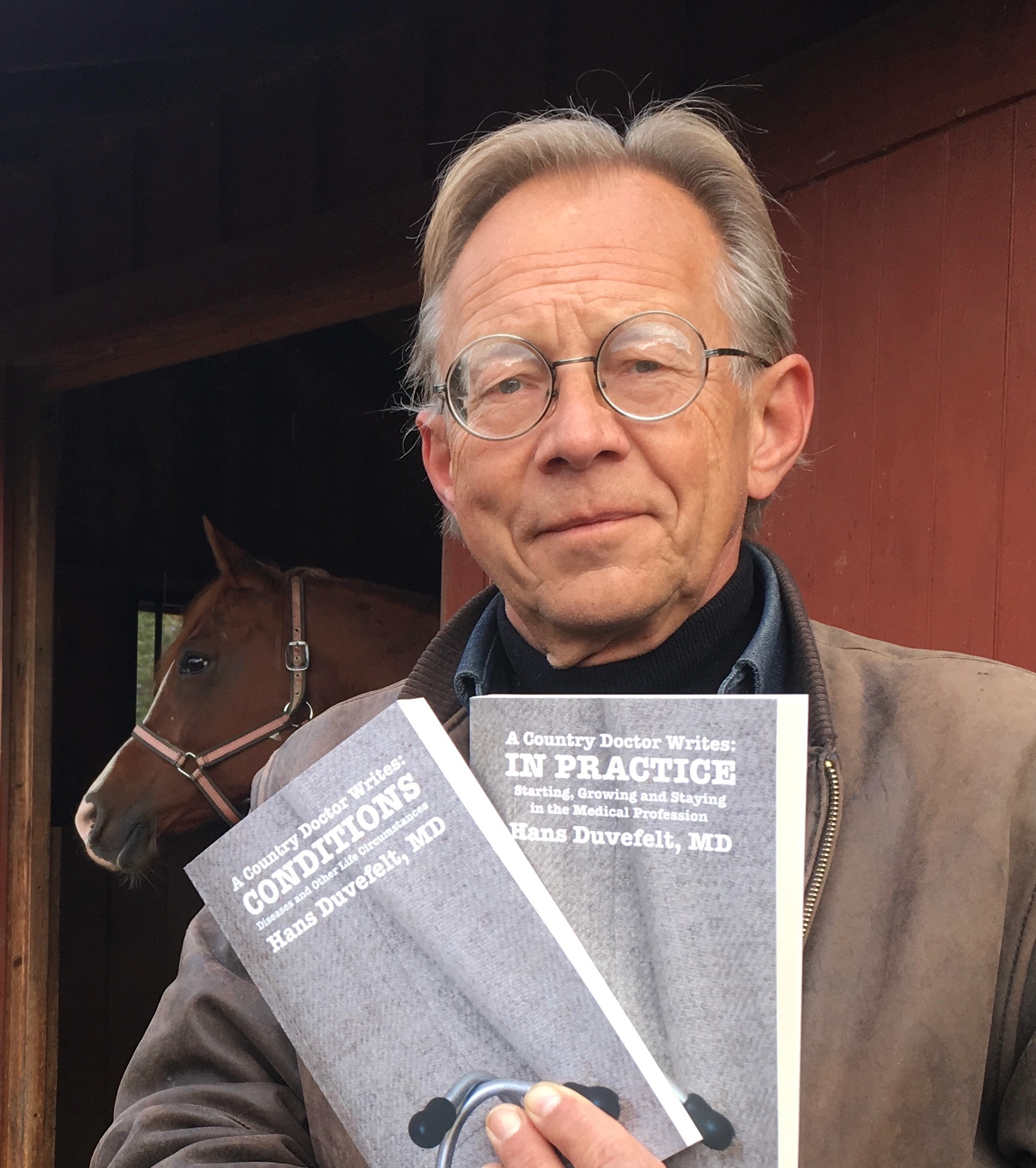
BOOKS BY HANS DUVEFELT, MD

CONDITIONS, Chapter 1: An Old, New Diagnosis

Top 25 Doctor Blogs Award

Doctor Blogs

Enter your email address to subscribe to this blog and receive notifications of new posts by email.

Mailbox

contact @ acountrydoctorwrites.com
Bookmark and Share
© A Country Doctor Writes, LLC 2008-2022 Unauthorized use and/or duplication of this material without express and written permission is strictly prohibited. Excerpts and links may be used, provided that full and clear credit is given.