Archive Page 147

It’s Time We Stop Comparing Health Care to Manufacturing

From ancient times, doctors have appreciated that, for all their similarities, no two patients are exactly alike. This understanding is what made physicians act like, and earn society’s respect as, professionals.

The commercialization of health care has brought in managers from other industries and other branches of academia, and their rise to power has been predicated on their ability to treat patients and doctors not as individuals, but as small cogs in the new health care industry.

There is no doubt that healthcare today is an industry, but I disagree with the notion that it can be closely compared with manufacturing.

In manufacturing, every aspect of production is built around standardized processes and standardized raw materials. But in health care, the “raw materials”, people with illnesses and risk factors we doctors seek to mitigate, are all different. And the processes often involve judgement calls and compromises between different objectives when patients have more than one disease.

Compare this to two types of carpentry:

Some carpenters build houses on empty plots of land, according to detailed architectural drawings, using standard sized lumber, creating homes that are identical, square and uniform. Novice carpenters learn relatively quickly how to build such homes, because the manufacturing process is consistent and predictable from one brand new home to the next.

Healthcare is more like old-house restoration than manufacturing. Put another way, real patients are more like old houses than new tract homes.

I have recently had reason to watch a master carpenter and a master painter turn a 1790 house and barn from a neglected near-dilapidated state into an inviting and comfortable home. Almost everything these two craftsmen did was improvised. Every flaw or asymmetry they tackled inevitably lead to another one that could not have been anticipated, let alone described with enough detail in architectural drawings or engineering diagrams for someone without decades of experience to tackle. Every decision these men made almost automatically and with little fanfare was a judgement call or an impromptu recreation of some antique detail; the carpenter chose lines to work from so that the house seemed straighter to the eye than if he had followed his level, and the painter filled gaps in the antique moldings with joint compound in a way that made the house seem tidy and whole but still showing its age.

When restoring a 200 year old house, there are no perfect squares or true plumb lines. The walls are never even and the floors are never level. But that doesn’t make such a house less livable, or less beautiful. It adds to its value. Manufacturing principles don’t apply when you set out to restore an old house, and the same holds true in holistic primary health care. Putting new drywall over a wavy plaster and lath wall is quicker than preparing the original surface for fresh paint, but the result breathes life and history into spaces that are now ready to live on with renewed purpose and dignity.

In medicine, whether it is doing plastic surgery, treating aging patients with three or four chronic medical conditions or counseling a patient facing life-changing circumstances, the manufacturing model can only cover the most rudimentary basics. It is the skill and experience of the practitioner in balancing all the variable manifestations of disease in real people that makes their treatment a source of healing.

Even the most predictable patient care processes, like taking out somebody’s appendix, don’t quite lend themselves to the manufacturing analogy. In medicine, the first step is not how to begin to remove the appendix; it is making the decision whether to do it in the first place. That isn’t always a straightforward, scientific decision, even with today’s imaging tests. It sometimes comes down to a judgement call here, too.

Absolution

“The last thing Edward did was bring in the groceries from the car. I saw the perspiration rolling off his forehead and I heard him moan, but he didn’t stop to rest. I should have told him to come inside and sit down for a while. The next morning, he was gone”, an eighty-two year old widow said to me the other day in a voice filled with the pain of a secret guilt she had harbored for almost a year.

I stretched my hands out toward her and she put her thin, arthritic hands in mine. I held them gently, careful not to squeeze so hard that I might cause her pain.

“Oh, Mary”, I said, “Edward had hardening of the arteries everywhere in his body. He could have had a heart attack many, many years ago if you hadn’t gotten him to quit smoking when you did twenty years ago.”

Her hands returned my gentle squeeze and she smiled faintly as the tears streamed down her furrowed cheeks.

Today, as I familiarized myself with the medical history of a delightful little preschooler, her forty-something mother blamed herself for the little girl’s speech delays. “With my husband’s first losing his job when the mill closed, and then having a stroke less than a year after that, I just wasn’t there for Hayley to nurture her the way I should have”, she said as her eyes turned red and her voice grew faint.

“Look at this wonderful little girl”, I said. “See how she waits for her turn to speak and see how engaging she is with Autumn and me, even though she’s never been to our office before. She exudes a sort of gentle confidence that comes from being loved and cared for. It seems to me you have done a wonderful job with her, in spite of all the challenges you’ve had to deal with.”

“Thank you”, she whispered as she bit her lip, turned her head toward the ceiling and closed her eyes.

I am often reminded of the power of a physician’s words and the role our patients put us in of advisers in matters that go beyond diagnosing and treating illness.

A doctor, as the word “docere” was originally used, is a scholar and teacher, and the office we hold in the conscious or subconscious minds of many patients is like that of a priest or a judge.

We need to be aware of how a single, careless word or even our body language can hurt or undermine a patient’s hope or confidence. And we need to use our words and the authority some of our patients grant us as a kind of surgical instrument that can cut away festering doubts, fears or guilt. We have the power to ease suffering by wisely accepting and judiciously exercising that power. It is our responsibility to use it when that is what our patients need.

The Legend of the Avoidable Hospital Readmission

A long, long time ago, hospitals existed to admit patients when they were sick, treat them with medicines or surgery and good nursing care, and discharge them after they became well.

Hospital care was at one time a charity, which evolved into a nonprofit service, before it became a Very Big Business.

In olden days, nonprofit hospitals charged patients straightforward fees for their services. Then, when you were just a young whippersnapper or perhaps merely a gleam in your father’s eyes, Medicare and Big Insurance started collecting premiums from workers and dole it out to hospitals when the workers or retirees needed hospital care.

At that point, hospital fees became confusing. The people who received care didn’t see what the charges were, and the payers didn’t really know how much care was medically necessary or even actually delivered by the increasingly profit-driven hospitals, let alone how much it cost to provide those services.

Insurers demanded deep discounts, and hospitals raised charges. Billing became more and more convoluted and required more hospital documentation and more business staff at both the hospitals and the insurers.

When an aspirin became as expensive as a four course meal and an overnight hospital stay became more expensive than the monthly lease payment for a Bentley, Medicare thought they had figured out a way to outsmart the hospitals: They started paying a flat rate for each hospital stay, based on the diagnosis. Suddenly, the hospitals were penalized if patients stayed longer or required more procedures or more aspirins than the average case.

That’s when patients no longer got to stay until they were well. People were discharged home at five o’clock on Friday afternoons, only partway cleared of their symptoms, with promises of a visiting nurse the following week and instructions to call their family doctor first thing Monday morning for an appointment.

A few years went by, and Medicare realized patients often ended up back in the hospital shortly after their discharge. Hospitals, of course, got to bill twice for each such episode and Medicare was obligated to pay the hospitals twice – not what they had expected would happen.

Medicare’s next move came swiftly: They didn’t retreat and say “we were wrong, keep patients in the hospital until they are well enough to go home”. Instead, they announced they would penalize hospitals if patients with certain hot button diagnoses got readmitted within thirty days of discharge.

This was an ingenious move on Medicare’s part. They are now imposing this penalty not just for patients who were sent home before they were stable, but also for patients who have severe chronic or near-terminal illnesses. For these patients, even the best possible prognosis is multiple admissions or a lengthy stay until they die. Medicare is now forcing the hospitals to spend more money than they receive during each such hospitalization, and, through the penalties, Medicare is giving itself a rebate every time one of these chronically ill patients gets readmitted appropriately, weeks after any shortcomings in the initial care would have been compensated for by the follow-up care or the passage of time.

Today, Medicare is looking outside the hospital wards for a happy ending to this situation. They are starting to spend money (presumably the money they are taking away from the hospitals) paying primary care practices for reaching out to patients immediately after they come home from the hospital in order to identify gaps in care and plan for follow-up visits. We are now becoming more and more involved with the social and economic barriers to health.

So the legend continues to evolve. But, like all legends, it is only partly true: Hospital care doesn’t cure everyone or everything. Primary care practices and their new partners – Community Care Teams and all the other agencies they network with – can only do so much to help patients overcome the obstacles that our society as a whole cannot remedy. And as primary care practices shoulder more and more chronic disease management responsibilities, even with some extra money thrown in, will we be able to also provide the timely urgent medical care our patients need in order to stay out of the Emergency Department and the hospital?

A Black Hole

Theresa arrived in a cloud of noise and commotion.

She had called after four o’clock the day before, but I hadn’t noticed the new message in my electronic inbox before I left the clinic.

Her almost brand new alprazolam bottle and her pain pills were missing, and Theresa was reeling. As she walked down the hall to the exam room, I heard her explain to Autumn how she had been to Walmart and a couple of other stores, slinging her big handbag over her shoulder, opening it to pull out her wallet, stuff receipts and her reading glasses away and fumble for her asthma inhaler.

In my exam room she repeated her story and demonstrated how she had held the bag open, pulled things out of it and then put them back in, and then realizing that her two pill bottles were missing. She proceeded to also show me how she rummaged around for the pill bottles and even emptied the large, brown bag with its purple lining.

In a loud voice and with oversized gestures, she replayed every conversation she had had about her missing pill bottles with store clerks, her girlfriend and her pharmacist in the last thirty six hours.

I sighed. Theresa had a small amount of pain pills on hand, which she could safely go without, but she was one of those patients who had seemed stable and truly helped by her long-term alprazolam. This was endorsed for selected patients at the psychopharmacology courses I had attended in Boston many years ago, but it has now fallen out of fashion.

“Well, Theresa, you know these controlled substance agreements you’ve had to sign always say that lost or stolen medications will not be replaced”, I said.

“But this has never happened to me before.” Her voice was as shaky as her large, bony hands. “I’ve been on alprazolam for years, what happens if I stop it suddenly? I took my last pill last night, one I had saved in my nightstand.”

“You’re right. Stopping alprazolam suddenly can actually be risky”, I agreed. “Here’s what I can do: I can give you half your usual dose, in weekly refills that you will have to pay for yourself, and I’ll see you back every Wednesday until your next regular prescription is due. Then we can assess how you’re doing.”

“Okay.”

I entered the new dose in the computer and clicked with my trackball on the “print” button. I doubted that Theresa was trying to scam me with diversion or addiction, but rules were rules. Obviously, I didn’t want risk withdrawal seizures.

Later that night I thought about Theresa again. I couldn’t completely ignore a slight shade of doubt. Was she becoming addicted or irresponsible with her medication? A mental black hole lay open but I resisted falling into it.

The next day, I heard Theresa’s resonant voice again, talking with Autumn somewhere down the hall. A short while later, Autumn appeared at my door. In her hand she held three pill bottles.

“Remember Theresa’s missing pill bottles?”

Without waiting for my answer, she continued:

“Well she was just here with that big handbag of hers. She lost her cell phone last night, so she emptied out her whole bag again and found a five inch hole in the lining. There, between the lining and the outer shell, was her cell phone, her two pill bottles and one of her spare pairs of reading glasses!”

The black hole was real, I thought, not in my mind, but in that big handbag of hers.

A Very Careful Driver

“I don’t know why Dr Brown took my license away”, the 92-year old man said. He was visibly shaking with anger. “I’ve been driving since I was a young boy, and I could find my way to California without a map”.

My associate, Dr. Wilford Brown, had sent in a State Driver Profile a few months ago, and made reference to an attached letter by a family member, which in his words would be “very damning, if true”. Apparently, the Department of Motor Vehicles had thought so too, as the elderly man explained their action through clenched jaws.

“I called them up, and they said that if you wrote to them, they would give me my license back”.

“They did, huh…” I said, while mousing and clicking my way back and forth in the documents section of the electronic medical record in search of the damning letter. I could not find it.

“How could Dr. Brown say that I’m not a good driver? What does he know about that?” The man raised his trembling hand and pointed in the general direction of Dr. Brown’s office.

“He says I have memory problems. My memory is excellent. I remember everything!”

I looked at his problem list, where “Dementia” was the first diagnosis.

“Maybe someone contacted the DMV about your driving”, I said cautiously, thinking I wouldn’t want to cause conflict or mistrust in the family by revealing everything I knew about the letter. “Maybe someone didn’t like the way you drive”, I tried, wondering if perhaps the missing letter might have been inaccurate or exaggerated.

I looked at his birth date on the computer screen and did a quick search in my memory bank about old cars.

They were still making Model T Fords when he was a little boy. Maybe he even learned to drive in one. I pictured traffic around here in those days, and my mind suddenly switched to the tourist traffic on Route One every summer weekend.

“My memory is excellent”, Mr. Gordon said again.

“Well, it’s not just memory, it’s eyesight, hearing, reaction time, judgement and reflexes”, I started.

“I am a very careful driver”, he interrupted. “When I come to an intersection, I stop, even if the light is green, and I look both ways before I go”.

As in a movie flashback, I saw him as a young boy, sitting next to his father, honking a rubber and brass horn and proudly maneuvering a Model T on an empty country road, surrounded only by cow pastures and potato fields.

“Well, Mr. Gordon”, I began. I knew what I had to do.


I just realized none of the posts show on an iPad or a computer, but they do show on an iPhone. WordPress is working on this. In the meantime, please visit my Substack.


Osler said “Listen to your patient, he is telling you the diagnosis”. Duvefelt says “Listen to your patient, he is telling you what kind of doctor he needs you to be”.


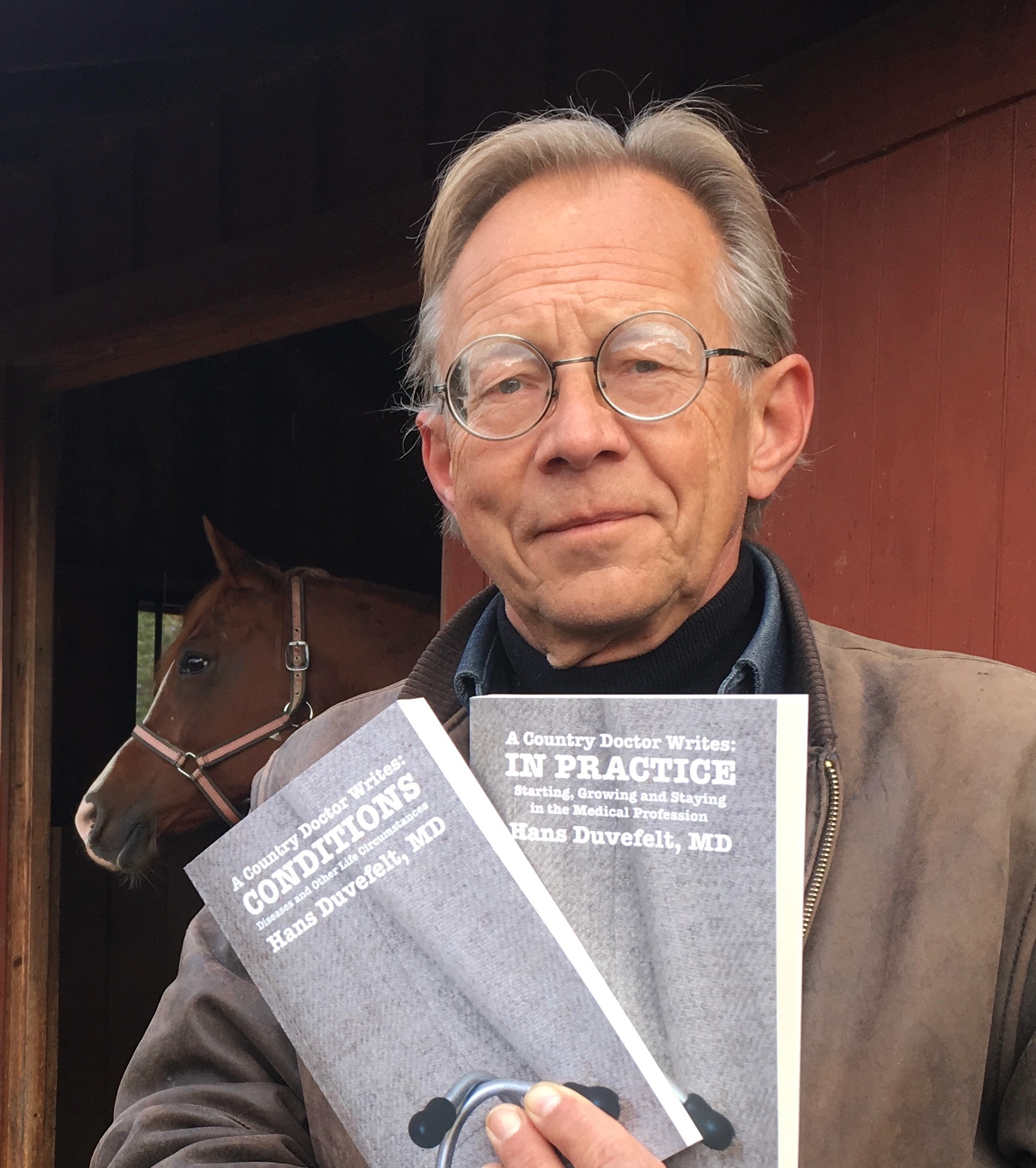
BOOKS BY HANS DUVEFELT, MD

CONDITIONS, Chapter 1: An Old, New Diagnosis

Top 25 Doctor Blogs Award

Doctor Blogs

Enter your email address to subscribe to this blog and receive notifications of new posts by email.

Mailbox

contact @ acountrydoctorwrites.com
Bookmark and Share
© A Country Doctor Writes, LLC 2008-2022 Unauthorized use and/or duplication of this material without express and written permission is strictly prohibited. Excerpts and links may be used, provided that full and clear credit is given.