Archive Page 145

The Interview

Today I met a man who wanted to interview me before transferring his records.

He was about my age and seemed polite and pleasant enough. He told me his doctor of a dozen years had started to taper him off his long term narcotics after he reported some of them missing because of theft. He used to take the equivalent of about 1,200 mg of morphine per day for his back pain. Our office classifies anything over 120 mg of morphine as a high risk dose.

He left that practice and transferred his care to a hospital run clinic across his home town. His next doctor at first prescribed him the medications, and then quickly begun tapering him off them. The story was a little vague as to exactly why.

He then landed in the hospital for something unrelated, and the report from that admission was available on our state’s medical information sharing website. He told the hospitalist that he was on the high dose that actually two doctors had already tapered him off. The hospital doctor called his new primary care doctor to clarify things and was told the patient had failed a urine drug test because it contained a pain killer he was supposed to have run out of months before. He told me he wasn’t trying to deceive the hospital, he just thought they wanted to know what he used to be on before things changed. He also told me he had kept a few of the discontinued pills on hand, and had used them when his main medicine was being tapered.

The man said he had been off his narcotic pain killers for a few weeks now. He drove himself the 25 miles to our clinic, and he walked the long way from the parking lot to my corner office. He sat in a relaxed position in the office chair across from me, but he told me that he had suffered a big loss of quality of life when he lost access to his narcotic prescription.

After he was done telling me about what it felt like to be tapered off his pain medications, and as a by-the-way, he also told me he needed to get back on the amphetamine he had been on for his attention deficit disorder.

I listened carefully and told him with my most gravelly and serious voice that I didn’t think any doctor would prescribe the kinds of doses he used to be on, and that he did seem to function without them – at least to a degree. I told him that his best bet was probably to talk with the doctor he had known for twelve years. I told him that particular practice has a committee that reviews the care of their difficult pain patients, and he could ask for their involvement. I offered to take care of his other medical needs if he wanted me to, but that there was not enough trust between us for me to just give him narcotics again because of the history he provided me with.

He thanked me politely, rose from his chair, offered a firm goodbye handshake and walked slowly down the hall back to the reception area.

All I Want For Christmas: Seven Things I Wish My EMR Could Do

Dear Santa,

I’ve been a very good doctor all year. I have checked all my boxes and aced all my Meaningful Use requirements. This year, I’m not asking you for anything fancy. I just thought you might be able to instill some kindness and good will into the people who designed the user interface of my EMR. Maybe, with your help, they would come to see how a few minor tweaks could make the practice of medicine safer and more efficient, and my day a lot more enjoyable than it already is:

1) I wish I could see a routine laboratory panel, like a CBC or a CMP, in one view without scrolling inside a miniature window. That would save time and help me not miss abnormal results.

2) I wish the patient’s next appointment date was displayed next to any incoming report I have to review. That would help me decide if I need to contact the patient about the results or if I’m seeing them soon enough that I can talk about the report then.

3) I wish I could split my computer screen so I could see an X-ray or consultation report or a hospital discharge summary at the same time as I type or dictate the narrative of my office note. That would help me quote them correctly.

4) I wish, when I open a patient’s actual visit note for today, the place where I do my documentation, that I could automatically see at least the beginning of the latest of every category of information we have received – latest labs, X-rays, outside reports and phone calls. It takes too much time to go searching in the places for each category separately just in case there might be something recent to catch up on in the visit.

5) I wish my EMR would know that prn medications, such as nitroglycerin, are not meant to be used for only a limited time, like 30 or 90 days, and would agree to e-prescribe them without a “duration”. If I could do that, they would not disappear from the medication list all the time.

6) I wish my EMR would automatically display the patient’s kidney function and allergies next to where I pick what medications to prescribe. That would make prescribing quicker and safer.

7) I wish my EMR wouldn’t alert me to drug warnings and interactions that are too obvious to need reminders for. I mean, any doctor would know that adding a second diabetes pill can cause low blood sugar (that’s why we do it) and that combining two drugs that can cause fatigue may cause even more fatigue! More intelligent warnings would be taken more seriously; now my trackball finger is automatically poised to close the “warning” pop-up, because I’m expecting it to be irrelevant.

I’m sure if I tried, I could think of an even ten wishes, or maybe even twelve – one for each day of Christmas. But these seven things illustrate the underlying, fundamental wish I have: that my EMR will evolve to be more user friendly. I wish, now that the basic functionalities of EMRs are in place, that somebody comes back to people like me and asks how to take this thing to the next level.

Night Call

“I was surprised when the emergency doctor at Cityside Hospital said he was going to call you to discuss my case”, Farmer Carr said when I saw him today. “I figured you’d be asleep at that hour.”

I smiled as I recalled the cell phone call that had come in at 9:30 the night I had sent him back to the hospital for a reassessment.

“No, I was sitting in my camping recliner in the tack room in our horse barn, writing on my iPad and listening to the barn animals chewing their hay.”

I saw his eyes soften. He no longer had a hundred head of cattle, but he was still Farmer Carr, and he loved animals.

I had been working on my post “This is America, You Don’t Have to Do Anything”, and I kept thinking about Farmer Carr. He had been hospitalized with pneumonia and when I saw him in followup he was weak, pale, short of breath and tachycardic; his resting pulse was 125 and after I had him walk down the hall, he reached 145. His EKG showed sinus tachycardia. His oxygen saturation was in the low 90’s, which wasn’t bad, but he had a little swelling and tenderness in his left calf, so a blood clot was a possibility. His white blood cell count was elevated, and his chest X-ray had some hilar fullness and some streaking in the mid right lung. I didn’t have access to his hospital X-ray, but even if I did, he looked like there was more going on than a slow-to-resolve pneumonia. He agreed to return to the hospital for reevaluation, and I called ahead and sent my records.

I remember, working on my post, hoping I would get a call from the hospital, and my mind wandered further back in time to call nights over the years when I had wished the opposite – that no one would call me.

When I started working at our clinic thirty years ago, one year out of residency, our town had a volunteer ambulance corps without Advanced EMTs, and it was the on-call doctor’s duty to meet the ambulance at the scene of car accidents, cardiac arrests and other calls that could use skilled care during transport to the hospital. It was also our duty to open the office, with no staff to help, for emergency cases that requested that we do so.

I remembered cleaning a facial road rash on a mean looking leather clad motorcyclist from Massachusetts in the middle of the night. He was twice my size, and he didn’t like the way I caused him pain picking out the pavement residue from his scraggly chin.

I remembered treating allergic reactions and asthma attacks with injectable medications, alone with the patient in the clinic.

I remembered the times I had to do CPR, in a motel room off Route One, in a trailer at the end of a dirt road and in the jalopy town ambulance with howling sirens over icy and snowy roads.

I remembered the sense of dread on call nights when anything could happen. I remembered trying to quiet my crying infant son late at night, with the little black Motorola beeper on my belt, and every cell in my body knowing that at any moment the shrill beeping might tear me away from him and out into the night to face situations I might or might not be able to handle with little equipment and little assistance.

Times have changed. We have a professional ambulance service. The hospital has full time hospitalists and we don’t open the office at night anymore. Some people miss the old days when we were available for emergencies right here in town, but most know that medical technology and the standard of care have advanced over the thirty years that have passed. A normal EKG doesn’t rule out a heart attack anymore, and no one rules out a fracture in a trauma case without X-rays anymore.

We are still available to triage and coordinate care after hours. And with remote access to our EMR I can even send a patient summary to the emergency room from my iPhone. Primary care doctors don’t try to do everything themselves anymore. But we take our job of coordinating care seriously.

Oh, I almost forgot: Farmer Carr’s CT scan didn’t show a pulmonary embolus, just an almost resolved pneumonia; his pulse was normal in the ER and when I saw him back today at the emergency doctor’s request, he did look a lot better.

“Today, you’re able to walk and talk at the same time”, I pointed out as we walked down the hall a ways together.

“This is America, You Don’t Have to Do Anything!”

“I just want you to know, I won’t have a colonoscopy”, my new patient said with some amount of fervor in his voice. “And I don’t want to take a lot of medications.”

I looked him straight in the eyes and said “This is America, you don’t have to do anything, and I work for you. My job is to help you know your options.”

He seemed to relax. I reflected on the words I had just uttered, yet another time – it is the way I often try to set the tone as a non-authoritarian, patient focused physician. “You don’t have to do anything”, of course, only applies to the patient. The doctor has to do a lot of things, like document a treatment or follow-up plan for Medicare patients with a BMI over 30, or provide computer generated patient education to a minimum percentage of patients, and achieve a certain percentage of e-prescriptions. And right about now, we are starting to see financial consequences if too many of our patients, like the man I had just met, don’t want to take the medications that can bring their blood pressures or blood sugars below certain targets.

My new patient illustrated plainly how impossible it is to be practicing both “evidence based” and “patient centered” medicine in a climate where doctors are held responsible for “outcomes” that are the result of patients exercising their free will.

Later, at home, I was reading The New England Journal of Medicine and came across a series of online posts about transforming healthcare. In one, Dr. Amy Compton-Phillips illustrates the way she feels healthcare has started to and must continue to evolve. She seems to think this nation will move “up, out” from “standardized, evidence based care” to “care driven by patient goals” very soon:

IMG_0109.PNG

(Image credit: http://catalyst.nejm.org/care-redesigned-for-a-new-age/)

I wonder how likely it is that payers like Medicare and for profit health insurers will loosen their grip on doctors’ day to day adherence to practices that are proven or at least strongly believed to save them money and benefit the greatest number of people, and instead allow the premiums they collect to satisfy individual, idiosyncratic patient preferences. That would reduce them to conduits for money, and strip them of their powers as arbiters and enforcers of “best practices”.

In fact, I seem to remember that’s what insurance companies were like when I was a resident more than thirty years ago. That was when doctors were supposedly authoritarian and paternalistic. In Family Medicine, that was certainly not the case – we were trained to put our patients’ values and preferences first. And back then, we didn’t get “dinged” by authoritarian, paternalistic insurance companies if our patients exercised their rights and declined to follow our advice.

I hope Dr. Compton-Phillips is right, and that healthcare in this country finds its way up and out of this oxymoronic situation that certifies clinics as “Patient Centered Medical Homes”, yet punishes them when they respect their patients’ wishes.

Not on a Silver Platter

The clues are usually there, even in the hardest of cases. They just aren’t presented to you on a silver platter.

Gwen Stephenson had an ill-defined polyarthritis and had been on methotrexate for some time. Her rheumatologist, Norm Fahler, had tapered her off the medication while keeping an eye on her inflammatory markers and they had leveled off at just above the normal range.

Seven or eight years ago, Gwen had suffered a bad bout of sciatica, and a few weeks ago, she had told me her sciatica was bothering her a little again. “Not enough to have those injections yet, mind you”, she had said with a grimace and a gesture indicating the length of the needle her pain specialist had used to deposit the steroid in her lumbar epidural space.

The visit when she mentioned her sciatica was a diabetes visit, full of bookkeeping tasks – keeping track of her eye exam, foot exam, microalbumen, blood pressure readings, blood sugar log, lipid management and cardiovascular review of systems.

I accepted her assessment that her sciatica was not of the magnitude that it required any immediate intervention.

After Gwen left, Autumn came into my office to pick up some forms I had signed, and she said:

“Did you notice that Gwen’s temperature was 99 for the second time in a row? I wasn’t sure if I should have pointed that out to you.”

I had not noticed it. Looking back, I saw that a week earlier, when she had come in just for her B-12 shot, it had also been 99.

“I’m not sure if that means anything”, I remember saying.

Two days later, Gwen came in with a nasty cough and I thought I could hear some very faint rales in her lower left lung. Her temp was 99.4 and I put her on antibiotics for pneumonia. We didn’t have X-ray available that day, but it was obvious at that time she needed an antibiotic.

The following evening I was on call. Gwen phoned the answering service around 9 pm and asked if an axillary temperature of 103 was high enough to be alarming. She hadn’t been able to take an oral temperature because her teeth were chattering with the terrible chills she was having.

She was admitted to the hospital, where intravenous antibiotics were started for her apparent pneumonia. Her fever didn’t come down, and the radiologist disagreed with the initial emergency room reading of her chest X-ray. So she became a “fever of unknown origin”. The blood cultures that were drawn in the emergency room grew staphylococci, and, because her back pain kept getting worse as she lay in bed day after day, she had an MRI of her lumbar spine. This showed a possible discitis at L5-S1 and a psoas abscess.

They teach you in medical school that early imaging isn’t indicted with back pain or sciatica, unless there are “red flag symptoms”. Fever is one of them. But Gwen’s back pain was recurrent, and had been there for a while, and her fever was borderline when I saw her, and it developed after the back pain. Still, I was quite humbled. I wasn’t actively connecting all the dots, and I was too focused on the housekeeping tasks of her diabetes care to see the subtle manifestations of her smoldering infection.


I just realized none of the posts show on an iPad or a computer, but they do show on an iPhone. WordPress is working on this. In the meantime, please visit my Substack.


Osler said “Listen to your patient, he is telling you the diagnosis”. Duvefelt says “Listen to your patient, he is telling you what kind of doctor he needs you to be”.


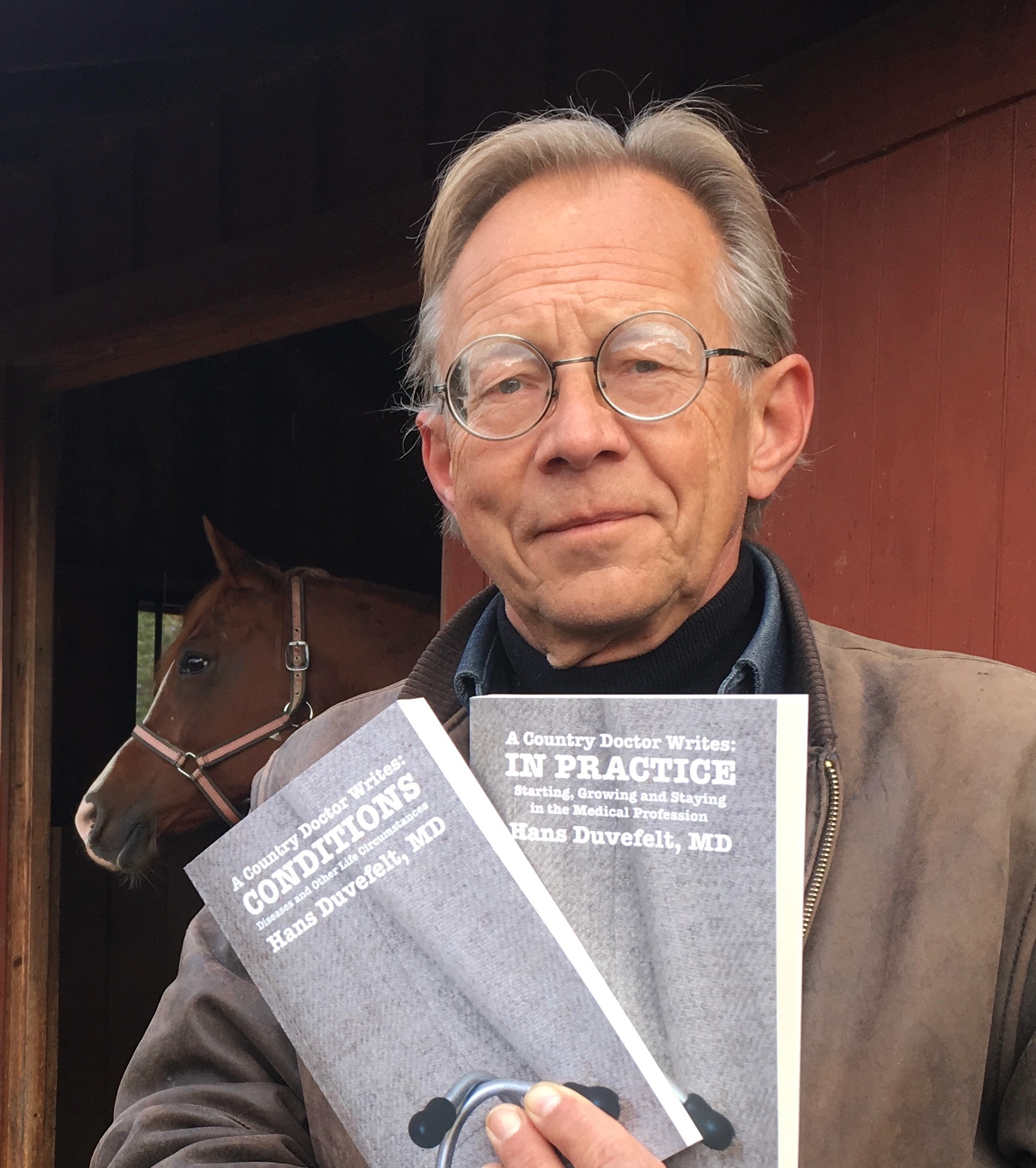
BOOKS BY HANS DUVEFELT, MD

CONDITIONS, Chapter 1: An Old, New Diagnosis

Top 25 Doctor Blogs Award

Doctor Blogs

Enter your email address to subscribe to this blog and receive notifications of new posts by email.

Mailbox

contact @ acountrydoctorwrites.com
Bookmark and Share
© A Country Doctor Writes, LLC 2008-2022 Unauthorized use and/or duplication of this material without express and written permission is strictly prohibited. Excerpts and links may be used, provided that full and clear credit is given.