Archive Page 133

A Bug in His Ear

It was a small deer tick, hidden by the Crus Helix, embedded in the Cymba Conchae, the crevice just above the ear canal of my seven year old patient halfway through my Saturday clinic.

He was worried that it would hurt. His parents hadn’t wanted to try removing it on their own. I had a hard time even seeing the small tick as it was sitting at an angle where I saw it from straight behind.

“Let me get some stuff”, I said.

I drew up a couple of milliliters of Xylocaine with epinephrine and discarded the needle, grabbed some 2″ by 2″ gauze pads and rummaged among my autoclaved instruments for the finest foreign body forceps we have.

Back in the exam room, I explained my strategy:

“This syringe doesn’t have a needle on it. I’m just going to pour some Novocain over the tick, then we’ll wait a few minutes before I gently pull him out with this instrument.”

The boy looked worried.

“Piece of cake”, I said, “it won’t hurt a bit”.

I asked the boy to lie on his side with his tick-ear facing upward. Holding his head at just the right angle, I expressed enough Xylocaine from the syringe to completely fill the cone shaped crevice in his ear where the tick was submerged . I then held his head firmly but gently to make sure the tick stayed under the surface of the anesthetic.

“I’ve seen a lot of tick bites already the last two weeks”, I said as we waited. “I haven’t seen any new cases of Lyme disease yet, though.”

“You know the rash of Lyme disease was actually first described in Sweden, way back in 1909, by a doctor named Arvid Afzelius. And it was discovered a long time ago that penicillin could be used to stop it. I remember hearing that was routine when I started medical school in 1974. But it wasn’t until the early 1980’s that doctors in Lyme, Connecticut saw the connection with all the other symptoms we now call Lyme disease.”

As I prepared to finally remove the tick, I added:

“We vaccinate dogs for Lyme disease here, but not people, but in Sweden, all my relatives have been vaccinated.”

I grabbed the handles of the forceps, pointed the tip away from me, reached into the Cymba Conchae while still holding the boy’s head in place. Then I closed the tip of the forceps gently, without locking the instrument, and pulled. The tick offered no resistance. It was intact.

“See, here he is, legs, jaw and all, out of where he doesn’t belong.”

The boy and his parents squinted as they looked at the tiny deer tick.

“And he didn’t feel a thing”, I added. The boy finally smiled.

“People use all kinds of different oils and things to suffocate the tick”, I said. “I prefer Xylocaine, which by the way was in developed in Sweden in 1943.”

To myself, I reflected that I don’t even remember when I first decided to try Xylocaine. I know people have had good luck with oils, but we don’t keep any of them in the office. But we always have Xylocaine. And that does add more of an air of medical magic than just plain olive oil.
Imagining a Doctor Shortage

Now, I’m just a country doctor, but I have to say I find it very hard to understand why folks in this country on one hand keep talking about a doctor shortage in primary care and on the other hand keep piling sillywork on those of us who are still here. The net effect is that the doctor shortage is going to be a whole lot worse than it has to be.

But it may just be a relative or imaginary shortage because of how this country defines the duties of doctors.

Public Health agendas have infiltrated health care to a degree that threatens to paralyze it. Physicians are increasingly told their primary concern should be their “population” and not their individual patients. We are charged with preventing disease rather than treat it.

But…

Public Health clinics regularly provide travelers with necessary immunizations. Pharmacists are now giving pneumonia and shingles shots on prescription and flu shots without. States are mandating immunizations for children, and penalizing physician practices with low immunization rates. There are whole departments within every level of Government trying to get people tho behave in healthier ways.

Why should we take the heat for something you don’t need a medical license to do?

A physician’s duty is first and foremost to serve each patient’s needs in treating actual disease. Isn’t that what people worry about when they imagine how a physician shortage would affect them?

Let’s think:

Who would worry that with a physician shortage, they wouldn’t get their flu shot?

Who would worry that there would be nobody to tell them to lose weight, stop smoking and eat less junk food?

Who would worry that there would be nobody to screen them for alcohol misuse or domestic abuse?

Who would worry that they’d be at risk for tripping on their scatter rug because there is no doctor to talk with them about their fall risk?

On the other hand:

You’ve had a cough for a month, and you’re short of breath. Who will diagnose your symptoms?

You have a nosebleed that won’t stop by itself. Who will cauterize it for you?

You have diabetes and can’t control your blood sugar with diet alone. Who will prescribe the right medicine for you?

You’ve become increasingly depressed and are at risk of losing your job because of your symptoms. Your therapist suggests you consider medication. Who will prescribe it for you?

America, the choice is yours: What is the best use of your primary care physicians’ time if there aren’t enough of us to be everything for everyone?

The Power of ACT

She didn’t seem obviously depressed as I entered the room.

“So, we have you taking a good dose of both antidepressants now”, I said. “How are you doing?”

“I feel about the same.”

“Have you done anything lately that could have made you feel a little better?”

“I’m not sure…”

“I’ll give you some examples. They can be different things for different people. It could be reaching out to a friend, helping a neighbor, watching the sunrise…”

“I listen to music. John can tell what kind of mood I’m in depending on what I’m playing. And I watch my shows on cable TV. I feel better when I do those things.”

“Are there things in your life that are more important than music and TV?”

“Our grandkids. Our youngest daughter lives here in town and her kids really light up my life.”

“And you see them quite often, right?”

“Yes, we babysit them every weekend. You should see John with them. He’s such an awesome grandfather. It warms my heart…”

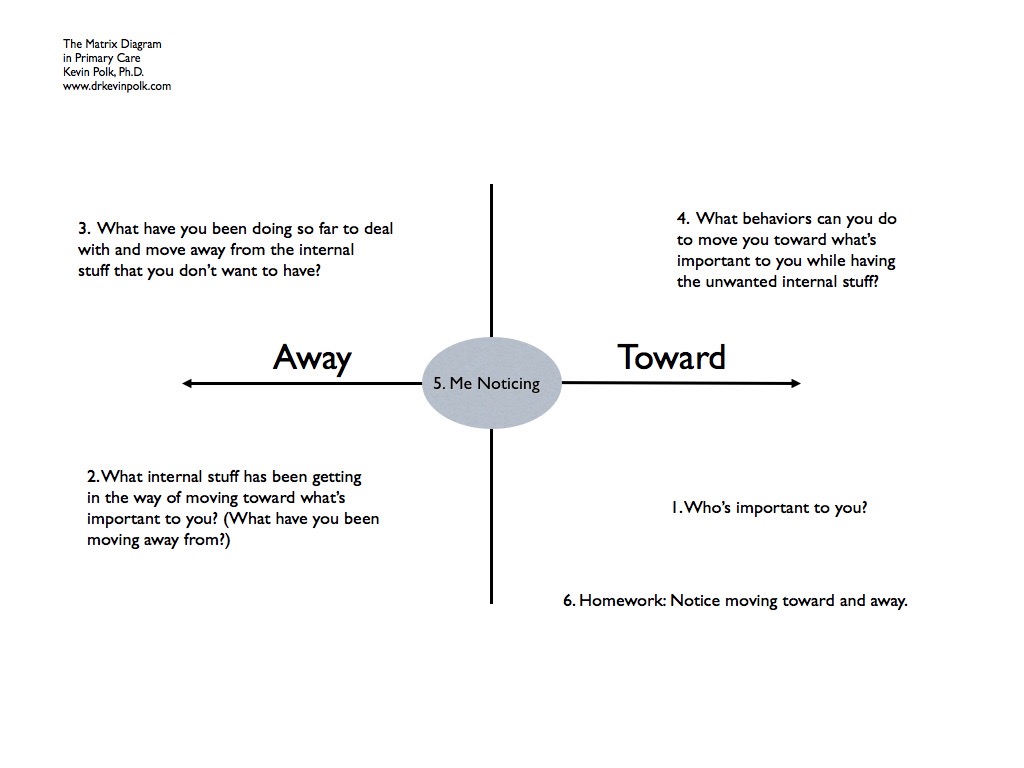
“You’ve started seeing Betty now, right? Did you notice over in the Behavioral Health wing that there is a white board that’s divided in four rectangles with a little circle in the middle?”

IMG_0284.JPG

“Yeah, I think I’ve seen that…”

Has Betty talked with you about that yet?”

“No…”

“She probably will. It’s a great way to organize your thoughts and your feelings. It’s called ACT. Let me tell you about one aspect of it. It’s the difference between away moves and toward moves.”

She shifted a little forward in her chair.

“The bottom right is what’s really, really important to you, like your grandkids. And the bottom left is all the stuff inside your mind that keeps you away from what’s important. The top left is all the moves you make that take you away from your sadness, anxiety, pain and so on, but that don’t actually bring you closer to what’s important. We call that Away Moves, almost like escapes. That’s where music and TV might belong, unless they are in the box on the lower right. But those things don’t bring you any closer to your grandkids and the happiness they give you, right?”

“I see what you mean…”

“The horizontal line has arrows at each end. By the arrow to the left it says Away and to the right it says Toward. And in the top right rectangle are little things, steps you can take, that bring you closer to what’s important.”

“I see the difference…”

“So, other than your grandchildren, who or what else is important to you?”

“My daughters in Lewiston and Bar Harbor.”

“Anything else?”

“I don’t know…”

“You have a cross on that chain. What’s your faith?”

“I was raised Baptist. My daughter in Lewiston sings in the church choir there and I used to do that many years ago…”

“How often do yo see these two daughters? How often do you go to church?”

“Not often enough…”

“Could you do more of that?”

“I don’t think John would want to go.”

“He might, or he might want to take care of the grandkids while you do those things, right?”

“I never thought of that…”

“It sounds like you have a lot of love inside you that hasn’t been expressed often enough, and it sounds like your faith hasn’t had enough space in your life lately.”

She nodded.

“I know you as a very caring and soulful person and I think of you as someone who thrives on connecting with others. Maybe your bond with your other daughters could be a lot stronger, and maybe that would help you feel happier and less depressed. You and Betty could talk more about that in your next session…”

“I really hope we can.”

“Because there is more to treating depression than picking the right medicine”, I said.

She smiled and locked her gaze straight at me. Her eyes were moist and she smiled faintly.

[”Acceptance and Commitment Training/Therapy (ACT) is an an evidenced-based way of helping people let go of struggling and get moving toward valued living. “Traditional” ACT is complicated and hard to learn. The ACT Matrix is easy.” Dr. Kevin Polk]
https://www.theactmatrixacademy.com/

Peer to Peer

My old strategy for getting insurance approvals for imaging tests doesn’t seem to be working anymore.

I used to put my thinking in my office notes so that a reviewer at one of the imaging management companies would clearly see my rationale for ordering that CT scan or MRI my patient needed.

Now I am getting more and more requests to initiate a “peer-to-peer” call instead. My heart sinks every time; each one is a sure time robber. Even with today’s talk about paying for value and quality, I still live in a world where my “opportunity cost” is $7 per minute. That is what I must generate every minute of my work day. A five minute call could mean one less patient visit for a skin rash or an ear infection or a patient call to communicate an important test result instead of sitting in a phone queue, listening to Barry Manilow tunes.

The other day, my “peer” was a nurse, a “near-peer” human filter, who listened to my story about why the abdominal and pelvic CT was necessary for my patient with abdominal pain, diarrhea and elevated liver function tests but otherwise unremarkable blood work, including hepatitis titers. She instantly gave me an authorization number. Afterward I asked, “don’t you read our office notes these days?”

“No, we stopped doing that. In this case we were told the patient had a lump.”

“I coded for the three symptoms.”

“But we need to know what you are looking for.”

“A rule out?”

“Yes.”

“But you can’t code for a diagnosis the patient doesn’t have, that’s insurance fraud.”

“Well, that’s what we need to know.”

“So I need to spell that out, if you don’t read my notes. You know, in many offices the one whose job it is to call you is a lay person.”

“And so is the person who answers the call at our end.”

And I thought my notes were still read by a medical person. I should have asked if they stopped reading the notes because they have gotten too long and cumbersome for them to read. I’m sure a radiologist who reviews imaging requests has an opportunity cost, or a must-save-the-company-per-minute cost, of a whole lot more than $7.

Note to self: Always add “R/O” after describing the symptoms.

Of course, in cases where there is no time for the Barry Manilow queue, it is a well known fact that the emergency room doesn’t have to worry about prior authorizations.

All or Nothing

The other day, as I was wrapping up my visit with Mrs. Brown, she said:

“Harry is no better, he is coughing and spitting something wicked.”

Her husband, silent during the visit, was unshaven and looked a little tired.

“How long have you been sick?” I turned to him.

“Going on two weeks now. The cough medicine I got last week hasn’t helped.”

I opened his chart in the computer. He had been in six days earlier. A colleague had noted that his lungs were clear and diagnosed him with a viral illness.

“Let me listen to you”, I said.

He had scattered rhonchi and a few wheezes, and at the bottom of his right lung I heard faint crackles.

“You need an antibiotic”, I said, and made sure he didn’t have a fever and that he wasn’t too short of breath.

I created a “new telephone encounter”, documented my findings and e-prescribed an antibiotic for him.

“Be sure to come back if things don’t turn around quickly”, I said.

There’s no way I could charge him for a brief visit. And that’s got nothing to do with whether I wanted to increase my productivity numbers or our clinic revenue.

In this day and age, there is no such thing as a quick visit to make sure someone is okay or to avert clinical deterioration or disaster.

In order to meet all our quality requirements for being a patient centered medical home and all the other ways we are judged and measured, a visit note has to include, even if the patient was seen just one single day before, a complete medication reconciliation, updated past medical and surgical history, social history and specific questions about any other care the patient has received since last seen. In our EMR it would be impossible to get around all these clicks by building a note template that says nothing has changed since last time; the computer tracks the actual clicks we make in the EMR.

So in cases like Harry Brown’s, I have these choices: Treat him for free right then and there, make him come back some other time when we have time for all the extras, or send him to walk-in care in the big city.

My choice is clear, but I can’t help wondering if the people who created the requirements for overambitious repetitive inquiries into the past history of people we already know quite well really understood that instead of becoming more patient centered, we would start giving free care or turn away patients and thereby fragmenting their care.


I just realized none of the posts show on an iPad or a computer, but they do show on an iPhone. WordPress is working on this. In the meantime, please visit my Substack.


Osler said “Listen to your patient, he is telling you the diagnosis”. Duvefelt says “Listen to your patient, he is telling you what kind of doctor he needs you to be”.


BOOKS BY HANS DUVEFELT, MD

CONDITIONS, Chapter 1: An Old, New Diagnosis

Top 25 Doctor Blogs Award

Doctor Blogs

Enter your email address to subscribe to this blog and receive notifications of new posts by email.

Mailbox

contact @ acountrydoctorwrites.com
Bookmark and Share
© A Country Doctor Writes, LLC 2008-2022 Unauthorized use and/or duplication of this material without express and written permission is strictly prohibited. Excerpts and links may be used, provided that full and clear credit is given.