Archive Page 127

How to Write Like a Dockter

Many physicians have become world famous writers and in Greek mythology, Apollo was the god of both poetry and medicine.

I can personally think of many prominent physician writers I have come across in my reading over the years:

There was the 12th century rabbi Maimonides, Copernicus in the 15th century and the poet John Keats in the 1700’s.

In the late 1800’s to early 1900’s there were Anton Chekhov, Sir Arthur Conan Doyle and William Somerset Maugham.

Examples from our time (or at least mine) are A J Cronin (Dr Finlay) Robin Cook (Coma), Viktor Frankl (Man’s search for meaning), Michael Chrichton (Jurassic Park), the Polish science fiction writer Stanislav Lem, M Scott Peck (The Road less traveled), Oliver Sacks, Frank Slaughter, Sherwin Nuland, Walker Percy and more recently, Mainer Tess Gerritsen.

But you wouldn’t think doctoring and literature are even remotely connected after reading what my colleagues and I are producing every day in our electronic medical records.

In journalism school and writing classes they tell you how to capture the reader’s attention and make your point effectively. They teach how to make the readers feel like they are witnessing real events and experiencing the emotions of the characters of the writing.

In medical charting class, and when using EMRs, the priority is to prominently list the items that are required for payment and compliance purposes.

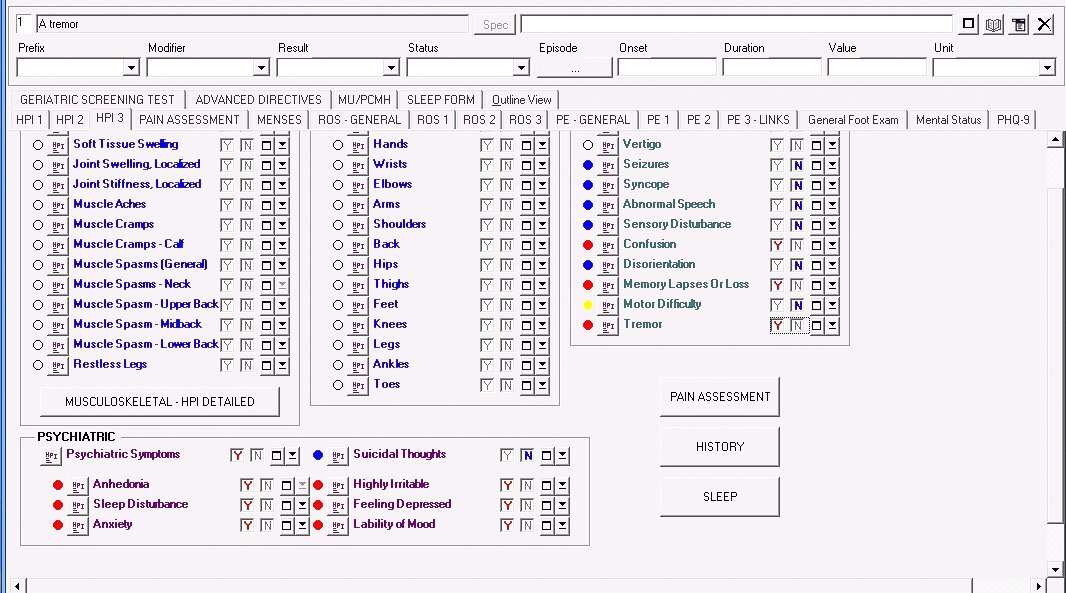
Evaluation and Management (E&M) reimbursement codes are built around how many aspects of a symptom or a physical exam are documented. Sometimes called “bullets”, each one is usually a separate sentence in the “printout” display of a medical record whereas to the documenting physician they may be a click box. Looking at the computer screen, they are sometimes quick to review, much like the paper forms I used to create for upper respiratory infections, urinary tract infections and physicals etcetera in the days of paper records. But when our computer programs turn these checkboxes into sentences, they look more like “See Spot run” grade-school English than an expert clinician’s narrative.

Here are two screen shots from a clinic a couple of towns north of here:

Writer’s view:
IMG_0354.JPG

Reader’s view:

IMG_0356.JPG

Anybody who tries to quickly read such notes would probably just as soon see the original clickboxes, instead of the stilted English produced by the EMR.

Back to the real writers among us – here is how Abraham Verghese explains the deep connection between doctoring and writing:

“I’m really struck by how much of what I learned in medical school has helped me to be a writer, and how much of what I learn as a writer helps my thinking as a physician. They are very parallel disciplines. When you take a patient’s clinical history, what is that but a story? What makes a good doctor is that he or she takes the story down well, sees the links and makes the connections toward a diagnosis. That’s also what writing is about.”

I guess that’s why, after a long day with my patients and my highly structured EMR, I like to sit down in my den next to the horse stalls with a completely blank screen in front of me and just tell stories.

Give Specialist Doctors a Break!

IMG_0351.JPG

As I scrolled toward the end of a consultation report from Cityside Pain Management the other day, I gasped internally. The pain clinic listed all kinds of mandated “quality” items, by number, that they have no chance of knowing.

Nor should they.

Since our EMRs don’t talk to each other, they have no way of knowing whether I ever ordered a bone density or pneumonia shot for my patient. And if they went ahead and did something preventative, how would I find out about it? Don’t assume I have a realistic opportunity to look for the occasional pearl in the massive number of outside computer printouts I get as PDFs in my electronic inbox.

No specialist should be jealous of my task of trying to stay on top of all my patients’ health maintenance. I send my patients to a specialist so they can spend 45-60 minutes on the single problem that is the main focus of their practice. Why would I want them to spend a significant portion of their valuable time on something that very plainly is my job?

The answer to my rhetorical question is:

Because CMS, the powerful agency behind Medicare, says so – that’s why. It makes no sense to me, but I’m just a country doctor, what do I know?

A Boomerang Patient

It is not unusual to see a patient for a timely “Transition Of Care” visit after a hospital admission and within a minute of entering the exam room know with all the bones in your body that this person needs to go back into the hospital.

The funny thing is that when that happens, if the patient has Medicare, we may indirectly suffer financially from such “avoidable readmissions”. We belong to an ACO, an Accountable Care Organization, which is one of the recent schemes Medicare created to save money. The hospital most of our patients go to, Cityside, is not part of our ACO, but we are at financial risk while we have absolutely no control over the hospital’s charges or readmission rates.

I mean, what else could I have done with Allan Beck?

He had rolled his tractor and broken half a dozen ribs a little while ago. Commendably, he didn’t want to go to the emergency room for nothing, so he had called and argued with the triage nurse about coming here instead. She thought she had him convinced, but half an hour later he showed up at the check-in window.

“Triage to the front desk” was announced and Dr. Kim ended up seeing him briefly and ordering ambulance transport to Cityside.

When I walked into the exam room a week and a half later, the muscular could-have-been-a-movie-star farmer was so pale and frail looking that he seemed to blend in with the faintly blue wall paint.

As the story unfolded between his laconic answers to my questions and my speed reading of the hospital discharge papers, it became evident that the day before discharge, he had substantial atelectases and possibly an evolving infiltrate of his left lung, but that his collapsed lung remained expanded with his chest tube gone.

“Yeah, I’ve been coughing up yellow crud since my first day in the hospital”, he told me.

He had almost no breath sounds in his left lung, his white blood count was up and his reds were the same as when he was discharged, one third down from his baseline. His X-ray showed what I had heard, a massive consolidation of much of his left lung – a nasty pneumonia or even empyema, pure pus.

The ER doc sighed. “OK, send him up.”

The irony is that there is a new scoring system that’s supposed to predict a person’s risk of readmission. Allan’s score was low. Everybody loves to use mathematical models, but when it comes down to it, clinical judgment and anticipating “the worst” would have been more valuable in the very moment that his last hospital X-ray was done.

Annual Evaluations

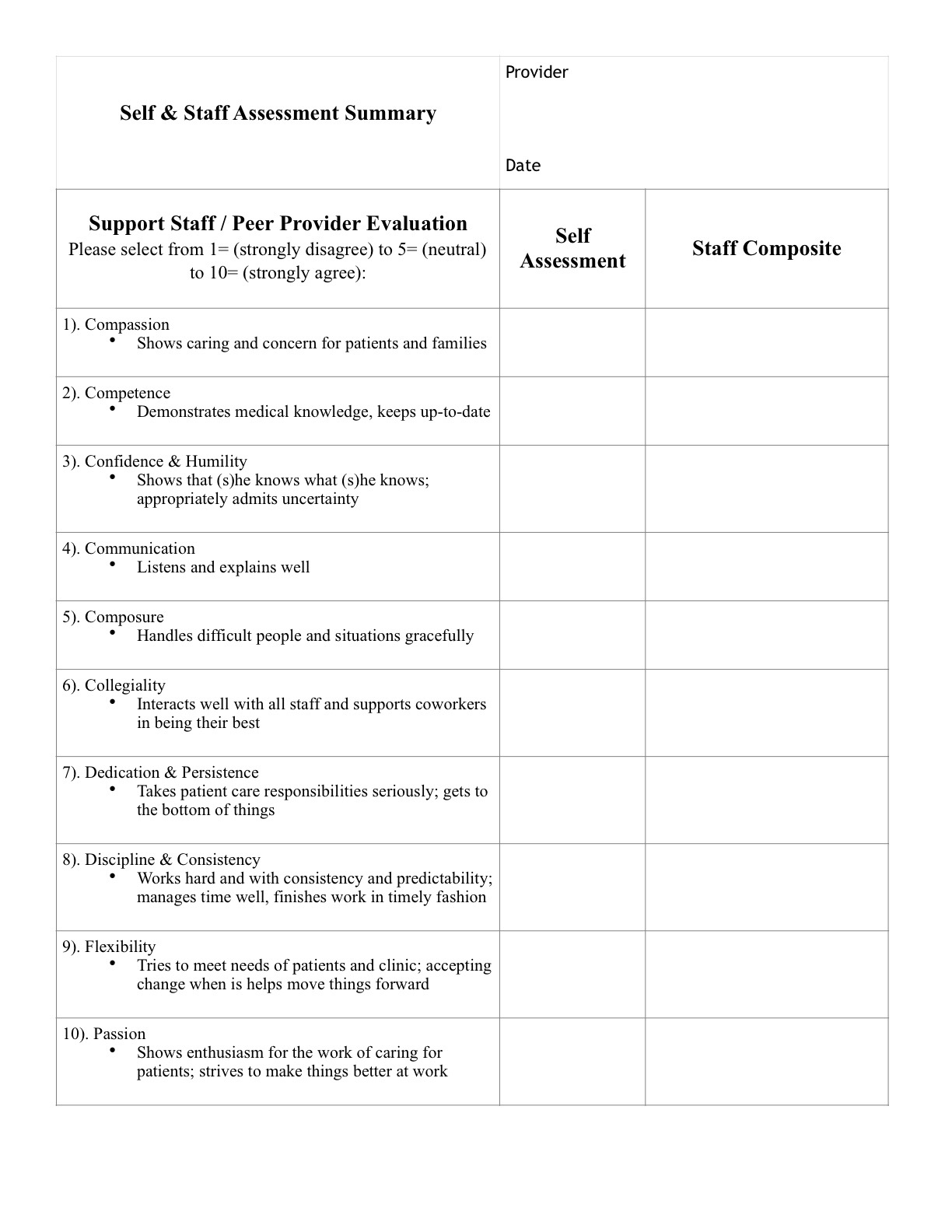
October is when we do our annual provider evaluations. I’m using the same format this year as last, a personal inventory done by each provider as well as three others – support nurse/medical assistant, clinic manager and referral coordinator/radiologist/care manager. This is complemented by assessments of billing/documentation, quality and productivity data and overall assessments by management.

I guess, in a way, I wrote the provider self assessment as a yardstick for myself. It’s hard sometimes in today’s detail driven healthcare environment to remain focused on what it means to be a doctor.

I’m sharing it here for anyone who is interested. Just to mention, only one of my providers gave himself/herself a “10” on every question, and it wasn’t me…

IMG_0343.JPG

The “Patient Centered” Medical Appointment: You Know the Drill

Health care was supposed to value patients’ privacy and be sensitive to their cultural, religious, philosophical, educational, sexual and socioeconomic background. It was supposed to move the visit agenda and the medical decision making authority from the doctor to the patient. It was supposed to create safe “medical homes” for patients of all backgrounds. It even established certification processes to ensure practices were indeed patient centered.

We are officially recognized as a patient centered medical home, and this is what that looks like:

When you arrive at the front desk for your routine physical, you are handed a form asking you to specify in great detail what your gender identification is.

In the exam room, the medical assistant administers, in rapid fire questioning, a “validated” nine item depression inventory. She then verifies your medications and updates your personal, family and social history. As part of your social history, if you happen to admit to being a smoker, a “smart form” with followup questions pops up with questions from “How many minutes after waking up do you smoke your first cigarette?” to “How ready are you to quit?” Similar questions about alcohol use follow.

If your visit happens to be a Medicare annual wellness visit, you are also bluntly queried about anxiety, sexual difficulties and history of falls as well as anything you want to confess about messing up your medication regimen. And, perhaps most invasive of all, if your body mass index is higher than ideal, your doctor will be required to document a treatment and followup plan to manage your overweight or obesity. If any of these items are omitted, Medicare has the right to demand their money back from your medical provider.

So, after all that, are you still going to be in the mood to discuss your most sensitive issues with your medical provider in the few minutes that remain?

Now, the most amazing thing to me is that people put so much faith in these blunt tools that are promoted as “validated instruments”.

Does a homicide detective ask a suspect “Did you do kill the victim?” and leave it at that? Does a customs and immigrations officer say “Are you a smuggler or a terrorist?” Does a principal ask a prospective teacher “Are you a pedophile?” That sounds about as sophisticated as today’s “validated instruments” in my business.

I still remember when, without using the words “patient centered”, we would sit down and have conversations with patients. We would say things like “can you tell me a little about your habits, your work and your home life?”

And, perhaps most important of all, just a few years ago, the opening phrase in a good medical office visit used to be ”what would you like to accomplish in today’s visit?”

That was before we became certifiably patient centered…


I just realized none of the posts show on an iPad or a computer, but they do show on an iPhone. WordPress is working on this. In the meantime, please visit my Substack.


Osler said “Listen to your patient, he is telling you the diagnosis”. Duvefelt says “Listen to your patient, he is telling you what kind of doctor he needs you to be”.


BOOKS BY HANS DUVEFELT, MD

CONDITIONS, Chapter 1: An Old, New Diagnosis

Top 25 Doctor Blogs Award

Doctor Blogs

Enter your email address to subscribe to this blog and receive notifications of new posts by email.

Mailbox

contact @ acountrydoctorwrites.com
Bookmark and Share
© A Country Doctor Writes, LLC 2008-2022 Unauthorized use and/or duplication of this material without express and written permission is strictly prohibited. Excerpts and links may be used, provided that full and clear credit is given.



