Archive Page 123

My Suboxone License is Capped at 100 Patients, Should My Opioid License Also Be?

I can prescribe Suboxone for 100 patients in opioid addiction treatment. You start with 30 and can upgrade after two years. Some Suboxone prescribing doctors have a waiting list; only when a patient “graduates” or gets dismissed from the practice can a new one enter.

In the State of Maine, there are now limits on the doses of opioids we can prescribe, and as a result of the efforts to reduce, some patients have come off pain killers completely. But providers regularly get emails from the Prescription Monitoring Program telling us whether we have more opioid patients or prescribe higher doses than our colleagues.

The handwriting is on the wall: Doctors are continually and systematically shamed into reducing their opioid prescribing. It is an unpleasant situation.

Maybe, since Big Brother is obviously involved here anyway, we should just be issued quotas: Don’t make us guess how many patients on opioids are “too many”, just spell it out. The DEA already does it for Suboxone. That would be cleaner. And it would make it easier for patients to understand:

“Sorry, Jim, I had to cut 35 patients from my opioid roster this year and you turned out to be one of them. Nothing personal…”

One More Question

“Any recent antibiotics? Steroids?” I asked my last patient of the day, a healthy looking young woman with what she described as a yeast infection that was driving her crazy. She’d had many of them, and they were always coming back, but she had only used over the counter topicals.

I knew she needed oral medication, but I asked one more question:

“Any trouble with high blood sugars?”

Her answer eliminated any late day drowsiness or fatigue I might have harbored.

“No, my sugars have always been fine, even during my pregnancies, but I always have sugar in my urine.”

“That’s why you get all these yeast infections. Has anyone ever looked into why you have sugar in your urine?”

“No.”

We got a fingerstick blood sugar, which was low normal, and a urinalysis which showed 4+ glucose, no protein, a pH of 5 and normal specific gravity.

I took a deep breath.

“When the blood is filtered in the kidney, a lot of valuable stuff ends up in the urine, but then we reabsorb things like sugar, because the body is thrifty. You have a kidney disease that keeps you from reabsorbing the sugar. I’m not smart enough to know exactly which variety of disease you have but I’d like to get some more labs tomorrow and refer you to a nephrologist.”

She asked for some information about the kinds of kidney disease she might have and added, “well, you’re smart enough to know what my basic problem is. I’ve had it all my life and nobody has said anything about any of this, they were just happy that my blood sugar was okay.”

A seemingly ordinary symptom, one additional piece of history and distant memories from medical school, never touched since then…

How can you not be fascinated by this job?

Doceo, Ergo Sum

One of the ways a doctor can document the value of an office visit is by keeping track of the number of symptoms the patient has and the number of items included in both the review of systems and the physical exam of the patient.

This way, for example, we can get paid more if we do an extensive evaluation of a dizzy patient by looking for both inner ear, cardiovascular and, for example, cerebral and psychiatric causes, rather than zeroing in on the most common cause while immediately disregarding the less common ones.

The other way we can charge is according to how much time we spend on “counseling and education” of our patient.

I reflected on that a lot this week. It seems most of what I do is counseling and education.

I have been working with a nurse practitioner student the past few months. I make these “externships” a mixture of independent work and observation with collaboration.

In my view, an almost-ready clinician needs to both hone their clinical skills and develop their own style of communication during these rotations.

In some cases, I introduce the student, leave the room and then get briefed on history and physical findings. We then wrap up the visit with me just reinforcing the plan and supporting the student and the patient in how this is supposed to work.

In some cases I conduct a good portion of the visit myself and then include the student in a three way conversation with the patient about the disease or the treatment. This allows students to see me and their other attendings’ way of diagnosing and different ways of sharing information or suggesting treatments to patients.

With an extra person in the interaction, I constantly reflect on my own style.

I usually talk a lot. In many cases I explain a great deal about how the body works and how diseases manifest. I also talk about the history of how they were discovered or how we used to treat them. I think that is a reflection of my own love and fascination with medicine. It is also an expression of my fundamental belief that I shouldn’t tell my patients what to do but instead empower them to choose between options and direct their own care.

Coming from another continent and, by now, another era, I can tell patients firsthand that there are and have been many ways of thinking about even the most straightforward seeming medical problems. I think this depth and context works for many patients. Only once in a while in my career have I had a patient say, “I wish you would just tell me what to do”.

I try very hard to “read” how each patient approaches their health problems, and over the years I have learned who wants a quick “here’s what we’ve got and here’s what to do” visit and who enjoys and grows from knowing the bigger context of what they have.

In some visits I say a lot less. I sometimes emulate Dr. Marty Samuels or my own Dr. Wilford Brown and use my silence to draw out the patient’s history. And sometimes I use open ended questions disguised as reflections to get more information – statements like “I wonder why you noticed this while…” or “I don’t know exactly how this is connected with that”.

When I teach clinical practice, I try to share my repertoire of ways to connect and ways to convey, not just how to diagnose and what treatment to choose. You can read that in a book or online. But you need to see how other people do things so you can choose how to behave yourself in the role of healer we are asked to live up to.

I don’t often save lives by performing sophisticated or intricate medical procedures. But I do think I change lives every day in small and subtle ways through how and what I communicate.

I believe in my heart that I need to fill different needs in different situations where my patients are looking for certain aspects of the archetypal “doctor” we all carry in our consciousness and our culture.

“Doctor” is derived from “docere”, a word for “to teach”. “Doceo” means “I teach”. “Ergo sum” means “therefore I am”.

That is really why am here, in this clinic, in this community and on this planet. I could probably bill 80% of my visits as time spent on counseling and education and forget about how many “bullets” I checked off from my history and physical exam. Those things seem rudimentary in comparison with the personal connection that allows my patient to take my explanations and my treatment options and make their own choice of how to proceed.

Orthopedic surgeons probably do most of their work in a form of silent solitude in the operating room.

I do most of my work in conversation.

All of it, really.

Thou Shalt Do More Physicals

Not long ago, I wrote a piece about the futility and waste of annual physicals. Soon after that, I suddenly saw the light. Or, rather, my CEO and COO educated me about why so many people still want physicals so badly: Obamacare is still with us.

When the Government regulates health care, medical sense is often disregarded and Medicine is replaced by Metamedicine.

Medicare has it own sets of parallel realities, and in my type of clinic Medicare is the largest health insurer we deal with.

Medicare covers a talk session they call the “Annual Wellness Visit” but doesn’t pay for physicals at all, except the HMO-like “Medicare Advantage” plans that survive through rationing diagnostic tests and also through extra reimbursement from the Government. They pay us a fee every year for providing them with a list of the specifics of our patients’ diseases and disease complications. This is what helps them get the extra money from the Government to cover their patients’ health care costs.

All the commercial insurances, like Anthem, Aetna, Cigna and the Obamacare companies put together, make up a smaller piece of our practice than Uncle Sam’s insurance for older Americans.

Those are the people that call for physicals and the people my bosses want me to provide them for.

This is why, and I kind of missed this ten year old fact:

Many people have lousy insurance with high deductibles, but under Obamacare “Annual Physicals” and many tests that can be construed as “screening” are FREE. So I have to pay more attention to the realities of health insurance today.

If a patient with newly diagnosed extremely high blood pressure and exertional chest pain needs lots of blood work, stress testing and imaging, he or she may pay thousands of dollars out of pocket. Or if a patient has abdominal pain, weight loss and severe diarrhea and needs a colonoscopy, it is considered a “diagnostic” test and potentially quite costly to the patient.

If, on the other hand, a healthy person with no symptoms wants a baseline electrocardiogram (proven useless and not recommended by the US Public Health Service Taskforce on Prevention), a PSA test (not recommended), breast, testicular or digital rectal exam (not recommended), an annual instead of biannual mammogram (not proven more effective) or random blood panels (of unproven value), there is no cost. I have read, in business literature, that the most powerful word in marketing is FREE. In American healthcare, very few things are.

After I was spoken to by my superiors about how people want physicals, how they bring in more revenue than sick visits and how doing them is often counted as a “Quality Indicator”, I realized I can’t live in my Evidence Based bubble any longer. I now understand that the realities of practicing medicine trump science and clinical judgement. How could I have been so blind as to think otherwise?

I did some research. The key issue is what constitutes “Prevention”.

There is great confusion about what “prevention” means. I always thought the word referred to not smoking, not eating junk food or drinking dirty water, not being permanently parked in front of the television and so on.

Anthem says 85% of illnesses can be prevented, inferring that the Annual Physical accomplishes that. This is of course total garbage, unless you believe that the only opportunity to get people to eat right and exercise is by having their Annual Physical.

But there are several types of prevention. Listening to a lecture recently, my own sense of prevention has sharpened. I always thought of it as PRIMARY (not smoking) or SECONDARY (stopping after you get diagnosed with COPD). But there is more to it. Here is what I learned about the World Health Organization’s definition of prevention :

PRIMARY PREVENTION is, for example, not smoking. It is also taking aspirin just beacause you are a male over 50.

SECONDARY PREVENTION is, for example, finding asymptomatic disease through screening, like low dose chest CT for lung cancer or cardiac CTs to demonstrate coronary atherosclerosis.

TERTIARY PREVENTION is treatment to minimize the effects and progression of symptomatic disease, like taking aspirin or Lipitor because you already had a heart attack.

I just never thought of screening as a form of prevention. I guess I took the word too literally.

So right now, we are working on my schedule and patient “panel management”: How many physicals can I do in a year, how many patients am I responsible for and, if the numbers don’t match, should I relinquish some physicals or some sick visits? Where is my 30+ year experience best utilized – by screening and motivating the well or caring for the sick?

I used to know the answer…

Hanging Up the Stethoscope

My senior colleague and former personal physician, Dr. Wilford Brown III, whom I have mentioned often in this weblog, appeared at the nurses station during my Saturday clinic.

He wanted to talk, and started walking toward my office, where I had just hung photographs of Sir William Osler, Uppsala University’s original anatomy building, Marcus Welby, the St Elsewhere crew, the lead actors from the British TV series “Doctor in the House”, and the M*A*S*H crew.

Sitting there against the backdrop of my other medical heroes and my alma mater, he told me he had been doing a lot of thinking. “My family has been bugging me to get done and, you know, during that staff meeting we had a couple of weeks ago about the quality indicators for the ACO and the EMR optimization, I thought to myself this is not medicine.”

He sat quiet for a few moments. Our eyes met and I frowned a little.

“I’d like to stop before my abilities fail me, I wouldn’t want to see my name on the front page of the newspaper for something I missed or didn’t do right.”

“How do I do this, I mean how much time…” his voice trailed.

“Well, we don’t have contracts, but the personnel policies say providers need to give three months notice”, I said. “But nobody has been held to that. How soon do you want to get done?”

“As soon as you think it’s all right.”

“You mean, the sooner the better?”

“Yes.”

“Do you want to write something, like a letter of resignation to the CEO?”

“Can you tell him?”

“I’ll tell him Monday morning.”

“Remember when I came here to be your patient and you asked me if I wanted to fill in a little? That was almost fifteen years ago…”

“I remember. It’s been a real pleasure to work with you.”

“Thanks”, he said, unceremoniously. “I’ll let you get back to seeing patients.”

He stood up. I was still sitting down, in my own thoughts about our years together. For a brief moment his face was right next to Sir Willam Osler’s face, and it was as if both men were looking down at me where I was sitting, feeling just a little bit lost.

(Three posts about Dr. Brown, all from 2008, are “The Doctor’s Doctor”, “My Senior Colleague” and “A Concurring Second Opinion”.)


I just realized none of the posts show on an iPad or a computer, but they do show on an iPhone. WordPress is working on this. In the meantime, please visit my Substack.


Osler said “Listen to your patient, he is telling you the diagnosis”. Duvefelt says “Listen to your patient, he is telling you what kind of doctor he needs you to be”.


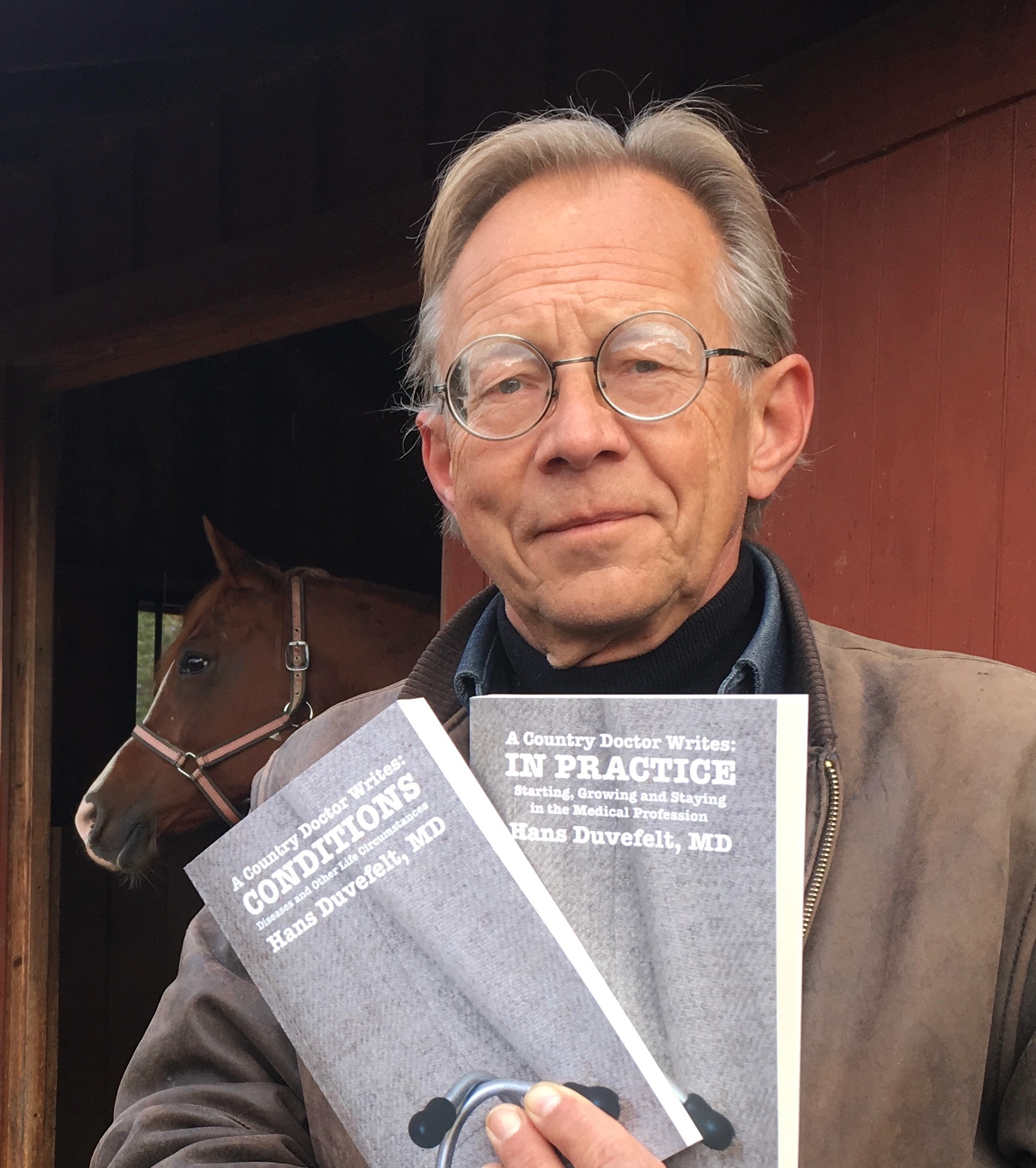
BOOKS BY HANS DUVEFELT, MD

CONDITIONS, Chapter 1: An Old, New Diagnosis

Top 25 Doctor Blogs Award

Doctor Blogs

Enter your email address to subscribe to this blog and receive notifications of new posts by email.

Mailbox

contact @ acountrydoctorwrites.com
Bookmark and Share
© A Country Doctor Writes, LLC 2008-2022 Unauthorized use and/or duplication of this material without express and written permission is strictly prohibited. Excerpts and links may be used, provided that full and clear credit is given.