Archive Page 119

Fundamentals of Medicine: Diagnosis and Guidance (Not Just Treatment)

Non-clinicians skip over some of the most necessary underpinnings of Doctoring and speak too much about housekeeping issues: Blood Pressure targets, aspirin use, mass screenings, immunization rates and so on.

People without medical degrees could do those things. But there are steps that must be taken before we worry about the measurables. These are the essence of being a physician, what people ask for when they come to see us. Most people don’t come in and say “I need you to regulate my blood pressure” or “Help me lower my cholesterol”. They come in saying “I don’t feel good” or “Help me stay healthy”.

DIAGNOSIS

More than anything, people come to us to find out what’s wrong with them. They come with rashes, aches, fevers, coughs, “bunches” (the Maine word for lumps and bumps on their bodies) and concerns like fatigue, which could be a symptom of almost anything.

In that scenario, not to be melodramatic, making a correct diagnosis could be a matter of life or death, or at least wasteful spending of thousands of dollars and valuable time.

We don’t get enough credit by outside observers, like health care administrators, insurers and “consumers” for the value of our diagnostic acumen. It is the first fundamental of health care. Different diseases have different treatments and the success of medical care hinges on treating the right diagnosis.

A trivial example is a patient I heard of just recently with sudden agitation and high blood pressure presenting to the emergency room. Many hours and many tests after arrival – blood tests, EKG, CT scans and so on, he turned out to have urinary obstruction. A Foley catheter relieved the obstruction and cured his high blood pressure as well as his agitation.

A young woman came to see me a few days before graduation for a mild rash on her legs. Not only was she about to graduate; she was also planning a long trip afterward. The bloodwork I ordered STAT on our first encounter showed that she had acute leukemia. She was allowed a temporary leave from the cancer clinic to attend the ceremonies and then went back to continue her treatment. Today, she is the proud mother of a soon-to-graduate teenager. What if I, as she later said, had glanced casually at her skin and sent her off on a faraway trip with a prescription for a cream?

GUIDANCE

“Treatment”, the second part of the traditional duad, is too simplistic a notion, only useful for lancing boils and prescribing penicillin for strep throat. Most diseases are multifaceted and most patients have several health and disease considerations. Most diseases are also chronic, even ones we thought of as rapidly terminal earlier in our own lifetime, like HIV and an increasing number of cancers.

The physician’s role is not a knee jerk intervention, it is informing and educating the patient and helping each patient choose a plan of action that is right for them.

Primary Care does what Google can’t, it applies knowledge of the patient and of the relative importance of medical facts and factoids and offers guidance in the sense of ranking options.

Even when the treatment requires specialized care we have a role as guides. We help patients choose specialists depending on each patient’s particular medical problems and personal preferences – referral to a particular subspecialty and to a take-charge doctor or a collaborative one, for example.

As guides, we follow patients along on their journey, sometimes actively by showing what to do, sometimes only watching from a distance, ready to intervene if they stumble. We don’t just prescribe, we anticipate – we warn patients and their families of things that may come up at the next turn. It takes experience and expertise do that well, not just handing out mass produced information to meet “meaningful use” mandates.

Sometimes our Guide role requires us to talk about a different journey – not one back to health and function, but one of decline and death. We must be comfortable with that role as well as the cheerleader’s.

The almost pastoral duty we have is to instill and preserve hope. Although this is often for a cure involving certain obstacles or challenges, sometimes the hope we can offer is only the hope of feeling better and sometimes it is just of relief from suffering.

We live in an era of tweets, sound bites and intellectual shortcuts. Medicine doesn’t fit into that kind of mindset very often. Contrary to what some outsiders think, ours is a deeply cognitive profession of careful consideration and deeply personal counsel.

“Treatment” is simply a misnomer for what we do. Even when there is no cure, there is care.

Dear [CEO]: The Letter I Gave My Boss This Week

I was behind on my charting, as were several of my colleagues. My boss asked me for ideas how to fix this problem. This is what I wrote:

A better day for medical providers:

1) Encounter Productivity Achieved

2) Charts done on time

3) Inboxes Cleared.

Those are the three basic tasks of a medical provider, yet most medical organizations only schedule providers for one of them, the patient visits, and somehow expect that by pure magic, superhuman willpower or personal sacrifice, the other two things will get done, and continually act surprised when that doesn’t happen.

Our clinic has recently heard from two departing providers that the non-patient visit work was a significant source of personal frustration.

Here is my suggestion for better efficiency and less professional stress with less risk for burnout:

1) Adopt a 20-40 minute grid.

2) Keep encounters at 15 or 30 minutes

3) Separate patient and computer time

In a 20 minute slot, the first 15 minutes are for the face to face visit and the remaining 5 are for charting. It is important not to suggest to the patient that the entire time slot is for face to face work, because that creates an untenable backlog for the provider.

In a 40 minute slot, 30 minutes are for face to face and 10 for documentation and ordering.

DETAILS:

A) Schedule ONE, TWO or THREE very special 40 minute slots per day (30 minutes for the patient and 10 for the provider), for very complex visits. There needs to be an understanding/protocol for which patients get these visits.

B) Schedule FIFTEEN, SEVENTEEN or NINETEEN 20 minute slots (15 minutes for the patient and 5 for the provider). If occasionally a patient requires the full 20 minutes, there is opportunity to postpone the documentation until the one hour block of desk time.

TOTAL 18, 19 or 20 patients/7 hours of face to face time depending on provider target.

FORMULA: (15×20)+(3×40)=420 Minutes

(17×20)+(2×40)=420 Minutes

(19×20)+(1×40)=420 Minutes

(For a 10 hour shift, 9 hours could contain 19x20min + 4x40min = 23 encounters.)

C) Schedule ONE HOUR of desk time (in the case of an eight hour day) so inboxes can be cleared daily. This would also be an opportunity to communicate with outside providers during their normal business hours.

A SCHEDULE LIKE THIS WOULD CREATE AND REINFORCE GOOD HABITS AND GOOD TIME MANAGEMENT. The hour devoted to provider “desk time” would also allow medical assistants a predictable opportunity to concentrate on tasks that require some uninterrupted time.

P.S. This was my 500th pst on A Country Doctor Writes.

M3DICINE: A Word With 3 Meanings

Everybody is a stakeholder these days in what we broadly call Medicine, or healthcare. But there is little agreement on what Medicine is and what the priorities of the healthcare “industry” should be.

I propose this breakdown of Medicine into 3 separate phenomena.

1) Micromedicine

2) Macromedicine

3) Metamedicine

Let me explain:

Micromedicine: One On One, Real Doctoring

Doctors from antiquity have served their patients one on one, as individuals. Osler, the father of modern medicine said “It is much more important to know what sort of a patient has a disease than what sort of a disease a patient has”.

My generation of physicians has seen the individualized care of patients fall from grace in favor of seeking the lowest common denominator for a particular medical problem. Hypertension treatment, for example was tailored to the “phenotype” of each patient: A high strung or Type A patient would get put on a beta blocker when I started out in Sweden, even though my American pharmacology text, Goodman & Gilman, pretty much dismissed beta blockers for hypertension. We knew better. A patient with overweight and edema would get a diuretic. When ACE inhibitors came along and did well in some randomized control studies, everybody suddenly ended up on them, regardless of what else was going on with them. That is still the party line, at least in the United States.

Micromedicine is concerned with accurate diagnosis, individualized treatment and patients’ values and priorities. It doesn’t matter to the individual patient if one type of blood pressure medication generally performs better than another if that patient’s blood pressure is elevated because of undiagnosed hyperthyroidism, alcoholism, coarctation of the aorta or a pheochromocytoma.

Micromedicine considers the average but never assumes that averages dictate action in individual patient encounters.

Macromedicine: Population Management

At the risk of offending some of my colleagues, I hereby declare that Population Management is reductive, simplistic and beneath physicians to spend their career on. It is a skeleton framework best handled by paraprofessionals. It is the broad strokes view from 30,000 feet, useful for policy makers and actuaries, but useless for individual doctors and patients in the exam room.

Macromedicine is all about averages. It is JNC blood pressure targets, Hemoglobin A1c targets, use of aspirin and statins, immunizations and bone density screenings.

In case anybody needs me to justify myself, a very low blood sugar in an eighty year old patient can result in a fall with a hip fracture. Aspirin use was recently a good thing and now it isn’t a good idea for most people. That’s how fickle the mistress of Quality Population Management can be. And don’t get me started on Lipid targets, the bane of our existence until the revised 2013 Lipid guidelines, and still a thorn in our sides because old habits die hard, especially among the less educated in our field.

Unfortunately, much of our time and effort in the office, those precious fifteen minutes with our patients, is spent on public health issues that even a nursing degree is superfluous for: If everyone should be offered a flu shot in the fall, you don’t need medical professionals to offer it. We can answer questions and reinforce the message, but it is a waste of our time to make us the primary promoters of such things.

Macromedicine is concerned with the masses, not infrequently at the expense of individuals that don’t seem average.

Metamedicine: The Parallel Universe of Non-Clinicians

Pharmacy Benefit Managers, Prior Authorizations, ICD-10 codes, EMR vendors, Meaningful Use, Maintenance of Certification – sometimes it seems that these non-clinical entities and considerations rule our lives, drain our energy, instigate burnout and overpower the fundamental motivations of physicians to help their patients.

I call all these things Metamedicine. The word is analogous to the Metadata that is recorded on websites and on our computers, like tracking codes, cookies, and even (invisibly) parallel to the music we listen to in the form of Gracenotes.

Metadata is necessary, but it shouldn’t overshadow real data; no amount of metadata can replace the value or experience of actually looking at a Da Vinci or listening to Beethoven.

Metamedicine means money unrelated to the patient visit. It means profit for middlemen. It means clutter in the diagnostic and therapeutic encounter. It is not the heart of the matter. It means measuring that which is easy to measure. It means satisfaction surveys and cycle times, it means cherry picking the easier cases to achieve better statistics; it means viewing patients as mere numbers.

Metamedicine is less concerned with patients and more with the data itself.

Endocarditis or Not? A Saturday Triage Decision

Saturday clinic. No lab. Just me and a medical assistant.

A fifty year old woman comes in with a fever a couple of days after a dental cleaning. Her gums are sore and she has some bodyaches. I’ve never seen her before. She used to see Dr. Wilford Brown and transferred to Dr. Kim.

The inflammation in her mouth is mild. She has a Grade 1 holosystolic murmur. Nobody has documented that before, but a Grade 1 is usually insignificant and barely worth documenting.

The only other thing I notice on her exam is that she has two thin brown lines under one of her fingernails. Like splinter hemorrhages. But there are only two.

“I banged that finger by accident a month ago, I’m pretty sure those lines have been there since way before my dental cleaning”, she said.

“Hmm, how bad are your bodyaches?”

“I’m not a complainer, I guess you could call them pretty bad.”

Time to make a decision. A judgement call: Hospital for blood cultures, possibly IV antibiotics, or blame the whole thing on a sore mouth and a virus and an incidental fingertip injury. One explanation or three?

Logic seemed to dictate one explanation for three clinical signs: mouth, fever, fingernail. But then there are bodyaches, bad bodyaches.

I made my decision, explained it carefully, and she concurred.

“So, stop in first thing Monday morning for some bloodwork, pick up the prescription I’m sending to the pharmacy, and call us if you don’t hear back from me by 10 am”, I said.

I slept well for two nights and did my Sunday farm chores without thinking much about it.

Monday, 9 am:

Lowish white blood cell count, close to 50% each of lymphocytes and neutrophils.

“I got your bloodwork. How are you feeling?”

“Fine, my mouth feels great and the fever is gone.”

“The blood count looks very typical for a virus.”

Minor mouth infection, viral illness and a banged fingertip. Bingo.

Two Cases of Bubbly Urine

I saw two patients with a chief complaint of bubbles in their urine this month.

One middle aged woman had eaten some wild mushrooms she was pretty sure she had identified correctly, but once her urine turned bubbly a few days later, she came in to make sure her kidneys were okay.

Even though she was feeling quite well they were not and she ended up going straight to Cityside hospital for IV fluids, a kidney biopsy and dialysis. We don’t know yet how much her kidney function will recover and we still don’t know if the mushrooms had anything to do with it.

I saw her in followup the other day and she was taking everything in stride, showing more curiosity than fear and despair.

The other, a woman in her thirties, came in for sudden swelling of her ankles. She mentioned her urine had been bubbly for months. She had googled her symptoms and was convinced she had either acute kidney or heart failure. She felt weak.

Her review of systems had several positives, including joint pain. Specifically, one knee had been swollen and painful for a while.

“Have you taken any ibuprofen or naproxen for your knee?” I asked.

“Yes, why?”

“Nonsteroidals can cause sodium and fluid retention”, I explained.

Her cardiovascular exam was normal.

Because of her obvious anxiety, I minimized the EMR on my computer screen and googled “leg edema NSAIDs” and showed her that Dr. Google agreed with me that this was a plausible explanation.

“The problem with Google is that it displays possible diagnoses without ranking their probability. Exotic things may rank higher because more people look them up”, I explained.

She understood but was visibly not reassured. She did agree to hold the ibuprofen for a while to see if her swelling resolved and to get some labwork to check her kidney function.

So far, I know that her kidney function is perfectly normal. We’ll see if her swelling goes away and stays away.

I didn’t tell her that I once had a woman about her age come in one December day with just a little ankle swelling and, ten years later, ended up with a heart transplant.

As I told another patient the other day, it is my job and not the patient’s to think of the worst case scenarios.


I just realized none of the posts show on an iPad or a computer, but they do show on an iPhone. WordPress is working on this. In the meantime, please visit my Substack.


Osler said “Listen to your patient, he is telling you the diagnosis”. Duvefelt says “Listen to your patient, he is telling you what kind of doctor he needs you to be”.


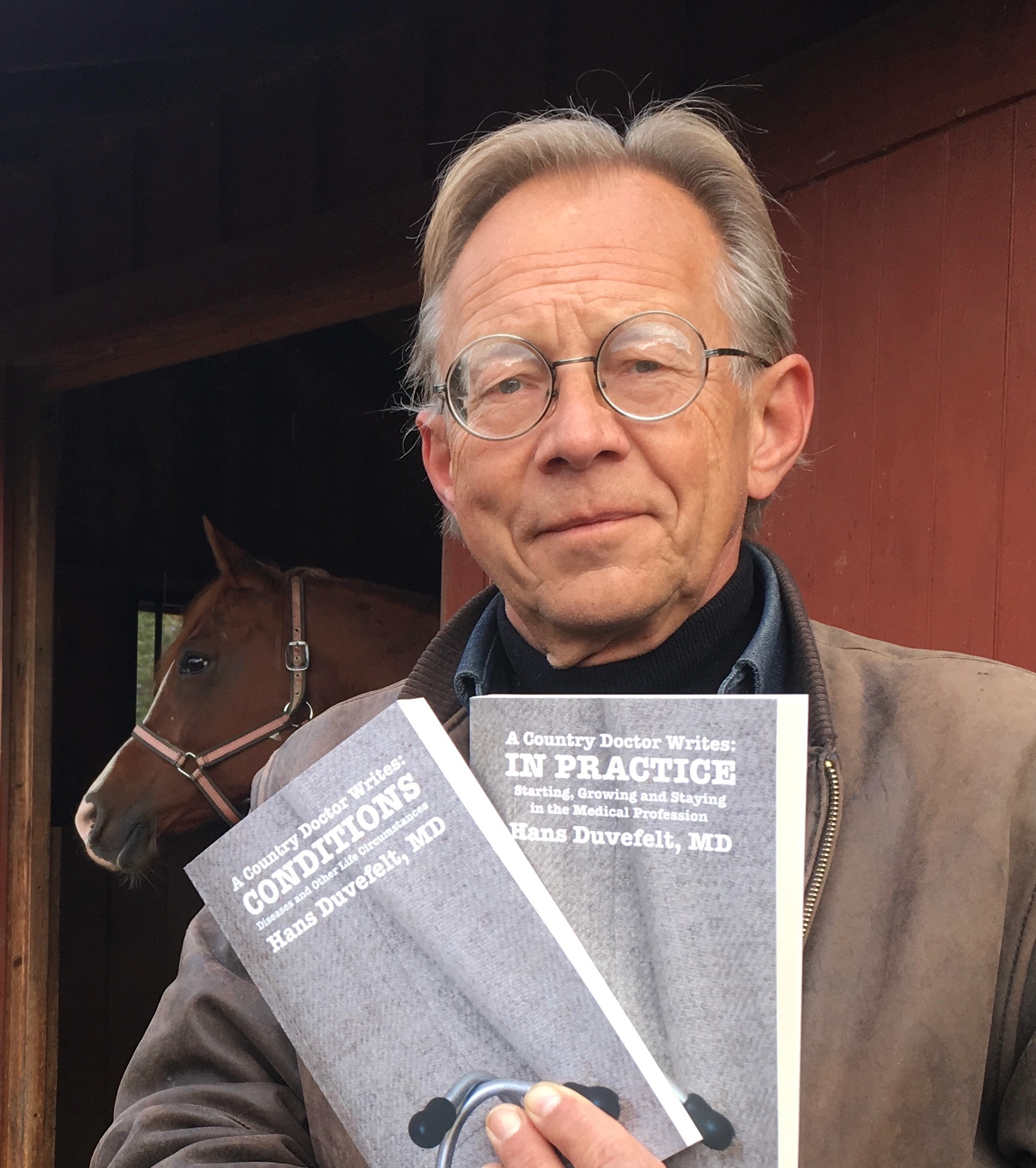
BOOKS BY HANS DUVEFELT, MD

CONDITIONS, Chapter 1: An Old, New Diagnosis

Top 25 Doctor Blogs Award

Doctor Blogs

Enter your email address to subscribe to this blog and receive notifications of new posts by email.

Mailbox

contact @ acountrydoctorwrites.com
Bookmark and Share
© A Country Doctor Writes, LLC 2008-2022 Unauthorized use and/or duplication of this material without express and written permission is strictly prohibited. Excerpts and links may be used, provided that full and clear credit is given.