Archive Page 111

Don’t Do Chronic Care in December

I am beginning to think that we should not see chronic care patients between Thanksgiving and New Year’s Day. It just makes us look bad.

Our quality metrics make the last blood pressure and the last diabetic lab test of the year for each of our patients our final report card. We should quit while we’re ahead, in mid November.

So here we are: The office has Christmas decorations up. There are trays of Christmas treats on desks and in break rooms. Patient after patient now declares that diet and exercise are on hold until after the holidays. The phrase of the month is “Next Year, I’ll Eat Better”.

I thought of this when I saw Jerry Rigg the other day.

His chest pain was a bit atypical, the stress test slightly equivocal. His belly was quite a bit bigger than last year, but the indigestion medicine seemed to work and the cardiologist was quite reassuring. He had also spoken of diet and exercise, just as I had done many times before.

This man with all the risk factors didn’t take this episode as a warning, but as a green light for stalling a little bit longer before doing something to change his trajectory.

So, instead of beating on people who really don’t want to feast less during Thanksgiving and Christmas, what is a Country Doctor to do?

It didn’t take me long to know:

My Suboxone patients, who can’t have Tuesday group on Christmas Day or New Year’s Day, had fretted about Thanksgiving, which in many families can be emotionally charged or awkward. Major holidays also often expose them to relatives who are not in recovery, who may bring drugs to the periphery of the festivities. Every single one did okay, though. But after realizing their degree of concern, we are holding groups on Christmas and New Year’s Eves and halfway between.

I also have seen a couple of patients already in tears because they can’t afford presents for their children, because they miss loved ones that won’t be there this year or because they weren’t invited to something others in their family did.

I can’t really postpone or cancel my remaining hypertension and diabetes visits on such short notice, but maybe in the future, we need to be more focused on those patients who find the holidays hard.

If by doing that our quality metrics should happen to improve, is that so bad?

I Love Calling Patients – And I Don’t

That is, I don’t do it very much and I don’t love it with all my heart.

Talking to patients on the phone can be very efficient and quite rewarding, like when I called a worried patient today and told her that her chest CT showed an improving pneumonia and almost certainly no cancer, but a repeat scan some months down the road would still be a good idea. She told me she was feeling better, but still quite weak and that her sputum was still dark yellow. So, while still on the phone, I e-prescribed a different antibiotic, after going over her long list of allergies with her.

But as a primary care doctor with a productivity target of 24 patients per day, and absolutely no credit for phone calls, this is not something I am incentivized to do.

So instead, I am tempted to resort to the internal EMR messages:

“Mrs. Jones is looking for her CT results, please advise.”

I could have typed in what to tell he patient, but then when the medical assistant had her on the phone, she probably (hopefully) would have mentioned that she was still raising dark yellow sputum. The medical assistant would then tell her she’d check with me and get back to her.

Would I have remembered that the levofloxacin the ER gave her caused horrific nightmares if I hadn’t been engaged in conversation with her? Maybe I would have just tried to refill that?

How many back and forth messages would it take to handle something as simple as this, and how many times would the medical assistant need to call the patient back to get all the necessary information?

If all work we do was recognized as work, if Medicare and Medicaid paid our clinics for phone calls, doctors would have time in their schedules to personally return patient calls. (Medicare does, but so far only for people we sign up for chronic care management where they will incur monthly copays for this “added service”, mostly designed for nurse calls).

Some commercial insurers now do pay for phone calls, but in Federally Qualified Health Centers, where I work, private insurance is such a minor portion of our payer mix that their reimbursement policies are close to irrelevant for our bottom line.

The struggle in primary care is that right now, we get paid “per visit” with very little regard to “outcomes”, but very soon, our clinics will prosper or perish depending on how well our patients do and how much they cost “the system”. I talk with my bosses every week about how we can make this transition without losing our shirts.

Mrs. Jones, if I hadn’t called her myself, might have gone back to the emergency room several days later, in terrible shape, required admission to the hospital and incurred thousands of dollars of cost. My doxycycline prescription may have avoided that.

And, being able to personally get back to patients fosters loyalty and provides levels of reassurance that only come with the role of the physician.

Darn it, that’s what I am, and that is what I need to provide as much as I can of.

Ask the Professor

After publishing the post about my first day of medical school, I felt a bit nostalgic. I googled some of the names I remembered from back then and sent a few emails with a link to my post.

C., who was a junior teacher and researcher in the department where I earned my one citation in Index Medicus, was the first to reply. Eight years my senior, he was listed in the University catalog as Professor Emeritus.

There is something profound about learning that someone you know reached such a pinnacle of academia, earning his place among Linnaeus, Celsius, Ångström, Berzelius and Bárány.

It is also remarkable that the man I remember as barely older than I is already an emeritus, and officially retired, although still busy in both academics and clinical medicine, as I learned.

In a return email, I shared with C. my memory of the practical portion of my internal medicine exam, where Professor Boström sat and broke tongue depressors in a corner of the room. Ever since, I have had a slight doubt in the back of my mind whether my performance on that day really was pathetic enough to drive the professor of medicine to distraction.

One sentence in C.’s reply wiped away thirty-eight years of gnawing self-doubt: “Harry was always fiddling with something or rubbing his palms together”.

That sentence was an unexpected bonus in my delight at reconnecting with C.

Sunday morning as I with my pitch fork and a tarp-covered garden cart took on the task of cleaning out the goat yard, I thought to myself: “Professor of medicine at Uppsala University, huh – I wonder if he has the answers to some of my questions that the specialists at Cityside Hospital haven’t answered to my satisfaction.”

As I toiled, I began making my list of things to ask C. The first thing I thought of was why a normal nuclear medicine study trumps an abnormal stress-EKG. That is the answer every cardiologist I have asked gives me.

The EKG can change with potassium levels, digitalis administration, pericarditis and all kinds of things. Why are cardiologists so nonchalant about ST depressions and T-wave inversions just because a grainy picture of the heart has a relatively uniform color? Is it, perhaps, because they still view coronary artery disease as a plumbing problem rather than an inflammatory condition?

Maybe a positive EKG stress test with a negative nuclear image should be viewed as evidence of heart disease with not-yet-critical blockages, but still cause for aggressive action, particularly to reduce inflammation and thrombosis risk?

That is probably enough to ask the professor; I wouldn’t want to bombard him with all the random everyday musings of a country doctor.

P.S. I first drafted this post in 2014 and never came back to it until now. Shortly after writing it, I realized that C.’s successor as Professor of Medicine at Uppsala University was S., a classmate of mine. He always had, like Columbo, one more question. I settled for “what do I do if I run into a [Blank]? That’s why S. became a professor and I a Country Doctor. But I wouldn’t trade my job(s) for any other career in the world.

Sometimes You Just Gotta Treat It

“Red” McDougall had terrible leg pains soon after going to bed. He did have a bad back, and some mild spinal stenosis, but I hadn’t heard much about that in the past few years. He was just dealing with the ache in his legs when he was on his feet too long.

A few months ago he saw his vascular surgeon for a routine followup. He’d had a femoral-popliteal bypass to restore circulation to his right leg a few years ago. The vascular surgeon was intrigued by the fact that both legs hurt when elevated. That is usually a sign of severe ischemia, but Red’s pulses were palpable. To play it safe, the surgeon ordered formal pulse volume recordings and a CT angiogram.

The studies were normal and the surgeon speculated that the pain could be related to Red’s bad back.

I saw him for a diabetes followup a few weeks ago. He had ever so slightly decreased monofilament sensation in both feet and his legs had normal strength, normal reflexes and no atrophy.

“Does it feel like cramps?” I asked.

“Not really, they just hurt”, Red answered. “It’s so bad I have to sit on the edge of my bed and dangle my legs or walk around a bit before it goes away. But it’s driving me crazy. I hardly get any sleep anymore.”

“Well, we know it’s not your circulation”, I began. “It could be just a form of leg cramps, even though you can’t tell if there is spasm in the muscles. Or it could be a strange way for your spinal stenosis to act up in the opposite position from the way it usually behaves. So I have an idea.”

“Anything”, he was quick to answer.

“Cyclobenzaprine. A muscle relaxer that is related to the antidepressant amitriptyline. In addition to preventing muscle spasms, it has pain relieving properties and it usually helps people sleep.”

“Gimme some”, Red held out his hand.

“I’ll send in a script. Let me see you back in two weeks, because if this doesn’t work, I’ll need to do some serious thinking.”

I thought to myself about how often specialists are in a position where they can simply declare “Not my department”, but primary care docs are then more or less obligated to pick up the ball again and do something.

Two weeks later, Red was a new man.

I’m sleeping through the night, and no pain”, he grinned.

I still don’t know exactly what this was, but it’s gone.

Sometimes you just gotta treat it.

Reruns

I have published well over 500 posts on A Country Doctor Writes since I started blogging over ten years ago. Right now I am pretty much posting something new twice a week. But I thought I’d put a “rerun” of an older post up every day (or almost every day) for the next year to allow frequent visitors to see older posts that would take lots of WordPress Infinite Scrolling or scrolling down the “Archive” to get to. The one I am pinning to the front page today is called “The Power of Words“.


I just realized none of the posts show on an iPad or a computer, but they do show on an iPhone. WordPress is working on this. In the meantime, please visit my Substack.


Osler said “Listen to your patient, he is telling you the diagnosis”. Duvefelt says “Listen to your patient, he is telling you what kind of doctor he needs you to be”.


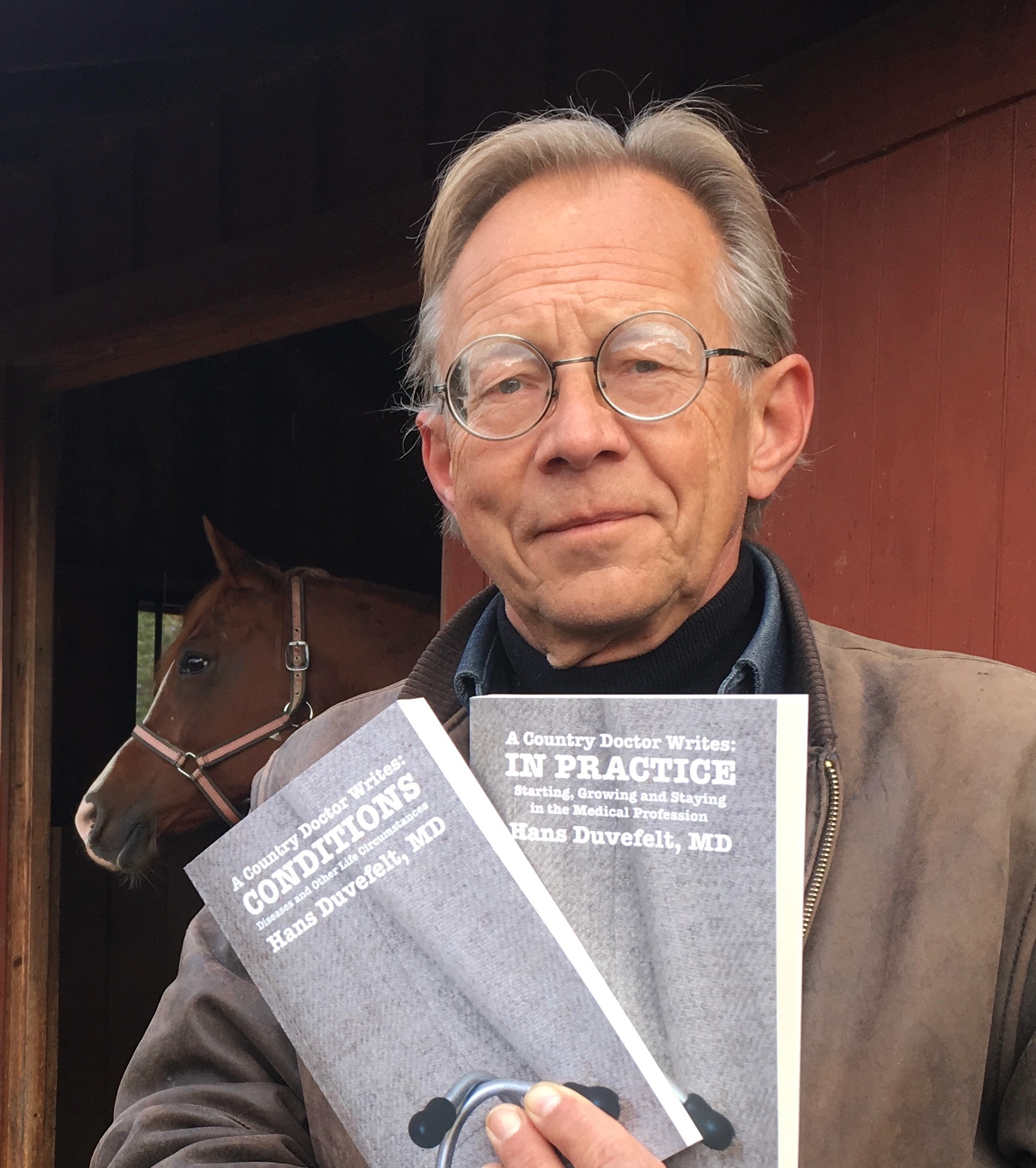
BOOKS BY HANS DUVEFELT, MD

CONDITIONS, Chapter 1: An Old, New Diagnosis

Top 25 Doctor Blogs Award

Doctor Blogs

Enter your email address to subscribe to this blog and receive notifications of new posts by email.

Mailbox

contact @ acountrydoctorwrites.com
Bookmark and Share
© A Country Doctor Writes, LLC 2008-2022 Unauthorized use and/or duplication of this material without express and written permission is strictly prohibited. Excerpts and links may be used, provided that full and clear credit is given.