Archive Page 109

“Let Food Be Thy Medicine and Medicine Be Thy Food”

The title of this post is a quote from Hippocrates, the father of Medicine. In my own life, practice and forays into Functional Medicine, I am increasingly convinced about the wisdom behind those words.

And, both foods and medications are best consumed in stringent moderation; less is usually more.

My 2011 post, “The Virtues of Oligopharmacy”, opens with the above Hippocrates quote, followed by Ben Franklin’s and Sir William Osler’s Words:

“I saw few die of hunger; of eating, a hundred thousand.” (Benjamin Franklin)

“The desire to take medicine is perhaps the greatest feature which distinguishes man from animals”

(William Osler)

I think that sums up where we are today:

There’s a pill for every ill. Eat too much sugar and Farxiga makes you pee it out. But you might get urinary tract infections, kidney failure, bladder cancer or Fournier’s gangrene. And so on.

Drug companies spend unimaginable amounts of money to produce drugs that allow us to have our cakes and eat them too. Most middle aged or older people with diabetes or hypertension are on three or four drugs, but foods, with their natural ingredients and lack of processed, unnatural or artificial ones can take the place of pills in many instances, at lower cost and with lower risk.

I have sometimes fumed about hospitalists suggesting our practice’s patients are on too many medications and then sending them home on magnesium, B12 and all kinds of more or less over the counter type medications. This irks me partly because of the hassle factor of documentation and cluttering up our medication lists. These days we are obligated to list all over the counter medications and supplements our patients are taking, even if our EMRs don’t have them in their data base…

But I guess I should be grateful that they’re not usually starting dangerous medications I wouldn’t agree with. I’ve never heard of anybody dying from low (or high) magnesium, but I guess I shouldn’t worry myself silly over a relatively harmless supplement to treat a laboratory abnormality still more or less looking for a purpose (seldom critical as an isolated finding, if other electrolytes and minerals are normal).

(UpToDate states: ●Hypomagnesemia is a common entity occurring in up to 12 percent of hospitalized patients. The incidence rises to as high as 60 to 65 percent in patients in an intensive care setting.)

But I do think we all, however conventional we may want to be, need to think hard about food:

If the wrong diet can cause kidney stones, migraines, diabetes, pancreatitis or whatever, shouldn’t we be better educated and more vocal about which foods can instead help patients avoid those conditions?

I, like most doctors, didn’t learn much about nutrition in medical school, but I was a squeamish eater, esthetic former and now recovering vegetarian, who (I always shock my patients with this) gained too much weight when I didn’t eat fish, chicken or bacon (I lived on pasta, sandwiches and oatmeal). This journey lead me to read a lot and learn a lot.

I’m not mad at my medical school for not teaching me more back then. Nobody ever suggested I’d be fully prepared for a lifetime of practice the day I graduated. I knew I’d have to keep learning, and that’s what I’m doing now…

Turmeric anyone? Blueberries?

A Country Doctor Reads: February 16, 2019

Find Nutrients Depleted by Medication – Nutrient Depletion Calculator – Mytavin.com

I came across a cute website that lists common deficiencies associated with medications, for example B12, iron and many others from Nexium, esomeprazole:

— Read on www.mytavin.com/results/medications/83

How Long Do Hip Replacements Last? -The Lancet

There is concern about hip replacements performed in middle aged adults. Will they wear out? The Lancet has an open access impressive review, which outlines the odds of failure over the remaining lifetime of 50-something patients:

“Moreover, these results are particularly important because of the growing number of younger, more active patients receiving hip replacements, as well as increasing population ageing and life expectancy.7,  8 In fact, lifetime risk of revision of total hip replacements for patients aged 50–54 years is estimated to be 29%, but only 5% in patients aged 70 years.9 Much of the increased risk of revision is due to component wear. The findings from Evans and colleagues’ study can therefore be used to more appropriately counsel patients”

https://www.thelancet.com/journals/lancet/article/PIIS0140-6736(18)31859-2/fulltext?dgcid=raven_jbs_etoc_email

Medicine is Not Like Math

We do a lot of things in our head in this business. Once a patient reports a symptom, we mentally run down lists of related followup questions, possible diagnoses, similar cases we have seen. All this happens faster than we could ever describe in words (let alone type).

And, just like in math class, we are constantly reminded that it doesn’t matter if we have the right answer if we can’t describe how we got there.

So the ninth doctor who observes a little girl with deteriorating neurologic functioning and after less than ten minutes says “your child has Rett Syndrome” could theoretically get paid less than the previous eight doctors whose explorations meandered for over an hour before they admitted they didn’t know what was going on.

Does anybody care how Mozart or Beethoven created their music? Or do we mostly care about how it makes us feel when we listen to it?

We know that stress, meditation and Thai Chi can alter metabolism, immune response and neurotransmission. But do we endorse them based on how many minutes, elements, movements or postures they involve over what their results are?

Of course not!

We also know that physician demeanor can affect treatment efficacy a whole lot more than the number of minutes spent or boxes checked in the EMR. So why are we so fixated with proving the monetary value of our process, instead of the value of our results?

Medicine, at least in the non-procedural specialties, is a relationship based business. If a hostile stranger spends fifteen minutes trying to change your behavior, is that more effective or more valuable than if a trusted doctor, friend or admired mentor mentions the same thing almost in passing?

Of course not!

So why is medicine viewed as an easily quantifiable and standardized endeavor? The manufacturing analogy is outdated; we are more like old-house renovators or art restorers most days, and, on perhaps rare but inspiring and memorable occasions, like composers. We sometimes find ourselves creating something new in the lives we touch and interact with. In those instances we should take little credit for anything except how we were able to awaken the healing potential within our patient.

Health care professes to value outcomes, but we are a long way from doing that. We are stuck in a thick soup of surrogate endpoints and ignorant overemphasis on standardized processes in an era where we are only beginning to understand how genetically different we all are.

Or, are we really suggesting our patients are all 70 kg white males with only one, typical and standardized, medical problem?

Paralyzed by Insurance Drug Formularies? Don’t Forget Cash!

I haven’t counted how many times this happens every month, but I find it annoying:

I send a prescription for a drug (sometimes not even expensive) to the pharmacy and soon after, I get a fax asking me (or my medical assistant) to go online and print a Prior Authorization form to complete and fax to the insurer, or answer numerous qualifying questions on the screen, or (worst of all) make a toll free call and spend unpredictable amounts of time pleading to have it paid for.

My time is worth (opportunity cost) $7-14 per minute, depending on if you count only my basic (E&M) professional fees or also the ancillary revenue (lab, x-ray and additional procedure charges) I generate.

This may be for a prescription with a cash cost of $10.

Sometimes I don’t even know if the new drug I prescribe will work. In the case of self-pay, a patient can buy a few pills cash to try them, and if they work, it may make more sense for me to offer my unreimbursed time to plead for coverage.

Because, of course, the cash cost is per pill whereas the insurance copay, and the amount posted toward your total drug plan benefit, is per prescription (same cost for anything up to the allowable monthly quantity), thus counting toward deductibles and the slide toward the dreaded (Medicare D) doughnut hole.

So even if I do my patient a favor and get the new drug “covered”, they may ultimately and in reality end up paying for a month of a medicine they couldn’t use.

Even worse than my own Prior Auth faxes, sometimes a specialist prescribes something esoteric, and when they get this dreaded fax, they forward it to me.

How am I supposed to justify a drug I didn’t choose?

And my biggest gripe with Prior Authorizations is that it can be hard to figure out what is covered and what isn’t.

One of my EMRs gives me an “emoji”, green smiley, yellow quizzing or red frowney, depending on status for many insurances, but only a question mark for some. My other EMR often just claims it doesn’t know.

In the case of our biggest payer for medications, Mainecare, they avoid the Prior Auth hassles fairly well by publishing rules like:

60 days of a preferred Proton Pump Inhibitor, like omeprazole, thereafter PA if you can’t wean down to an H2 blocker, like famotidine.

Coverage for preferred stimulants only if ADHD is mentioned on the prescription.

AARP Medicare D required a phone call, with hold time, to get non-valvular atrial fibrillation to justify a prescription for Eliquis, and another Medicare D plan a similar holdup to explain Suboxone was for opiate dependence and not for pain. In both those instances, the drugs are simply only indicated for certain conditions.

There are bigger foes to contend with than the insurance companies if you break those rules…

Maybe there should just simply be a CPT code and an RVU for obtaining a Prior Authorization?

A Country Doctor Reads: February 9, 2019

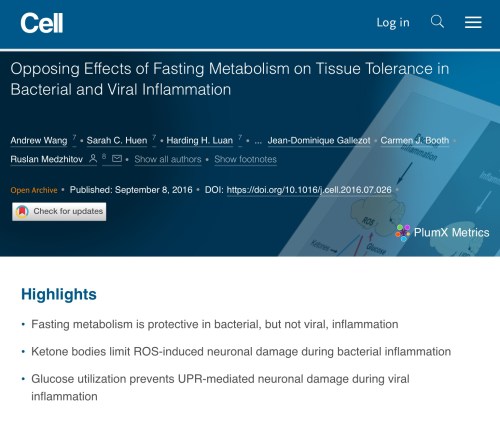
Feed a Cold, Don’t Starve It – Cell via The Atlantic

“Feed a fever, starve a cold”, the saying goes. But, unlike many old adages, this one is turning out to be dead wrong, literally.

A 2016 article in The Atlantic, number 3 under “Popular” on their website, quotes an article from the same year in Cell with a longer and less catchy title: “Opposing Effects of Fasting Metabolism on Tissue Tolerance in Bacterial and Viral Inflammation”.

The Atlantic staff writer James Hamblin, MD, explains, “Sometimes sugar causes inflammation. Sometimes it does the opposite.”

Researcher Ruslan Medzhitov conducted a series of distasteful experiments on mice with various infections, and found that mice with listeria, a bacterial infection, survived when they were refusing to eat and perished if they were force fed, but only if their diet was essentiallly sugar; they survived if they were fed fat and protein.

Mice with influenza fared better if they were force fed glucose than if they were allowed to refuse food.

The Cell article concludes: [In influenza infection,] “inhibition of glucose utilization is lethal.” Whereas glucose was “required for survival in models of viral inflammation, it was lethal in models of bacterial inflammation… Glucose Utilization Promotes Tissue Damage in Endotoxemia”.

And the article implies that ketosis has a protective effect in bacteremia.

The conclusion: Drink juice and tea with sugar or honey when you have the flu. But don’t eat if you don’t feel like it when you have pneumonia.

https://www.theatlantic.com/science/archive/2016/09/glucose-inflammation/498965/

https://www.cell.com/cell/fulltext/S0092-8674(16)30972-2

——————————————————————————————————————

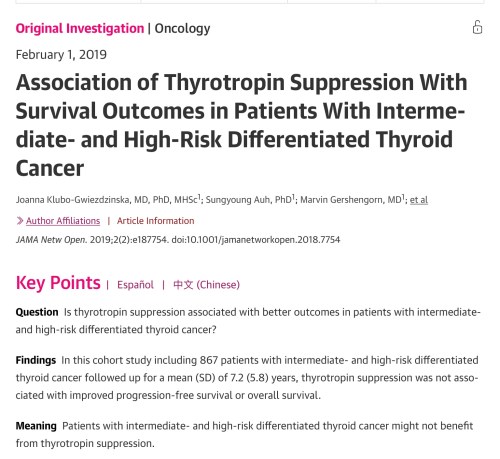
Association of Thyrotropin Suppression With Survival Outcomes in Patients With Intermediate- and High-Risk Differentiated Thyroid Cancer – JAMA

A dear friend and an anxious woman with a history of thyroid cancer is simply not tolerating suppressive doses of thyroid hormone, so with the blessing of my go to endo, she is on suboptimal suppressive doses. This article helps me sleep better at night:

https://jamanetwork.com/journals/jamanetworkopen/fullarticle/2723409

——————————————————————————————————————

Eczema and Our Skin Biome – The Wall Street Journal and the AAAAI

The prevalence of eczema in children has doubled in the past 17 years. Now we are starting to think of our bacterial skin flora as another area where promoting good bacteria can improve health. The Wall Street Journal reports on two small studies that demonstrated that applying healthy bacteria to eczematous skin brought clinical improvement.

“15 pa­tients, in­clud­ing five chil­dren, sprayed their rashes with bac­te­ria that re­searchers sus­pected could im­prove eczema. Two-thirds re­ported less itch­ing, less need for top­i­cal steroids and bet­ter sleep af­ter us­ing the spray twice a week for four months. On av­er­age, these mea­sures im­proved by 84% in adults and 78% in chil­dren.”

https://www.wsj.com/articles/bacteria-may-offer-new-hope-for-treating-skin-disorders-11549394922

This led me to look for more information, and it’s out there:

https://www.jacionline.org/article/S0091-6749(18)31664-6/abstract


I just realized none of the posts show on an iPad or a computer, but they do show on an iPhone. WordPress is working on this. In the meantime, please visit my Substack.


Osler said “Listen to your patient, he is telling you the diagnosis”. Duvefelt says “Listen to your patient, he is telling you what kind of doctor he needs you to be”.


BOOKS BY HANS DUVEFELT, MD

CONDITIONS, Chapter 1: An Old, New Diagnosis

Top 25 Doctor Blogs Award

Doctor Blogs

Enter your email address to subscribe to this blog and receive notifications of new posts by email.

Mailbox

contact @ acountrydoctorwrites.com
Bookmark and Share
© A Country Doctor Writes, LLC 2008-2022 Unauthorized use and/or duplication of this material without express and written permission is strictly prohibited. Excerpts and links may be used, provided that full and clear credit is given.