Archive Page 100

A Country Doctor Reads: June 1, 2019

Thought Provoking Titles and Concepts

This week I read some articles whose titles or first few words grabbed my attention and opened my mind to issues I had thought about only casually in recent months. These pieces put their concepts in the forefront of my thinking as a physician. The last item seemed thought provoking enough as it promised to tell the story of how human adipose tissue became a hot commodity a couple of hundred years ago, but the story gets better, or, rather, worse – much worse.

ARRIVAL FALLACY – NYT

Thursday’s The New York Times has an article titled “You Accomplished Something Great. So Now What?” It describes the phenomenon of striving for something you expect to make you happy, but once you achieve it, you just feel empty. This introduced me to the term “Arrival Fallacy”.

“Arrival fallacy is this illusion that once we make it, once we attain our goal or reach our destination, we will reach lasting happiness,” said Tal Ben-Shahar, the Harvard-trained positive psychology expert who is credited with coining the term.

Dr. Ben-Shahar said arrival fallacy is the reason some Hollywood stars struggle with mental health issues and substance abuse later in life.

“These individuals start out unhappy, but they say to themselves, ‘It’s O.K. because when I make it, then I’ll be happy,’” he said. But then they make it, and while they may feel briefly fulfilled, the feeling doesn’t last. “This time, they’re unhappy, but more than that they’re unhappy without hope,” he explained. “Because before they lived under the illusion — well, the false hope — that once they make it, then they’ll be happy.”

The article offers this advice on how to avoid Arrival Fallacy:

“We need to have goals,” Dr. Ben-Shahar said. “We need to think about the future.” And, he noted, we are also a “future-oriented” species. In fact, studies have shown that the mortality rate rises by 2 percent among men who retire right when they become eligible to collect Social Security, and that retiring early may lead to early death, even among those who are healthy when they do so. Purpose and meaning can generate satisfaction, which is part of the happiness equation, Dr. Gruman said.

https://www.nytimes.com/2019/05/28/smarter-living/you-accomplished-something-great-so-now-what.html?smprod=nytcore-ipad&smid=nytcore-ipad-share

LANGUAGE OF TOUCH – NYT

Another piece in Thursday’s The New York Times with the title “Your Surgeon’s Childhood Hobbies May Affect Your Health” introduced me to the concept of “The Language of Touch”, similar to a language you learn as a young child as opposed to in college or graduate school.

Medical schools are noticing a decline in students’ dexterity, possibly from spending time swiping screens rather than developing fine motor skills through woodworking and sewing.

“There is a language of touch that is easy to overlook or ignore,” said Dr. Roger Kneebone, professor of surgical education at Imperial College London. “You know if someone has learned French or Chinese because it’s very obvious, but the language of touch is harder to recognize.” And just like verbal language, he thinks it’s easier to acquire when you’re young: “It’s much more difficult to get it when you’re 24, 25 or 26 than when you’re 4, 5 or 6.”

Dr. Robert Spetzler, former president and chief executive of the Barrow Neurological Institute in Phoenix, agreed. “Think about the difference between someone who has learned to ski when they were a little kid and someone who spent a long time, perhaps even the same amount of time, skiing as an adult,” he said. “That elegance that you learn when very young, doing that sport, can never be equaled by an adult learning how to ski.”

Dr. Spetzler earned a reputation as a virtuosic brain surgeon during his more than 40 years operating. He said he developed his dexterity as a child by playing the piano. And he began performing surgery in high school — on gerbils. All of them survived.

“The sooner you begin doing a physical, repetitive task, the more ingrained and instinctive that motor skill becomes,” Dr. Spetzler said. “What makes a great surgeon is unrelenting practice.”

https://www.nytimes.com/2019/05/30/well/live/surgeons-hobbies-dexterity.html?smprod=nytcore-ipad&smid=nytcore-ipad-share

DIAGNOSTIC OVERSHADOWING – NEJM

I have often thought of this phenomenon, but never heard this term for it: When someone has an important or severe diagnosis, we tend to blame it for everything else that ever happens to them and thus run the risk of missing new diagnoses in such patients.

So here is my speculation about Michael’s diagnostic delay. His providers saw a patient with complete quadriplegia, paralyzed below his neck. When he developed new symptoms, perhaps they succumbed to “diagnostic overshadowing” — the erroneous attribution of all new symptoms to an underlying health condition, especially in patients with disability. After all, maybe extreme MS-related constipation caused Michael’s distended abdomen; wheelchair users commonly have lower extremity edema; and breathing difficulties occur in late-stage MS. Perhaps they thought Michael’s PPMS was at its end stage.

https://www.nejm.org/doi/full/10.1056/NEJMp1903078?query=featured_home

SPONTANEOUS HUMAN COMBUSTION – The Atlantic

The Atlantic has a story about human fat that opens with a case of a corpulent woman who burst into flames, presumably a victim of what we now call Spontaneous Human Combustion.

The Lucrative Black Market in Human Fat

In 16th- and 17th-century Europe, physicians, butchers, and executioners alike hawked the salutary effects of Axungia hominis.

One night in 1731, Cornelia di Bandi burst into flames. When the 62-year-old Italian countess was found the next morning, her head and torso had been reduced to ash and grease.

https://www.theatlantic.com/health/archive/2019/05/human-fat-was-once-medicine-black-market/590164/

I had never heard of this phenomenon, but it has been described many times:

Though the term “spontaneous human combustion” is of fairly recent vintage, it was a rare-but-real concern to many in the 1800s. In fact, there are nearly a dozen references to people bursting into flames in pre-1900 fiction. The most famous example is Charles Dickens’s 1853 novel “Bleak House,” in which a character explodes into fire, though the phenomenon can also be found in the works of Mark Twain, Herman Melville, Washington Irving and others. In modern times, SHC has appeared in movies and on television shows, including “The X-Files,” and it’s even, sort of, the super-power of Johnny Storm, the Human Torch, in “Fantastic Four” comic books.

https://www.livescience.com/42080-spontaneous-human-combustion.html

Is Hate Ever Therapeutic?

Most Saturdays I join a therapy session down the hall from where I do my walk-in clinic. A patient of mine has a weekly session just before the Alcoholics Anonymous meeting at noon in our big conference room.

Last weekend he told my behavioral health colleague that the people in the AA group who have the most solid recovery seemed to be the ones who claimed to really carry a lot of hatred for alcohol.

Later that day as David and I wrapped up our week, we talked about this. Generally, we don’t think of hatred as particularly healthy or therapeutic. Hatred for others is thought to always eventually create negative feelings towards oneself and even illness. “Depression is anger turned inward” is a common saying attributed to Sigmund Freud. He used the word “ambivalence” for the coexistence of love and hate, which many others have also written about.

(Freud’s linkage of love and hate now have a Functional MRI correlate: According to a ten year old article, “The Origin of Hatred” in Scientific American, the areas of the putamen and insula that are activated by individual hate are the same as those for romantic love. “This linkage may account for why love and hate are so closely linked to each other in life,” neurobiologist Semir Zeki, of University College London’s Laboratory of Neurobiology wrote in 2008.)

https://www.scientificamerican.com/article/the-origin-of-hatred/?redirect=1

But is there a place for pure, single-focused hatred? Freud, again, “defined hate as an ego state that wishes to destroy the source of its unhappiness, stressing that it was linked to the question of self-preservation” (Wikipedia, referencing ‘The instincts and their vicissitudes’ (1915) in On Metapsychology (PFL 11) p. 135).

David had already asked our patient to write down for next week if there was anything about alcohol that he hated, and he asked me as the primary care physician to list each of my patient’s health problems that could be related to alcohol. Of course, we can’t be sure, but it’s like the question on Maine death certificates whether smoking contributed to the death: There is a “probably” answer option. Before next Saturday I’ll have to go through the chart and make my list. I know it won’t be short.

Will our respective lists bring this patient to hatred of alcohol according to Freud’s definition?

But will such hatred, if not coexisting with its opposite, eventually cause this man to be depressed because of anger turned inward? In fact, he is already on medication for depression and it seems to be working well.

Maybe hatred of an inanimate object is different from hatred of any of our fellow humans, like hatred of plastic, pesticides or pollution. Maybe hatred for alcohol, once the spreadsheet we’ll create together makes its many negative effects on this person’s life and health undeniably and objectively evident, will make ambivalence impossible?

But maybe alcohol has more than two dimensions in my patient’s life. In his current ambivalent state of seemingly equal parts love and hate there is a tiebreaker, or maybe this one is a third and equal part of a complicated triangle: Habit. It isn’t for nothing we speak of someone’s alcohol habit. Alcohol is a strong one, linked to food, celebration, socialization and relaxation. It is for many people a strong conditioned response to all kinds of external and internal triggers.

I believe anger and hatred could have a catalytic effect, because few of us make purely logical decisions from lists of pros and cons. Rather, we use logic to justify the emotional split-second decisions we have already, at least almost, made.

I believe in the possibility that something emotional uncovered or triggered through this exercise might become the seed of hatred we are hoping for. Maybe it will be the sheer size of the list; maybe a health issue he never realized alcohol’s connection to; maybe a single item on the list will trigger a flashback to some childhood impression related to alcohol.

The more I think of it, I believe hatred is necessary because we are fighting both “love” and a very strong habit in this case. And I do think you can hate a thing without hurting yourself.

Beyond the Other Viagra: Curiosities in Off-Label Prescribing

Some drugs are used for indications beyond their original FDA approved ones that make complete sense. I mean, if old seizure medications help nerve pain, it might be reasonable to try new ones for the same purpose if everything else fails.

Sometimes the broader use of a medication leads to additional FDA approved indications. One good example is bupropion, Wellbutrin, for smoking cessation. It even got a new name for that indication, Zyban, presumably to remove the stigma of taking an antidepressant.

The story behind Viagra is interesting:

Sildenafil, eventually marketed as Revatio, at 20 mg three times daily, was studied for angina and hypertension. At the end of the trial, many male patients refused to return their unused medication. Researchers asked why in the world these middle aged men wanted to keep their leftover experimental heart medication. The rest is history.

Sildenafil had little effect on heart disease, did work for pulmonary hypertension, and wasn’t a major blockbuster as a drug for that indication. But it certainly was when two years later, in 1998, it was re-marketed under the name Viagra, (a word play on virility and Niagara, I am told).

Now, even shortly after Viagra went generic, the 25, 50 and 100 mg tablets are quite expensive. But the generic version of Revatio, same compound in a 20 mg dose, costs about $1 per pill. Two or three of them on a PRN basis is the same, right? No, actually not. The 20 mg pill strength has only been approved for pulmonary hypertension. So at the moment, this may very well be one of the more prevalent forms of off-label prescribing in the US.

Today, beyond the FDA approved indications of pulmonary hypertension and erectile dysfunction, sildenafil is used off-label for Rayneaud’s phenomenon, female sexual arousal disorder and, non-prescribed, for athletic performance enhancement (placebo or not?)

Any FDA approved medication can be prescribed for other indications. Sometimes insurance companies and pharmacy benefit managers (PBMs) save money by only paying for “approved” use of expensive drugs (See my post “Calling Mrs. Kafka“).

Some “unapproved” drugs from my personal tool bag are:

Cyproheptadine is an antihistamine with anticholinergic and antiserotonergic properties. I have used this very successfully to treat SSRI induced delayed ejaculation. I have also tried it many years ago, based on the literature, for migraine prevention and cyclic vomiting syndrome with dubious efficacy. Reading up on it today, I also see that it has been used off-label for psychogenic itch and drug induced akathisia and hyperhidrosis. It is also used as an appetite stimulant.

Doxepin is an antidepressant with anticholinergic properties. I use it occasionally as a sleep aid and for chronic urticaria, because the modern nonsedating antihistamines are less effective for itching. It is the anticholinergic effect that relieves itching and the more famous diphenhydramine (Benadryl) is too short acting to be very practical for chronic itching.

Misoprostol is one of the few medications that can help tinnitus. The use of benzodiazepines for this condition, which is what I was thought in medical school, has largely fallen out of fashion. Misoprostol is only approved as a stomach protectant for people who take NSAIDs like ibuprofen, and to induce abortions, start labor or control postpartum hemorrhage. Why it sometimes works for tinnitus is a mystery to me.

Off-label use of a whole host of medications is so common that we almost forget that the FDA hasn’t caught up yet, but of course the FDA will only “approve” an indication after it has been presented with sufficient evidence (at great cost to somebody). Who will do testing on old, generic and inexpensive drugs if there is no money to be made from the new indication?

Very rarely does a drug company bring evidence to the FDA about the safety and efficacy of an old drug. This happened some years ago with the ancient drug colchicine for gout. One manufacturer produced the required evidence and got a patent, and the new brand name Colcrys. Now that patent has expired and, ironically, now there is another indication, still off-label, we all use: It is very effective for painful pericarditis. But who will spend the money to get it “approved”?

Medicine is an art, and use of medications is one of the expressions of this. There are two ways of looking at off-label prescribing. You can be rigidly against it and deprive your patients of perhaps their only chance of relief from their suffering, or you can read the literature, remember your pharmacology and weigh the risks and benefits with your patient and make a shared, informed treatment choice.

A Country Doctor Reads: May 19, 2019

“The physician–patient encounter is health care’s choke point” -NEJM

This week’s Journal has a very profound article about why healthcare has not evolved through its technology the way other sectors of society have.

My take, and extrapolation, is that there are three reasons why healthcare has failed to evolve in usefulness of both our product (the care we deliver) and our technology (our EMRs), our customer centeredness and the value/cost relationship of the services we provide.

1) Healthcare is not at all customer centered. Even the required operational framework for Patient Centered Medical Home recognition is completely top-down. We are being crushed by mandated screenings for everything from obesity to domestic abuse (see my postBrief is Good”). The whole notion of Quality is arbitrary and paternalistic. Cash practices are appearing and evolving to meet patients’ needs without the mandates of Medicare and the private insurance industry, but are in essence duplicating cost and effort because of Obamacare’s insurance mandate.

2) Our technology was not created with the purpose of speeding up or simplifying documentation so that clinicians can deliver better care. Instead, there was a dual focus of maximizing billing and controlling the “Quality” in clinician performance. Since we basically don’t have a clue, let alone agreement, about what Quality really is (see my 2009 postQuality or Conformity?”), any effort to promote or require Quality through templates and “hard stops” becomes cumbersome and potentially meaningless.

3) Healthcare is still practiced as if we were all solo practitioners without technology, seeing one patient at a time, in person, in the office, which is marginally more efficient than housecalls. So far, we have no incentives to do anything different. A silly example: A patient with perfect blood pressure at home on their internet connected sphygmomanometer doesn’t help my Quality ratings one iota, since my “grade” for the year is the last blood pressure recorded in the office for the calendar year (see my postDon’t Do Chronic Care in December”). And, as the NEJM article points out, there are no financial incentives to have nurses or other non-providers manage routine problems like hypertension in our current system.

Here is an eloquent section of the article by Asch, Nicholson and Berger:

“Information technology is changing medicine, but electronic health records (EHRs) are mostly demonized by clinicians, and the promised customer efficiencies seen in the retail, financial, entertainment, and travel industries have been largely absent in health care.

These approaches will improve with time. It’s worth noting, however, that the transformations seen in other industries have followed a different path. In these cases, aligned financial incentives, better customer centricity, and technology have been motivating and enabling forces for change, but the transformations themselves came from operational changes that enhanced productivity — mostly by finding ways to use fewer people.

The movement from bank tellers to automated teller machines to cashless digital transactions has reduced effort all around. Because of easy-to-use software, fewer people now use travel agents. Yet despite increased use of EHRs by clinicians and smartphones and wireless technology by patients, the fundamental approaches to managing hypertension, diabetes, and chronic lung disease have remained the same for 50 years. The drugs are better, but the way patients engage with doctors during office visits and hospital stays is unchanged.

The physician–patient encounter is health care’s choke point. So long as we continue to think of health care as a service that happens when patients connect with doctors, we shackle ourselves to a system in which increased patient needs must be met with more doctors. Other industries overcame similar constraints in various ways — McDonald’s pioneered a production-line approach to fast food, for example — but more recent transformations have come from facilitated self-service. Taxpayers abandoned tax preparers when TurboTax created a new pathway to what they wanted. Until we invent the TurboTax of health care, we won’t achieve the kind of productivity gains needed for transformative change in quality, access, or cost.”

https://www.nejm.org/doi/full/10.1056/NEJMp1817104

The Folly of Self Referral

A lot of Americans think they should be able to make an appointment with a specialist on their own, and view the referral from a primary care provider as an unnecessary roadblock.

This “system” often doesn’t work, because of the way medical specialties are divided up.

If belly pain is due to gallbladder problems you need a general surgeon. If it’s due to pancreas cancer, you need an oncologic surgeon. If the cause is Crohn’s disease, any gastroenterologist will do, but with Sphincter of Oddi problems, you’ll need a gastroenterologist who does ERCPs, and not all of them do. Now, of course, if you’re a woman, that abdominal pain may actually be referred pain from an ovarian cancer, best treated by a GYN-oncology surgeon, which anywhere in Maine means a drive down to Portland.

The other day I saw an older man for a second opinion. He had been through one hand surgery for a small tumor many years ago in Boston, and another unrelated operation for a fracture in Bangor a few years ago. Then, after a non surgical injury, he developed stabbing pains in the same hand. Someone referred him to a neurologist for EMG testing, which was normal, and the man told me that was all the neurologist did, not a full consultation.

The man, who has traditional Medicare and thus the right to see any specialist who accepts Medicare, wanted me to get him in touch with the brilliant Boston hand surgeon. The man told me he wanted a diagnosis and a cure, and not just a bunch of pills, which is what his family doctor had offered him.

“I won’t take gabapentin, I mean, with all those side effects”, the man said emphatically.

“Did anybody suggest the diagnosis of Reflex Sympathetic Dystrophy or Regional Complex Pain Syndrome?” I asked.

“No, is that the name for what I’ve got?”

“I think so”, I told him. “And I don’t think even the most brilliant hand surgeon can help you. Around here, this is a problem that physiatrists, rehabilitation specialists, handle. I think you should see Dr. Paul DeBeck.”

“What would he do?”

“Confirm the diagnosis and probably offer you medication to start.”

The man frowned.

“The list of side effects is only a list of possibilities. It’s published for legal purposes, so you can’t sue the drug company for not warning you”, I explained. “I mean, would you drive a Jeep, or any car, on a public road if you read a document that said your gas tank could explode if you got rear ended, you could hit a moose, you could roll over if you went through a curve too fast, you could slide into a ditch on an icy road or you could get impaled if you drive too close behind a logging truck…”

“Anyway”, I continued, “I think your problem is not surgical, so going all the way to Boston would probably be a big waste of your time. I suggest you ask your doctor for a referral to Dr. DeBeck, right in Bangor. Then he could guide you from there, even if he doesn’t think it is what I think you have. He sees a lot of that type of problem, so he’ll know.”

The same day, I saw a woman with “hip pain”, which turned out to be on the lateral, outer side, of her hip and a little toward the back side. That spelled sciatica from lumbar disc disease. She had wanted an orthopedic referral. But in the northern half of Maine, almost none of the orthopedic surgeons deal with back problems, so an orthopedic referral would have been a terrible waste of time for her.

I sometimes wonder why it is that medical specialties are divided up the way they are; you need to know the diagnosis before knowing what specialist to see. I mean, why isn’t there a belly pain speciality? But, that is why it makes sense to see a generalist first. Plus, we are qualified to treat most cases of the majority of diseases people run into.


I just realized none of the posts show on an iPad or a computer, but they do show on an iPhone. WordPress is working on this. In the meantime, please visit my Substack.


Osler said “Listen to your patient, he is telling you the diagnosis”. Duvefelt says “Listen to your patient, he is telling you what kind of doctor he needs you to be”.


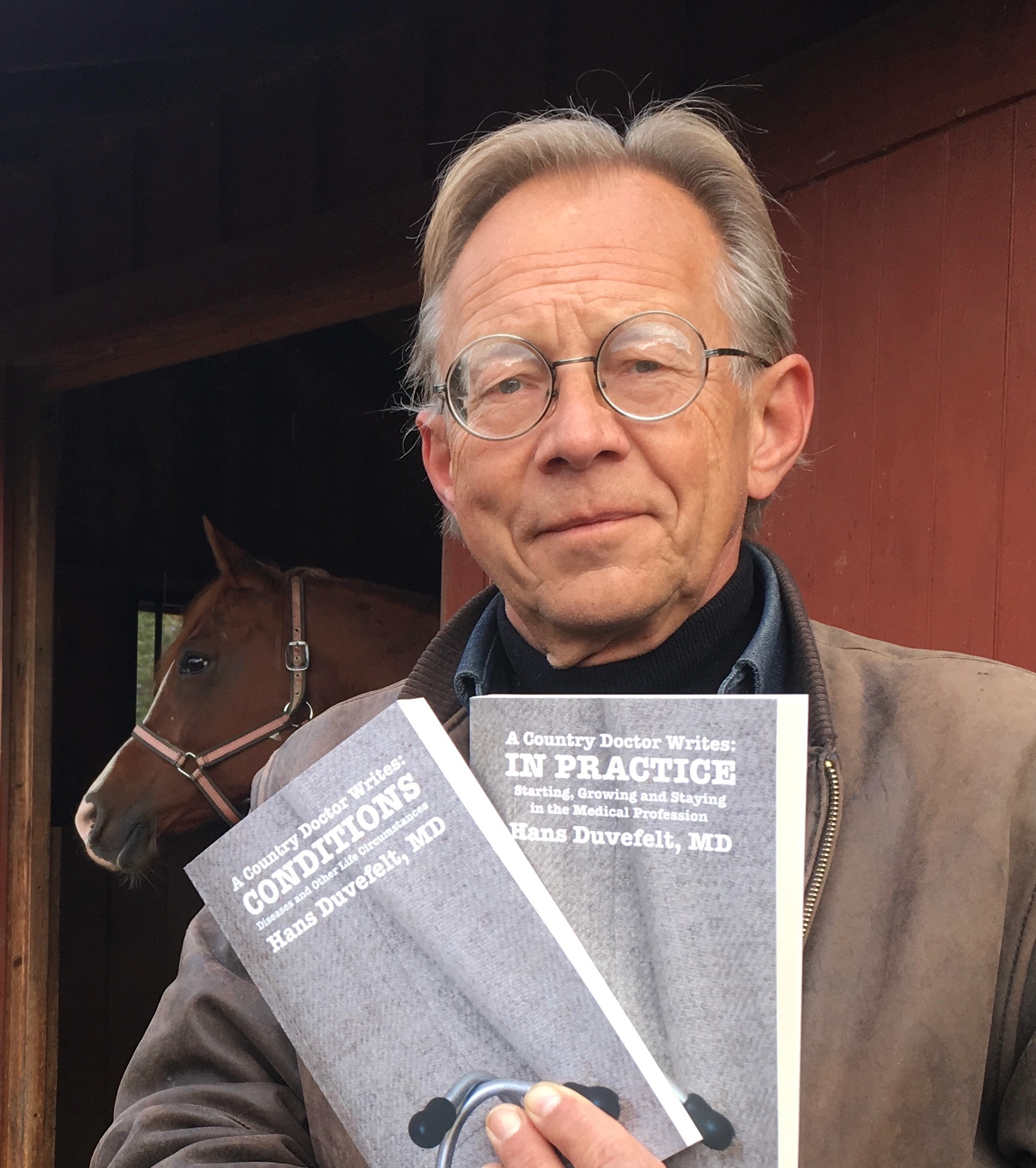
BOOKS BY HANS DUVEFELT, MD

CONDITIONS, Chapter 1: An Old, New Diagnosis

Top 25 Doctor Blogs Award

Doctor Blogs

Enter your email address to subscribe to this blog and receive notifications of new posts by email.

Mailbox

contact @ acountrydoctorwrites.com
Bookmark and Share
© A Country Doctor Writes, LLC 2008-2022 Unauthorized use and/or duplication of this material without express and written permission is strictly prohibited. Excerpts and links may be used, provided that full and clear credit is given.