Archive Page 10

Do Something, Do Nothing or First Do No Harm?

The other day, I reposted a piece from 2010 on my Substack, titled Doing Nothing, about an older woman who elected to leave her blood pressure untreated rather than putting up with the side effects she had experienced with every blood pressure medication she had tried.

When it comes to cardiovascular risk, I often use the American heart Association/American College of Cardiology risk calculator. But it doesn’t go beyond age 79. I use it a lot to show patients that statistical impact of quitting smoking, controlling blood pressure or taking cholesterol medication. Just to illustrate, I imagined a 79-year-old woman, non-smoker, who has high blood pressure and let the app tell me how much cardiovascular risk would be reduced if I put her on blood pressure medicine. Untreated her 10 year cardiovascular risk would be 36.3 if she were 79. The optimal risk is 18.4% and the impact of controlling blood pressure would be a reduction down to a 10 year risk of 26.6%. The woman in my story was much older, so her risk would be much higher than 36%.

I find that people have an easier time handling statistical odds if you also give them the probability of nothing bad happening. So, Ms. perfect would have an 81.6% probability nothing would happen. The 79 year old with untreated high blood pressure would still have a 63.7% chance of being okay, but could improve that to 73.4% by taking blood pressure medication.

The woman in my story was 88 years old. According to the Social Security Administration tables, her remaining life expectancy would be just over 5 1/2 years.

Her decision was to stay away from medications because they made her feel bad. It was a quality of life choice she made. I couldn’t blame her. Doctors these days get graded on what numbers our patients achieve. A blood pressure of 140/90 or more is a failing grade and 139/89 is a passing grade. Statistics like that one impact our practices’ bottom line and possibly our own salaries and at least our quality ratings on various websites.

So how bad do doctors feel if their older patients are not “at target“ with blood pressure, cholesterol and other things that we are being graded on? And how good do we feel if we let patients decide for themselves what their priorities are?

You can’t always both ace your quality metrics and also be patient centered at the same time. It’s easier to be hung-ho in getting a 40 year old to quit smoking than it is to make an 88 year old with a remaining life expectancy of less than 6 years to suffer from medication side effects for the rest of her days.

A Wide Range of New Year’s Celebrations

Something I wrote on my Substack a year ago…with an update.

I don’t think it matters so much how we celebrate the new year, just as long as we pause and reflect, in case we need to make some course corrections. And as long as we celebrate the symbolic new opportunity that a new year brings.

As an only child in a family with a relatively small social circle, New Year’s was never a big hullabaloo when I was growing up. In my late teens, I was a scout and part of a group that wanted things to be more rugged. We hijacked the American name, Explorers,and dressed in green overalls with an emblem painted on the back, and one of the things we did was celebrate New Year’s by hiking in the woods in the snow regardless of the temperature. We had army tents, very similar to the one in this picture and there was a little stove in there, but of course you still needed the most expensive sleeping bag you could buy in those days. I still have mine. When I have had to sleep in the horse barn on cold winter nights, I have resorted to using that, I still have mine, bought in 1970. Pretty amazing durability.

Fast forward to the 2000’s, black tie, multi-course dinners with dancing at Chateau Frontenac in Quebec several years in a row, and now home cooked Swedish holiday meals with children, grandchildren and girlfriend right here in Caribou, Maine. We cook together and eat the traditional Swedish holiday foods and we may play some silly games. Then we melt soldering “lead” and pour it into cold water and analyze the shapes created, which are supposed to foretell the next year’s biggest events.

All ways to celebrate are good, there is a time and a place for everything. In fact, this year will be different from the last few because my daughter just changed jobs and can’t get New Year’s off. So, Della and I will celebrate by ourselves with dinner, a movie and watching the ball drop at Times Square, where we just visited a couple of weeks ago. And Asti Spumante at midnight!

Happy New Year!

Who’s a Diehard Allopath? Not Me, Actually

An Early and Late Career Collaboration

See Dr Lilian White’s post at

https://learningmedicine.substack.com/

I was trained in allopathic medicine, which is sometimes referred as Western medicine. The Greek word implies treatment with the opposite of what causes our patient’s suffering. It was coined by Samuel Hahnemann, the father of homeopathy. Homeopathy means treating like with like, giving very small doses of substances that in higher doses could cause the very symptoms our patient has.

There was intense competition between the two practice philosophies. At one point in the United States, the homeopaths seemed to have the upper hand. They even formed their American Institute of Homeopathy in 1844, three years before we got our American Medical Association off the ground.

Eventually, allopathic medicine became the leading practice in this country and homeopathy became sidelined. But here and there, homeopathic principles made their way into Western medicine. Robert Koch developed tuberculin in 1820, an extract of the TB bacillus, and tried it in hopes of curing TB, starting with very small doses. That ultimately didn’t work well enough, but tuberculin became a way to test for exposure to TB. Vaccines introduce miniscule doses of parts of viruses or weakened forms of viruses to prevent disease. Allergy shots are made with “homeopathic” doses of the very substances people are allergic to. And even in behavioral health and psychiatry, we widely practice desensitization for phobias. There, too, we use miniscule pictures of what a patient may be afraid of, starting with a picture of a stick figure of a very small dog far away, for example. So, none of us allopathically trained doctors can say that it is always wrong to treat, or at least prevent, disease or suffering according to the principle of treating like with like.

Another practice of medicine originated with Andrew Taylor Still in 1874. He called it osteopathic medicine. Trained as an MD, he looked for alternative ways to prevent and treat disease. He took Hippocrates view that all parts of the body are interconnected and viewed the musculoskeletal system as fundamental in that regard. Osteopathic means suffering of the bones. Physical manipulation of the musculoskeletal system is paired with an emphasis on prevention and wellness, which are an ever-increasing part of what allopathic physicians also practice. And as far as connection between body parts and their influence on each other, the P6 acupressure point near the wrist and its relation to nausea and vomiting is fairly well accepted, for example.

And, speaking of interconnectedness between body parts, we now have concepts like psychoneuroimmunology, PNI, “a discipline that has evolved in the last 40 years to study the relationship between immunity, the endocrine system, and the central and peripheral nervous systems”.

This brings me to the term “placebo effect”, which we use as a derogatory way of explaining why patients can appear to get better from therapies we don’t believe in. For example, homeopathy is probably only that according to many allopaths.

But, what if our bodies have a much greater ability to heal than we ever imagined, now that we even know some of the mechanisms behind that? What if a harmless homeopathic dose of a substance with a suggestive name can trigger a positive chain reaction of psychoneuroimmunological events in our bodies? Compare that with the nocebo effect of having to list all the possible side effects of the medicines that we allopaths prescribe – and many of them have very real risks. Ortega and others wrote in 2022:

The placebo effect can be defined as the improvement of symptoms in a patient after the administration of an innocuous substance in a context that induces expectations regarding its effects. During recent years, it has been discovered that the placebo response not only has neurobiological functions on analgesia, but that it is also capable of generating effects on the immune and endocrine systems. The possible integration of changes in different systems of the organism could favor the well-being of the individuals and go hand in hand with conventional treatment for multiple diseases. In this sense, classic conditioning and setting expectations stand out as psychological mechanisms implicated in the placebo effect. Recent advances in neuroimaging studies suggest a relationship between the placebo response and the opioid, cannabinoid, and monoaminergic systems. Likewise, a possible immune response conditioned by the placebo effect has been reported. There is evidence of immune suppression conditioned through the insular cortex and the amygdala, with noradrenalin as the responsible neurotransmitter.

So, I think we could borrow from other schools of thought in order to better help our patients. And I absolutely think the allopathic healthcare “system” has made it harder and harder for us to promote healing because of the bureaucratic and regulatory requirements it imposes on us. They make it harder for us to live up to one of my personal favorite concepts – when the doctor is the treatment.

When the Doctor is the Treatment

Christmas Reflections at Winter Solstice

When the sun set this afternoon, it had been one of the shortest stretches of daylight hours in my life – since I moved to this country at age 28, that is. In Caribou, Maine we had about 8 1/2 hours of daylight today. In Uppsala, Sweden, today only had just under six hours of daylight. Sunrise there was at 8:50 am.

I was born at 2:30 in the afternoon on July 18 near Stockholm. That day the sun set around 9:45 pm – 7 hours and 15 minutes of daylight on a day I got a late start.

No wonder we Swedes burn a lot of candles in the winter. Our ancestors did, and they created rituals around them, from the four Advent candles to Saint Lucia with candles in her hair to lots of little live candles in the Christmas tree. That particular ritual now involves electric lights, thank goodness.

Between the darkness and the cold of winter, in Sweden and Maine both, everything seems a little harder to do. I remember when I had manual transmissions in my cars, it was sometimes very difficult to move the stick shift because of the viscosity of the transmission fluid in cold weather.

My own gear shifting is a little sluggish this time of year. I feel like winding down as it gets dark around four in the afternoon. I do get less done around the house and am more likely to just watch a show or movie on my big screen, listen to music, read or write in my library/media room.

I do think back over the year that has passed and think about the year to come. I do try to show up for my Suboxone patients extra meetings to help them get through the holidays. And I always put my thoughts down on this platform every year.

I have wrangled Sir William Osler’s words into a Christmas message for today’s frontline physicians, I have incorporated the Hebrew Mezuzah as a concept for myself and I have written about my shrinking world during the pandemic.

Since my divorce and my move back to Caribou almost five years ago, I have found new rhythms and new traditions for Christmas and New Years, but this year looks like it will be different because of the work schedules of everyone involved. A little bit like the pandemic, my world may seem smaller for a while. But there will be other times to get together as a large extended family.

This year I am making plans for some more ambitious home improvement projects I’ve been thinking about ever since I moved back to my little farm. I have to finish some remaining trim work in my library and more than one person has told me I should dust off my guitar (literally) and make music again.

I guess one conclusion here is that things don’t always turn out exactly as we have planned. That’s certainly no news to me. But that doesn’t mean we can’t do something enjoyable and meaningful no matter where we are, no matter who is missing in that particular moment and no matter what new things we might end up doing instead of what we did last year.

Subjective Pain Assessments are Disappearing. As a Medicare Quality Metric, that is

Quality in medicine is a moving target. I have reflected and written about this topic many times, perhaps most recently in March of this year. When I was medical Director in Bucksport, Maine, I did not allow the use of numeric pain scales for the simple reason that frame of mind influences perception, and even though opiates are often effective as anxiolytics and antidepressants, there are safer treatment options. It is ironic that it takes so long for medical evidence to be adopted into practice (17 years average), and then when it comes to quality metrics there is another delay on top of that. Well, anyway, I was just informed that pain assessments for Medicare patients’ quality scoring is about to be “retired“ with the beginning of the new year. Thank goodness.

Of course, we still need to deal with patients who have pain, but assessing pain is not straightforward, much less numeric. We need to understand the significance, the symbolism and the psychological components of what people view as pain. Narrative medicine, if you will.

Mandatory Pain Assessments Are Such a Pain


I just realized none of the posts show on an iPad or a computer, but they do show on an iPhone. WordPress is working on this. In the meantime, please visit my Substack.


Osler said “Listen to your patient, he is telling you the diagnosis”. Duvefelt says “Listen to your patient, he is telling you what kind of doctor he needs you to be”.


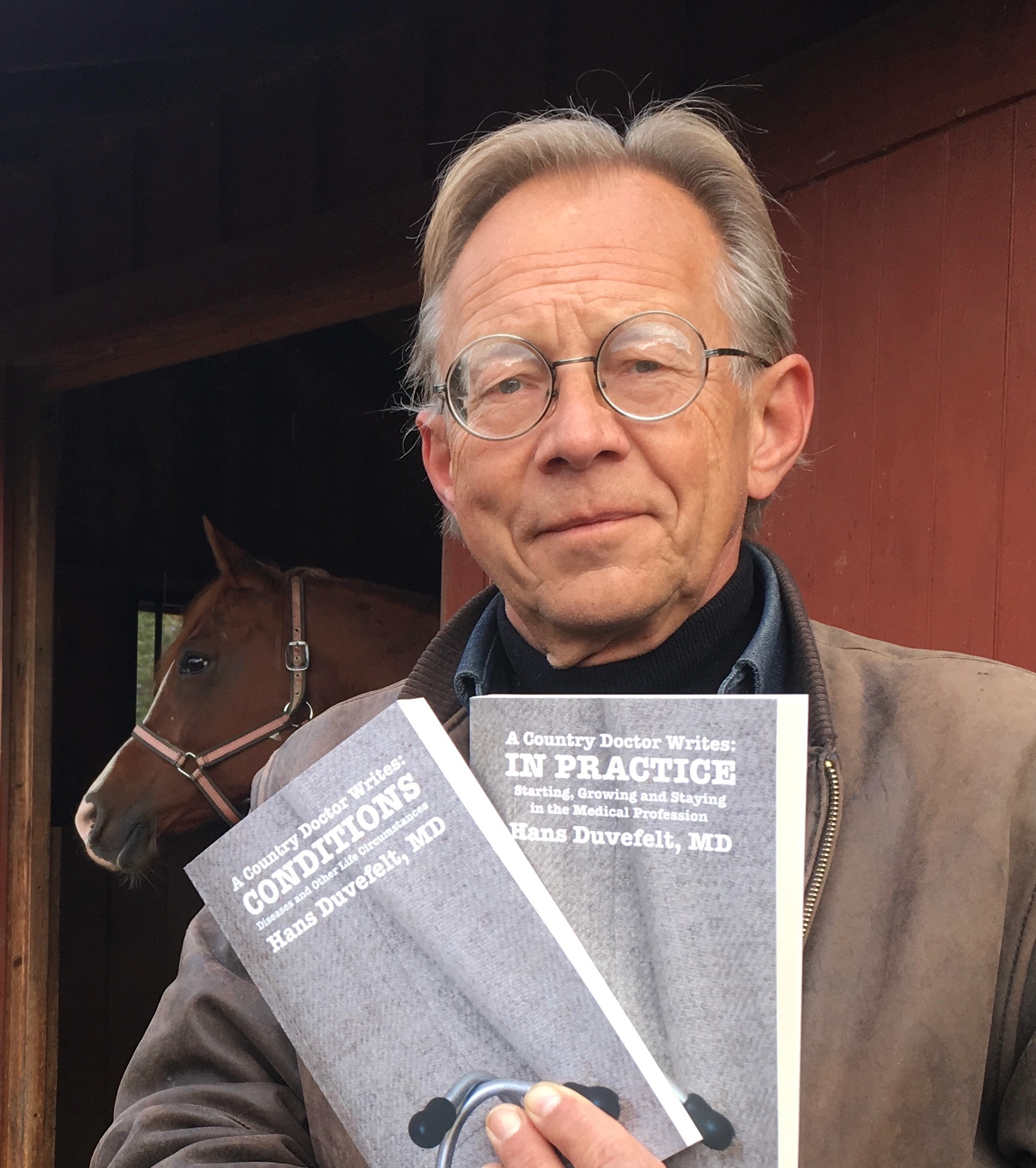
BOOKS BY HANS DUVEFELT, MD

CONDITIONS, Chapter 1: An Old, New Diagnosis

Top 25 Doctor Blogs Award

Doctor Blogs

Enter your email address to subscribe to this blog and receive notifications of new posts by email.

Mailbox

contact @ acountrydoctorwrites.com
Bookmark and Share
© A Country Doctor Writes, LLC 2008-2022 Unauthorized use and/or duplication of this material without express and written permission is strictly prohibited. Excerpts and links may be used, provided that full and clear credit is given.