Archive for the 'Reflections' Category


An Outsider’s View of Cardiology

When I started my first internship, back in Sweden in 1979, I worked under a fifty-something cardiologist who spoke slowly with a southern drawl – yes, there is a southern drawl there, too, slightly reminiscent of Danish, spoken not far from where my supervisor grew up.

He epitomized the the old school of cardiology, before it became a procedural specialty. He diagnosed heart murmurs by auscultation with his stethoscope, and he even claimed he could hear faint cardiac rubs or pulmonary râles in patients who were having a heart attack. He seemed to share the temperament of neurologists – slow and methodical master diagnosticians with, very much then and to a degree also today, limited or no treatment for a substantial portion of the diseases they diagnose.

In 1979, color Doppler echocardiography was not yet invented, and coronary angiography was not available where I worked. Cardiology was a purely cognitive specialty. The most important condition cardiologists treated, angina pectoris, was diagnosed on the basis of history, physical exam and at most a stress EKG.

Over just two decades, cardiology became a procedural specialty, and the diagnosis and management of angina became high tech with nuclear imaging, coronary angiography, cardiac stenting and bypass surgery. The view of angina became focused on stentable, “critical” lesions.

But people still died from heart attacks, even with only minor blockages on angiography and normal nuclear stress tests. And patients with classic angina symptoms were told they had non-cardiac chest pain if their stress EKG was abnormal but their nuclear scan was normal, or if the EKG and scan were abnormal, but the angiogram showed no critical stenosis. For over 100 years, the term “pseudoangina” was used to characterize this syndrome.

Every few years I would ask whichever consulting cardiologist seemed the most approachable, and every time I would get essentially the same answer: Angiogram trumps MIBI, MIBI trumps EKG, EKG trumps clinical history, kind of like the old rock-paper-scissors game.

Ironically, in 1973, the year before I started medical school, Harvey Kemp coined the term “Cardiac Syndrome X” for effort angina with normal coronary arteries. We now have some understanding of the mechanisms behind this condition, and this has led to some techniques for proving and studying it, but the diagnosis is largely clinical. We essentially don’t do coronary angiography with injection of adenosine or acetylcholine, measurements of coronary flow reserve, single photon emission computed tomography, positron emission testing or stress cardiac magnetic resonance imaging, at least not at Cityside Hospital. One thing we have learned is that this condition does progress relentlessly in 20-30% of cases and causes heart attacks and death in some patients, even though this was initially thought to be very rare.

The most dramatic development in cardiology in the last twenty years is probably our understanding that rupture of non-critical cholesterol plaque, small enough to go undetected during routine EKG or nuclear stress testing, accounts for somewhere around 85% of all heart attacks.

So much for all the angiograms, elective stents and bypasses cardiologists have been doing. In acute coronary syndrome, which is unstable angina or a heart attack without classic EKG changes of a completed heart attack, there is still an important role for urgent cardiac catheterization, but its role in stable angina or asymptomatic coronary stenosis is debatable at best.

So, now cardiologists are having to reconcile that their angiograms are a most imperfect predictor of disability and death, their stents don’t save lives except in acute coronary syndrome, and more and more of their patients will be plodding along with medical management of coronary disease that doesn’t show up on angiograms. They may find themselves tinkering with medical management of an incompletely understood syndrome, choosing drugs and dosages based on -gasp- patients’ subjective histories and clinical experience.

The pendulum is swinging back; a circle seems to be completed. Will cardiologists become slow and methodical internists again?
All I Want For Christmas: Seven Things I Wish My EMR Could Do

Dear Santa,

I’ve been a very good doctor all year. I have checked all my boxes and aced all my Meaningful Use requirements. This year, I’m not asking you for anything fancy. I just thought you might be able to instill some kindness and good will into the people who designed the user interface of my EMR. Maybe, with your help, they would come to see how a few minor tweaks could make the practice of medicine safer and more efficient, and my day a lot more enjoyable than it already is:

1) I wish I could see a routine laboratory panel, like a CBC or a CMP, in one view without scrolling inside a miniature window. That would save time and help me not miss abnormal results.

2) I wish the patient’s next appointment date was displayed next to any incoming report I have to review. That would help me decide if I need to contact the patient about the results or if I’m seeing them soon enough that I can talk about the report then.

3) I wish I could split my computer screen so I could see an X-ray or consultation report or a hospital discharge summary at the same time as I type or dictate the narrative of my office note. That would help me quote them correctly.

4) I wish, when I open a patient’s actual visit note for today, the place where I do my documentation, that I could automatically see at least the beginning of the latest of every category of information we have received – latest labs, X-rays, outside reports and phone calls. It takes too much time to go searching in the places for each category separately just in case there might be something recent to catch up on in the visit.

5) I wish my EMR would know that prn medications, such as nitroglycerin, are not meant to be used for only a limited time, like 30 or 90 days, and would agree to e-prescribe them without a “duration”. If I could do that, they would not disappear from the medication list all the time.

6) I wish my EMR would automatically display the patient’s kidney function and allergies next to where I pick what medications to prescribe. That would make prescribing quicker and safer.

7) I wish my EMR wouldn’t alert me to drug warnings and interactions that are too obvious to need reminders for. I mean, any doctor would know that adding a second diabetes pill can cause low blood sugar (that’s why we do it) and that combining two drugs that can cause fatigue may cause even more fatigue! More intelligent warnings would be taken more seriously; now my trackball finger is automatically poised to close the “warning” pop-up, because I’m expecting it to be irrelevant.

I’m sure if I tried, I could think of an even ten wishes, or maybe even twelve – one for each day of Christmas. But these seven things illustrate the underlying, fundamental wish I have: that my EMR will evolve to be more user friendly. I wish, now that the basic functionalities of EMRs are in place, that somebody comes back to people like me and asks how to take this thing to the next level.

“This is America, You Don’t Have to Do Anything!”

“I just want you to know, I won’t have a colonoscopy”, my new patient said with some amount of fervor in his voice. “And I don’t want to take a lot of medications.”

I looked him straight in the eyes and said “This is America, you don’t have to do anything, and I work for you. My job is to help you know your options.”

He seemed to relax. I reflected on the words I had just uttered, yet another time – it is the way I often try to set the tone as a non-authoritarian, patient focused physician. “You don’t have to do anything”, of course, only applies to the patient. The doctor has to do a lot of things, like document a treatment or follow-up plan for Medicare patients with a BMI over 30, or provide computer generated patient education to a minimum percentage of patients, and achieve a certain percentage of e-prescriptions. And right about now, we are starting to see financial consequences if too many of our patients, like the man I had just met, don’t want to take the medications that can bring their blood pressures or blood sugars below certain targets.

My new patient illustrated plainly how impossible it is to be practicing both “evidence based” and “patient centered” medicine in a climate where doctors are held responsible for “outcomes” that are the result of patients exercising their free will.

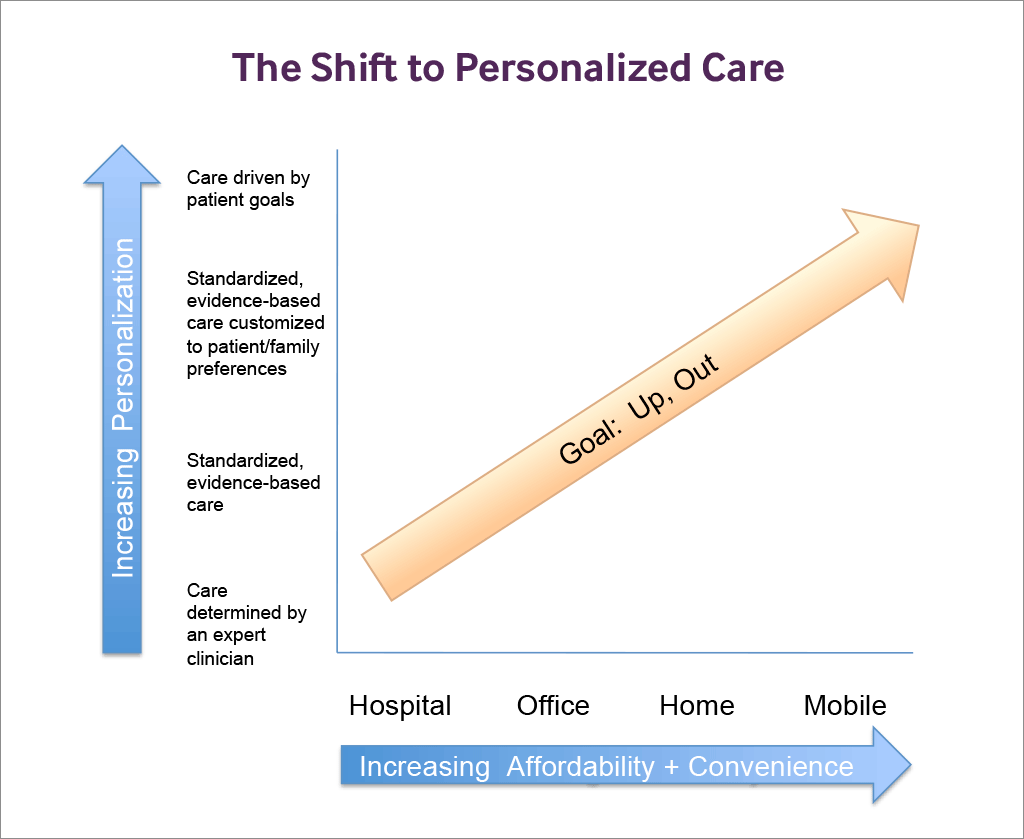
Later, at home, I was reading The New England Journal of Medicine and came across a series of online posts about transforming healthcare. In one, Dr. Amy Compton-Phillips illustrates the way she feels healthcare has started to and must continue to evolve. She seems to think this nation will move “up, out” from “standardized, evidence based care” to “care driven by patient goals” very soon:

IMG_0109.PNG

(Image credit: http://catalyst.nejm.org/care-redesigned-for-a-new-age/)

I wonder how likely it is that payers like Medicare and for profit health insurers will loosen their grip on doctors’ day to day adherence to practices that are proven or at least strongly believed to save them money and benefit the greatest number of people, and instead allow the premiums they collect to satisfy individual, idiosyncratic patient preferences. That would reduce them to conduits for money, and strip them of their powers as arbiters and enforcers of “best practices”.

In fact, I seem to remember that’s what insurance companies were like when I was a resident more than thirty years ago. That was when doctors were supposedly authoritarian and paternalistic. In Family Medicine, that was certainly not the case – we were trained to put our patients’ values and preferences first. And back then, we didn’t get “dinged” by authoritarian, paternalistic insurance companies if our patients exercised their rights and declined to follow our advice.

I hope Dr. Compton-Phillips is right, and that healthcare in this country finds its way up and out of this oxymoronic situation that certifies clinics as “Patient Centered Medical Homes”, yet punishes them when they respect their patients’ wishes.

Art and Archetypes in Medicine

The cognitive part of the practice of medicine spans between two extremes, from registering and recognizing the most minute nuances of human and biological expression to seeing the overarching big picture of complex constellations of details.

Like the arts of painting and photography, it requires us to see both the unique and the universal in the most ordinary manifestations of everyday human life. But instead of capturing with imaging tools what we see and perceive, we turn those impressions and observations into the understanding and interventions we call diagnosis and treatment.

The art of medicine involves both technical mastery of treatment and the carefully honed ability to register, analyze and evaluate a vast array of what we might call data. While there is still respect for masterful treatment, perhaps especially when it is of a technical or procedural nature, there is growing disdain and disrespect for what we used to call clinical judgement. In picking stocks, web design, marketing and many other human endeavors, experience seems to have retained or even expanded its value, but in medicine it is often downplayed or even ridiculed.

Non-physician healthcare thinkers have evangelically big hopes for “data”, entered into medical office computers by fallible, disillusioned (think “Meaningful Use”) and distracted humans and new generations of “connected” medical instruments, and analyzed by centralized computers at Medicare, research institutions or big insurance companies. The vision is that more data will unlock the hidden potential for economies of scale and unseen patterns of disease, and generate vastly improved accuracy and efficiency of diagnosis and treatment.

But more data doesn’t always lead to better insights. Borrowing from other arts, a well-written poem can sometimes convey to the reader as much as a novel. And the weight of each piece of “data” isn’t the same to an experienced physician as it is to a computer. Humans in the healing arts can do the work of a recording device, a lie detector, a microprocessor, a translator, a judge, a pastor and a teacher.

In real therapeutic encounters, the agenda is not always the stated one, the given history isn’t always accurate and the clinical exam isn’t always typical or even relevant; sometimes the physician gives more weight to the unspoken clues in a case, something a computer isn’t likely to do.

Even our definition of disease lends itself poorly to interpretation and intervention guided by a computer. Examples are obesity, diabetes and chronic back pain. The measurable parameters of these conditions, biometrics, average laboratory values or pain rating scales, tell little about what role the disease plays in the patient’s life. And, unlike routine cases of pneumonia or step throat, sometimes the disease defines the person across a whole lifetime, and takes on archetypal meaning. Just talking numbers isn’t likely to change the manifestations of such conditions. Only going to the depths of the subconscious can alter the trajectory in most such cases. It would be naive to think that computers can do anything for such patients. Only a human with considerable skill and wisdom can penetrate the layers surrounding the core of these conditions.

The art of medicine is making the connections on a personal, case-by-case level with the archetypes that most of us relate to on some level, but which almost never exist in the physical realm. But they exist in the inner lives of all of us, as heroes and villains, as our inner children, older selves, and better or worse incarnations of our own spirits.

Classic disease presentations are like archetypes; we look for them all the time, and we think we see glimpses of them, but we seldom see the true personification of them.

And, the most important archetypes of all in the realm of medicine, the Patient and the Healer, hover in the air above us in every clinic room, hospital ward and nursing home. Patients enter the therapeutic encounter with ancient perceptions of what healers can or should do for them, and providers have visions of how patients should behave; we fill these roles for each other in the slowly evolving ritual we call healthcare.

It is probably terribly inefficient, but modern life generally is; we are not machines, but an ancient species with stone age reflexes in a postmodern society.

Husbands and Wives

When a wife suddenly comes in for her husband’s appointment, I usually worry a little; when a husband shows up for his wife’s visit, I sometimes worry a lot.

I have come to expect that when I enter an exam room and a male patient has his wife with him in the room, she is there to make sure I hear some part of his symptom history that he has never told me before.

It may be vague chest pains after splitting wood, snoring and interrupted nighttime breathing, excruciating headaches or profound and worrisome memory lapses. Men can be minimizers when it comes to bodily symptoms, and women end up being the designated worriers in many families.

Sometimes, the wives talk about their husbands during their own appointments, and I can listen, but I can’t usually say much. Even if spouses have given me permission to share their medical information, the foundation of medical diagnosis and treatment is the exchange and relationship between doctor and patient.

Not infrequently, wives ask me to speak to their husbands about something without letting them know who put me up to it. That can be a difficult request to honor, but sometimes I know I am in a unique position to turn a bad situation around.

Concerns about things like problem drinking are easy to handle, as we are expected to screen for those sorts of things anyway. Less straightforward is the angry and irritable husband who himself denies any psychological symptoms when I screen him for depression in the office. Not long ago, such a husband admitted to insomnia and feeling some stress but denied that it affected his mood or behavior. I treated his insomnia with an antidepressant that is commonly used for insomnia, rather than a straight sleeping pill. He was pleased with how the medicine worked, and his wife was very grateful when she told me he wasn’t just sleeping better, but he also wasn’t tense or edgy anymore.

One request I get periodically is from wives of recently retired husbands to help get the men to stop following them around, questioning and offering helpful advice about everything the wife used to do without the husband’s interference all the years he was working. “Please tell him to get a hobby or something“, is a plea I have heard more than once. In that kind of situation I offer what sounds like generic advice I might give to anybody in that particular stage of life.

Two things about wives’ visits worry me.

The first thing is the wives who come in numerous times with multitudes of concerns. Usually the underlying problem is somatization and anxiety, which can often be very difficult conditions to make better, but sometimes the source of the psychosomatic symptoms or anxiety is a bad or abusive marriage that the patient may or may not be admitting, even to herself.

Sometimes the frequent return visits of wives, or in some cases mothers with children, are acts of self-protection in situations of domestic abuse. By going to the doctor’s office often, abused wives sometimes create a measure of relative safety by indirectly letting her husband know that there is someone who will notice if she is distraught from emotional abuse or if she has a bruise or any other visible sign of physical abuse.

The second worrisome type of wife visit is when the husband starts coming in. Unlike the wives who add to their husbands’ medical history, a lot of men who come in for their wives visits sit quietly and just listen. That raises the possibility that instead of being there out of concern for her health, he could be there to discourage her from revealing anything about a bad or abusive relationship.

Nobody wants to be paranoid, but as members of a healing profession, our mission is not only to prevent and treat disease, but also to prevent and relieve suffering when we have the opportunity to do so.

One in four women in this country will experience domestic abuse in her lifetime, which makes this a true epidemic, almost as prevalent as obesity. Are we physicians considering it in our differential diagnosis often enough?


I just realized none of the posts show on an iPad or a computer, but they do show on an iPhone. WordPress is working on this. In the meantime, please visit my Substack.


Osler said “Listen to your patient, he is telling you the diagnosis”. Duvefelt says “Listen to your patient, he is telling you what kind of doctor he needs you to be”.


BOOKS BY HANS DUVEFELT, MD

CONDITIONS, Chapter 1: An Old, New Diagnosis

Top 25 Doctor Blogs Award

Doctor Blogs

Enter your email address to subscribe to this blog and receive notifications of new posts by email.

Mailbox

contact @ acountrydoctorwrites.com
Bookmark and Share
© A Country Doctor Writes, LLC 2008-2022 Unauthorized use and/or duplication of this material without express and written permission is strictly prohibited. Excerpts and links may be used, provided that full and clear credit is given.