Archive for the 'Reflections' Category


Don’t Ask Me to Work for the Other Side

As a physician with a strong sense of calling, I always see myself working for each patient, regardless of who pays the bill. Following in the footsteps of role models like Hippocrates and Osler, how could I do anything else?

Ted Ross has been my patient for decades. He can’t seem to lose weight.

John Jackson has admitted he doesn’t know how long he can keep doing the kind of work that has supported his family until now.

Ted is a long distance truck driver. He needs a DOT physical. Because of the new requirements, he will probably need a sleep study to rule out sleep apnea. If he fails, he could lose his job, because we all want to feel safe on our highways.

John came in with back pain the other day. As I filled out the Workers Comp M-1 form, he sighed “this may be it for me”.

John told me his back started hurting when he lifted a washing machine at work. As long as his employer’s Workers Comp carrier doesn’t challenge the claim, he’s covered for medical costs, rehabilitation and disability income, possibly even for life. If it had happened at home, on his own time, he would not be entitled to anywhere near the same benefits.

Medicine is a very personal business. A trusted provider hears more than a stranger and his or her words have more impact. Our patients assume we are there to help them. But sometimes we are put in a position of working for someone else, against our own patients.

In Ted’s case, I won’t be the one to tell him that his job is on the line because of his obesity. When the new requirements and certifications for performing physicals for the Department of Transportation went into effect, I simply didn’t pursue them.

In John’s case, as the treating physician, I have to file regular reports with his employer’s insurance company, and every test or referral I want to make has to be approved by them. If I keep him out of work longer than they expect or prescribe more pain medication than the average situation requires, I get a call from an insurance company nurse whose job it is to bring my treatment in line with their expectations.

It is impossible to overlook the fact that his employers Comp carrier is trying to direct John’s care; they are the ones who pay me for each one of his visits.

If other life circumstances come into being while I am treating him for his back injury, I have to be very careful not to spend too much time talking about them, and I certainly can’t put any of it in his record, since every Comp visit goes to the insurance company for review. I have to constantly remind patients that a Comp visit is a legal document, to be used in what amounts to a case of litigation.

If I could help it, I wouldn’t treat Workers Compensation cases for the same reason I don’t do DOT physicals: I never want to represent an authority or institution that can be seen as the opponent of patients I need to have a therapeutic relationship with.

If John’s Comp carrier were to claim that since he went to the Cityside Hospital emergency room with low back pain after a minor car accident ten years ago, he had a preexisting back problem, his medical expenses could bankrupt him. He has a high deductible health insurance. If he can’t go back to work, he will have 26 weeks of reduced-pay short term disability benefits. After that, he’d have to apply for Social Security Disability, which could take several years.

If Ted loses his DOT certificate, how can I be effective as his personal physician with my signature on the document that cost him his career? And if he were to commit suicide, as some middle aged men who lose their jobs do, could I counsel and care for his wife and daughter?

I often think about my native Sweden in cases like these. I saw many things that frustrated me when I worked there after graduating from medical school, but they didn’t have one level of health and disability benefits for injured workers and little or no help for people who got hurt on their own time. That is a pretty arbitrary and inhumane way of stratifying health care.

If you’re hurt, you’re hurt, regardless of whose fault it is. (I’ll tell you about Sweden’s no-fault medical malpractice payments some other time.) And if you seek help from a doctor, you expect the doctor to be working with your best interest in mind. And if the society you live in doesn’t take good care of people who are sick or injured, you may have trouble accepting that your doctor is putting the good of “society” or “the system” before your most urgent needs to put food on your family’s table.

Primary Care Has a Dirty Little Secret

We are like restaurants that charge handsomely for sit down dinners but give away food for free at the takeout window. And we pay our providers only for serving the dining room guests. If traffic gets backed up at the drive-through, we hold our providers responsible, even though we never planned for our ever increasing demand for takeout.

In simpler times, patients went to the doctor when they felt unwell, and doctors didn’t claim responsibility for what patients did on their own time between visits.

Now, doctors are working just as hard taking care of patients in the office, but they are also expected to, on their own time, handle all sorts of ongoing hand-holding between visits. This happens through phone calls, electronic messaging and reading and commenting on endless streams of reports from case managers, specialists, hospitals, emergency rooms, walk-in clinics, pharmacy benefit managers, insurance companies and medical supply companies.

There is talk about how all this extra work will some day generate income streams from cost savings and improved outcomes, but today, the very foundation of how doctors get paid is how many patients they see in the office on a daily basis. Few health care organizations have the cash on hand to schedule provider time for what isn’t going to bring money in during the present budget year.

The dirty little secret we all deal with in primary care is that we make our doctors, PA’s and NP’s see as many patients as they possibly can, with ever increasing demands on the complexity of care they deliver, and on the comprehensiveness of their documentation and quality reporting, and then we quietly assume they will be able to do all this extra, unscheduled and uncompensated work without falling behind, making medical mistakes or simply burning out.

Imagine a CEO who spent all day in meetings and never had any time to himself or herself available to think, plan or write.

Imagine an average office worker, who is said to spend 25% of their time on business related email, suddenly being told that all company emails from now on have to be done outside working hours.

Imagine a judge, presiding over case after case at the bench from 8 am to 5 pm, without any scheduled time to read briefs or write judgements.

Imagine a TV anchor, broadcasting 8 hours a day, never taking any time to study the issues of the day or to speak with colleagues or newsmakers.

Imagine an orchestra, constantly performing, never practicing, never studying the sheet music.

And we are now offering resilience training to our medical providers to help them not burn out…

Today’s Medicine has no Credibility

This week’s issue of The New England Journal of Medicine once again questions two practices that used to be almost the backbone of primary care.

One article is about the low likelihood that prostate cancer detected through PSA screening will shorten a man’s life, even if he chooses just to keep an eye on it.

The other article is about how repeated mammography screening mostly leads to the diagnosis of small and not very aggressive tumors, just like PSA screening.

These two common health screening issues, along with the disappearance of all scientific rationale for cholesterol targets, baseline EKGs, digital rectal exams, testicle exams and “routine” lab work, not to mention routine physical exams, have essentially forced primary care doctors to rethink how they spend their days.

CMS has plenty of other things for us to do, although they still want us to do some of the things the evidence has debunked, and much of their vision for doctors falls within the Public Health domain.

As a result of these changes, physicians today face a serious credibility problem. The more dogmatic we have been before about following the guidelines that are now relegated to the history books, the more ridiculous we look to our patients as we more or less enthusiastically make our required 180 degree course corrections.

Thank goodness I always spoke of the guidelines as just that, current expert opinion, not something carved on stone tablets, handed down to us from Mount Sinai. As my father used to say, “view everything a little von Oben”. That’s the German expression for “from above”. The full phrase is von Oben heraus”, which rings of superiority and can even mean snooty.

As a physician, I am not putting myself above the expert opinion of the day, but I see myself as a humble servant and disciple, not of the current guidelines but of the principles of my forbears, from Hippocrates to Osler. If I take them seriously, and always speak of today’s guidelines as something likely to be temporary, I don’t seem to have to feel embarrassed when the guidelines change, which they inevitably do.

I think this attitude requires knowing your caft and its science well enough to be able to tell why the guideline looks the way it looks. Without the proper depth of knowledge you can’t be “above it all”.

Seriously, whether we are making guideline related u-turns without explaining why suddenly our practice is changing, or reciting all the possible side effects of a medication we are about to prescribe, we are making ourselves look bad compared to other practitioners, whose research isn’t double blinded and who aren’t mandated to badmouth their own treatments the way we are.

With guidelines coming and going, promising new drugs suddenly disappearing from the market, and with so many of our favorite prescriptions barely more effective than placebos, we need to go back to the source for the physicians of yesterday and those of the future:

Know your science, view today’s guidelines from a historical perspective and don’t be completely immersed in today. Because the present is just the razor sharp boundary between the past and the future.

“Just in Time” Information – Lessons from Manufacturing

One of the things that can cause physician burnout is the arcane way information flows in medical offices. In essence, due to EMRs we are the recipients of increasing amounts of unfiltered data without context.

Pre-EMR, team members sorted incoming data, which allowed us to deal with it more efficiently. We would have piles of things that needed a signature just as a formality, other piles for normal reports, smaller piles for abnormal reports, or whatever system worked best for us and our practices.

Because EMRs were created by people who never imagined that doctors themselves knew anything about how to maximize their own efficiency, results and reports now fill our inboxes in random order and demand our attention and our electronic signatures more or less immediately.

There is a better way. It is standard practice in manufacturing. They call it “Just in Time”.

First, let me describe the way it works now:

I saw Mrs. Keller three months ago for her diabetes. Next week, she will be back for her three month followup appointment. In the next few days, I will get her blood test results, each requiring my electronic signature. This time that might be her HbA1c and her annual urine microalbumin and a chemistry profile. I might also have received an eye doctor report from last week and a progress report from her podiatrist, neither one of which requires any action on my part. That means I must “steal” time from this week’s patients to peruse and electronically sign off five items, which I will have to review again when I see her next week. I also have to remember to flag the eye doctor report for my medical assistant to enter in the flowsheet so we can keep up our quality reports.

In my mind, I multiply Mrs. Keller’s five sign-offs by the number of followup visits I have every week. Even CT scans, MRIs and other imaging could be reviewed and signed off at the time of the followup visit; the radiology departments at all my area hospitals have routines in place to flag critical results.

Why should I look at everything twice? Why are physicians, the highest paid members of the health care team, essentially opening and sorting the mail?

I imagine how my day would flow if none of those five items cluttered my inbox, but popped up when I sat down with Mrs. Keller to talk about her diabetes or with Bill Watterson to talk about his partially torn meniscus.

In the lean, “Just in Time” manufacturing paradigm, factories don’t store parts and raw materials needed for production. They save space, time and money by planning for what they will need and having these supplies arrive just before they are needed.

In medicine, information like test results and outside reports are the parts we need in order to produce treatment plans, which is the output in our “industry “.

Most of the time today, we get paid only for face-to-face visits, and not for “managing” patients’ care. Even in the future, when Medicare starts paying us for outcomes, efficient information flow is essential. Imagine getting important information in random order versus delivered in context, when it is time to assess a patient’s or an entire population’s health status.

Between the skill and experience of our team members and the vast untapped potential of the expensive information systems we have, we could get to where we touch most incoming information only once, just when we need it. Imagine how much time, energy, frustration and money that could save us all.

Role Play

Physicians play many roles in patients’ health care and lives in general.

In one encounter we may be the only one encouraging a hesitant or discouraged person to look inside and outside themselves for the strength to move forward with a difficult decision.

In the very next appointment we may be taking charge as a patient develops chest pain and shortness of breath in front of our eyes.

We sometimes find ourselves in a position where we are uniquely able to challenge our patients by saying things they wouldn’t even let their own families tell them, just because we are their doctors, because of the authority they consciously or subconsciously are willing to give us.

Again and again I find myself in situations where I, the person, might hesitate about what to say or do, but I, the doctor, sense what my archetypal role is for that patient in that moment.

I regularly find myself filled with a sense of peaceful warmth, a sense of quiet certainty that changes my demeanor, posture, voice and words, as if I am carried by a greater force. I don’t have enough religious conviction to state for sure that I am at that moment under any kind of divine influence, but I certainly know that I, the doctor, handle all kinds of difficult situations better than I, the graying and nearsighted Swede.

I believe very firmly that I am carrying on the legacy of millennia of healers, the masters of modern medicine and the mentors of my own education. I am aware of my split second reflections about what my old eye doctor, my family practice residency director or the specialists I have observed and tried to emulate would have done in a given situation.

The role I play is bigger than the person I am. It gives me the ability to rise above my own shortcomings, to enlist whatever the source of my abilities is as I move through my daily list of patient encounters.

In this era of social media, lack of privacy and challenging of authorities, doctors sometimes sabotage themselves by revealing too much of themselves. This can detract from the important roles they are called to play.

Sir William Osler once said “look wise, say nothing and grunt”. I am sure it was tongue-in-cheek and for effect, but it was a warning not to speak mindlessly. He also spoke and wrote a great deal about pursuing equanimity, defined as mental calmness, composure, and evenness of temper, especially in a difficult situation.

Both pieces of advice encourage physicians to remain a little bit removed or apart, in order to effectively carry out the roles we are called to play in ministering to the sick. They also serve to enhance our abilities of observation and listening, the foundation of medical diagnosis.

Playing the different roles of a physician is not a frivolous game or charade. It is more like being a musician in a well tuned orchestra. Our demeanor, our voice and our words are our instruments. We use them, not to shine or stand out for ourselves, but to express and deliver our measured parts in a great symphony that touches both listener and player profoundly, albeit each one of us differently.


I just realized none of the posts show on an iPad or a computer, but they do show on an iPhone. WordPress is working on this. In the meantime, please visit my Substack.


Osler said “Listen to your patient, he is telling you the diagnosis”. Duvefelt says “Listen to your patient, he is telling you what kind of doctor he needs you to be”.


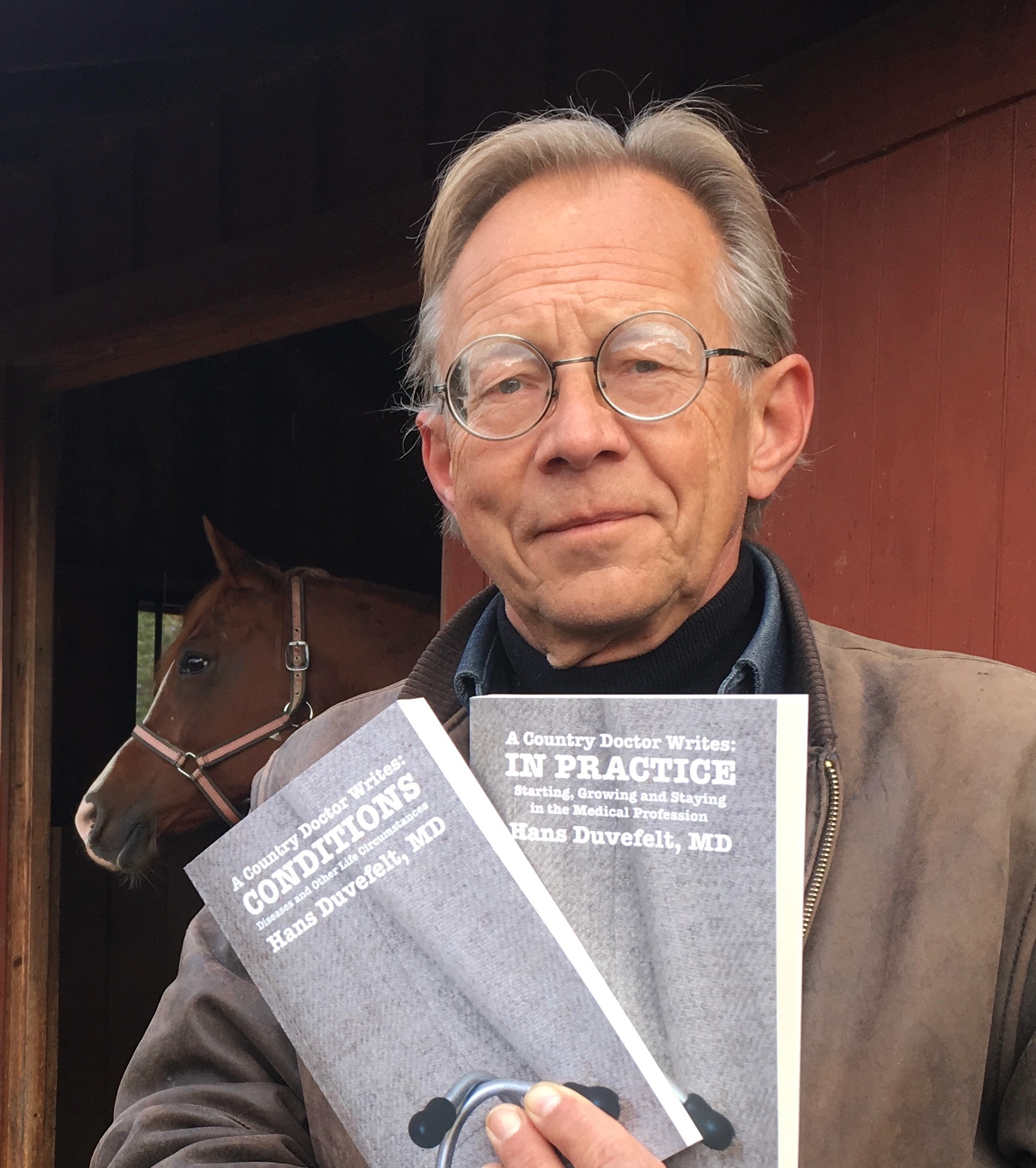
BOOKS BY HANS DUVEFELT, MD

CONDITIONS, Chapter 1: An Old, New Diagnosis

Top 25 Doctor Blogs Award

Doctor Blogs

Enter your email address to subscribe to this blog and receive notifications of new posts by email.

Mailbox

contact @ acountrydoctorwrites.com
Bookmark and Share
© A Country Doctor Writes, LLC 2008-2022 Unauthorized use and/or duplication of this material without express and written permission is strictly prohibited. Excerpts and links may be used, provided that full and clear credit is given.