Archive for the 'Reflections' Category


The Other Opioid Epidemic

“I made myself a hypodermic injection of a triple dose of morphia and sank down on the couch in my consulting-room….I told her I was all right, all I wanted was twenty-four hours’ sleep, she was not to disturb me unless the house was on fire.”
– Axel Munthe, MD, The Story of San Michele (1929)

When people in this country mention the opioid epidemic, most of the time it is in the context of addiction with its ensuing criminality and social deprivation, and the focus is on opioids’ medical complications like withdrawal, overdose and death.

But that is only one of the opioid epidemics we have. Far greater is the epidemic of largely compliant patients who take their modest three or four daily doses of opiates for pain that was originally described as physical, but which in many cases is at least as much psychological – not imagined, in fact often quite severe, but nevertheless without a physical explanation or available cure.

Stimulation of opioid mu-receptors in the central nervous system induces euphoria more reliably than it reduces pain. In fact low dose opiates have been shown to sometimes lower pain thresholds but at the same time allowing dissociation from the pain experience.

People who smoked opium in antiquity didn’t all have intractable pain to begin with; many had miserable lives, just like many of my countrymen today with health problems, low income, poor education, lacking social supports and limited prospects for even a sustainable future in a job market they cannot even begin to qualify for.

Most physicians have or know of patients who have remained on the same moderate or low doses of opioids for many years and never failed a pill count or a urine test. They show no addictive behaviors, but without their prescriptions they function less well. We are still tapering most of them down or off their pain medications because that is what we do these days in response to the more famous opioid epidemic and in an effort to have fewer opioids, legal ones, that is, in circulation.

Ronald is a 57 year old patient of mine with a bad back, diabetic neuropathy and generalized anxiety disorder. He has been off his 5 mg oxycodone-acetaminophen (paracetamol) pills for two years now, takes pregabalin for his neuropathy and escitalopram for his anxiety with a low dose diazepam as needed. Since he came off his pain pills, his anxiety has been almost paralyzing. Social stressors, like a move to a different neighborhood, sent him into a frenzy. Then he fractured several ribs moving his washer and dryer up the icy front steps of his new home. The emergency room gave him just a couple of days worth of his old pain pills.

“It was amazing”, he explained to me, “I felt a warm wave travel through my body and it was like I was being hugged and everything felt all right, like I didn’t have a single thing to worry about in the whole world, even my nerve pain seemed like it didn’t bother me even though it was still there.”

Next, he asked if he could stay on them, “just three a day”.

I shook my head no.

He has his three other pills that don’t work as well. But at least they’re not opiates.
Routine Physicals, Routine Labs

I still sometimes get messages from patients without known chronic illnesses who want “routine blood work” and “routine physicals”. This terrible set of medical myths just won’t go away. It is even getting promoted by well-meaning but misinformed employee wellness programs.

In spite of all the talk about evidence based medicine, patients and colleagues all around me are clinging to the antiquated misperception that disproven rituals like digital rectal and testicular exams, clinical and self administered breast exams, annual lipid profiles, PSA tests, EKGs and 20-item chemistry profiles have anything to do with good health and longevity.

A dozen years ago I started offering instead an “Annual Health Review”, a brief opportunity to talk about each patient’s individual risk factors, based on family history, personal metrics and lifestyle. I also did a symptom inventory or review of systems. But I did not check their sodium or vitamin D levels, their back molars or the lint between their toes.

That sounds a little like the new Medicare Annual Wellness Visit, but that one rigidly demands that every patient gets screened for exactly the same items (risking non-payment if a single thing is missed). The AWV is cluttered by more or less mandated silly, medically unproven items like baseline EKGs and visual acuity by means of the Norman Rockwell style eye chart (seniors need their intraocular pressures measured; even the DMV checks their acuity, at no extra cost).

The canned Routine Physical, no longer recommended by the US Public Health Service Taskforce on Prevention, is a relic from a bygone era. These days, when people can send out for their own personalized genetic profiles, their family doctors are stubbornly treating everyone according to the same yardsticks and protocols.

This costly ritual consumes more than half of the working hours of some doctors: Thirty minutes per patient times the “ideal” panel size of 1,500-2,000 patients amounts to 750-1,000 hours of a normal 2,000 hour year. Consequently we see our patients go to walk-in care or, worse, the emergency room when they get a cut, a headache, bronchitis or the flu, so we can keep doing all those physicals.

A Christmas Wish

It’s just after six o’clock on a Sunday morning in December. The barn animals have fresh hay and warm water. My wife and the dogs are asleep. The cats are gathered around me as I sit down to write. One of them has jumped up in my lap and is pawing and clawing my jeans.

The fire is roaring in the wood stove but the 1790 room is still cold. I have read the morning news on my iPad. Our house is quiet, always; we don’t have a television or a radio. We have more time to think that way.

I do a lot of thinking these days, even though I put in long hours at work. During my commute to and from the clinic and during the long winter evenings I have plenty of time to think about my role as a doctor at this age, in this place and in these times.

I never wanted to do anything else, and I never want it to end. I cringe when I hear things like the commenter on my blog who wrote “I am sick of it and intend to retire as soon as I am able”. What a shame, what a waste. Kings, Presidents, Supreme Court Justices, Popes and Archbishops don’t usually retire “as soon as they are able”.

In some fields, age and wisdom are valued, especially the combination of the two. In many areas of medicine, at least in this country, doctors aren’t feeling valued at any age or skill level. Many feel like pawns or cogs in big, corporate schemes.

We have allowed ourselves to be devalued, and we as a profession have lost our clarity of vision, our sense of calling. Because of how unappreciated and squeezed we feel, we are at risk of losing our love for mankind, without which we will completely lose our professional purpose. We are thinking too much about production and quality metrics and losing sight of our apostolic and archetypal role in the lives of the patients we serve.

We are too distracted these days; we are practicing medicine with our minds, but not always with our hearts. We need to remember why we are in this profession and we need to stop feeling sorry for ourselves.

Victims of psychological domestic abuse undervalue themselves, overestimate the power of their tormentors and underestimate their own options. They stay in abusive situations sometimes because they don’t see clearly what is happening to them. They become physically isolated and feel shame, isolation and loneliness.

Professional burnout has many similarities with these facets of domestic abuse. But doctors are not really as tortured and trapped as abused spouses. Some of us just feel and act that way. We have one of the most meaningful jobs in the world. What a shame that so many of us want to get out of it while they are still able to do it.

Others have thought and written many wise words, not so often spoken today, about finding meaning in work:

“No man needs sympathy because he has to work, because he has a burden to carry. Far and away the best prize that life offers is the chance to work hard at work worth doing.”
― Theodore Roosevelt

“He who works with his hands is a laborer.
He who works with his hands and his head is a craftsman.
He who works with his hands and his head and his heart is an artist.”
― Francis of Assisi

“The purpose of life is not to be happy. It is to be useful, to be honorable, to be compassionate, to have it make some difference that you have lived and lived well.”
― Ralph Waldo Emerson

A small taste of these ideas is what I wish for those of my colleagues who are unhappy this Christmas.

Between Patients: The Myth of Multitasking

Primary care doctors don’t usually have scheduled blocks of time to read incoming reports, refill prescriptions, answer messages or, what we are told the future will entail, manage their chronic disease populations. Instead, we are generally expected to do all those things “between patients”.

This involves doing a little bit of all those things in the invisible space between each fifteen minute visit, provided we can complete those visits, their documentation and any other work generated in those visits, in less than he fifteen minutes they were slotted for.

If we can’t capture (steal, really) enough time from our scheduled visits, we are still expected to somehow get that work done, but then on our own time. This results in most primary care doctors logging in to their EMRs from home after supper and on the weekends. Mismatched workloads and work schedule are a major source of professional burnout.

Compare this with air safety. Are airplanes scheduled to be in the air all the time, with refueling and maintenance squeezed in only if they happen to land ahead of schedule?

Quickly reviewing a couple of messages, a few lab results and some imaging reports, and then rushing in to see the next patient is an extremely inefficient and sometimes unsafe way of working.

I have likened this to jumping back and forth between baking a cake, balancing your checkbook and mowing the lawn. Normal people don’t work that way. Why do we expect doctors to?

Neuroscience teaches us that there is no such thing as multitasking. We really only do one thing at a time, and every time we switch from one task to another, we expend mental energy and brain glucose. Switching rapidly between tasks reportedly reduces usable IQ by ten points. Maybe doctors in general have IQ points to spare, but why organize our work that way on purpose?

MIT neuroscientist Earl Miller points out that juggling multiple plates floods the brain with cortisol (the stress hormone) and adrenalin (the fight or flight hormone), which prevents clear thought.

And those are the chemicals involved in burnout. In moderate doses, they are known to boost performance, but constant, low levels of them are the biochemical basis for burnout. We all know that.

My ideal way to work would be “protected” time for Results Review and Care Planning, and then, while another doctor does that, give me two medical assistants and double my number of exam rooms for efficient visits where I have already studied the charts and know better what I’m supposed to accomplish.

And, let me do slow visits grouped together, like physicals and wellness visits, and quick visits together, like sore throats, earches, rashes and knee pains. Slow and fast visits require different mindsets and skill sets. Again, comparing with everybody’s personal life, playing ping-pong or whack-a-mole interspersed with practicing or teaching yoga is very unintuitive an inefficient, at least as far as the yoga part goes.

Kind of like scheduled refueling and maintenance for aircraft…

How to Write Like a Dockter

Many physicians have become world famous writers and in Greek mythology, Apollo was the god of both poetry and medicine.

I can personally think of many prominent physician writers I have come across in my reading over the years:

There was the 12th century rabbi Maimonides, Copernicus in the 15th century and the poet John Keats in the 1700’s.

In the late 1800’s to early 1900’s there were Anton Chekhov, Sir Arthur Conan Doyle and William Somerset Maugham.

Examples from our time (or at least mine) are A J Cronin (Dr Finlay) Robin Cook (Coma), Viktor Frankl (Man’s search for meaning), Michael Chrichton (Jurassic Park), the Polish science fiction writer Stanislav Lem, M Scott Peck (The Road less traveled), Oliver Sacks, Frank Slaughter, Sherwin Nuland, Walker Percy and more recently, Mainer Tess Gerritsen.

But you wouldn’t think doctoring and literature are even remotely connected after reading what my colleagues and I are producing every day in our electronic medical records.

In journalism school and writing classes they tell you how to capture the reader’s attention and make your point effectively. They teach how to make the readers feel like they are witnessing real events and experiencing the emotions of the characters of the writing.

In medical charting class, and when using EMRs, the priority is to prominently list the items that are required for payment and compliance purposes.

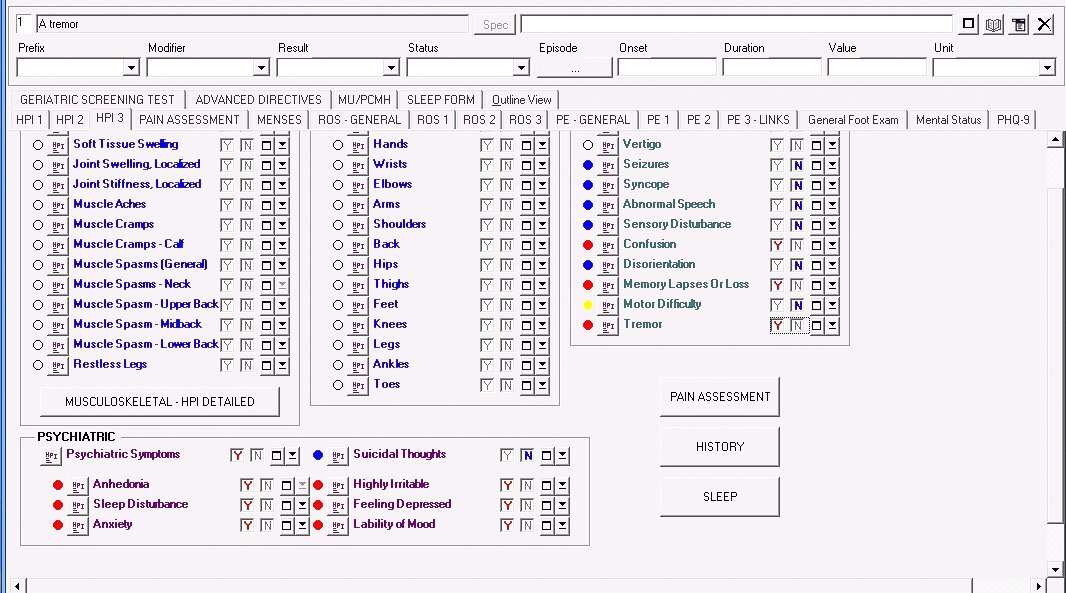
Evaluation and Management (E&M) reimbursement codes are built around how many aspects of a symptom or a physical exam are documented. Sometimes called “bullets”, each one is usually a separate sentence in the “printout” display of a medical record whereas to the documenting physician they may be a click box. Looking at the computer screen, they are sometimes quick to review, much like the paper forms I used to create for upper respiratory infections, urinary tract infections and physicals etcetera in the days of paper records. But when our computer programs turn these checkboxes into sentences, they look more like “See Spot run” grade-school English than an expert clinician’s narrative.

Here are two screen shots from a clinic a couple of towns north of here:

Writer’s view:

IMG_0354.JPG

Reader’s view:

IMG_0356.JPG

Anybody who tries to quickly read such notes would probably just as soon see the original clickboxes, instead of the stilted English produced by the EMR.

Back to the real writers among us – here is how Abraham Verghese explains the deep connection between doctoring and writing:

“I’m really struck by how much of what I learned in medical school has helped me to be a writer, and how much of what I learn as a writer helps my thinking as a physician. They are very parallel disciplines. When you take a patient’s clinical history, what is that but a story? What makes a good doctor is that he or she takes the story down well, sees the links and makes the connections toward a diagnosis. That’s also what writing is about.”

I guess that’s why, after a long day with my patients and my highly structured EMR, I like to sit down in my den next to the horse stalls with a completely blank screen in front of me and just tell stories.


I just realized none of the posts show on an iPad or a computer, but they do show on an iPhone. WordPress is working on this. In the meantime, please visit my Substack.


Osler said “Listen to your patient, he is telling you the diagnosis”. Duvefelt says “Listen to your patient, he is telling you what kind of doctor he needs you to be”.


BOOKS BY HANS DUVEFELT, MD

CONDITIONS, Chapter 1: An Old, New Diagnosis

Top 25 Doctor Blogs Award

Doctor Blogs

Enter your email address to subscribe to this blog and receive notifications of new posts by email.

Mailbox

contact @ acountrydoctorwrites.com
Bookmark and Share
© A Country Doctor Writes, LLC 2008-2022 Unauthorized use and/or duplication of this material without express and written permission is strictly prohibited. Excerpts and links may be used, provided that full and clear credit is given.



