Archive for the 'Reflections' Category


Rural Medicine – Not Just Runny Noses

A lot of people, many of them medical students, think that rural doctors don’t get to see many interesting cases.

The opposite is true; if you are the only doctor within a wide radius, people will come to you for help, rather than try to pick the appropriate out-of-town specialist to diagnose their problem. In this state with widespread physician shortages most specialists won’t even see self-referred patients.

Sir William Osler wrote:

“The environment of a large city is not essential to the growth of a good clinical physician. Even in small towns, a man can, if he has it in him, become well versed in methods of work, and with the occasional visit to some medical centre he can become an expert diagnostician and reach a position of dignity and worth in the community in which he lives.”

Today, with UpToDate and all the medical journals of the world instantly at our disposal through the Internet, rural physicians cannot blame the size of their patient panel or of their medical community for not keeping up with the essentials in their field. Rural primary care doctors are usually the first ones with an opportunity to evaluate and diagnose our community members’ medical problems, regardless of their complexity or severity.

In situations when I feel stumped with a difficult diagnosis, I sometimes end up explaining to patients that until I understand better what the nature of the problem is, I don’t even know which specialty is the right one to refer them to, since the delineation of specialties follows disease location or mechanism rather than presentation.

For example, a person with weight loss could have an endocrine problem, an intestinal problem, cancer or a psychiatric diagnosis. The family physician is usually in the best position of all specialists to sort out which is the underlying cause.

It is sometimes quite touching when, after I have diagnosed a patient with a rare disease that only a big city or university-based specialist can manage, patients say “ah, Doc, can’t you treat me instead – I’m comfortable with you, and you’re the one who figured out what was wrong with me”.

Rural medicine, in terms of the spectrum of disease we encounter, is the most challenging and most stimulating kind of primary care medical career available to doctors in this country.

The double-booked visit with the Chief Complaint “I think I have a sinus infection” could be a brain tumor. The woman with chest pain could have an esophageal diverticulum, and the man with heart palpitations could have hyperthyroidism, an arrhythmia, a drinking problem or an anxiety disorder – perhaps even a pheochromocytoma.

It is my job to do the right thing, not too little and not too much, for each one of these patients, who trusts me with their care.

It’s all in a day’s work in primary care.

And, oh, one man with a runny nose just didn’t act right. He seemed vague with some word-finding difficulties. I had never seen a brain abscess before, but that is what he had.

QS, Ad Lib and PRN

Our hospital has a list of approved abbreviations. It is shorter than the list I had to memorize during my training. The reason some long-established abbreviations have been banned is their similarity to other abbreviations with different meaning. Even when doctors type orders instead of writing them by hand, the concern is that nurses and pharmacists may mistake them for something other than what the doctor ordered.

For this reason both QID (quater in die; four times a day) and QD (quaque die; once daily) are off the list; a hurried nurse or pharmacists could inadvertently quadruple a patient’s daily dose by imagining an “I” that wasn’t there to begin with.

At the local pharmacy, thanks to e-prescribing, we are forced into a specificity we weren’t tied to before:

Gone is the universal “QS”, (quantum sufficat; sufficient quantity), which made it the pharmacist’s responsibility to figure out how many pills it takes to do a prednisone taper with 6 pills the first two days, 5 the next two, then 4 a day for two days etcetera until zero.

“QS” also got us doctors off the hook with liquid medicines for children; while the printed “Monthly Prescribing Reference” listed the size bottles all the common antibiotics come in, the new e-prescribing software doesn’t tell us that. Consequently we have to prescribe the exact volume needed for a full course, hoping there is a bottle of just that size or that the pharmacist will be allowed to pick the closest size up without having to call us back.

“Ad Lib” (ad libitum; “freely as wanted”) has fallen by the wayside in medicine, and now seems mostly a term used in theater, public speaking or music.

Curiously, a theatrical synonym for ad libitum, extempore, was often used in my native Sweden for a custom prescription, usually for a cream or ointment, less often a hand-made capsule or pastille. In the United States, this term is seldom used, although the concept of specially compounded medications is not uncommon.

“PRN” (Pro Re Nata; “as the circumstance arises”) seems to have survived the abbreviation cutbacks. It allows the patient or caregiver to use the medication as needed.

Prescriptions were historically a vehicle for doctor-to-pharmacist communication that was written specifically to exclude the patient. This is to some extent why so many abbreviations were used. Somewhere near the bottom of most prescriptions typically was the word Label with a check box in front of it. Only when checked did the patient get to see the name of the medication on the bottle. That was before the era of informed consent, but the word and the check box can occasionally still be found on prescriptions.

Abbreviations and secret symbols still find their way into modern medical jargon and documentation, even if they are not allowed on prescriptions or in hospital records, from the handwritten Ψ for psychiatry or psychiatric to classics like GOMER – Get Out of My Emergency Room, ETKTM – every test known to man, and FF – Frequent Flyer, to some newer ones like:

PJAR – Person Just Ain’t Right

SALT – Same As Last Time

TMB – Too Many Birthdays, and

GOK – God Only Knows

Every profession needs its abbreviations…

Art, Science and Charity in Medicine

Sir William Osler spoke of the influence of these three forces on the life and conduct of a physician. He eloquently used temperature analogies to characterize the necessary qualities of a physician – burning hot or keeping cool, but never being lukewarm:

”….of Art, the highest development of which can only come with that sustaining love for ideals which burns bright…”;

 “Science, the cold logic that keeps the mind independent and free from the toils of self-deception and half-knowledge”;

“of Charity, in which we of the medical profession, to walk worthily, must live and move and have our being.”

                                      (Aequanimitas, 1904)

Today’s medicine tends to be more tepid, at least in my field, Primary Care. Others clamor to set our priorities, to the point that doctor and patient sometimes both feel marginalized. The personal doctor-patient relationship is sometimes replaced by a more generic consumer-provider exchange, where a patient may see the physician as just a necessary intermediary between their need and the solution they already know they want – as in the case of asking for a drug advertised on television.

We must start with what Osler calls “the cold logic of Science”. It is our role and our duty as physicians to view new claims of clinical benefit from tests, procedures or pharmaceuticals with a critical mind, applying our training and experience. Simply following guidelines is an abdication from our professional responsibility. You don’t need to go to medical school to follow guidelines – in fact, it may make it harder sometimes.

The burning flame behind our passion for the Art and compassion for our fellow human beings, what Osler calls Charity, must never be lukewarm.

We all have to work at the Art of medicine. It is easy to slip into routines of complacency; another case of this or that, giving it our usual “Spiel”. Seeing each patient and each clinical presentation as unique is necessary in order to connect with the other person in the exam room. Finding the right way to approach each one of many seemingly similar case histories is what makes a personal physician just that – each patient needs something slightly different from us. The better we understand those needs, the more effective we can be.

The Art of the medical practitioner lies in the balance between cold science and hot passion. This is where the chemistry between physician, patient and disease takes place.

Call it chemistry, even alchemy: As physicians, we are catalysts in each patient’s transformation. And just as any other catalyst, we cause a chemical reaction to take place without being consumed ourselves in the process.

Our true challenge as physicians in today’s health care climate is keeping the flame Osler spoke of. Without that flame we are at risk for straying from the ideals behind our profession.

Osler warned us never to feel lukewarm about being doctors:

“By far the most dangerous foe we have to fight is apathy – indifference from whatever cause, not from a lack of knowledge, but from carelessness, from absorption in other pursuits, from a contempt bred of self satisfaction.”

A Doctor By Any Other Name?

(A reflection for Doctors’ Day)

I am used to being called a “medical provider” instead of a doctor or a physician these days, but it makes me think about the implications of our choices of words. The word “provider” was first used in non-medical contexts over 500 years ago. It is derived from the Latin providere, which means look ahead, prepare, supply.

“Medical provider” is part of the Newspeak of America’s industrialized medical machine. It implies, as Hartzband and Groopman wrote in The New England Journal of Medicine, that:

“…care is fundamentally a prepackaged commodity on a shelf that is “provided” to the “consumer,” rather than something personalized and dynamic, crafted by skilled professionals and tailored to the individual patient”.

The 800-year-old word “doctor” is Latin for Church father, teacher, adviser and scholar. It infers more closely the Hippocratic and Oslerian ideal of what a physician should be like. “Doctor” is used as a title for physicians in many languages, even if other words – like physician – are used to describe the professional role of a medical doctor.

Those other words are often less than flattering in their derivation or usage. Physician, for example, comes from physic, the Latin word for natural science and art of healing, which is noble enough. Less noble is the use of the word physic for a laxative due to the common practice of purging by physicians of the past.

In Medieval times, both physicians and their commonly used blood-sucking worms were called leeches. The Middle English word leche has lived on in many languages’ words for doctors: Läkare (Swedish), læge (Danish) and lääkärit (Finnish). These words are similar to the Indo-European lepagi. It means talk, whisper and incantation and is thought by some to be the true origin of the Scandinavian words for physician.

The Russian word for physician, врач (pronounced vratch), is uncannily similar to врать, which means talk nonsense or lie, and ворчать, mutter. These similarities also harken back to ancient and mysterious rituals of physicians of the past.

The German Arzt is perhaps the most flattering of the words I know for physician; it is derived from the Late Latin word archiater (Chief physician or physician to the Court) and the Greek arch-iatros, where iatros is the familiar word for physician we use in “iatrogenic”.

Personally, if someone asks what I do, I answer “I’m a doctor”, but I never insist on what people should call me.

The language, as it changes, may accurately reflect one very powerful view of what medicine is, but neither the words nor the business model can change what patients need when they are ill or frightened. They need more than generic providers; they each need a human being with knowledge, wisdom and compassion.

Ultimately, whether others call us physicians or medical providers, it is still up to us to define our professionalism and to defend our personal standards. These things are neither generic among providers nor, as some are hinting these days, almost replaceable by technology or treatment protocols.

Star Trek’s fictional United Federation of Planets Starfleet did have a technologic replacement for their flesh-and-blood ships doctors, still nick-named “The Doctor”; installed in most Starfleet ships’ sick-bay was an Emergency Medical Hologram, EMH for short. When its transmitter was activated, it mechanically said: “Please state the nature of the medical emergency”. The EMH eventually evolved into a sort of sentient being, but it is unclear to me how patients really felt about this contraption.

What, then, is a physician? A sixty-year-old answer still says it well:

“The value of the physician is derived far more from what may be called his general qualities than from his special knowledge. A sound knowledge of the aetiology, pathology, and natural history of the commoner diseases is a necessary attribute of any competent clinician. But such qualities as good judgement, the ability to see the patient as a whole, the ability to see all aspects of a problem in the right perspective, and the ability to weigh up evidence are far more important than the detailed knowledge of some rare syndrome, or even the possession of an excellent memory and a profound desire for learning”

Dr John W. Todd, The Lancet, 1951

The Gift of Healing: Pastor Graf and Henri Nouwen

My last encounter with Pastor Graf was brief, a few words exchanged on a windy sidewalk. I, a young hospital intern, was on a quick lunch break errand downtown. He, an aging, slightly disheveled country minister, was in town to visit his 94-year old mother.

I have carried the image with me ever since then of the tall, heavy-set man with his unbuttoned overcoat flapping around him. I remember his dark, peaceful eyes and his full, carefully moving lips as he spoke. I can still hear his soft, yet penetrating voice. I had listened to him speak so many times – in his little village church on Sunday mornings and during midnight masses, driving along dirt roads at breakneck speeds in his Peugeot station wagon and over tea with scones in the vicarage.

I was his assistant for a couple of summers, an unpaid job that evolved from my position as junior leader at a co-ed Scout confirmation camp.

Pastor Graf needed an assistant and I didn’t mind a closer look at the life of a country preacher. My own confirmation classes had been anything but inspiring. I attended Saturday classes in my parish church with a bunch of boys, who did their best to sabotage the aloof, prim and occasionally ill-tempered minister. I never heard anyone in the neighborhood say they had been inspired or helped by Pastor Berglund.

Pastor Graf was anything but aloof. He spoke plainly with people from all walks of life. He knew about fishing and farming. He took a deep interest in everyone in his rural parish, and had a hand in most community events. He knew everybody by name. Day or night, he was always available to listen to anyone’s sorrows or worries. He was a healer of troubled souls.

He was a man with many interests, loved music, art and history. Technical things, from cars to stereo equipment, fascinated him. He was also an entrepreneur who brought in royalties for his church from sales of liturgical items he had created.

What I didn’t know when I signed up to work for him, but what made me respect him more and more during the years I knew him, was that in spite of his gifts and standing as a clergyman, he wasn’t on top of the world. He worried constantly about his elderly but healthy mother and he was tormented by religious doubts and feelings of inadequacy in doing God’s work. And although I never saw him drink alcohol any other time, he always poured a very full goblet for communion and savored what was left when the service was over.

Later I would hear of him, not by name, but I knew he was the one people at the hospital talked about; local minister in the Emergency Room with a manic episode, respected pastor dropped off by police to avert OUI charge. My understanding of the man beneath the white collar deepened, and my admiration for him grew even more as I learned about his challenges and heard others speak of him disparagingly.

I understood then, more than when I was with him, that through his own angst and his own doubts he found the common ground to connect with the people in his community. I also understood that his God, the one he asked to strengthen his faith, had chosen him as His vehicle because of all his weaknesses, not in spite of them.

I didn’t have the words for it then, but years later I heard of Henri Nouwen’s book “The Wounded Healer”, which was written during the time I worked with Pastor Graf. It was one of those titles that can instantly change how you see the world before you even open the book. I actually didn’t read it until recently. Nouwen doesn’t say that a minister needs to have deeper wounds than his parishioners or that he needs to expose his own suffering in order to be effective. He does say that it is through his own wounds that he can relate to the suffering of humanity all around him.

People have taken Nouwen’s concepts into the arena of medicine as well, although he didn’t specifically include physicians in his thesis. I believe there is no difference between spiritual and physical healing; all healers must know suffering personally in order to be effective. It doesn’t mean the physician’s suffering needs to be the same as the patient’s, nor does it mean that the physician, any more than the minister, needs to show his wounds publicly.

It does mean that those among us, ministers and physicians, who are unaware of or deny their wounds and weaknesses, cannot fully use the great gift of healing that isn’t their own but only passes through them. For that to happen they need both self-awareness and empathy.

“The Wounded Healer” made me think of Pastor Graf when I first heard the title. Now, many years later, I finally know for sure that the book is about people like him.


I just realized none of the posts show on an iPad or a computer, but they do show on an iPhone. WordPress is working on this. In the meantime, please visit my Substack.


Osler said “Listen to your patient, he is telling you the diagnosis”. Duvefelt says “Listen to your patient, he is telling you what kind of doctor he needs you to be”.


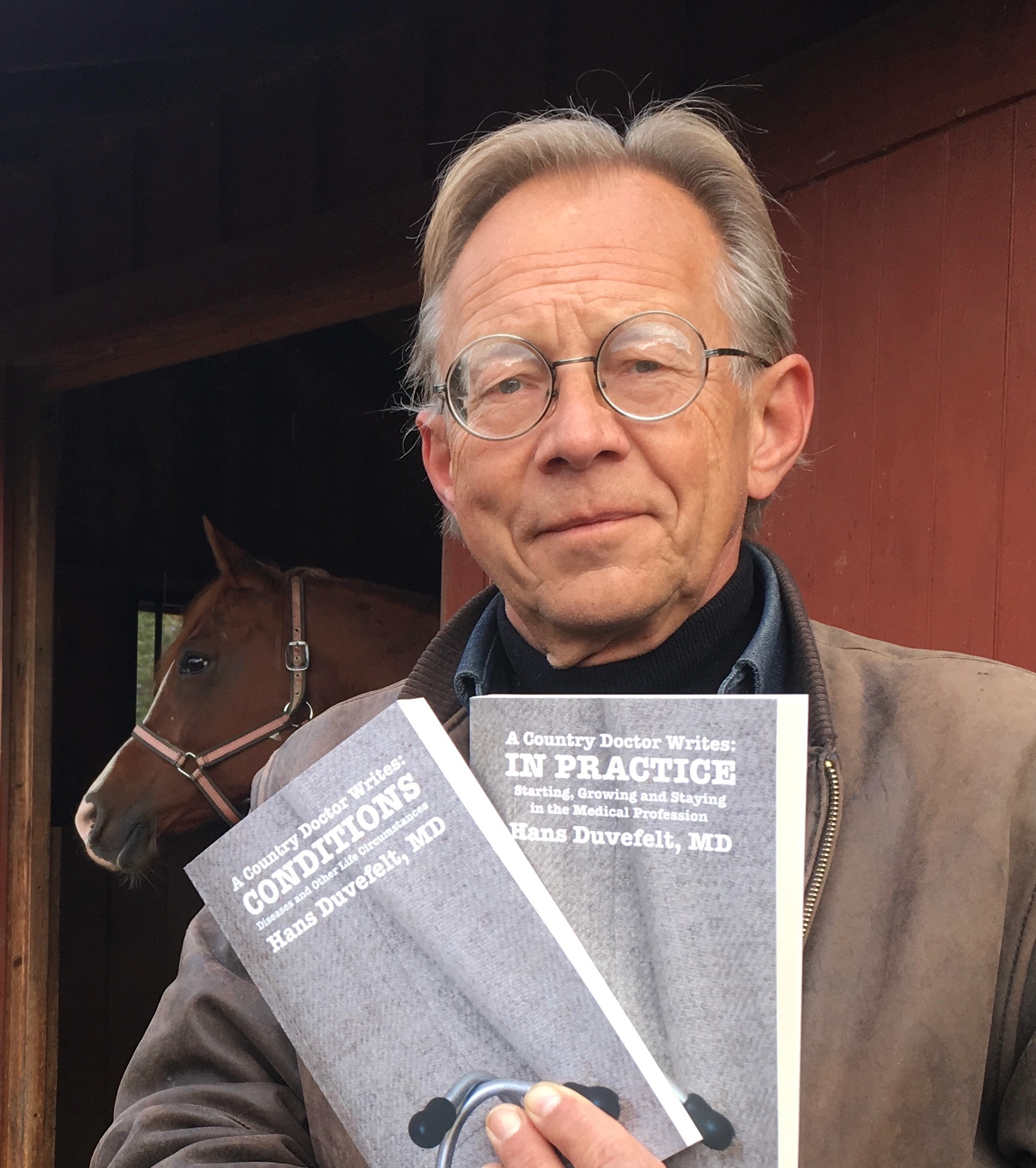
BOOKS BY HANS DUVEFELT, MD

CONDITIONS, Chapter 1: An Old, New Diagnosis

Top 25 Doctor Blogs Award

Doctor Blogs

Enter your email address to subscribe to this blog and receive notifications of new posts by email.

Mailbox

contact @ acountrydoctorwrites.com
Bookmark and Share
© A Country Doctor Writes, LLC 2008-2022 Unauthorized use and/or duplication of this material without express and written permission is strictly prohibited. Excerpts and links may be used, provided that full and clear credit is given.