Archive for the 'Reflections' Category


Is it the Devil or God in the Detail?

“We must bear in mind the difference between thoroughness and efficiency. Thoroughness gathers all the facts, but efficiency distinguishes the two-cent pieces of non-essential data from the twenty-dollar gold pieces of fundamental fact.”

Dr. William Mayo

The practice of medicine involves a lot of details, but details without the big picture are meaningless at best and distracting at worst.

The expression “The Devil is in the Detail(s)” implies that the details can trip you up, whereas the original, older, idiom “God is in the Detail(s)” conveys the importance, even beauty or virtue, of paying attention to the details when trying to do good work.

I think medicine has lost sight of the big picture when it comes to its thoroughness and its pursuit of efficiency. And I don’t see much beauty or virtue in today’s medical charts.

This was going on before electronic medical records, but quantum leaped with the switch from transcribed dictation to click boxes and copy-and-paste functionalities.

The root of this problem lies with the Evaluation and Management (E&M) coding that literally gives points for how many questions a doctor asks about a symptom – onset, character, duration, severity and so on. Points are also given for documenting which symptoms a patient doesn’t have. In earlier times, we used the phrase “pertinent negatives” for items a reasonable physician would want to know in order to work through the possible differential diagnoses for a particular symptom

With the reimbursement system we now have, the number of questions and physical exam items, regardless of whether they are relevant or just filler material, drives physicians’ income and practices’ bottom line.

It was often possible when reading an old-fashioned, dictated, narrative to relatively quickly sort through the irrelevant items, particularly if the style and grammar were used to provide emphasis. For example, when dictating, you had the option of grouping all the negatives together and of keeping the positives separate and emphasized. With an EMR, the items in structured data entry fields tend to come in a predetermined order, making it much harder for the reader to find the relevant items.

The forest of details in today’s medical record serves purposes other than the efficient documentation for doctors to remember their own inquiry and thought processes. It also isn’t primarily designed for doctors to communicate to each other what they have observed and how they propose to treat it.

Today, under the new Government edicts, medical records have to contain hoards of details doctors never thought were relevant, but politicians and insurance actuaries do and future generations of researchers might. Plaintiffs’ lawyers and medical boards might need them, and patients need to be able to read them, so we can no longer create notes that efficiently document our findings, conclusions and plans. It is as if the conductor’s sheet music at the Symphony could no longer have musical notes, G-clefs and technical terms like “mezzo forte”, in case a non-musician wanted to follow along with the orchestra.

It is a bizarre situation: Imagine the Ministry of Culture requiring that all poetry contain certain elements about the beauty of America and the threat of global warming. Similar things have happened in countries that shall not be named here.

This is where the religious analogy really plays out: Which higher power decides the relative importance of what details in medical records? I have a theory.

Details, details, details…

A Country Doctor in his Sixties


“Once you start studying medicine you never get through with it.”

Dr. Charles Mayo

Marcus Welby, M.D. was 62 in the first episode of the TV series. My father, not a physician, retired at 62. As I am now beginning my sixty-second year, I seem to be thinking a lot about my place in time and in medicine.

Thirty years ago people often told me I looked too young to be a doctor, and I felt I had to work extra hard to seem wise. I developed a habit of carefully explaining what I understood of each patient’s condition, what I saw as the options for further testing and treatment, and what I expected the outcome to be. I also made a point of being respectful and seeking out each patient’s views and preferences.

That is still how I work, but I have found that over time, as my appearance more and more plainly suggests my years in the business, patients are more and more willing to take my advice with fewer explanations. They are also more openly seeking my opinions, support and advice in matters that go beyond the purely medical aspects of life.

It is an honor and a humbling responsibility to be in that position. It comes from not only looking like you have lived through a lot, and I have, but also from being privileged to see up close the joys and travails of so many fellow human beings.

Few professions see as much of the human condition as we physicians, and especially in these secular times, our role can sometimes have similarities with that of the village priest, especially because we deal with matters of birth, life and death.

Early on, I wrote a post titled “The Apostolic Nature of Our Profession”. The older I get in my vocation, the more I see of that; I feel more kinship and indebtedness to the ancient physicians and to my own mentors that guided me to where I am now, and I feel more tangibly the responsibility that goes with years of practice, suddenly graying hair and the earnest requests from some of my patients to fill their archetypal need for the services of a physician.

At the same time, I feel a strengthening of my desire to understand more of medicine. This truly is a lifelong pursuit, and every year I know more, but also wish for deeper and deeper knowledge than I have achieved. Dr. Charles Mayo said it succinctly in the quote above, and Sir William Osler elaborated eloquently:

“The hardest conviction to get in the mind of a beginner is that the education upon which he is engaged is not a college course, not a medical course, but a life course, for which the work of a few years under teachers is but a preparation.”

Like Osler, I believe medicine is a genuine calling for many physicians, but unlike him, I believe it can be practiced into old age, as long as we have the physical and mental vigor this kind of work requires.

I bring the enthusiasm of a young man and the experience of a sixty-one year old to my remote clinic five days a week, and most nights and weekends I read, think and write about doctoring.

I hold these words by Dr. William Mayo close to my heart as I imagine myself following in the footsteps of mentors like my senior colleague Dr. Wilford Brown, III:

“The keen clinician, as he grows in experience, becomes more and more valuable as age advances.”

In order to be as valuable as I can be to my patients thirty-five years after medical school, I need to read a lot. I need to read the major medical journals not only to learn what applies directly to my everyday work, but also to be cognizant of how the basic sciences are evolving. I need to translate my life experience and what I have learned from well over 100,000 patient encounters into a language with many dialects that I can use in familiar and unfamiliar situations with patients from a multitude of backgrounds. I need to continually learn about psychology, philosophy and religion in order to be a support to patients who face life altering circumstances and diseases.

I need to maintain my equanimity through busy clinic days in our tumultuous national health care environment, so that my patients don’t become pawns in the system any more than they have to. I need to maintain my sense of proportion in everything I do: in differential diagnosis, in helping patients set priorities, in managing agendas imposed on me by “the system”, and in my own expectations as only one mere human.

This is what I hope to continue to bring to work with me every day for as long as I can do it well.

Context, Always

Question: What do you do when presented with abnormal lab results?

Answer: Ask lots of questions.

The nursing home just sent over a urinalysis on a patient of Dr. Carlyle. I am covering his practice for a few days. The test showed that an 82 year old woman had 3+ white blood cells in her urine. “NKDA” was written in the margin, indicating she had no allergies.

I sighed internally and called the nursing home. The charge nurse seemed a little surprised at all my questions.

“What are the symptoms? What is the patient’s kidney function? Is she on blood thinners or any other medications that might interact with an antibiotic?”

The presence of bacteria or white blood cells in the urine should not usually be treated if there are no symptoms. That’s not always been our belief, but most doctors agree with this approach today.

Looking at a test result without knowing the story behind it, we cannot decide whether or how to act.

Last week we got a critically high potassium result on a patient with normal kidney function and no prescription medications in her profile. I did nothing about it, except order a repeat test that was normal. The obvious explanation was hemolysis; red blood cells contain more potassium than the serum that transports them and if the cells break during blood draw or handling of the vial, serum potassium will be falsely elevated.

A seizure patient of Dr. Carlyle had a high phenytoin level. I pestered the nurse to give me several past results and to track any previous dose changes. It turned out this patient had stable levels for a year and a half and suddenly had a low level last month. Dr. Carlyle raised the dose. In retrospect, the patient probably had missed a few doses, and would have been fine staying on the same dose. I dropped the prescribed dose back down and expect the patient to do fine.

A hypothyroid patient, Diane Green, was hospitalized with abdominal distention and constipation. She is nonverbal, and fearful of medical procedures. The hospitalist checked her thyroid function, as undertreated hypothyroidism can contribute to constipation. The test suggested Diane needed a higher dose, so she was discharged on a substantially increased dose of levothyroxine. As soon as I saw her again, I reversed the medication change; her TSH had been normal one week before her admission, and a severe illness or traumatic experience can affect thyroid values. I figured the hospitalist did not notice Diane’s old TSH result in the hospital computer.

Context is crucial when deciding what to do with abnormal test results. But doctors are often pressed for time, and finding the story behind the results takes time. Even when all the data is in our electronic medical records, it takes time to see the patterns: The test results are usually in one place, the prescriptions in another, the office notes in a third, and the phone messages in a fourth. My own EMR can produce flowsheets with lab results, but each test is identified by the date it was ordered instead of the date it was performed, so correlating lab values with prescription dates becomes confusing, for example when following thyroid cases.

In times past, when solo practice physicians cared for their patients in the office, hospital and nursing home, they kept the threads of context and continuity together more easily. Today, with more providers sharing the care, and with other office staff also interacting with patients and their families, there is more room for errors, gaps and confusion. The tools we have right now are not always as effective as we would like, and they certainly can be cumbersome and slow to use. Reading each other’s notes can take a while, as the EMR format is primarily built for coding and not for ease of following the clinical “story”.

A few words doctor to doctor, doctor to nurse or doctor to patient can sometimes do what half an hour on the computer might not. Treatment without context is essentially just random reflex actions: Killing the innocent bacteria, lowering the falsely elevated potassium, treating the lab value and not the patient – none of it does anybody any good, and probably will cause harm to some unfortunate patients.

Our temptation to view test results as obvious facts in a predictable process instead of possibly misleading clues in a complex mystery reminds me of these words from a Sherlock Holmes novel:

“There is nothing more deceptive than an obvious fact.”

Sir Arthur Conan Doyle

Primary Care is Messy

Primary care is a messy business. Nobody has just one simple problem and no patient has all the typical symptoms for their diagnosis. Most don’t even tell us everything that’s going on. And most don’t follow their treatment plan completely. But this may be O.K., since we often change our minds about what is right or wrong in the practice of medicine.

Knowing what constitutes success in frontline medicine is not easy. Let me illustrate:

A middle aged smoker comes in for a follow up on his blood pressure treatment and mentions that he would like to try Chantix (varenicline) to help him quit. My nurse has already secured our practice credit for documenting his smoking status. I can use certain billing codes to document my counseling on the subject, and I can get credit for printing out the drug information, even though the pharmacy also provides a printout. This is a successful visit, it might seem.

But I also ask, “Ron, what makes you want to quit at this particular point in time?”

“Well, I’ve had this funny cough, like a dry hack, for the last two weeks whenever I take a deep breath”, he answers.

Ron turns out to have a very small, resectable lung cancer. My question about the reason for his request probably saved his life, and catapulted us from shallow administrative success to probable or at least possible clinical victory, without making any further difference in my own quality metrics.

Another patient, Ellen Wurtz, a diabetic in her late fifties, makes me look like I am treading water. Her blood sugar, blood pressure, weight and cholesterol are all above target, and she never brings in her blood sugar logs. She has nonspecific side effects from every new medication I prescribe for her. But she keeps all her appointments. We talk about how she can best help raise her granddaughter, now that Ellen’s daughter is in rehab, and we talk about how she can support her husband’s self esteem after he lost his job at age 61. Am I wasting her time and mine, or am I part of the safety net that helps her keep her family going through difficult times that threaten to shatter their lives?

Joe Parva, a 65 year old with high cholesterol and two previous heart attacks, never reached his LDL target of 70 or less, and both his triglycerides and HDL were out-of-range. I just kept him on his Lipitor. I didn’t prescribe Zetia (ezitimibe) to push his LDL to target, and I never gave him niacin for his HDL or a fibrate for his triglycerides. We talked about it several times, and when I told Joe that Zetia and niacin had never been shown to lower heart attack risk, he chose not to try them. After hearing that there were no studies comparing heart attack risk on 80 mg of Lipitor alone versus Lipitor plus a fibrate, and after hearing that the combination increases the risk of side effects, he elected not to be a guinea pig. If we had done quality metrics around lipid treatment during the last half dozen years, Joe would have made me look pretty bad, but after the introduction of last year’s new guidelines, Joe’s care has been top-notch all along.

When my own children were infants, we laid them on their bellies to sleep because science had shown that infants sleeping on their back had an increased risk of Sudden Infant Death Syndrome (SIDS). My grandchildren were placed on their backs instead, because by then science had shown that infants sleeping on their bellies had an increased risk of SIDS.

Every primary care provider’s day is filled with moments of opportunity to do the right thing or not; we are almost always walking that fine line between failure and success. Sometimes the balancing act is about noticing clinical signs, sometimes it is about setting the right priorities, sometimes it is about weighing guidelines versus actual evidence and applying it all to individual patients. Much of the time we won’t know if we did the right or the wrong thing until much later, and in many cases we’ll never know. All we can do is be diligent, do our best and be willing to learn and re-learn.

Just like tightrope walkers, we can’t focus our attention on the hard surface beneath us should we falter and fall, but on what’s straight ahead, or we will lose our courage and our concentration.

A career on the frontlines of medicine requires that you are comfortable with uncertainty, because primary care is very often messy and quite seldom completely straightforward.

In the words of Elbert Hubbard:

“The line between failure and success is so fine. . . that we are often on the line and do not know it.”

Primary Care isn’t Brain Surgery

A brief exchange I had with a neurosurgeon in the comment section on KevinMD the other day left me pondering the diversity of skills needed in different types of medical specialties, and also how differently technology has impacted various specialties during my years in medicine.

Neurosurgeon F. X. Wall disagreed with the post author, Dr. James Aw, about the value of old-fashioned physical exam skills, because in neurosurgery the anatomical accuracy of interventions has approached 100% as a result of new technology.

I can see that in neurosurgery and many other surgical specialties the advances in imaging have made clinical exam skills too inaccurate to guide treatment in this day and age, just like few cardiologists would forego an echocardiogram in evaluating a heart murmur.

My reply to the neurosurgeon was:

“Good points, but possibly more relevant in specialty care. When a patient in primary care has nonspecific symptoms, like shortness of breath, we need doctors with enough clinical exam skills to notice pallor, prolonged expiratory phase, JVD, irregularly irregular pulse, tachycardia and all the other clues that help us decide what tests to order first.”

The more I thought about it, the more fundamental this seems to me: In primary care, we don’t have many technologies that make clinical exam skills entirely obsolete. When I see a patient in my office 20 miles from the nearest X-ray machine, when a simple lab test won’t be resulted for 6-24 hours, when there is almost no way I could get a same-day echocardiogram or MRI, clinical exam skills are essential.

Time and distance aside, primary care doctors also need enough clinical skills to either make the diagnosis without technology or at least to know which diagnostic possibilities to pursue before others; if we did every possible test in every case, we would obviously waste a lot of resources. Just like in my example of shortness of breath above, almost every presenting complaint in primary care has many diagnostic possibilities, ranging from trivial or self-limited to serious or even life-threatening.

The broad range of differential diagnoses to consider when we evaluate both common and unusual symptoms people see primary care providers for is something to consider when we look at what type of clinician we assign to front-line duty. In many practices, this task falls on the least experienced providers. This is also the case in some freestanding urgent care centers. Having more seasoned doctors available as back-up isn’t necessarily a good system if the clinician on the front line hasn’t seen enough to know what he or she doesn’t know.

There have been many attempts to use technology as a substitute for clinical experience in front-line medicine. In my opinion none have really emerged that can compare with the technological revolution we have seen in imaging, microsurgery or laboratory diagnosis.

Systems that require the clinician or the patient to enter data in order to produce differential diagnoses, for example, are clumsy and either simplistic or bogged down with detail, and assume that everybody shares language and values they in fact don’t. In real practice, the patient who says “it only hurts a little”, but whose pained or panicked facial expression makes the hairs stand up on the back of a seasoned doctor’s neck is not likely to be better diagnosed by today’s available technology.

Even in more technology dependent specialties, there are good reasons to cultivate low tech proficiency. What does a doctor do during a hurricane or an ice storm, during a war or on a foreign assignment when there is no technology available? Why would we not listen to hearts, lungs and peripheral blood vessels and then compare our impressions with the results of the imaging?

And, without excellent clinical exam skills, how do we evaluate unexpected or conflicting technology-derived results?

Ultimately, we need both hands-on and technical assessments in health care. But on the front lines, we are perhaps more dependent on our clinical assessment skills. I never get praised for ordering lots of tests, only for ordering the right one.


I just realized none of the posts show on an iPad or a computer, but they do show on an iPhone. WordPress is working on this. In the meantime, please visit my Substack.


Osler said “Listen to your patient, he is telling you the diagnosis”. Duvefelt says “Listen to your patient, he is telling you what kind of doctor he needs you to be”.


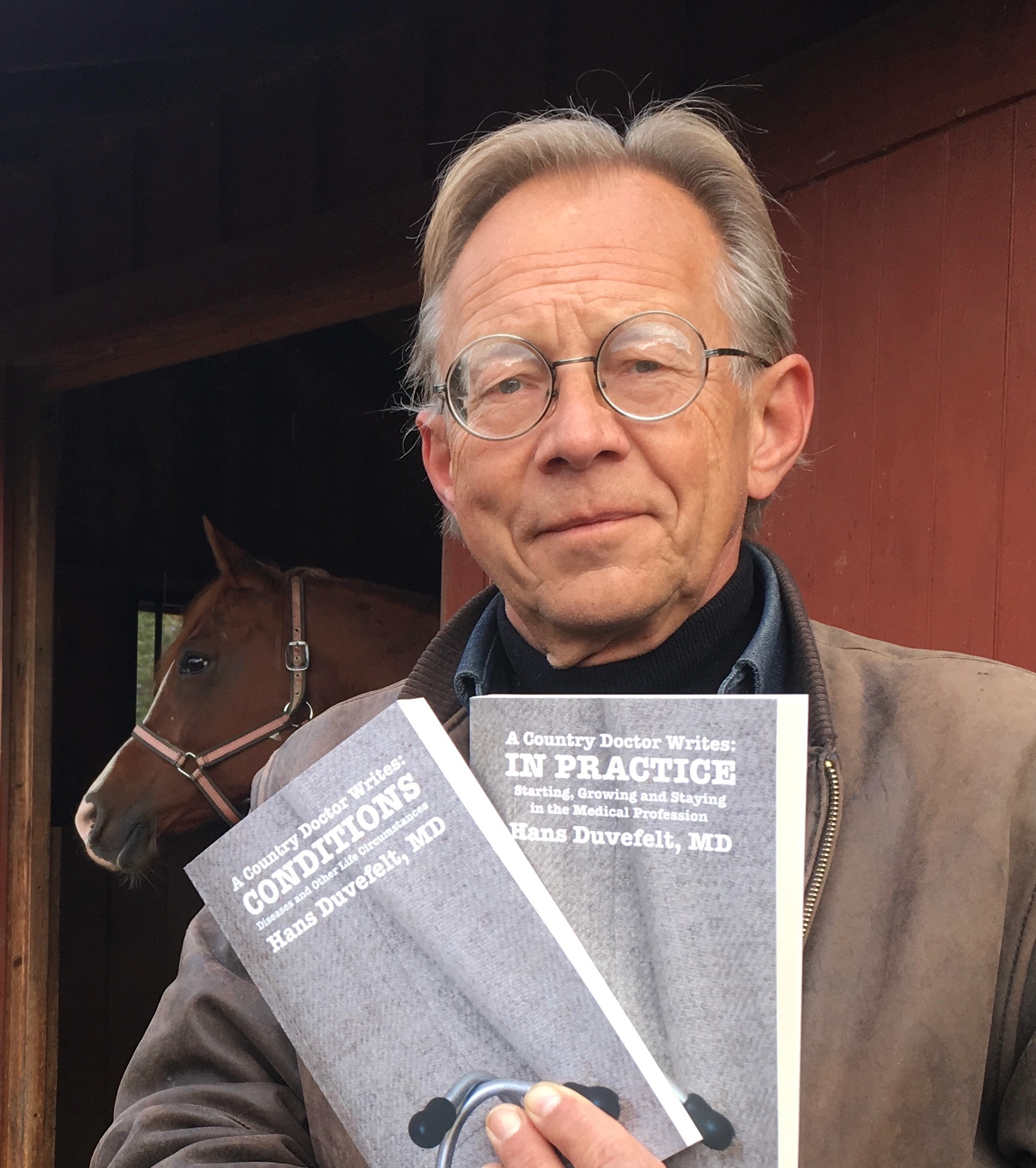
BOOKS BY HANS DUVEFELT, MD

CONDITIONS, Chapter 1: An Old, New Diagnosis

Top 25 Doctor Blogs Award

Doctor Blogs

Enter your email address to subscribe to this blog and receive notifications of new posts by email.

Mailbox

contact @ acountrydoctorwrites.com
Bookmark and Share
© A Country Doctor Writes, LLC 2008-2022 Unauthorized use and/or duplication of this material without express and written permission is strictly prohibited. Excerpts and links may be used, provided that full and clear credit is given.