Archive for the 'Progress Notes' Category


Passed a Stress Test With Flying Colors and Had a Heart Attack on the Way Home, How Could That Happen?

Tomorrow I’ll have another “Medical Monday” talk taped for our local TV station.
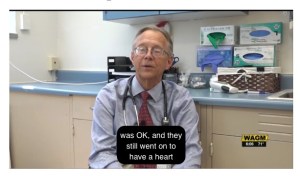
It’s set up more like an interview but I still have to prepare it like a talk. It’s a little speech I give to patients several times per week, but it still causes some raised eyebrows, so I think it’ll be useful for a bigger, more general, audience.

I think I’ll say something like this:

The reason you can have a heart attack even after a normal stress test is that it isn’t necessarily the biggest blockages that cause heart attacks.

Big blockages, or plaques, don’t develop overnight. They take a while, and are more likely to either be silent (if other blood vessels take over the blood flow, like when commuters start to choose the side streets because the highway gets too congested) or to cause what we call stable angina.

Stable angina is chest pain after a certain work load, say two flights of stairs but not one.

Big blockages don’t always cause people to have chest pain if they push themselves too hard; diabetics, for example, often don’t feel pain when the heart is suffering lack of oxygen from its diminishing blood supply, because diabetics can have all kinds of nerve damage, not just in their feet.

Medium sized blockages, say 30-50 percent ones, are the scariest ones, because they may not limit blood flow enough to cause EKG changes or any visible decrease in the radioactive glow we measure in a nuclear stress test.

But 85% of all heart attacks happen as a result of plaque rupture. The wall of the plaque breaks and the “gooey stuff”, cholesterol and other lipid particles, oozes out into the blood stream and a clot forms around it. That’s why we give “clot busters”, fast acting blood thinners, to people who are teeter-tottering on a heart attack. This is what we call Acute Coronary Syndrome.

A couple of decades ago, doctors first gave Lipitor to people with Acute Coronary Syndrome and their pain went away. Lowering cholesterol doesn’t happen that quickly, so what was that all about? More on that in a bit.

Of course, big blockages can rupture, but they are more likely to cause warning symptoms before that happens, while the smaller ones are undetectable unless you do a heart catheterization on everybody.

(CT scans can be used to look for calcified plaque, but the non-calcified, softer plaque might actually be more dangerous.)

So, let me come back to he smaller blockages.

The first thing to make clear is that our arteries are not metal pipes, or even plastic tubes. they are living tissue. And just like our skin renews itself every thirty days or so, our arteries are undergoing all kinds of repair and renewal.

One important aspect of how healthy our arteries are is whether there is inflammation, and we are talking coronary arteries here, but the same thing holds true for the blood vessels to our feet and our brains, too.

When there is inflammation in, say a knee or on the skin, there is redness and swelling and all kinds of chemical reactions that work great if you need to heal broken bones or open wounds. But that kind of reaction can also lead to unwanted bone spurs, thick and peeling skin or, in our arteries, plaque formation.

And sure enough, people with inflammation, be it rheumatoid arthritis or chronic gum infections, on average have more plaque and more heart attacks than you would expect from looking at just the classic list of risk factors, like blood pressure and cholesterol.

Another alarming tidbit here is that some foods cause inflammation, like sugars and refined carbohydrates, while other foods like fish and olive oil reduce it.

In addition to lipid blood testing for determining heart attack risk, we sometimes use blood tests we call “inflammatory markers” (one of them is CRP, or C-Reactive Protein) to decide who should take drugs to lower their heart attack risk.

And this is where Lipitor, now generic atorvastatin, comes in.

It was one of many “statin” drugs developed for lowering harmful LDL cholesterol. It also lowers inflammatory markers in the blood, and as we found out after years of study, it decreases, and in high doses it can even reverse, plaque buildup in the neck arteries as measured by ultrasound, and it can reduce heart attack and stroke risk by 30-50%.

There are other, non-statin drugs (like Zetia), that lower cholesterol and inflammatory markers, but have nowhere near the impact on heart attack risk that the statins have.

So what’s going on?

We now know that Lipitor and the other statins actually do five things:

1) THEY LOWER CHOLESTEROL AND LDL, and that means something but is probably not their main action.

2) THEY MAKE THE PLAQUE WALL LESS BRITTLE, LESS LIKELY TO RUPTURE.

3) THEY PREVENT PLAQUE BUILDUP AND CAN SHRINK EXISTING PLAQUE.

4) THEY HAVE ANTI-CLOTTING PROPERTIES THAT ARE DIFFERENT FROM THE WAY ASPIRIN WORKS.

5) THEY RELAX THE LITTLE MUSCLES IN THE WALLS OF OUR ARTERIES THAT CAN CAUSE “CORONARY SPASM”.

The second through fifth of these mechanisms are well known by now, but we can’t measure them, so people still spend a lot of attention on the numbers that we can measure.

And speaking of measures: In 2013 the American Heart Association and the American College of Cardiology issued a new lipid guideline, with an update added this past year.

Instead of dividing people into just high, medium or low risk for heart disease, the new guideline has a calculator that lets you figure out somebody’s ten year risk. You can then compare this to the best case scenario, and also see what the impact would be of treating blood pressure, quitting smoking or taking Lipitor.

Now, I don’t mean to be overly enthusiastic about Lipitor. It can have unwanted side effects, from brain fog to rising blood sugars to muscle aches. But I am enthusiastic about how much better we understand how heart disease develops.

And I am also excited about what other research has shown: Our diet and lifestyle can address the same five mechanisms of action that Lipitor does. There is more and more proof that avoiding junk food and soda, following a plant based OR a Paleo OR Mediterranean diet, being physically active, sleeping well, managing stress and so on, can have the same impact and reduce a person’s heart attack risk by half.

I’m sure there will be reasons to ad-lib, answer questions, go in depth or off on tangents, but this is the framework I’ll start out with.
A Day of Practicing Medicine Without the Computer

It wasn’t even nine o’clock when the screen on my laptop suddenly froze. From that moment until my last patient left the building, my clinic had no Internet.

For my part, the day went pretty smoothly, mostly because of some of my own work habits. It also helped that it was a warm, sunny day and my schedule was on the light side. Others have frowned at my old-fashioned work habits, but this is what I do:

PRINTING THE LAST OFFICE NOTE

For all pre-booked visits, we print the last office note. We also print important lab results and outside reports. One reason is that I may give these to the patient. The other is that when you create an office note and need to incorporate what happened in the ER or hospital, what the MRI showed and so on, the EMRs I have worked with don’t easily allow me to read the source document and type/dictate my own note in a split screen. And since interoperability is just a theoretical concept most of the time, I cannot import or cut and paste from outside sources.

Having the last office note printout gives me a reminder of what happened, the medication and allergy lists, all kinds of information that helps me move quickly through an Internet blackout day.

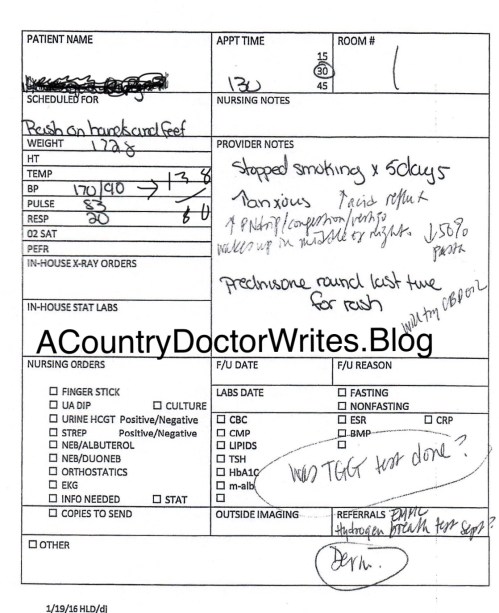
MY WORK SHEET

I don’t know what life would be like without this paper, which has gone through a few renditions over the years. It lets me quickly jot down important parts of my patient’s history and exam, what tests I need to order, what referrals I need to make and all kinds of things which in theory would be super quick to do with a computer but unfortunately aren’t.

At the end of the day yesterday, I copied these sheets, left the originals with my medical assistant and brought the copies home, so that on my day off (who pays the price for a computer failure?) I can finally enter the lost visits into the system while the office schedules the followup appointments and things like that.

Ironically, I have been toying with the idea of making an update to my work sheet, inspired by old rheumatology notes I used to see; they had a drawing of a body with each joint made into a stylized box for notations about which joints were affected by disease.

My recent thought has been to put a picture of a body on my sheet with simple indicators for things like, how much edema, size of a lesion, grade of murmur and so on…

Here is my work sheet in its current form. It saved the day for me yesterday:

How Much Should Physicians Touch?

Touch is a sensitive thing. No pun is intended here, but whether and how we touch our patients deserves our careful thought and deliberation.

So much interpersonal contact these days is virtual, with emojis, abbreviations and whole words thrown around as substitutes for human contact. Think :-), 💕, 😏, XOXO and “Hugs and kisses”. And when people do touch in our healthcare environment it is often with gloves, even for simple fingerstick blood sugars, immunizations or routine ambulance transports.

Shaking hands when you meet a patient for the first time is not standard procedure by any means. I wonder if it shouldn’t be in this country. There’s a lot of cultural history behind such a simple gesture.

When I examine a patient I often start by listening to their heart. I do this sitting and I almost always do this through their shirt or blouse. For my purposes, I’m able to hear what I need to hear through one thin layer of clothing; these days we tend to get an echocardiogram anyway if we hear or suspect that a murmur is present.

Listening to the heart is something so expected that almost no one is surprised, intimidated or offended by it. As I do this, I often put my left hand on the patient’s back as I press my stethoscope a little firmer against the patient’s chest with my right hand. This does give me a better chance to hear and it prevents the patient from moving away subconsciously from my stethoscope. It also creates a sort of clinical embrace as I, still fairly lightly and very clinically and professionally put their body between my two hands.

Listening to someone’s lungs, whether I do it through a thin layer of clothing, which I sometimes do, or after asking permission to pull a shirt or blouse up on the back, I don’t also touch the back with my hands while I listen to the lungs.

If, in doing a review of systems, the topic of leg swelling comes up, I often start my exam checking there by first lightly touching and then pressing with my finger for pitting edema. This is a non threatening place to start touching a patient and it feels natural as part of the history taking.

After either of those two initial exam points, I do what everyone does, although I will point out that I don’t wear gloves unless I am doing a genital or rectal exam or perhaps examining an Ebola suspect or something else that might be dreadfully contagious. I have known doctors who wear gloves for every patient visit and I think that does not help in gaining anybody’s trust or confidence in you.

Social touching I don’t do much of. I often shake hands at the end of a visit, and I only occasionally put my hand on somebody’s leg, arm or shoulder. The reason is that I’m not a very gregarious person and I wouldn’t feel that being socially touched by me would seem natural in most cases. I do make a point of “touching” people in spirit, by talking about their personal concerns and sometimes sharing my interests, joys or experiences.

The more I feel that we have a personal connection, the more likely I would be to place my hand on an arm or shoulder, and the less we connect in words or “energy”, the less likely I am to touch someone in a social way.

I find that by being “open” as a person, patients are likely to initiate social physical contact with me, and that’s easier to navigate.

But I do feel awkward if during a visit with a patient there isn’t even a brief clinical physical contact, and I have heard so many patients speak of other doctors with the words “he didn’t even touch me”. I feel strongly that even a small amount of physical contact can cement the therapeutic alliance between doctor and patient.

As I renewed my Maine medical license the other day, I had to answer questions about what is proper and improper physical contact between doctor and patient. I answered correctly the multiple choice questions about kissing and about having affairs when the patient initiates them.

It’s sad to think that someone would have to formulate questions like that for licensing adults who are supposed to be among the most trusted professionals in our society.

“Thanks for Your Time”: Einstein’s Relativity in the Clinical Encounter

In business literature I have seen the phrase “getting paid for who you are instead of what you do”. This implies that some people bring value because of the depth of their knowledge and their appreciation of all the nuances in their field, the authority with which they render their opinion or because of their ability to influence others.

This is the antithesis of commoditization. Many industries have become less commoditized in this postindustrial era, but not medicine. Who in our culture would say that a car is a car is a car, or that a meal is a meal is a meal?

The differences between services with the same CPT code for the same ICD-10 code aren’t, hopefully, quite that vast. But they’re also not always the same or of the same value. There is a huge difference between “I don’t know what that spot is, but it looks harmless” and “It’s a dermatofibroma, a harmless clump of scar tissue that, even though it’s not cancerous, sometimes grows back if you remove it, so we leave them alone if they don’t get in your way”.

I always feel a twinge of dissatisfaction when, after a visit, a patient says “Thanks for your time”. It always makes me wonder, on some level, “did my patient not get anything out of this other than the passage of time, did we not accomplish anything”?

It reminds me of a phrase from an ancient Swedish language course on cassette my first American girlfriend played over and over (she eventually became fluent, but only by living in Sweden): “Vad kostar tre minuter?” (”How much is three minutes”, referring to operator connected long distance phone calls.)

Three minutes of static on a phone line or three minutes with a dear one can never seem like the same three minutes, so thanking a doctor for his or her time only makes me think of an almost wasted encounter, almost like “thanks anyway”.

Now, one thing about charging for time that isn’t completely ridiculous is the fact that you can charge even if you don’t do a physical exam if “greater than 50%” of the visit was spent on “counseling and education“, which is pretty much the majority of what we do in primary care.

We are all familiar with Einstein’s formula E=mc2. He showed that energy equals mass times the speed of light squared.

Einstein’s formula, if you allow speed to be variable, also applies to calculating the impact of head-on motor vehicle collisions or the stopping distance of a freight train.

In medicine, just like in physics, the energy (impact) of a visit and the mass of its actual, meaningful medical content are really just different manifestations of the same thing. Their conversion factor is time.

When calculating the stopping distance of a train or impact of a head on vehicle collision, the speed means a whole lot more than the weight (mass) of the moving object. In our business, energy and mass are presumed constants and therefore time is thought of as the variable, especially when it comes to provider scheduling.

All of us intuitively know that a ping pong ball traveling at many times the speed of a slow moving freight train would still never cause similar damage on impact.

Similarly “Mass” in medicine (or “amount of clinical information considered or conveyed”) can vary enormously and isn’t always what it appears to be. Let’s say an unknown, untrusted clinician speaks at length, using many big words and all the patient hears is the “static” of one of my three minute phone call examples above.

What if “Mass” in these sample formulas is not what the provider THINKS (and documents) is delivered, but actually what the patient receives or “HEARS”?

It seems as if the staticky three minute phone call is like an office visit with a provider with lower credibility due to less relationship or shared history, resulting in less therapeutic weight and impact.

To quote myself:

“Medicine, at least in the non-procedural specialties, is a relationship based business. If a hostile stranger spends fifteen minutes trying to change your behavior, is that more effective or more valuable than if a trusted doctor, friend or admired mentor mentions the same thing almost in passing?”

So, instead of thinking of TIME as the variable, as in 15, 20 or 30 minute visits, we need to look harder at the “Mass”, or what might be called effective content of a visit.

Let’s think of time as a constant and accept that during their career, clinicians have the same number of hours available to them every week.

Let’s think more about the two things that are the value laden variables in Einstein’s theory:

E (Energy, or therapeutic impact) = M (Mass, or ACTUAL effect of our attempted clinical interventions).

If we counsel smokers at a rate of a hundred every month and none of them actually quit, does anybody really believe that is that better than succeeding a dozen times a month with fewer patients?

Health care should not be a speed contest. That would be like saying we could increase cardiac output in heart failure patients by increasing their heart rate. We all know from medical school that this isn’t true if their heart rate was normal to begin with. Like I explain to my patients: if you try to flush your toilet too frequently, each flush will become less effective.

So, while speed in medical encounters may not be a absolute constant, its variability is definitely limited, and as we approach that limit, we risk becoming less and less effective.

I believe it is easier and more effective to work on increasing the value and weight of each of our clinical encounters. Then, and only then, might it be possible to improve our speed. This is where the idea of being paid for who you are instead of what you do comes in. One sentence of advice from a professor, judge, priest, guru, most trusted friend or personal physician could be worth much more than fifteen minutes with a generic health care provider.

Everybody Seems to be an Expert, Except Your Family Doctor?

It’s a funny world we live in. Lots of people make a handsome living, defining their work and setting their own fees and hours with little or no formal education or certification

There are personal and executive coaches, wealth advisers, marketing experts, closet organizers and all kinds of people offering to help us run our lives.

In each of these fields, the expectation is that the provider of such services has his or her own “take” or perspective and offers advice that is individual, unique and as far removed from cookie cutter dogma as possible. Why pay for something generic that lots of people offer everywhere you turn?

So why is it, in this day of paying lip service to “personalized medicine”, genetic mapping, the human biome and psychoneuroimmunology that we expect our healthcare to be standardized and utterly predictable?

And why is it that we are so willing to fragment our care, using convenient care clinics, health apps, specialists who don’t communicate with each other and so on? Does anybody believe it makes sense to have your life coach tell you to have a latte if you feel like it because it makes you happy and your financial adviser scorn you for wasting money, never mind your health coach talking about all those unnecessary calories?

In today’s world, almost all knowledge and information is available, for free, instantly and from anywhere on the planet. But this has not eliminated our need for “experts”. It used to be that we paid experts for knowing the facts, but now we pay them for sorting and making sense of them, because there are too many facts and too much data out there to make anything self explanatory.

The information explosion of our era has brought with it an implosion and a near extinction of common sense.

The facts contradict each other:

Eggs are good for you and bad for you. Almost everybody should take aspirin and most people don’t need it. The bread of life is the bread of death. Low LDL is desirable, low LDL confers risk of disease.

I think there are way too many non-medical providers giving medical advice and way too few medical providers daring and taking the time to do it.

Our nation’s doctors are busily checking virtual boxes trying to randomly cover way too much ground instead of meeting their patients “where they are at”.

Kenny Lin, a fellow medical blogger, has a perfect name for his blog, “Common Sense Family Doctor”.

We don’t need more “Experts”. We need well trained, experienced professionals with common sense. Like Family Doctors.


I just realized none of the posts show on an iPad or a computer, but they do show on an iPhone. WordPress is working on this. In the meantime, please visit my Substack.


Osler said “Listen to your patient, he is telling you the diagnosis”. Duvefelt says “Listen to your patient, he is telling you what kind of doctor he needs you to be”.


BOOKS BY HANS DUVEFELT, MD

CONDITIONS, Chapter 1: An Old, New Diagnosis

Top 25 Doctor Blogs Award

Doctor Blogs

Enter your email address to subscribe to this blog and receive notifications of new posts by email.

Mailbox

contact @ acountrydoctorwrites.com
Bookmark and Share
© A Country Doctor Writes, LLC 2008-2022 Unauthorized use and/or duplication of this material without express and written permission is strictly prohibited. Excerpts and links may be used, provided that full and clear credit is given.


